BrewVoice
Why Blue-Collar Hiring in India Is Broken - And How an AI Caller Fixes It
Hiring frontline workers at scale? See how an AI caller automates first-round telephonic screening for blue-collar roles, fast, regional, and built for Indian recruitment.

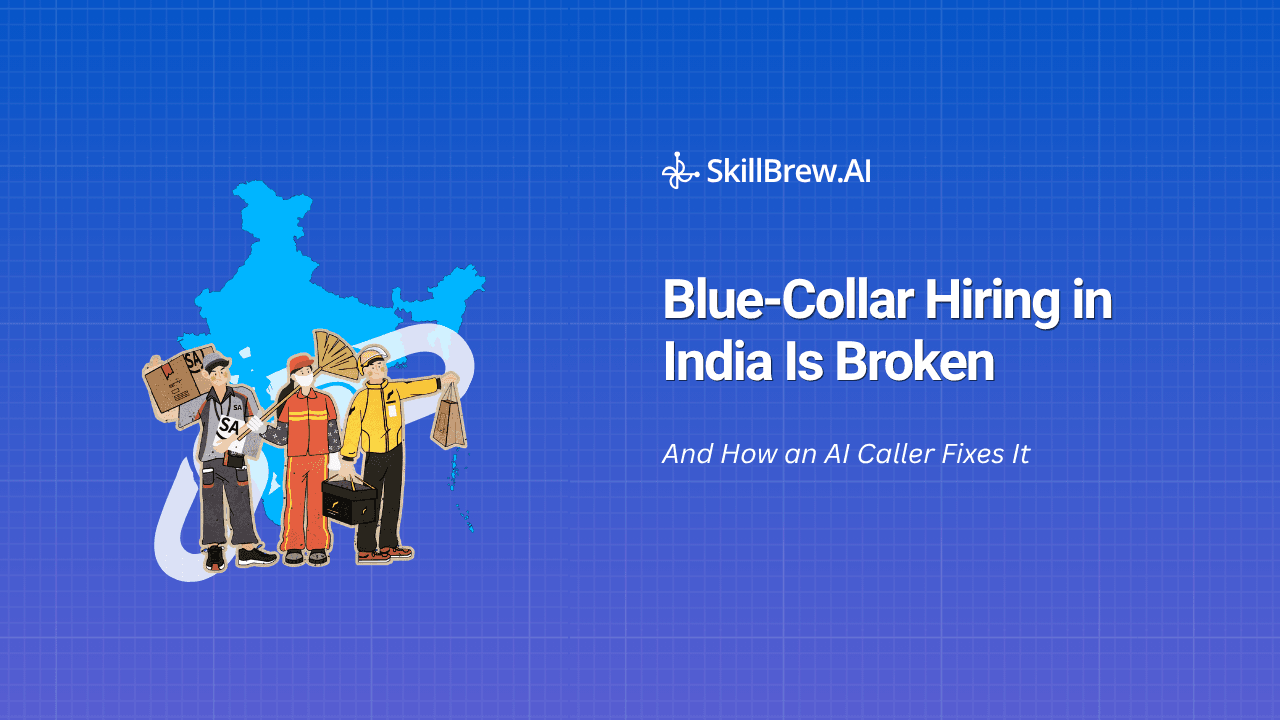
India's frontline hiring engine runs at enormous scale. A new warehouse opens. A logistics company launches operations in a new city. A retail chain expands into multiple locations. Within days, hundreds or even thousands of candidates enter the hiring pipeline.
The challenge isn't that HR teams don't know how to hire. The challenge is that most recruitment systems were built for office-based hiring, not for frontline and blue-collar workforces where candidate volumes are high, turnover is constant, and traditional processes break under pressure. This is exactly the gap automated telephonic screening is built to close.
This article breaks down why blue-collar hiring needs a fundamentally different approach, and why automated telephonic screening through an AI caller has become one of the most effective solutions for large-scale frontline recruitment in India.
Table of Contents
- Why Frontline Hiring Is Different
- The Three Biggest Challenges in Blue-Collar Recruitment
- Why Traditional Recruitment Processes Fail
- How an AI Caller Solves the Problem
- Why Phone Calls Beat Digital Workflows
- The Importance of Language and Accent Familiarity
- How BrewVoice's AI Caller Automates Frontline Screening
- Where the AI Caller Fits Into Your Hiring Workflow
- FAQs on Using an AI Caller for Frontline Hiring
- Final Thoughts
Why Frontline Hiring Is Different
Hiring delivery executives, warehouse associates, factory workers, security personnel, field staff, and retail employees is fundamentally different from hiring knowledge workers.
Most frontline candidates apply using mobile devices, prefer phone conversations over email, may not have regular access to laptops, often work during the day and respond outside standard business hours, and expect fast communication from employers.
Yet many hiring processes still rely on long application forms, email communication, ATS-driven workflows, and scheduled video interviews. The result is simple: many qualified candidates disappear before recruiters ever get a chance to speak with them, which is precisely the failure mode this technology is designed to prevent.
The Three Biggest Challenges in Blue-Collar Recruitment
1. Candidates aren't sitting behind desks.
A warehouse associate may apply during a lunch break. A delivery executive may submit details between shifts. A construction worker may register at a hiring camp and not check email for days. These candidates are mobile-first and phone-first, and traditional workflows often assume the opposite. When the hiring process demands laptops, strong internet, or multiple digital steps, candidate drop-offs increase significantly.
2. The volume math doesn't work.
Consider a hiring drive with 500 applicants, 80 open positions, and one recruitment team. A recruiter can typically complete 40-60 quality screening calls per day. At that pace, first-contact outreach alone can take more than a week. By the time recruiters reach the final batch, candidates have accepted other jobs, phone numbers become unreachable, and interest levels decline. The problem isn't recruiter productivity. It's scale.
3. Constant hiring cycles create constant pressure.
Blue-collar industries often see annual attrition rates between 60% and 90%. That means hiring never truly stops. Recruitment teams continuously replace employees while simultaneously supporting growth hiring. Without automation, recruiters spend most of their time repeating the same screening process rather than focusing on candidate quality and hiring outcomes.
Why Traditional Recruitment Processes Fail
Most recruitment technology was designed for professional hiring environments. Blue-collar recruitment needs something different: immediate response times, high-volume outreach, regional language support, mobile-first engagement, and simple communication channels.
The closer recruitment gets to how candidates naturally communicate, the higher the completion rates. For most frontline workers in India, that communication channel is still the phone call.
How an AI Caller Solves the Problem
An AI caller doesn't replace recruiters. It removes the repetitive work that keeps recruiters from focusing on higher-value activities.
When a candidate enters the hiring pipeline, an AI caller immediately initiates a structured screening conversation. It calls candidates automatically, verifies eligibility criteria, assesses communication ability, answers common questions, records responses, and generates recruiter-ready reports. Instead of reviewing hundreds of unqualified applicants, recruiters begin with a pre-screened shortlist.
Why Phone Calls Beat Digital Workflows
Accessibility. Phone calls don't require app downloads, video capabilities, high-speed internet, or user training. Candidates can participate from virtually anywhere, particularly important for workers in logistics, warehousing, retail, manufacturing, security services, and construction. Meeting candidates through their preferred channel dramatically improves engagement.
Immediate engagement. Timing matters. The highest response rates typically occur shortly after application. An AI caller engages candidates within minutes rather than days, a level of responsiveness no recruiter working standard business hours can replicate at scale.
The Importance of Language and Accent Familiarity
One of the biggest failures of generic voice AI systems is their inability to understand India's linguistic diversity. Candidates don't speak in a single standardized format, they communicate through Hindi, Hinglish, regional English variations, and local accents and dialects. A screening system that struggles with these realities creates friction and reduces completion rates.
A modern AI caller built specifically for India needs to understand regional pronunciation patterns, accent variations, mixed-language conversations, and natural conversational behavior. Candidates should feel like they're having a normal conversation, not interacting with a machine. That sense of familiarity directly impacts candidate experience and screening completion rates.
How BrewVoice's AI Caller Automates Frontline Screening
BrewVoice is SkillBrew.AI's AI caller, purpose-built for Indian recruitment workflows. When a candidate enters the SkillBrew.AI platform through job portals, QR code campaigns, hiring drives, placement camps, or direct applications, BrewVoice automatically begins the screening process.
During the call, BrewVoice:
- Introduces itself naturally, with a clear explanation of the screening process
- Verifies eligibility, checking shift availability, location suitability, joining timelines, and basic eligibility criteria
- Evaluates communication, assessed against standards relevant to the role
- Handles common questions about job responsibilities, work location, compensation structure, and hiring timelines
- Guides next steps, so every candidate knows exactly what happens after the call
What recruiters receive after screening?: complete call recordings for every conversation, structured candidate profiles instead of raw call notes, fit scores ranking candidates against role-specific criteria, and a prioritized shortlist so recruiters focus on qualified candidates instead of manually processing large volumes. Whether you're screening 200, 500, or 2,000 candidates, the quality and consistency of the AI caller's screening stays the same.
Where the AI Caller Fits Into Your Hiring Workflow
BrewVoice's AI caller operates as the first qualification layer within the broader recruitment process. A typical workflow looks like this:
Application Received → AI Caller Telephonic Screening → Shortlisted Candidate Dashboard → Resume Evaluation → Skill Assessment → Human Interview
Each stage narrows the candidate pool before recruiter involvement. By the time recruiters engage, candidates have already been evaluated for communication ability, basic eligibility, availability, and initial role fit. This dramatically reduces recruiter workload while improving hiring quality.
FAQs on Using an AI Caller for Frontline Hiring
Q1. Can an AI caller understand regional Indian accents?
Yes. BrewVoice is trained on Indian English variations, Hindi, and regional accent patterns. Candidates are evaluated on communication clarity rather than accent familiarity.
Q2. How long does a typical AI caller screening call take?
Most frontline screening calls complete within 3-5 minutes, covering availability, eligibility, communication assessment, and basic role fit.
Q3. What happens if a candidate doesn't answer the AI caller?
BrewVoice automatically schedules follow-up attempts based on predefined retry rules. Recruiters can also review missed-call patterns and initiate manual outreach when needed.
Q4. Does automated calling comply with Indian regulations?
Candidates who submit job applications provide consent to participate in recruitment communication. SkillBrew.AI supports compliance-focused configurations aligned with applicable recruitment communication requirements.
Q5. Can candidates with little interview experience use an AI caller comfortably?
Yes. BrewVoice is specifically designed for frontline and first-time job seekers. The conversation style is simple, guided, and easy to follow.
Q6. Can an AI caller support contract and gig hiring?
Absolutely. The platform can be configured for contract staffing, gig workforce recruitment, seasonal hiring, and permanent hiring, with screening criteria customized per requirement.
Q7. How is an AI caller different from an IVR system?
Traditional IVR systems rely on fixed menus and keypad inputs. An AI caller supports natural conversation, candidates can speak freely, ask questions, clarify responses, and engage in dynamic dialogue. The experience feels much closer to speaking with a recruiter than navigating an automated phone menu.
Final Thoughts
The biggest challenge in blue-collar hiring isn't finding candidates. It's reaching them, screening them quickly, and doing so consistently at scale. Traditional recruitment processes struggle because they were never designed for the realities of frontline hiring.
An AI caller changes that. Instead of spending days making repetitive calls, recruiters receive pre-qualified candidate shortlists and can focus on interviews, hiring decisions, and candidate engagement. For organizations hiring hundreds or thousands of frontline workers every month, the advantage isn't having more recruiters. It's having a recruitment system that scales.
BrewVoice's AI caller helps make that possible.
Want to see an AI caller run a live screening call on your own frontline roles? Book a demo with SkillBrew.AI.
See AI-powered hiring in action
Discover how SkillBrew helps hiring teams cut time-to-hire by 60% with skill-validated assessments and AI-ranked shortlists.
Book a free demoNo commitment required · 30 minutes
Continue reading
View All Posts