Technical Screening
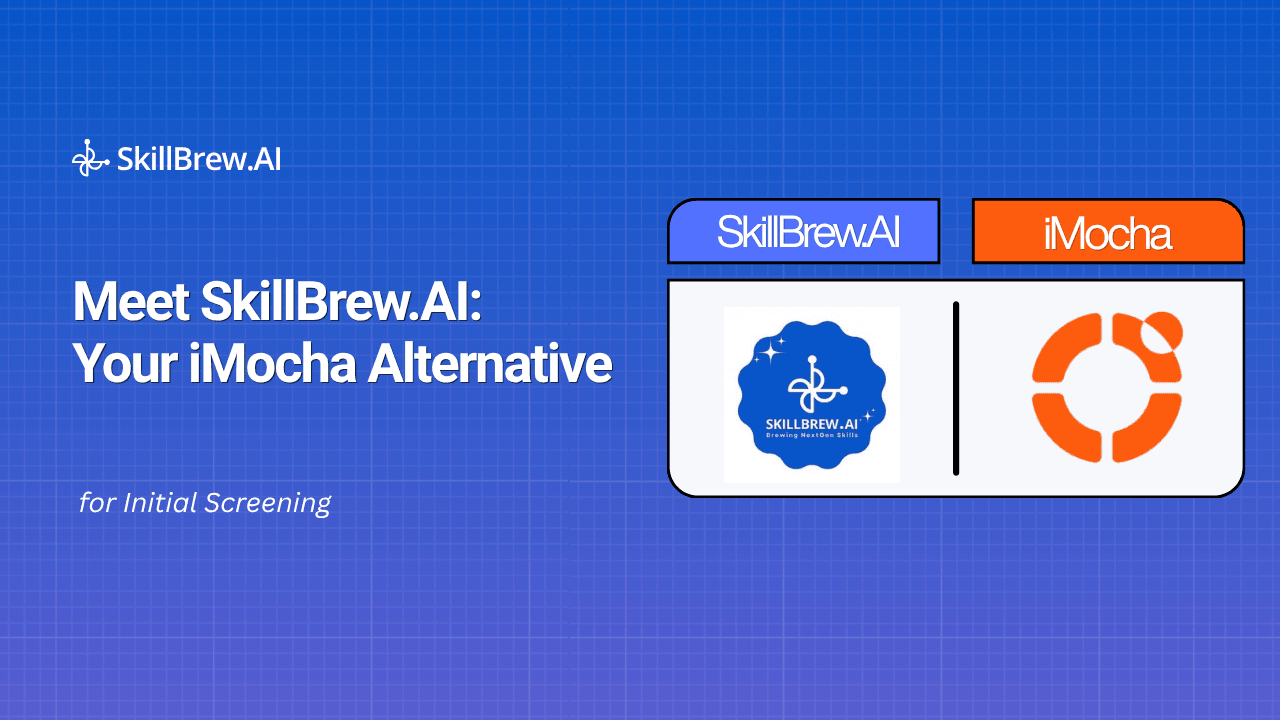
Meet SkillBrew.AI: Your iMocha Alternative for Initial Screening
Recruiters open a resume, glance at it for less than a minute, and move to the next one. That is not laziness. That is what happens when 400 applications land for one role and the first-round screening process has not scaled to match. This is exactly why so many talent acquisition teams start searching for an iMocha alternative. Not because iMocha is a bad product, but because the first-round screening problem and the skills-assessment problem are two different problems, and most teams eventua

Recruiters open a resume, glance at it for less than a minute, and move to the next one. That is not laziness. That is what happens when 400 applications land for one role and the first-round screening process has not scaled to match.
This is exactly why so many talent acquisition teams start searching for an iMocha alternative. Not because iMocha is a bad product, but because the first-round screening problem and the skills-assessment problem are two different problems, and most teams eventually need tools built for each one.
This guide breaks down SkillBrew.AI and iMocha honestly: what each platform actually does, where they overlap, where they diverge, and which one (or both) belongs in a hiring stack depending on volume, role type, and hiring goals. By the end, the goal is a clear answer to whether an iMocha alternative even makes sense for a given hiring team.
Table of Contents
- Why Recruiters Look for an iMocha Alternative
- What Is SkillBrew.AI?
- What Is iMocha?
- iMocha Alternative: A 1-Minute Summary
- First-Round Screening: Which Platform Filters Faster?
- Candidate Assessment: Which Platform Measures Skill?
- Shortlisting and Recruiter Workflow
- Pricing: What Teams Are Actually Paying
- How to Choose Between SkillBrew.AI and iMocha
- Can They Be Used Together?
- Why Teams Choose SkillBrew.AI as Their iMocha Alternative
- Frequently Asked Questions
- Final Verdict and Recommendation Matrix
If a resume gets less than a minute of attention and 400 applications are sitting in a queue for one role, the problem is not the resumes. It is that first-round screening has not scaled to match volume.
This is exactly why so many talent acquisition teams start searching for an iMocha alternative. iMocha is a respected assessment platform, but assessment and first-round screening are two different jobs:
- iMocha is built to measure skill with precision once a candidate reaches a test. It starts with an assessment link and produces scored, benchmarked results.
- SkillBrew.AI is built to filter and rank candidates before a recruiter ever opens a profile. It starts with an AI voice conversation over phone or WhatsApp, not a test link.
This guide compares both platforms across screening, assessment, scoring, recruiter workflow, and pricing, so a hiring team can decide whether an iMocha alternative belongs in their stack, and where iMocha itself still earns its place.
Why Recruiters Look for an iMocha Alternative
Most hiring teams do not lose good candidates in the final interview. They lose them, or lose good judgment about them, in round one.
- Resume review is fast, not thorough. Survey data on recruiter behavior shows that a large majority of recruiters spend under a minute reviewing the majority of resumes they receive, which means qualified candidates get filtered out by pattern-matching, not by actual evaluation.
- Assessment links go unopened. A candidate screening software that starts with a static test link often sees drop-off before the candidate ever demonstrates a skill.
- Fake profiles are rising. Industry benchmark research on hiring fraud shows identity fraud has moved from a rare edge case to a documented risk across regions, which is why identity verification is becoming a core requirement, especially for remote and high-volume frontline hiring.
- Manual scheduling eats recruiter hours. Coordinating first-round calls across hundreds of candidates is where most of the 28+ hours per hire disappear.
Some platforms solve this by making assessments faster to build and score. Others solve it by removing the test link entirely and replacing it with a conversation. This split is exactly why the phrase "iMocha alternative" shows up so often in recruiter searches today.
What Is SkillBrew.AI?
SkillBrew.AI is a first-round screening platform built around one idea: before recruiters look at a candidate, an AI should already have talked to them. It is worth understanding on its own terms before comparing it as an iMocha alternative.
Instead of sending a test link, SkillBrew.AI's AI Interviews call candidates directly over phone and WhatsApp using a conversational voice agent. The candidate answers questions out loud, the way they would in a real first-round call, and the platform evaluates role fit, technical signal, and communication clarity in the process.
Core capabilities that make SkillBrew.AI a serious iMocha alternative for teams that screen before they assess:
- Voice-first screening instead of web-based test links, useful for high-volume and frontline roles where candidates may not sit at a desk to complete an assessment.
- 10+ Indian languages, including regional languages, with accent-aware scoring that evaluates communication rather than penalizing accent.
- Identity and skill verification built into every call.
- AI proctoring with 10+ signals across camera, screen, voice, and behavior patterns.
- Ranked shortlists delivered automatically, so recruiters only review candidates who already cleared a first conversation.
- HireFlow, the free orchestration layer, tracks every candidate from outreach to shortlist on one Kanban board.
- Same-day setup with free account creation and pay-as-you-go pricing, no monthly minimum.
What Is iMocha?
iMocha is an established skills assessment and talent intelligence platform. It is not trying to replace the first-round interview. It is trying to measure skills with precision, at scale, across a large library of tests. This is precisely the gap that pushes many teams toward an iMocha alternative for the earlier stages of hiring.
iMocha's core strengths:
- A large assessment library covering technical, cognitive, and domain-specific skills.
- Coding simulators for live, hands-on technical evaluation.
- Skills intelligence and gap analysis, useful for both hiring and internal workforce planning.
- Benchmarking against role-specific skill standards.
- Internal mobility analytics, which extends the platform beyond hiring into workforce development.
- Async video assessments delivered through a web-based assessment link.
- Enterprise pricing and deployment, with a trial available before commitment.
iMocha's candidate journey typically starts with an assessment link, not a conversation. That makes it strong for structured, skills-heavy evaluation, particularly for technical roles where a coding simulator adds real signal. It is less built for the earlier, higher-volume filtering problem that voice-first screening solves.
iMocha Alternative: A 1-Minute Summary
- For first-round screening, SkillBrew.AI is the clear choice for fast, human-feeling filtering. AI voice interviews over phone and WhatsApp are the core product, built specifically to cut volume before any assessment begins. iMocha's platform starts with an assessment; a filtered candidate pool is expected before it becomes useful.
- For candidate assessment, the right choice depends on what needs to be measured. iMocha provides more assessment depth: coding simulators, a large skills library, and benchmarking against role standards. SkillBrew.AI provides conversational, resume-aware evaluation of role fit and communication rather than deep technical simulation.
- For scoring and shortlisting, SkillBrew.AI produces a ranked shortlist automatically the moment a candidate finishes their AI interview, no manual review required to produce it. iMocha produces assessment scores that a recruiter still has to review and shortlist manually.
- For recruiter workflow, the platforms solve different problems. If the goal is a pre-verified, ranked shortlist with automated candidate communication, SkillBrew.AI's HireFlow layer is built for that. If the goal is deep technical benchmarking before a final interview, iMocha's assessment reports are built for that.
- For pricing, SkillBrew.AI suits teams who want spend to flex with hiring volume. Pay-as-you-go, no monthly minimum, favors teams with seasonal or unpredictable hiring volume. iMocha suits teams with predictable, larger annual hiring budgets who are ready for an enterprise contract.
At a Glance
| Category | SkillBrew.AI | iMocha |
| Best for | High-volume, voice-first first-round screening | Deep, structured skills assessment |
| Candidate starts with | Phone/WhatsApp AI interview | Web-based assessment link |
| Pricing model | Pay-as-you-go, no minimum | Enterprise licensing, quote-based |
| Time to deploy | Same-day setup | Onboarding project typical for enterprise rollout |
| Key limitation | Not built for deep coding simulation | No native voice, phone, or WhatsApp screening |
First-Round Screening: Which Platform Filters Faster?
SkillBrew.AI is the clear choice here. It has a native voice-screening layer built specifically for volume reduction, and it runs before any formal assessment happens. First-round filtering is not something iMocha was designed to solve; a filtered candidate pool is expected before the platform becomes useful.
SkillBrew.AI
Before a recruiter looks at a single profile, SkillBrew.AI's AI voice agent has already called the candidate over phone or WhatsApp, asked adaptive, resume-aware questions, and scored role fit, technical signal, and communication clarity. Identity verification and AI proctoring with 10+ signals run in the background of that same call. A candidate who does not clear the conversation never reaches a recruiter's queue, which means no recruiter hours are spent screening candidates who were never a fit.
iMocha
iMocha's candidate journey starts with an assessment link sent by email. There is no voice or conversational layer in front of that link, so volume reduction has to happen somewhere else in the process, typically through resume screening or an ATS filter, before iMocha becomes useful.
What this means for the hiring team: if an ATS or existing process already handles filtering, iMocha's entry point at assessment is a clean handoff. If it does not, that filtering layer has to be built elsewhere, and SkillBrew.AI's voice-first screening is the more complete answer to that specific problem.
Candidate Assessment: Which Platform Measures Skill?
iMocha provides deeper technical assessment tooling. SkillBrew.AI provides faster, conversational evaluation of fit and communication. Neither replaces the other's core strength.
SkillBrew.AI
SkillBrew.AI's assessment happens inside the AI interview itself. The adaptive, resume-aware avatar asks probing follow-up questions based on the candidate's actual answers, not a fixed script, and evaluates role fit and communication alongside basic skill signals. It is not built as a deep technical testing engine. There is no dedicated coding simulator or large domain-specific test library.
iMocha
iMocha's assessment library covers technical, cognitive, and domain-specific skills, with coding simulators for hands-on evaluation and benchmarking against role-specific standards. For engineering-heavy roles where a candidate's ability to actually write working code matters, this is where iMocha's depth shows.
What this means for the hiring team: for high-volume roles where communication, role fit, and basic screening matter most, SkillBrew.AI's conversational evaluation gets a recruiter to a decision faster. For technical roles that need hands-on coding proof, iMocha's assessment library still adds real signal that a conversation alone will not capture.
Shortlisting and Recruiter Workflow
SkillBrew.AI gets recruiters to a ranked shortlist the moment a candidate finishes their AI interview, no manual review required to produce it. iMocha produces assessment scores that still require a recruiter to compare and shortlist manually.
SkillBrew.AI
Every completed AI interview feeds directly into HireFlow, where candidates appear on a ranked, automated shortlist alongside identity verification and skill verification status. Recruiters open the dashboard and see who already cleared screening, not a queue of raw scores to interpret. WhatsApp and email communications to candidates run automatically as they move through stages.
iMocha
Completed assessments generate score reports that recruiters review against benchmarks before deciding who advances. This works well when scores need human interpretation, but it means the shortlisting step is still manual work sitting on the recruiter's desk after the assessment is done.
What this means for the hiring team: if a team is running high volume and the bottleneck is recruiter hours spent shortlisting, SkillBrew.AI's automated, ranked output removes that step. If shortlisting decisions benefit from a recruiter reading and interpreting detailed scores before a call, iMocha's report format supports that more directly.
Pricing: What Teams Are Actually Paying
SkillBrew.AI and iMocha take different pricing philosophies, which matters as much as the feature list, and it is often the deciding factor when a team is weighing an iMocha alternative against staying on enterprise contracts.
SkillBrew.AI Pricing
| Pricing Factor | Details |
| Model | Pay-as-you-go |
| Entry cost | Free account creation |
| Monthly minimum | None |
| Onboarding project | Not required |
| Time to deploy | Same-day setup |
iMocha Pricing
| Pricing Factor | Details |
| Model | Enterprise licensing |
| Entry cost | Trial available |
| Per-use cost | Not publicly listed |
| Monthly minimum | Typical for enterprise contracts |
| Onboarding project | Often required for enterprise rollout |
| Time to deploy | Onboarding-dependent |
What this means for budget planning: SkillBrew.AI's model suits teams that want to start small, prove value, and scale spend with actual hiring volume, with no annual commitment required to begin. iMocha's model suits teams with predictable, larger annual hiring budgets who are ready for a quote-based enterprise conversation. For unpredictable hiring volume, spiky campus drives, or seasonal frontline hiring, pay-as-you-go pricing without a monthly minimum is often the deciding factor when comparing an iMocha alternative against a traditional enterprise assessment contract.
How to Choose Between SkillBrew.AI and iMocha
Neither platform is the right answer for every hiring team. The decision comes down to where the process actually breaks down: at the top of the funnel, or at technical depth, and that is the real test for whether an iMocha alternative is needed at all.
Choose SkillBrew.AI if:
- Hiring volume is high and first-round screening is the bottleneck
- Roles are frontline, blue-collar, or regional-language-heavy
- Candidates need to be reached over phone or WhatsApp, not just email
- Recruiters need a ranked shortlist instead of raw scores to review
- Budget needs to flex with hiring volume rather than a fixed enterprise contract
SkillBrew.AI might be a poor fit if:
- The role requires deep, hands-on coding evaluation with a dedicated simulator
- Internal mobility analytics and workforce-wide skills benchmarking are the primary goal
- A large, pre-built domain-specific test library is a hard requirement
Choose iMocha if:
- Roles are highly technical and need deep coding simulators
- The organization needs skills intelligence and internal mobility analytics beyond hiring
- Assessment benchmarking against large skill libraries is a core requirement
- Enterprise-scale deployment and dedicated onboarding are already budgeted
iMocha might be a poor fit if:
- The primary challenge is top-of-funnel volume rather than assessment depth
- Candidates need to be reached by phone or WhatsApp, not just an emailed link
- Budget needs to stay flexible without a 12-month enterprise commitment
- Recruiters need an automated, ranked shortlist rather than scores to interpret manually
This is exactly the decision most teams are making when they search for an iMocha alternative: not a full replacement, but a tool that handles the volume problem iMocha was never built to solve.
Can They Be Used Together?
Yes, and for some organizations pairing an iMocha alternative with iMocha itself is the strongest setup.
A common combined workflow:
- SkillBrew.AI's AI Interviews handle first-round voice screening at volume, verifying identity and communication fit early.
- Candidates who pass move into iMocha for deep, role-specific technical assessment using coding simulators and skills benchmarking.
- Recruiters make final decisions with both a conversational signal and a hard skills score.
This layered approach is common enough that using an iMocha alternative for first-round screening and iMocha for technical depth has become a practical hiring stack rather than an either/or decision. Companies running high-volume tech hiring, in particular, often use both tools for different stages of the same funnel.
Why Teams Choose SkillBrew.AI as Their iMocha Alternative
SkillBrew.AI is not trying to out-assess iMocha on technical depth. As an iMocha alternative, it is solving the problem that sits before assessment: too many applicants, not enough recruiter time, and a candidate experience that feels transactional.
- Conversational, voice-first screening replaces the static test link with a phone or WhatsApp call, so candidates who never open an email still get screened.
- 10+ Indian languages with accent-aware scoring make SkillBrew.AI a stronger iMocha alternative specifically for the Indian hiring market and regional-language roles.
- Identity verification and AI proctoring with 10+ signals run inside every call, not as a bolted-on add-on.
- Automated, ranked shortlists through HireFlow mean recruiters review pre-qualified candidates, not raw scores.
- Same-day setup and pay-as-you-go pricing, with no monthly minimum and no onboarding project, remove the barrier enterprise contracts create for smaller or seasonal hiring teams.
This fits a hiring team if:
- Hiring volume is high and screening, not assessment, is the bottleneck
- Roles are frontline, regional, or hard to reach by email alone
- Recruiters need a shortlist to act on, not a report to interpret
- Budget needs to flex with hiring volume rather than lock into an annual contract
Frequently Asked Questions
Q1. Is SkillBrew.AI a good iMocha alternative?
SkillBrew.AI is a strong iMocha alternative specifically for first-round screening, where voice-based AI interviews and automated shortlisting replace static test links. For deep technical assessment, iMocha's coding simulators remain a separate strength.
Q2. What makes SkillBrew.AI different from iMocha?
SkillBrew.AI screens candidates through conversational AI interviews over phone and WhatsApp before recruiters get involved. iMocha evaluates candidates through web-based assessments and a large test library. They solve different parts of the hiring funnel.
Q3. Does SkillBrew.AI replace the need for skills assessments?
Not entirely. SkillBrew.AI focuses on first-round screening, identity verification, and role fit. Teams needing deep coding or domain-specific skills testing often pair SkillBrew.AI with an assessment platform like iMocha.
Q4. Why are recruiters searching for an iMocha alternative?
Many teams need faster, more human first-round screening, especially for high-volume or regional-language hiring, which is a gap traditional assessment platforms were not built to fill.
Q5. Is SkillBrew.AI cheaper than iMocha?
SkillBrew.AI uses pay-as-you-go pricing with no monthly minimum, which tends to be more flexible than iMocha's enterprise licensing, though iMocha does offer a trial.
Q6. Can SkillBrew.AI screen candidates in regional Indian languages?
Yes. SkillBrew.AI supports 10+ Indian languages, including regional languages, with accent-aware scoring designed for the Indian hiring market.
Q7. Does iMocha offer voice or WhatsApp-based screening?
No. iMocha's candidate experience is built around web-based assessments and async video, not phone or WhatsApp conversations, which is one reason teams look for an iMocha alternative for that specific use case.
Q8. Which platform is better for campus hiring at scale?
For high-volume campus drives with thousands of applicants and drop-off risk, SkillBrew.AI's voice-first screening and automated shortlisting are typically a better iMocha alternative, while iMocha can still support technical benchmarking for shortlisted candidates.
Final Verdict and Recommendation Matrix
SkillBrew.AI and iMocha are not direct substitutes. They are built for different moments in the hiring funnel.
SkillBrew.AI is the stronger iMocha alternative when the real problem is first-round screening: too many applicants, too little recruiter time, and a candidate experience that needs to feel human, not transactional. iMocha remains a strong choice when the priority is deep, structured skills assessment, particularly for technical roles that benefit from coding simulators and benchmarking against a large test library.
For many hiring teams, the honest answer is not choosing between iMocha or SkillBrew.AI. It is treating SkillBrew.AI as the iMocha alternative for volume, and iMocha as the tool for depth, used together across the same funnel.
| Company Profile | Recommended Approach |
| High-volume, frontline, or regional hiring | SkillBrew.AI as the primary iMocha alternative |
| Mid-size company scaling hiring unpredictably | SkillBrew.AI for pay-as-you-go flexibility |
| Enterprise with technical, benchmark-heavy roles | iMocha, or iMocha combined with SkillBrew.AI for early screening |
| Campus hiring across multiple colleges | SkillBrew.AI for screening, iMocha for technical shortlists |
| Organizations needing internal mobility analytics | iMocha, alongside SkillBrew.AI for external hiring |
Want to see how it works? Book a demo to see SkillBrew.AI in action, or explore Technical Assessments to see how skill verification fits into the same workflow.
See AI-powered hiring in action
Discover how SkillBrew helps hiring teams cut time-to-hire by 60% with skill-validated assessments and AI-ranked shortlists.
Book a free demoNo commitment required · 30 minutes
Continue reading
View All Posts