BrewVoice
Why Traditional Sectors Can't Afford to Ignore Bulk Telephonic Screening Software
Hiring in India's traditional sectors doesn't happen inside glass offices. It happens on factory floors, construction sites, hospital campuses, warehouses, distribution centers, and pharmaceutical territories spread across the country. A machine operator looking for a night-shift role isn't sitting in front of a laptop waiting for a Zoom invite. A site supervisor managing a highway project isn't checking an ATS portal during work hours. A Medical Representative covering field visits across mult

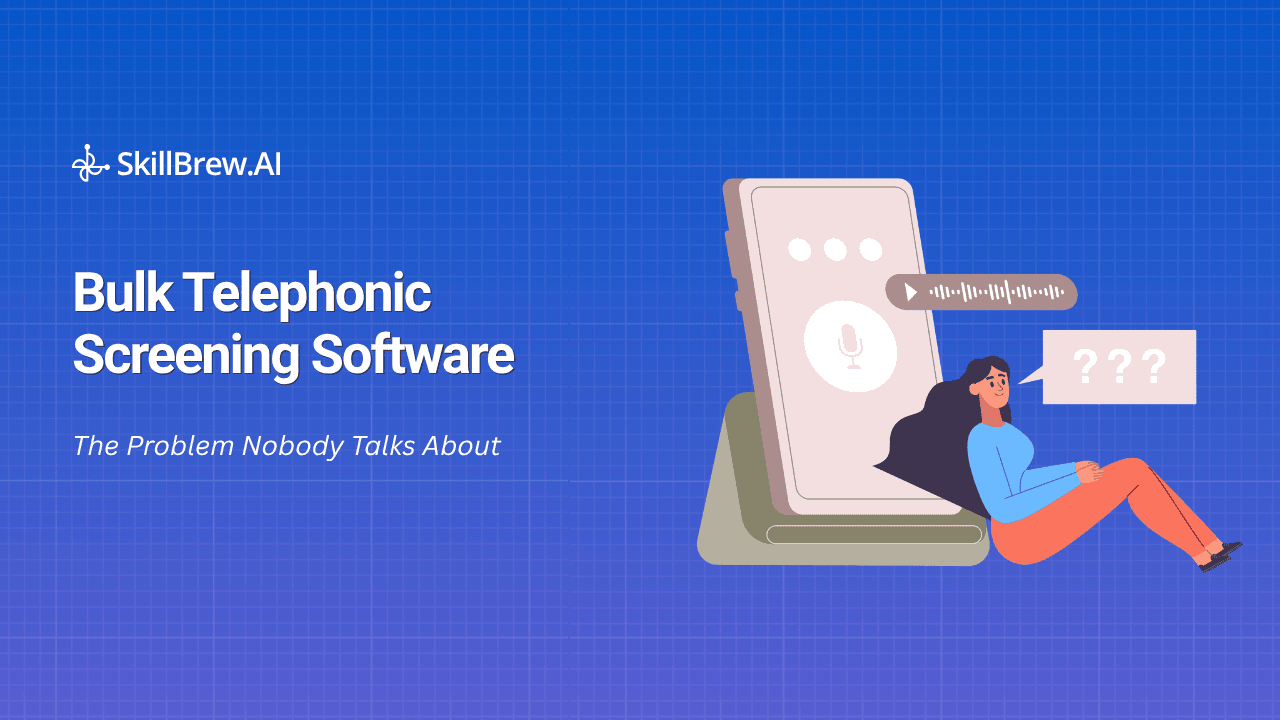
Hiring in India's traditional sectors doesn't happen inside glass offices. It happens on factory floors, construction sites, hospital campuses, warehouses, distribution centers, and pharmaceutical territories spread across the country.
A machine operator looking for a night-shift role isn't sitting in front of a laptop waiting for a Zoom invite. A site supervisor managing a highway project isn't checking an ATS portal during work hours. A Medical Representative covering field visits across multiple districts isn't refreshing their email waiting for recruiter communication.
Yet many hiring teams still run recruitment the way they did a decade ago: one recruiter, one phone call, one candidate at a time. When hundreds of candidates enter the pipeline every week, that process breaks down fast. This is exactly why bulk telephonic screening software has become essential for manufacturing, civil engineering, pharma, healthcare, and other frontline-heavy industries.
Table of Contents
- Why Traditional Sector Hiring Is Different
- Why Manual Phone Screening Doesn't Work Anymore
- What Traditional Industries Need From Bulk Telephonic Screening Software
- Manufacturing Hiring: Screening for Shift Readiness and Compliance
- Civil Engineering Hiring: Evaluating Site Supervisors at Scale
- Pharma Recruitment: Assessing Communication for Medical Representatives
- Healthcare Hiring: Managing High-Volume Candidate Intake
- How BrewVoice Runs Bulk Telephonic Screening
- Benefits of Bulk Telephonic Screening Software for Traditional Industries
- FAQs on Bulk Telephonic Screening Software
- The Bottom Line
Why Traditional Sector Hiring Is Different
Most HR technology is designed around desk-based hiring. Traditional sectors operate very differently. Candidates often apply from mobile phones, work in field-based environments, have limited laptop access, prefer phone conversations over forms, and need quick responses before accepting competing offers.
Recruitment workflows built around emails, ATS portals, video interviews, and scheduling links create unnecessary friction here. Organizations lose qualified candidates before meaningful engagement ever begins, which is exactly the gap bulk telephonic screening software is designed to close.
Candidates aren't sitting behind desks. Factory workers, warehouse associates, nursing staff, site coordinators, and field sales professionals apply during breaks, register through job fairs, share details through QR codes, and respond faster to phone calls than emails. The longer the gap between application and first contact, the higher the drop-off.
We cover the underlying volume math (why two recruiters can't manually screen 500 applicants in a week) and the attrition-driven pressure that keeps frontline hiring continuous in detail in our breakdown of AI callers for frontline hiring. The short version: manufacturing, logistics, healthcare support, retail, and construction often run 60-90% annual attrition, so hiring never really stops, and manual screening simply can't keep pace at that rhythm.
Why Manual Phone Screening Doesn't Work Anymore
Traditional first-round screening creates predictable bottlenecks: slow response times (candidates wait days to hear back), recruiter burnout (hours of repetitive calls erode decision quality), inconsistent evaluation (different recruiters ask different questions and score differently), and limited scale (recruiters can only handle one call at a time, and business growth doesn't wait for recruiter calendars).
What Traditional Industries Need From Bulk Telephonic Screening Software
Not every voice AI product is built for frontline recruitment. To work in India, bulk telephonic screening software needs four things.
Multilingual support. Candidates communicate in Hindi, English, Hinglish, and regional English variations. This isn't optional, it's essential.
Low-latency voice interactions. Even small delays cause candidates to disengage. The conversation has to feel natural and responsive, not laggy.
Accent awareness. Candidates across India speak differently, North Indian, South Indian, Eastern, and Western accents all need to be understood without penalizing communication quality. We go deep on exactly how accent bias creeps into voice AI and what fixes it in our guide to accent bias in multilingual voice agents.
Human-like conversation. Candidates should feel like they're having a genuine conversation, not navigating an IVR menu. Trust significantly improves completion rates.
Manufacturing Hiring: Screening for Shift Readiness and Compliance
Manufacturing recruiters need answers to practical questions: can the candidate work rotating shifts? Have they worked in similar facilities? Do they understand safety protocols? Are they willing to relocate or commute?
BrewVoice runs these checks automatically through structured voice conversations, delivering faster shortlisting, better candidate filtering, and less recruiter time spent on repetitive qualification calls.
Civil Engineering Hiring: Evaluating Site Supervisors at Scale
Construction and infrastructure hiring has its own challenges. Strong candidates are often working on active sites, constantly moving, and difficult to reach through traditional channels.
BrewVoice contacts candidates immediately after application and evaluates previous project experience, team management exposure, site readiness, relocation flexibility, and availability timelines. Recruiters get structured screening reports instead of spending hours coordinating calls with people who are hard to reach in the first place.
Pharma Recruitment: Assessing Communication for Medical Representatives
For Medical Representatives and field sales roles, communication skills often matter more than the resume itself. Hiring teams need to evaluate fluency, confidence, clarity, product explanation ability, and professional communication, which traditionally requires multiple recruiter conversations per candidate.
BrewVoice runs these assessments automatically during first-round screening and generates standardized communication scores, letting pharma hiring teams evaluate hundreds of candidates in days instead of weeks.
Healthcare Hiring: Managing High-Volume Candidate Intake
Hospitals constantly hire for ward administrators, billing executives, lab technicians, OPD coordinators, and nursing support staff. Candidates frequently juggle multiple offers at once, so speed becomes critical.
BrewVoice contacts candidates shortly after application, helping healthcare organizations reduce candidate drop-off, improve response rates, accelerate hiring timelines, and standardize screening quality across roles that rarely look alike on paper.
How BrewVoice Runs Bulk Telephonic Screening
BrewVoice is SkillBrew.AI's voice calling agent, built directly into the recruitment workflow rather than bolted on as a separate tool. Applications arrive through job boards, campus drives, QR code campaigns, or direct applications, and BrewVoice automatically initiates candidate calls based on predefined workflows, no recruiter intervention required.
During the call, BrewVoice evaluates communication ability, role suitability, availability, language proficiency, location fit, shift preferences, and culture-fit indicators, adapting the conversation based on candidate responses. Recruiters then receive candidate scores, call recordings, transcripts, qualification summaries, and recommended next actions, so teams focus only on qualified candidates instead of reviewing hundreds of raw applications.
We cover the full step-by-step call mechanics and scoring methodology in our deep dive on voice AI agents for first-round screening. BrewVoice complements existing recruitment processes rather than replacing them:
Application Received → BrewVoice Screening Call → Ranked Dashboard Shortlist → Resume Evaluation → Assessments → Recruiter Interview → Hiring Decision.
Human recruiters stay responsible for final decisions, bulk telephonic screening software just removes the repetitive first-screening workload sitting in front of them.
Benefits of Bulk Telephonic Screening Software for Traditional Industries
Organizations using bulk telephonic screening software typically see faster candidate engagement (contacted within hours instead of days), higher screening throughput (hundreds of candidates screened simultaneously), better recruiter productivity (time spent on qualified candidates, not repetitive calls), improved candidate experience (immediate engagement and faster updates), more consistent evaluations (every candidate assessed against the same criteria), and lower cost per hire (reduced manual effort improves efficiency at scale).
FAQs on Bulk Telephonic Screening Software
Q1. What is bulk telephonic screening software?
Software that uses AI voice agents to conduct first-round candidate screening calls automatically. The system asks questions, evaluates responses, scores candidates, and generates recruiter-ready reports without requiring manual phone interviews.
Q2. Can bulk telephonic screening software understand Hindi and Hinglish?
Yes. Purpose-built systems like BrewVoice support English, Hindi, and mixed-language conversations common across Indian candidate pools, including regional accents and code-switching patterns.
Q3. Why does low latency matter in bulk telephonic screening software?
Candidates expect natural conversations. Long pauses, delayed responses, or robotic interactions increase call abandonment. Low latency keeps conversations smooth and engaging.
Q4. How does bulk telephonic screening software help manufacturing recruitment?
It automatically evaluates shift readiness, compliance awareness, previous factory experience, location suitability, and basic role qualifications before recruiters get involved at all.
Q5. How does bulk telephonic screening software help pharma companies hire Medical Representatives?
It evaluates communication quality, fluency, confidence, and response clarity at scale, helping pharma recruiters identify strong field-facing candidates much earlier in the process.
Q6. Does bulk telephonic screening software replace recruiters?
No. It handles repetitive first-round screening conversations. Recruiters continue to manage interviews, candidate engagement, client discussions, and final hiring decisions.
Q7. Which industries benefit most from bulk telephonic screening software?
The strongest results show up in manufacturing, civil engineering and construction, pharmaceuticals, healthcare, logistics, warehousing, retail, and high-volume campus hiring, sectors that consistently deal with large candidate volumes and time-sensitive hiring requirements.
The Bottom Line
Traditional industries don't struggle because recruiters aren't working hard enough. They struggle because modern hiring volumes can't be managed through manual phone screening alone.
When hundreds of candidates enter the pipeline every week, recruiters need bulk telephonic screening software that handles repetitive outreach, qualification checks, and first-round evaluations automatically. BrewVoice helps manufacturing, civil engineering, pharma, healthcare, and other frontline hiring teams automate candidate outreach, run structured voice screening at scale, and deliver recruiter-ready shortlists directly inside the SkillBrew.AI dashboard.
The result: faster hiring, lower recruiter workload, better candidate experience, and a recruitment process that scales alongside business growth.
See bulk telephonic screening software handle your next hiring drive. Book a demo with SkillBrew.AI.
See AI-powered hiring in action
Discover how SkillBrew helps hiring teams cut time-to-hire by 60% with skill-validated assessments and AI-ranked shortlists.
Book a free demoNo commitment required · 30 minutes
Continue reading
View All Posts