AI Interview
How AI Interviews Screen, Score, and Shortlist Candidates
Most recruiters don't have a candidate problem. They have a bandwidth problem. A single role can pull in 300+ applicants. Each one deserves a real first-round conversation. None of them are getting one, because no team has the hours to run that many interviews manually, so candidates wait, recruiters burn out, and the strongest applicants take offers elsewhere while you're still scheduling round one. This is the exact gap AI interviews for candidate screening are built to close. Not a recorded

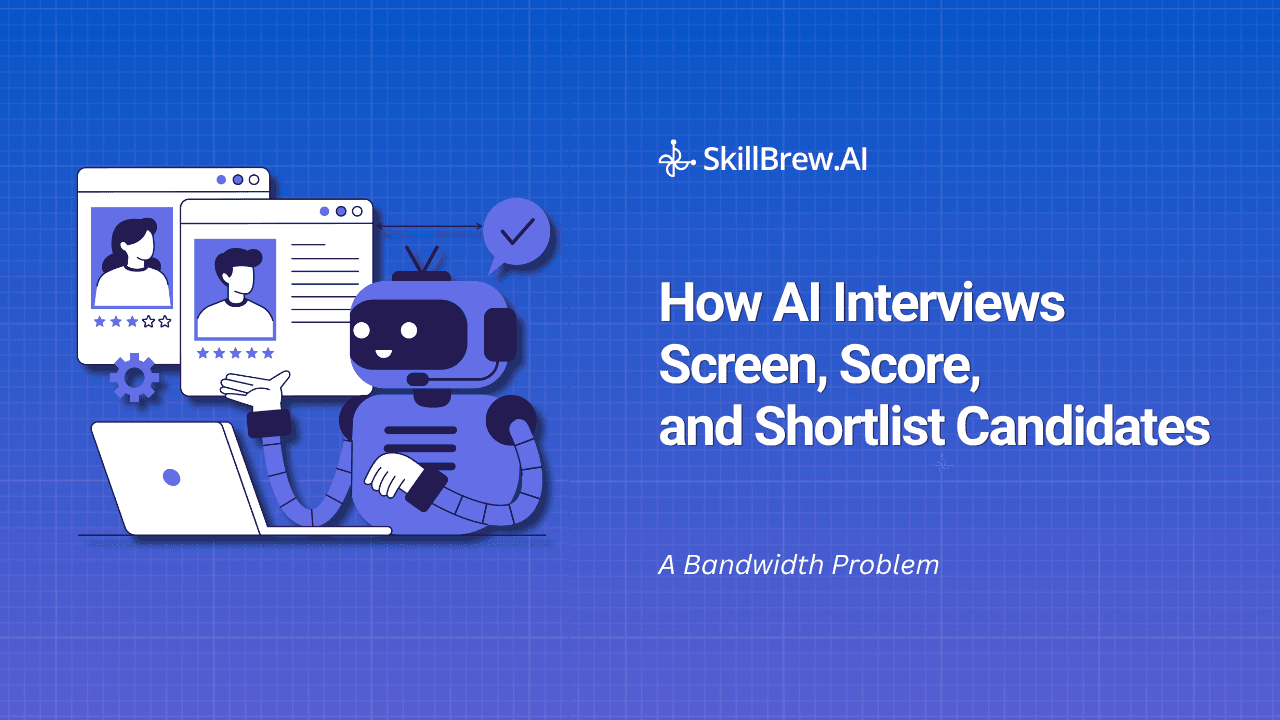
Most recruiters don't have a candidate problem. They have a bandwidth problem.
A single role can pull in 300+ applicants. Each one deserves a real first-round conversation. None of them are getting one, because no team has the hours to run that many interviews manually, so candidates wait, recruiters burn out, and the strongest applicants take offers elsewhere while you're still scheduling round one.
This is the exact gap AI interviews for candidate screening are built to close. Not a recorded video assessment. Not a static questionnaire. A live, adaptive interview that asks role-specific questions, probes weak answers, and hands back a scored report your team can act on in minutes.
This guide breaks down exactly how AI interviews for candidate screening work at scale, from question generation to final score, so you know what's actually happening behind the interface before you put it in front of applicants.
Table of Contents
- What Actually Counts as "AI Interview Software" (And What's Just Hype)
- How the AI Builds Role-Specific Questions Without You Lifting a Finger
- Inside a Live Interview AI Session: What Your Candidates Actually Experience
- The Scorecard: How Every Candidate Gets Ranked, Not Just Recorded
- AI Interview Questions vs. Mock Interview AI: Know the Difference Before You Buy
- What Lands on Your Desk: The Recruiter's View
- Frequently Asked Questions
What Actually Counts as "AI Interview Software" (And What's Just Hype)
"AI for interview" gets used loosely. It covers everything from a chatbot that emails you five fixed questions to a system that conducts a genuine adaptive conversation and evaluates the response in real time.
The distinction matters because it determines whether the output is usable.
A fixed-question tool gives you transcripts. Real AI interviews for candidate screening give you a structured, comparable, scored evaluation, the difference between reading 300 raw conversations and reviewing 300 ranked outcomes.
SkillBrew.AI's AI Interviews module sits firmly in the second category. It's built specifically to run AI interviews for candidate screening without a recruiter present for every session, while still producing interview-quality signal, not a watered-down substitute.
Teams evaluating AI interview software for the first time usually ask the same question: does it actually replace a human first-round, or just delay the work? The honest answer depends entirely on whether the AI interviews for candidate screening you're using are adaptive or static. This guide only covers the adaptive kind.
How the AI Builds Role-Specific Questions Without You Lifting a Finger
This is the part most platforms get wrong: they treat every interview like the same interview.
A generic question bank doesn't tell you whether a backend engineer can reason through a system design tradeoff, or whether a sales candidate can handle objection-handling under pressure. Different roles need different interviews.
Here's how AI interviews for candidate screening actually build the question set at SkillBrew.AI:
- JD parsing. You paste or upload the job description. The system extracts required skills, seniority level, role type, and key responsibilities, no manual tagging required.
- Question generation. Based on that parsed JD, the AI generates a role-specific set of AI interview questions covering technical depth, behavioral fit, and communication, calibrated to the seniority level detected.
- Setup in under 2 minutes. The full setup for AI interviews for candidate screening, from JD upload to a live, ready-to-send interview link, takes under two minutes. No template library to browse, no question bank to manually assemble.
- Adaptive follow-up logic. The avatar isn't reading a fixed script. If a candidate gives a vague or incomplete answer, the system asks a clarifying follow-up, the same way a sharp human interviewer would dig deeper instead of moving on.
This is what separates real AI interviews for candidate screening from a static video assessment: the questions exist because of the role, not despite it.
It's also why role-specific AI interview questions outperform generic ones on signal quality. A question bank built for "software engineer" in general can't tell you whether this specific candidate can handle this specific JD's tradeoffs, but a question set generated from the actual posting can.
Inside a Live Interview AI Session: What Your Candidates Actually Experience
Once the link goes out, the live interview Aisession runs independently, no scheduling, no recruiter on the call, no timezone juggling.
Throughout AI interviews for candidate screening, there's no point where a human needs to intervene to keep things moving, the system handles scheduling, delivery, conversation, and reporting end-to-end.
The candidate experience:
- Joins on their own time, 24/7, no coordination required
- Faces a resume-aware adaptive avatar that references their actual background, not generic prompts
- Answers role-specific questions generated from the JD
- Gets probed with natural follow-ups when answers are thin or unclear
What's running in the background:
While AI interviews for candidate screening are running, BrewShield proctoring monitors integrity signals, camera activity, tab-switching, and other indicators, so the evaluation reflects the candidate's actual ability, not whether they had help off-screen.
The conversation itself is built to feel less like an interrogation and more like a structured conversation, because stiff, robotic Q&A produces stiff, low-signal answers. The closer it feels to a real interview, the more useful the data coming out of it.
The Scorecard: How Every Candidate Gets Ranked, Not Just Recorded
This is where most "AI interview" tools stop short, they hand you a transcript and call it done. Actual AI interviews for candidate screening have to end in a decision-ready report, not raw text someone still has to read end-to-end.
Without structured scoring, AI interviews for candidate screening are just automated video calls, useful for convenience, but no faster to evaluate than a manual one. The value shows up specifically at the scoring stage.
SkillBrew.AI's AI Interviews module scores every session across three signals:
| Signal | What It Measures | Why It Matters |
| Role Fit | Alignment between candidate experience and JD requirements | Filters out resume keyword matches with no real depth |
| Technical Signal | Depth and accuracy of technical/functional answers | Surfaces candidates who can actually do the job |
| Communication | Clarity, structure, and confidence in responses | Predicts how they'll perform in client or team-facing situations |
Each signal is scored individually, then rolled into an overall report your team can sort, filter, and rank, turning a stack of interviews into a shortlist in minutes, not days.
AI Interview Questions vs. Mock Interview AI: Know the Difference Before You Buy
Worth clearing up, since the terms get conflated.
Mock interview AI tools are typically candidate-facing, built to help a job seeker practice answering questions before a real interview. They're a rehearsal tool.
AI interviews for candidate screening are recruiter-facing, it's the real interview, not a rehearsal for one. The questions are generated from an actual JD for an actual open role, and the output feeds directly into a hiring decision, not a self-improvement loop.
This distinction is also why pricing models differ. A mock interview AI product is usually a flat consumer subscription. AI interviews for candidate screening are typically priced per use, since volume scales with open roles, not with a single user's practice sessions.
If your team is evaluating "AI for interview" tools, this distinction should be the first filter. A platform built for candidate practice will not give you defensible, role-specific hiring data.
What Lands on Your Desk: The Recruiter's View
By the time a candidate finishes the session, your team isn't looking at a video file to scrub through. They're looking at:
- A scored report across role fit, technical signal, and communication
- Specific answer highlights tied to each score
- A ranked view across all candidates for the role, inside HireFlow's free orchestration layer
- Direct routing into your existing pipeline, no manual export
Recruiters running AI interviews for candidate screening report shortlisting decisions in minutes per candidate instead of the 20+ minutes a manual first-round call typically takes.
This is, ultimately, the whole point: AI interviews for candidate screening so your team spends its time on final-round conversations with strong candidates, not on screening everyone who applied.
Frequently Asked Questions
How does AI interview software generate questions for different roles?
For AI interviews for candidate screening, the system parses the job description for required skills, seniority, and responsibilities, then generates a tailored set of questions calibrated to that specific role, rather than pulling from a generic, role-agnostic bank.
Is a live interview AI session actually adaptive, or just a fixed script?
A genuinely adaptive system asks follow-up questions when a candidate's answer is vague or incomplete, similar to how a human interviewer would probe further. A fixed script repeats the same questions regardless of the response.
What's the difference between AI interview questions and mock interview AI?
AI interview questions are generated for a real, open role and feed into an actual hiring decision. Mock interview AI is a practice tool for candidates preparing for interviews elsewhere, it doesn't connect to a live hiring pipeline.
How long does it take to set up an AI interview for a new role?
With JD-to-interview generation, setup typically takes under two minutes from uploading the job description to having a live, shareable interview link.
How are candidates scored after an AI interview?
Scoring typically covers three areas: role fit (alignment with JD requirements), technical signal (depth of functional answers), and communication (clarity and structure of responses), rolled into a single comparable report.
Can AI interviews be cheated?
Platforms with integrated proctoring monitor signals like camera activity, tab-switching, and unusual screen behavior during the session, flagging anomalies so recruiters can weigh the score accordingly.
See AI interviews for candidate screening in action against your actual open role. Book a live demo →
We'll run a live interview against a real JD and walk through the scored report in real time.
See AI-powered hiring in action
Discover how SkillBrew helps hiring teams cut time-to-hire by 60% with skill-validated assessments and AI-ranked shortlists.
Book a free demoNo commitment required · 30 minutes
Continue reading
View All Posts