BrewVoice
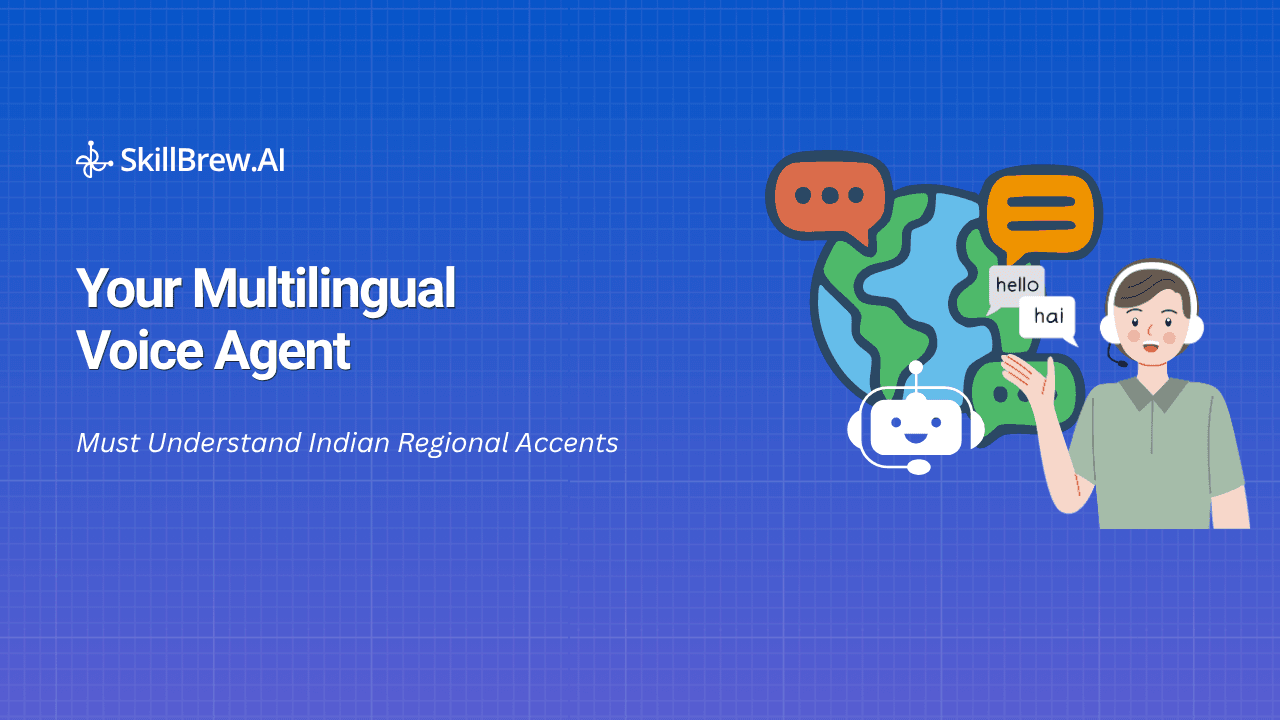
Why Your Multilingual Voice Agent Must Understand Indian Regional Accents
Picture this. A new engineer joins the hiring process from Coimbatore. She clears the written assessment with a strong score. Her academic background is solid. Her technical answers are excellent. Then the multilingual voice agent marks her "low in communication skills." Not because she struggled to answer. Not because she lacked confidence. Because the system couldn't properly parse her Tamil-influenced English accent. She drops out of the pipeline. No recruiter ever reviews her profile. No h

Picture this. A new engineer joins the hiring process from Coimbatore. She clears the written assessment with a strong score. Her academic background is solid. Her technical answers are excellent.
Then the multilingual voice agent marks her "low in communication skills."
Not because she struggled to answer. Not because she lacked confidence. Because the system couldn't properly parse her Tamil-influenced English accent. She drops out of the pipeline. No recruiter ever reviews her profile. No hiring manager ever sees her application. No one even realizes a strong candidate got filtered out.
This isn't hypothetical. It's happening today across recruitment processes in India. Every time a voice system trained primarily on American or British English evaluates Indian candidates, accent differences risk getting mistaken for communication problems. If a multilingual voice agent claims to support English and Hindi speakers but can't reliably understand Indian regional accents, it isn't improving screening. It's creating a new source of hiring bias.
This article breaks down why accent awareness is one of the most overlooked requirements in recruitment AI, exactly how accent-blind systems damage hiring outcomes, and what a genuinely India-ready multilingual voice agent needs to get right.
Table of Contents
- The Accent Diversity Problem No One in HR Tech Talks About
- What Generic Voice AI Gets Wrong in Indian Recruitment
- What "India-Ready" Actually Means for a Multilingual Voice Agent
- How BrewVoice Handles Indian Accent Diversity
- The Business Case: What an Accent-Blind Multilingual Voice Agent Costs You
- FAQs on Multilingual Voice Agents and Accent Bias
- The Standard You Should Hold Every Multilingual Voice Agent To
The Accent Diversity Problem No One in HR Tech Talks About
India isn't a single-accent country. It has 22 scheduled languages, hundreds of regional dialects, and more than 780 documented language varieties, plus millions of English speakers whose pronunciation is shaped by their first language. Even when candidates are speaking English, they're often speaking a version influenced by their regional linguistic background. A candidate from Lucknow sounds different from one in Chennai. A graduate from Kolkata sounds different from one in Ahmedabad. These differences are entirely normal. Unfortunately, many voice AI systems, including plenty marketed as a "multilingual voice agent," were never actually trained to handle them.
| Region | Common Characteristics |
| North India (Delhi, UP, Haryana) | Retroflex consonants, Hindi-influenced stress patterns |
| South India (Tamil Nadu, Karnataka, Andhra Pradesh, Kerala) | Extended vowel sounds, different speech rhythm, Dravidian language influence |
| East India (West Bengal, Odisha) | Softer consonants, distinct intonation patterns |
| West India (Maharashtra, Gujarat) | Nasal vowel influence, unique stress placement |
Now picture a campus hiring drive spanning 40 colleges, 12 states, and thousands of candidates. A single automated interview platform encounters all of these accent variations in one hiring cycle. If the underlying voice model only understands a narrow version of English, qualified candidates get filtered out for reasons that have nothing to do with ability.
What Generic Voice AI Gets Wrong in Indian Recruitment
Most recruitment voice bots weren't originally built for India. Many started as Western-market products and later bolted on limited Indian English datasets. That creates four predictable problems.
1. Transcription accuracy drops hurt evaluation integrity:
Every screening decision starts with transcription. If the transcript is wrong, everything downstream becomes unreliable. A candidate says "I have worked extensively on data pipelines" and the system hears "I have worked extensively on data lines." Skill extraction goes inaccurate, keyword matching becomes unreliable, sentiment analysis gets distorted, and communication scoring becomes questionable, all based on information the candidate never actually said.
2. False negatives in communication assessment:
Many systems evaluate fluency, clarity, sentence structure, and response coherence, but the problem starts when the system assumes American or British English is the benchmark for effective communication. A candidate from Hyderabad speaking fluent English with a Telugu accent may score lower than someone communicating less effectively but closer to the model's preferred pronunciation. That isn't communication assessment. That's accent assessment wearing a communication-assessment costume.
3. Candidate experience suffers:
Candidates notice immediately when a voice system can't understand them, repeating answers, getting interrupted by bad transcriptions, slowing their speech unnaturally, rephrasing responses over and over. For campus hiring and fresher recruitment, this is often a candidate's first interaction with your employer brand, and a bad one spreads fast through placement groups, WhatsApp communities, and student forums.
4. Invisible bias in bulk hiring:
This is arguably the biggest risk. Recruiters rarely review every rejected applicant in large campaigns. When 5,000 candidates apply, AI screens everyone, and 4,000 get rejected, nobody manually checks whether the rejected pool disproportionately comes from specific regions. If a multilingual voice agent consistently scores Tamil-speaking or Hindi-speaking candidates lower, those patterns stay hidden. The bias scales silently.
What "India-Ready" Actually Means for a Multilingual Voice Agent
Supporting Indian recruitment takes more than adding a few Indian voice samples. A genuinely India-ready multilingual voice agent needs four capabilities.
Training data that reflects Indian English. Everything starts here. An effective system should be trained on large-scale Indian English speech datasets spanning multiple regions, age groups, educational backgrounds, and professional contexts. When evaluating any multilingual voice agent, ask what percentage of its training data comes from Indian English speakers. If a vendor can't answer clearly, that's a warning sign.
Contextual language understanding. Accent awareness isn't only pronunciation, it's understanding how Indian professionals naturally communicate. "I am having three years of experience" may sound unusual in American English, but it's standard in Indian workplaces. A properly built multilingual voice agent evaluates intent and meaning instead of penalizing regional variations in expression.
Reliable performance on Indian networks. Recruitment doesn't happen in ideal testing environments. Candidates interview from hostels, shared apartments, small towns, noisy rooms, and unstable mobile networks. An India-ready system needs to handle network fluctuations, background noise, audio compression, and variable call quality without breaking the candidate experience.
Configurable accent profiles. Advanced systems let recruiters optimize screening for specific hiring campaigns, Tamil Nadu campus drives, Telangana engineering recruitment, pan-India graduate hiring. Different talent pools create different linguistic realities, and the voice model should adapt accordingly.
How BrewVoice Handles Indian Accent Diversity
BrewVoice is SkillBrew.AI's voice recruitment platform, built specifically for Indian hiring environments rather than adapted from a Western product. It treats regional pronunciation patterns as normal input, not speech errors, and scores communication against Indian professional standards rather than American or British benchmarks. We cover the full mechanics of how BrewVoice runs a screening call, from call trigger to structured report, in our deep dive on voice AI agents for first-round screening, and the broader language-support case in our multilingual AI voice recruiter guide.
The piece specific to accent fairness: BrewVoice's scoring patterns are continuously reviewed for disparities across regions, language backgrounds, and accent groups, and models get recalibrated if scoring patterns indicate unfair treatment. That's a standing process, not a one-time fix, which is what separates an accent-aware multilingual voice agent from one that just claims broad language support.
The Business Case: What an Accent-Blind Multilingual Voice Agent Costs You
This isn't only an ethics discussion. It's a hiring effectiveness discussion.
Losing qualified talent. Strong candidates from Tier 2 and Tier 3 cities disappear from the pipeline before any human review happens.
Increasing cost per hire. Recruiters spend more time reviewing borderline candidates because the AI can't reliably distinguish qualified applicants from misread ones.
Damaging employer brand. Freshers share poor experiences with placement communities and peers fast, faster than most recruiting teams realize.
Creating compliance risk. Regulators globally are paying increasing attention to AI-driven hiring systems. Organizations using automated screening need to be able to demonstrate fairness and explainability, and accent-related bias may become a significant compliance concern as regulations evolve.
The ROI of a properly accent-aware multilingual voice agent isn't just faster screening. It's broader access to talent. The gap between an accent-aware system and an accent-blind one is often the gap between expanding your talent pool and quietly shrinking it.
FAQs on Multilingual Voice Agents and Accent Bias
Q1. Can a multilingual voice agent fairly assess candidates with strong regional accents?
Yes, but only if the speech recognition models are trained extensively on Indian English speech data. Systems trained primarily on American or British English generally show lower accuracy evaluating diverse Indian accents.
Q2. Will a regional accent automatically lower a candidate's score?
It shouldn't. But many generic systems unintentionally penalize accents because they measure communication against narrow fluency benchmarks. An effective multilingual voice agent separates accent from communication effectiveness entirely.
Q3. What's the difference between "supporting Indian English" and being accent-aware?
Supporting Indian English means the system can generally process Indian English speech. Being accent-aware means it can accurately interpret and evaluate English from different linguistic backgrounds without introducing bias. The difference matters more than most vendors let on.
Q4. How does a multilingual voice agent handle poor audio quality during campus drives?
Strong platforms are built for real-world conditions: background noise, variable network quality, audio compression, shared environments. Testing under imperfect conditions before deployment is essential, not optional.
Q5. Can a multilingual voice agent evaluate culture fit instead of just fluency?
Modern systems analyze response quality, behavioral indicators, confidence levels, thought structure, and relevance, all independent of accent.
Q6. Can a multilingual voice agent replace human recruiters in fresher hiring?
No. It's most effective as a first-round screening layer, ensuring every candidate gets consistent evaluation while recruiters focus on shortlisting, interviews, and final decisions. The best outcomes combine automation with human judgment.
The Standard You Should Hold Every Multilingual Voice Agent To
India processes millions of job applications every year. A large share of those candidates come from regions where English is naturally shaped by local languages and speech patterns. That isn't a problem. It's reality.
If a multilingual voice agent can't distinguish between poor communication and strong communication delivered through a regional accent, it isn't improving hiring. It's introducing another barrier.
The standard should be simple: every candidate gets evaluated on what they say, not how closely they sound like someone from another country. That's the standard BrewVoice was built to meet.
Want to see how BrewVoice's multilingual voice agent handles large-scale campus hiring across Indian languages and regional accents? Book a demo and see it in action.
See AI-powered hiring in action
Discover how SkillBrew helps hiring teams cut time-to-hire by 60% with skill-validated assessments and AI-ranked shortlists.
Book a free demoNo commitment required · 30 minutes
Continue reading
View All Posts