BrewVoice
Why Indian TA Teams Are Automating First-Round Audio Call Interviews (And How to Do It Right)
You post a job. Within three days, 600 candidates apply. Your recruitment team has three recruiters. The math doesn't work. First-round telephonic screening has always been one of the most time-consuming parts of recruitment. During India's campus hiring season, walk-in drives, and bulk hiring campaigns, recruiters often spend entire days making screening calls, repeating the same questions, chasing callbacks, and manually documenting responses. Candidates wait days to hear back. Recruiters bur

You post a job. Within three days, 600 candidates apply. Your recruitment team has three recruiters. The math doesn't work.
First-round telephonic screening has always been one of the most time-consuming parts of recruitment. During India's campus hiring season, walk-in drives, and bulk hiring campaigns, recruiters often spend entire days making screening calls, repeating the same questions, chasing callbacks, and manually documenting responses. Candidates wait days to hear back. Recruiters burn out. Shortlists become inconsistent.
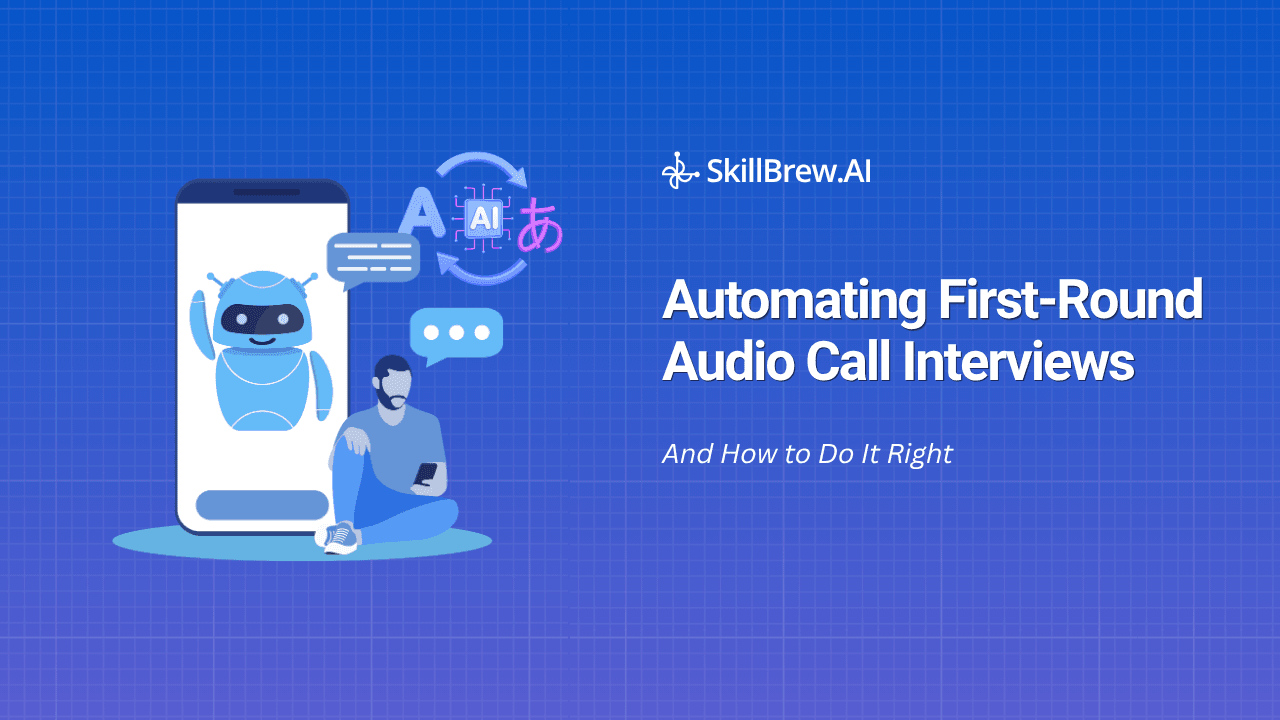
A voice AI agent changes that math. It can conduct first-round audio call interviews automatically, evaluate candidate responses, and generate structured reports for recruiters. What sounded futuristic a few years ago is now a practical reality for TA teams across India.
This guide explains exactly how a voice AI agent works, what it actually evaluates, and how to roll one out successfully.
Table of Contents
- What Is a Voice AI Agent for First-Round Screening?
- Why Indian Recruitment Teams Need One
- Breaking the Recruiter Burnout Cycle
- How BrewVoice's Voice AI Agent Works Inside the Recruitment Workflow
- What a Good Voice AI Agent Actually Evaluates
- The Unbiased Screening Advantage
- What to Expect During the First 30 Days
- Common Concerns About Voice AI Agents
- FAQs on Voice AI Agents
- Final Thoughts
What Is a Voice AI Agent for First-Round Screening?
A voice AI agent for first-round screening calls candidates automatically, conducts structured screening conversations, understands spoken responses, adapts follow-up questions based on answers, evaluates communication skills and role fit, and generates scored candidate reports, all without a recruiter on the line.
This is not a robocall playing recorded messages. A modern version of this technology engages candidates in real conversations, collects responses, and hands recruiters structured insights before any human interview takes place. Recruiters simply open their dashboard and review shortlisted candidates instead of spending hours making calls.
Why Indian Recruitment Teams Need One
The challenges facing Indian TA teams are unique in scale and complexity, and they consistently trace back to three issues: massive application volumes, language and accent diversity, and recruiter bandwidth limitations.
We cover the volume side of this in detail, campus drives generating 1,000-10,000 applications and the math that makes manual screening impossible, in our breakdown of AI callers for frontline hiring. And we go deep on India's language and accent diversity specifically, 22 scheduled languages, hundreds of dialects, and how unconscious bias creeps into human screening, in our multilingual AI voice recruiter guide. Both problems point to the same fix: automated screening that scales first-round conversations without adding recruiters.
Breaking the Recruiter Burnout Cycle
Recruiters conducting dozens of screening calls daily face a simple reality: decision quality drops over time. After 30-40 similar conversations, fatigue sets in. Candidates interviewed late in the day may receive different evaluations than candidates interviewed in the morning, not because of ability differences, but because of recruiter exhaustion.
Automating this stage eliminates the problem entirely. It conducts every screening call, applies the same evaluation framework, never gets fatigued, and maintains consistency across thousands of interviews. Meanwhile, recruiters focus on hiring manager coordination, candidate engagement, offer management, and final interviews. The result is better use of recruiter time and more consistent candidate evaluation.
How BrewVoice's Voice AI Agent Works Inside the Recruitment Workflow
BrewVoice is SkillBrew.AI's built-in voice AI agent, designed specifically for recruitment workflows. Unlike standalone calling tools, it operates directly inside the recruitment dashboard.
Step 1: Candidate enters the dashboard.
Candidates apply through job boards, career pages, campus portals, or direct applications. Their profiles immediately appear inside the SkillBrew.AI dashboard, no exports or manual uploads required.
Step 2: The voice AI agent triggers the audio call.
Recruiters can configure BrewVoice to call candidates automatically, schedule outreach within defined time windows, and launch batch screening campaigns. The system manages call timing and sequencing on its own.
Step 3: The voice AI agent conducts the screening conversation.
The candidate receives a structured but natural voice interview. BrewVoice evaluates communication quality (clarity of speech, response structure, confidence indicators), language proficiency (vocabulary, fluency, grammar, conversational flow), culture-fit signals (self-awareness, professional attitude, interpersonal communication), and role-specific responses. Recruiters can customize questions based on job requirements, and the AI asks dynamic follow-ups whenever clarification is needed.
Step 4: Recruiters receive a scored candidate brief.
After the interview, recruiters get an overall screening score, a category-wise performance breakdown, highlighted audio clips, AI-generated summaries, and a recommended candidate status. Recruiters can review, override, and advance candidates directly from the dashboard.
What a Good Voice AI Agent Actually Evaluates
Not all voice screening platforms are built the same. Basic systems simply look for keywords, mentioning "leadership," "teamwork," or "problem-solving" can artificially inflate scores in weaker systems.
A high-quality system goes deeper. It evaluates communication effectiveness (can the candidate explain ideas clearly?), response relevance (did they actually answer the question?), confidence indicators (do they communicate with conviction and clarity?), logical thinking (are responses structured and coherent?), and role alignment (do they demonstrate traits relevant to the position?). This is what separates meaningful voice screening from simple keyword matching.
The Unbiased Screening Advantage
One of the strongest benefits of this approach is consistency. Every candidate gets evaluated against the same framework. The AI doesn't know the candidate's college, city, background, or appearance, it only evaluates responses against predefined criteria.
This creates an auditable, transparent screening layer before recruiter judgment enters the process. Recruiters still make final decisions. The difference is that bias enters after structured evaluation, not before it.
What to Expect During the First 30 Days
Organizations implementing this technology typically follow a phased rollout.
Week 1-2: Configuration.
Teams define question banks, scoring rubrics, retry policies, and calling windows.
Week 3: Pilot deployment.
The first candidate batch runs through BrewVoice. Recruiters compare AI-generated shortlists against manually screened candidates.
Week 4: Full rollout.
Most organizations begin seeing a 60-75% reduction in recruiter screening calls, faster candidate response times, improved shortlist consistency, and better recruiter productivity. The operational benefits appear quickly. Trust in the system builds after several hiring cycles.
Common Concerns About Voice AI Agents
"Candidates will feel uncomfortable talking to AI."
In practice, many candidates prefer immediate engagement over waiting days for a recruiter callback. Transparency matters, candidates should always be informed they're participating in an AI-led interview.
"Our roles require deeper technical screening."
A voice AI agent is designed for first-round communication and fit assessment. Technical evaluation still happens through SkillBrew.AI's assessment and interview workflows. The tools complement each other.
"What if candidates don't answer the phone?"
BrewVoice supports configurable callback attempts. Recruiters can track completed calls, missed calls, retry status, and final outcomes.
"Can it accurately understand Indian languages and accents?"
Yes. BrewVoice is built specifically for Indian recruitment environments and supports Indian English, Hindi, and regional speech variations through accent-aware voice recognition, built into the platform rather than bolted on later.
FAQs on Voice AI Agents
Q1. What is a voice AI agent for first-round screening?
A recruitment process where an AI voice agent conducts initial candidate interviews, evaluates responses, and generates recruiter-ready reports without requiring human participation during the call.
Q2. How does a voice AI agent help high-volume hiring?
It lets organizations screen hundreds or thousands of applicants simultaneously, dramatically reducing recruiter workload while maintaining consistent evaluation standards.
Q3. Can a voice AI agent handle Indian accents?
Yes. Recruitment-focused voice AI platforms built for India are trained to understand Indian English and regional speech patterns, so candidates get evaluated on communication quality rather than accent familiarity.
Q4. What does a voice AI agent evaluate?
Typical areas: communication skills, language proficiency, confidence indicators, response relevance, cultural alignment, and role-specific suitability.
Q5. What is bulk telephonic screening software?
Software that uses a voice AI agent to conduct large volumes of screening calls automatically, score responses, and deliver structured reports to recruiters.
Q6. Is a voice AI agent fair?
When properly designed, it applies the same evaluation criteria to every candidate, reducing inconsistency, fatigue-based decisions, and certain forms of unconscious bias.
Q7. What is BrewVoice by SkillBrew.AI?
BrewVoice is SkillBrew.AI's voice AI agent that conducts automated first-round audio interviews, evaluates communication and fit, and delivers scored candidate summaries directly inside the recruitment dashboard.
Final Thoughts
For years, first-round phone screening has been one of the biggest bottlenecks in recruitment. In India's high-volume hiring environment, where campus drives, mass recruitment campaigns, and multi-city hiring programs are common, the traditional approach simply doesn't scale.
A voice AI agent doesn't replace recruiter judgment. It moves recruiter effort to where it creates the most value. Instead of spending days making repetitive screening calls, recruiters can focus on evaluating shortlisted talent, engaging candidates, and closing hires.
Teams that adopt a voice AI agent gain speed, consistency, and capacity. Teams that don't will keep spending valuable recruiter hours on a process technology can now handle more effectively.
See BrewVoice's voice AI agent in action. Book a demo and test it against your current candidate pipeline.
See AI-powered hiring in action
Discover how SkillBrew helps hiring teams cut time-to-hire by 60% with skill-validated assessments and AI-ranked shortlists.
Book a free demoNo commitment required · 30 minutes
Continue reading
View All Posts