Assessment
10 Best AI Assessment Tools & Pre-Employment Assessment Software (2026)
Most platforms called an "AI assessment tool" are still doing something fairly simple: pulling questions from a static library, tagging them by role, and calling the match "AI-powered." That's not automatically bad, plenty of these platforms are well-built and widely trusted. But it's worth knowing what you're actually buying before you commit budget to one. Hiring assessments have become a default part of the funnel for a straightforward reason: application volumes keep climbing, and the cost

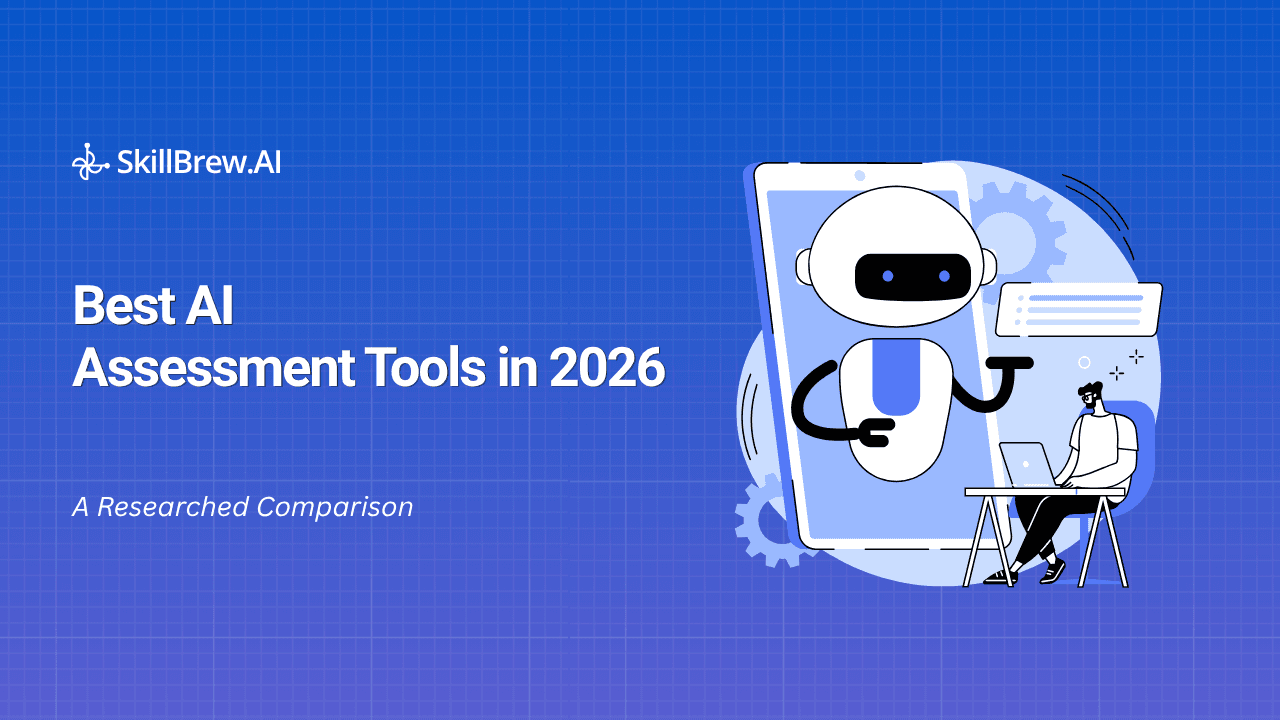
Most platforms called an "AI assessment tool" are still doing something fairly simple: pulling questions from a static library, tagging them by role, and calling the match "AI-powered." That's not automatically bad, plenty of these platforms are well-built and widely trusted. But it's worth knowing what you're actually buying before you commit budget to one.
Hiring assessments have become a default part of the funnel for a straightforward reason: application volumes keep climbing, and the cost of a bad hire is high enough that manual screening alone doesn't hold up at scale anymore.
This post walks through how we evaluated the market, ranks the 10 platforms worth knowing about for technical and behavioral recruitment assessments, and is candid about what each one, including SkillBrew.AI, does well and where it doesn't.
Table of Contents
- Why Most AI Assessment Tools Produce Inconsistent Signal
- How We Evaluated These Tools
- The 10 Best AI Assessment Tools, Ranked
- Quick Comparison: Capabilities at a Glance
- Pre-employment Assessment Software: What to Look For
- AI Assessment Tools vs. Manual Test-Building
- Matching the Tool to Your Hiring Situation
- Frequently Asked Questions
Why Most AI Assessment Tools Produce Inconsistent Signal
The category struggles for a structural reason: many platforms were originally built to solve a distribution problem, getting a test in front of more candidates faster, and only later layered AI onto the evaluation side.
That shows up in a few recognizable ways:
Library-matched tests aren't always role-specific. When a platform routes every "backend engineer" requisition to the same tagged bundle of questions, it's testing fit against that bundle, not necessarily the stack, seniority, or scope a specific req needs.
Multiple choice measures recall, not application. A candidate can identify correct syntax and still struggle to write working code. This isn't a flaw unique to any one vendor, it's a known limitation of pure MCQ formats, which is why most serious platforms, including several reviewed below, now pair MCQ with coding simulators or scenario-based tasks.
Proctoring depth varies enormously across the category. Integrity monitoring ranges from basic webcam checks to genuinely multi-signal detection, and screening accuracy varies accordingly. Neither extreme is universal to "AI assessment tools" as a category, it depends entirely on the specific vendor.
Regulatory scrutiny is increasing, which is a good thing for buyers. More jurisdictions are moving toward bias-audit and transparency requirements for automated hiring tools. Vendors that can point to compliance documentation deserve real credit for it.
None of this means AI-based hiring assessments are a bad idea. It means "AI-powered" alone tells you very little, and it's worth being specific about what a given platform actually automates before comparing price tags.
How We Evaluated These Tools
Before ranking anything, here's the methodology, so you can weigh it yourself.
What we checked for each platform:
- Question generation - does it build genuinely role-specific content from a job description, or route to a filtered library?
- Grading depth - how are coding and open-ended answers actually scored, not just multiple choice?
- Integrity monitoring - what specific signals are tracked, and is monitoring native to the assessment or a separate bolt-on?
- Setup speed - how much recruiter or engineering time does one role-specific test require?
- Candidate experience - does the format hold up against known completion-rate and drop-off patterns in assessment design?
- Pricing structure - subscription versus usage-based, and how that scales with actual hiring volume.
The 10 Best AI Assessment Tools, Ranked
1. SkillBrew.AI
Category: AI-generated technical, behavioral, and cognitive assessment platform Best for: High-volume TA teams, campus drives, technical screening, RPOs
SkillBrew.AI generates a full technical, behavioral, and cognitive test, MCQ, SCQ, and coding, directly from a pasted job description in about two minutes, with auto-generated test cases and a reference solution for coding questions. Teams that want tighter manual control can build from a curated question bank instead of using generation.
BrewShield, the platform's integrity layer, runs by default inside every assessment and tracks 13 signals across camera, screen, voice, and behavior. Pricing is usage-based: creating and enrolling candidates costs nothing, and only an actual attempt deducts credits (15 per attempt).
Strengths: Fast, genuinely role-specific test generation; integrity monitoring built into the core product rather than sold as an add-on; pricing that doesn't penalize outreach volume; free pipeline orchestration (HireFlow) included.
Where it falls short: SkillBrew.AI hasn't yet published an independent third-party bias or efficacy audit of the kind HireVue has, so claims about BrewShield's detection accuracy and the impact of its candidate-reward mechanic on completion rates are, at this point, vendor-reported rather than externally verified. The platform is also newer to the market than several names below, which means a thinner base of third-party reviews to point to.
See SkillBrew.AI's Technical Assessments →
2. HireVue
Category: Enterprise assessment and video interview platform
Best for: Large organizations with global hiring programs and compliance requirements
HireVue pairs game-based cognitive testing and technical assessment modules with its video interviewing product, and has published bias-audit documentation, which remains uncommon in this category.
Strengths: Broad assessment modalities, published third-party audit history, strong enterprise trust and scale.
Where it falls short: Configuring multiple assessment types across large, varied hiring programs can get complex, and some customers have reported ATS write-back gaps for multi-stage evaluation data once a candidate is marked complete.
3. TestGorilla
Category: Pre-built skills and cognitive test library
Best for: Fast setup across common, well-defined roles
TestGorilla offers a large library of scientifically designed tests spanning technical, cognitive, and soft skills, and is generally well-regarded on third-party review sites.
Strengths: Fast setup, strong library breadth, straightforward scoring accessible to non-technical recruiters, strong third-party review base.
Where it falls short: Library-based tests are strong for common roles but thinner for specific or emerging technical stacks, where a generated, role-specific test may fit better than a filtered library match.
4. iMocha
Category: Skills-intelligence platform with a large pre-built library
Best for: Broad skill coverage across technical, functional, and language competencies, plus internal workforce mapping
iMocha offers over 2,500 validated assessments and positions itself for both external hiring and internal skills benchmarking, with proctoring that flags behaviors like irregular eye movement and multiple faces in frame.
Strengths: Very broad skill coverage, dual use case beyond hiring, large validated question set.
Where it falls short: Some advanced customization and benchmarking features reportedly require vendor support to configure well, according to user reviews.
5. Codility
Category: Deep coding and technical evaluation
Best for: Senior and specialist software engineering hiring
Codility puts candidates in a live coding environment, evaluates how code is written and refined rather than only whether the final submission passes, and benchmarks against a large existing pool of engineering candidates.
Strengths: Best-in-class algorithmic and language-specific coding evaluation for engineering-heavy hiring.
Where it falls short: Narrow by design, it doesn't cover behavioral or cognitive assessment, so most teams pair it with a broader platform for anything outside pure coding.
6. Mercer Mettl
Category: Assessment platform with advanced proctoring
Best for: Organizations with strict integrity requirements across many industries
Mettl covers assessments across more than two dozen industries with a large question bank and proctoring that includes facial analysis and secure-browser lockdown.
Strengths: Wide industry coverage, mature and well-established proctoring infrastructure, extensive question bank.
Where it falls short: Some users report a steeper learning curve and a candidate experience that feels less streamlined than newer competitors.
7. Talview
Category: Combined video interviewing and assessment platform
Best for: Multilingual hiring, particularly in Asia-Pacific and the Middle East
Talview pairs video interviews with cognitive and communication testing, using NLP-based analysis on spoken responses inside a proctored environment.
Strengths: Genuinely useful for teams that want interviewing and testing in one platform, strong multilingual support.
Where it falls short: Some reported learning curve for recruiters new to the platform, and more limited UI customization for employer branding compared to some competitors.
8. Vervoe
Category: Job-simulation and AI-graded skill assessment
Best for: Roles where practical output matters more than theoretical knowledge
Vervoe emphasizes realistic job simulations, scenario-based tasks that mirror actual work, over abstract multiple choice, graded by AI trained on the employer's own preferences.
Strengths: Strong "can you actually do the job" signal, well-regarded anti-cheating suite.
Where it falls short: Building and customizing simulation-based assessments can take longer to set up than filling a test from a pre-built library.
9. Criteria Corp
Category: Cognitive and psychometric testing
Best for: Predicting job performance and reducing turnover through validated psychometrics
Criteria Corp focuses on research-backed cognitive aptitude, personality, and emotional intelligence testing rather than hard technical skill validation.
Strengths: Strong psychometric validation, ability to build role- or company-specific benchmarks.
Where it falls short: Limited depth on technical, code-heavy evaluation, this is typically a complement to a technical assessment platform rather than a replacement for one.
10. Peoplebox.ai
Category: Assessment plus post-hire performance tracking
Best for: Teams that want to validate whether screening predicts actual on-the-job performance
Peoplebox.ai automates resume screening and assessment workflows, then carries that data into post-hire performance tracking, closing a loop most platforms on this list don't attempt.
Strengths: Useful long-term feedback loop between hiring assessment data and performance outcomes.
Where it falls short: Feature depth and customization can feel more limited compared to platforms purpose-built around assessment alone.
Quick Comparison: Capabilities at a Glance
The ranking above covers depth and trade-offs. This table is a faster reference for where each platform actually stands on the capabilities most TA teams ask about first.
| Platform | JD Gen | Coding | Behavioral | Proctoring | Best For |
| SkillBrew.AI | Yes | Yes | Yes | Yes (13-signal) | High-volume, campus, RPO hiring |
| HireVue | No | Limited | Yes | Yes | Enterprise compliance-heavy hiring |
| TestGorilla | No | Yes | Yes | Yes | Fast setup, common roles |
| iMocha | No | Yes | Limited | Yes | Broad skill coverage & benchmarking |
| Codility | No | Yes | No | Partial | Senior/specialist engineering hiring |
| Mercer Mettl | No | Yes | Yes | Yes (advanced) | Strict integrity, many industries |
| Talview | No | Limited | Yes | Yes | Multilingual APAC/Middle East hiring |
| Vervoe | No | Yes | Yes | Yes | Practical, scenario-based evaluation |
| Criteria Corp | No | No | Yes | Limited | Personality & cognitive validation |
| Peoplebox.ai | No | Limited | Limited | Limited | Post-hire performance tracking |
A few things worth reading into this table rather than just off it: "JD Generation" is the capability that separates a genuinely tailored test from a library match, and SkillBrew.AI is currently the only platform in this set that builds the full test from a pasted job description rather than routing to pre-built content. That's a meaningful difference in setup speed, but it isn't automatically a quality advantage everywhere, Codility's narrow, library-free focus on live coding evaluation still outperforms generated tests for deep algorithmic assessment specifically, and Criteria Corp's psychometric depth isn't something JD generation is built to replace.
Pre-employment assessment software: what to look for
Pre-employment assessment software helps employers evaluate candidates before interviews or hiring decisions. The right platform should support the skills required for each role, maintain assessment integrity, and fit the organization's hiring volume and budget. Here are three factors to consider when comparing pre-employment assessment software.
1. Types of tests and skills assessments
Look for software that supports assessments relevant to the roles you hire for. Depending on your requirements, this may include:
- Technical assessments: Coding challenges, programming questions, and role-specific technical tests for engineering and IT positions.
- Aptitude tests: Logical reasoning, numerical ability, verbal reasoning, and problem-solving assessments.
- Communication and behavioral assessments: Tests that help evaluate communication skills, workplace behaviors, and other job-relevant competencies.
- Role-specific assessments: Tasks designed to evaluate practical skills for sales, customer support, operations, and other functions.
Before choosing a platform, check whether you can customize assessments by job description, skill level, and role requirements. For campus recruitment, the ability to assess large groups of students using consistent criteria can help recruiters compare candidates more efficiently.
2. Proctoring and cheating checks
Assessment integrity matters when employers evaluate candidates remotely or run high-volume campus hiring drives. Compare the monitoring and security features available in each platform, including:
- Identity and access checks: Confirm that the assessment is taken by the intended candidate, where supported.
- Browser and activity monitoring: Check for supported controls that help identify suspicious activity during an assessment.
- Camera, microphone, and screen monitoring: Review whether the platform offers these features, whether they are configurable, and what permissions candidates must grant.
- Suspicious behavior indicators: Understand how the software flags potential violations and whether recruiters can review the evidence before making decisions.
Proctoring capabilities vary by provider and assessment type. Verify which checks are included in the plan you intend to purchase, how flagged activity is reviewed, and how candidate privacy is handled. Automated flags should support human review rather than serve as conclusive proof of misconduct.
3. Pricing for bulk hiring and campus recruitment
Pricing can significantly affect the total cost of pre-employment assessment software, particularly when hundreds or thousands of candidates need to be evaluated during a short recruitment window.
Compare these pricing factors before selecting a platform:
- Pricing model: Determine whether charges are based on individual assessments, candidate attempts, monthly or annual subscriptions, or usage-based credits.
- Volume discounts: Ask whether per-assessment rates decrease when you purchase credits or assessments in bulk.
- Campus hiring packages: Check for pricing options suited to seasonal recruitment drives, graduate hiring programs, or large candidate batches.
- Proctoring and feature costs: Confirm whether advanced monitoring, detailed reports, integrations, and additional assessment types incur separate charges.
- Unused credits and renewals: Review credit expiry, minimum commitments, renewal terms, and any limits on usage.
For a fair comparison, calculate the estimated cost per completed assessment rather than comparing headline subscription prices alone. Also consider the number of candidates expected to complete assessments, the features required, and the time recruiters spend reviewing results.
The best pre-employment assessment software is not necessarily the cheapest option. Choose a platform that balances relevant testing capabilities, reliable assessment integrity, and predictable costs at your expected hiring volume.
AI Assessment Tools vs. Manual Test-Building
| Task | Manual Process | Typical AI Assessment Tool |
| Writing role-specific questions | Hours per role, often outsourced to an engineer | Minutes, either generated or pulled from a curated library |
| Grading coding submissions | Manual review of every submission | Automated test cases and instant scoring, where supported |
| Catching cheating | A recruiter watching a webcam feed, if at all | Monitoring ranging from basic webcam checks to multi-signal detection |
| Comparing candidates | Inconsistent, depends on who graded what | Standardized scoring against consistent criteria |
| Scaling to 200+ candidates | Requires proportional recruiter hours | Similar setup effort regardless of volume, for most platforms |
Worth noting: not every platform above delivers every row in that right-hand column equally well. That variance is exactly why the criteria in the methodology section matter more than any single vendor's marketing claims.
Matching the Tool to Your Hiring Situation
High-volume or campus hiring across varied roles: SkillBrew.AI, TestGorilla
Enterprise-grade compliance with published third-party audits: HireVue
Fast setup for common, well-defined roles with strong review-site trust signals: TestGorilla
Broad skill coverage plus internal workforce benchmarking: iMocha
Senior or specialist software engineering hiring specifically: Codility
Integrity monitoring as the top non-negotiable across many industries: Mercer Mettl
Multilingual hiring across Asia-Pacific or the Middle East: Talview
Practical, scenario-based evaluation over theory: Vervoe
Psychometric and personality validation over technical testing: Criteria Corp
Tracking whether assessment scores actually predict performance: Peoplebox.ai
Frequently Asked Questions
What are the best AI assessment tools in 2026?
Based on the criteria above, platforms worth evaluating include SkillBrew.AI, HireVue, TestGorilla, iMocha, Codility, Mercer Mettl, Talview, Vervoe, Criteria Corp, and Peoplebox.ai. Which one is genuinely "best" depends on whether your priority is role-specificity, compliance history, coding depth, or psychometric validation, no single platform leads on every dimension.
What's the difference between an AI assessment tool and a traditional online test?
A traditional online test pulls fixed questions from a bank and scores every candidate the same way. An AI assessment tool can generate role-relevant questions, automate grading for coding or open-ended answers, and layer in integrity monitoring, though the depth of each varies significantly by vendor, so it's worth confirming specifics rather than assuming "AI-powered" implies a particular feature set.
How do AI-based hiring assessments compare to manual screening tests?
AI-based hiring assessments can cut question-writing and grading time substantially and standardize scoring across candidates. Manual screening depends entirely on who's building and grading it, which introduces both inconsistency and a hard ceiling on how many candidates a recruiter can realistically evaluate. That said, automation quality varies by vendor, and a poorly built AI tool can still produce weak signal.
Are automated hiring assessments accurate?
Accuracy varies widely across the category. It depends heavily on whether a tool generates genuinely role-specific questions and grades coding submissions against real test cases, versus relying on keyword matching or static multiple choice.
Is proctoring included in most AI assessment tools?
Most established platforms offer some form of proctoring, but depth varies widely, from basic webcam monitoring to multi-signal detection across camera, screen, voice, and behavior. Ask any vendor for the specific list of signals monitored, and whether results have been independently audited, rather than accepting "we have proctoring" as a complete answer.
Can an AI assessment tool replace technical interviews?
Not usually, and most vendors in this space don't claim it should. AI assessment tools are typically used for early and mid-funnel screening, narrowing a large applicant pool to a manageable shortlist, while structured technical interviews handle final-stage validation where the stakes of the hiring decision are highest.
Are AI hiring tools regulated?
Increasingly, yes. More jurisdictions are introducing bias-audit, transparency, and candidate-notification requirements for automated hiring tools. Buyers evaluating any AI assessment tool, ours included, should ask what compliance documentation a vendor can provide rather than taking fairness claims at face value.
See how SkillBrew.AI's Technical Assessments work, including where BrewShield's proctoring currently stands versus a full independent audit. Book a demo →
See AI-powered hiring in action
Discover how SkillBrew helps hiring teams cut time-to-hire by 60% with skill-validated assessments and AI-ranked shortlists.
Book a free demoNo commitment required · 30 minutes
Continue reading
View All Posts