BrewVoice
How Staffing Agencies Are Winning Recruitment Mandates Faster With AI Voice Screening
The recruitment mandate comes in at 11 AM. Your client wants 40 shortlisted candidates by Friday. Two other staffing agencies have received the same requirement. You have 200 applications waiting. Your recruiters are already busy chasing candidates for yesterday's mandates. The competing agency submits first. You lose the placement. For staffing agencies and RPO firms operating in India's high-volume hiring market, this isn't unusual. It happens every day. The reality is simple: speed wins. Th

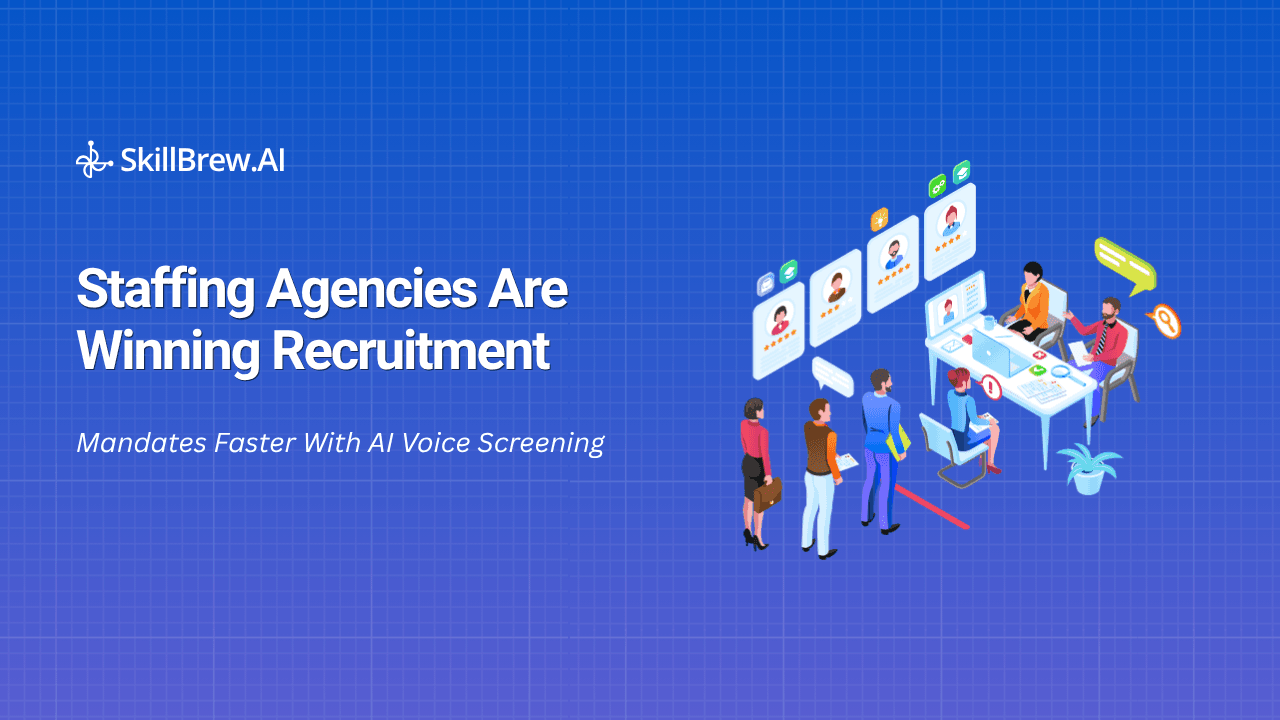
The recruitment mandate comes in at 11 AM. Your client wants 40 shortlisted candidates by Friday. Two other staffing agencies have received the same requirement.
You have 200 applications waiting. Your recruiters are already busy chasing candidates for yesterday's mandates. The competing agency submits first. You lose the placement.
For staffing agencies and RPO firms operating in India's high-volume hiring market, this isn't unusual. It happens every day. The reality is simple: speed wins. The faster an agency identifies qualified candidates and submits them to clients, the higher its chances of winning the business. Yet most agencies still rely on a screening process that was never built for today's hiring volumes, exactly the gap first round screening software is built to close.
Table of Contents
- The Real Economics of Staffing Agencies Are Built on Speed
- Why Manual Telephonic Screening Kills Competitive Advantage
- What Happens When First Round Screening Software Takes Over
- How BrewVoice Fits Into a Staffing Agency Workflow
- The Business Impact of First Round Screening Software
- FAQs on First Round Screening Software
- The Agencies That Win Are the Ones That Move First
The Real Economics of Staffing Agencies Are Built on Speed
Most conversations around agency productivity focus on better job boards, larger candidate databases, improved job descriptions, and expanded sourcing channels. But these usually aren't the biggest bottlenecks. The real slowdown happens during the first screening call.
Before a candidate reaches a client shortlist, recruiters typically run an initial telephonic screen to check communication skills, role fit, notice period and availability, salary expectations, and basic qualifications. Each call takes roughly 8-12 minutes. For a role with 200 applicants and a target shortlist of 40, recruiters spend between 25 and 40 hours on screening before a single profile reaches the client. This is exactly where agencies lose the mandate, and exactly where first round screening software earns its ROI.
Why Manual Telephonic Screening Kills Competitive Advantage
Most agency leaders already know screening takes time. What often goes unnoticed is how directly it hits revenue.
Recruiters can only handle one call at a time. Even an efficient three-person team can screen around 15-18 candidates per hour under ideal conditions. Hiring demand rarely waits for ideal conditions.
Candidate pickup rates are unpredictable. Industry callback rates for recruitment calls typically run 40-60%. Missed calls create additional follow-ups, scheduling delays, recruiter workload, and slower client submissions.
Bulk hiring timelines are brutal. Clients working with multiple staffing partners don't wait. The first agency that delivers a reliable shortlist usually wins the mandate. The rest become backup options.
Recruiter burnout gets expensive. Phone screening is repetitive and consumes hours of recruiter capacity for limited strategic value, driving lower productivity, higher burnout, increased attrition, and greater internal hiring costs. For RPO teams managing multiple clients simultaneously, this compounds fast.
What Happens When First Round Screening Software Takes Over
AI-powered screening changes the role of recruiters entirely. Instead of spending time on repetitive qualification calls, they focus on client management, candidate engagement, offer negotiations, final interviews, and placement closures. The impact shows up in three places.
1. Instant speed-to-market.
Traditional screening waits for recruiter availability. First round screening software doesn't. The moment applications arrive, outreach begins automatically. A mandate that receives 200 applications within a few hours gets every candidate a first-round screening call immediately, instead of waiting until tomorrow. This is especially powerful for campus hiring, walk-in drives, volume recruitment, seasonal hiring, and RPO projects. When shortlists arrive in hours instead of days, agencies gain a real competitive edge, a five-person team using screening software can often compete with agencies running much larger recruitment teams.
2. Lower cost-per-hire.
Every hour spent on first-round phone screens is an hour not spent closing placements, and those lost hours hit profitability directly. With automation handling initial screening, recruiters engage only with qualified candidates, qualification happens automatically, screening capacity scales instantly, and teams manage more mandates at once. For agencies on tight margins, saving 4-8 recruiter hours per mandate with first round screening software can meaningfully improve profitability.
3. Consistent quality across every submission.
Manual screening introduces inconsistency, different recruiters ask different questions, interpret responses differently, and apply varying standards. Good first round screening software fixes this: every candidate gets evaluated against the same criteria for communication ability, role-specific fit, joining availability, confidence, and language proficiency, whether they're screened at 9 AM or 6 PM. That consistency builds client trust. When every submitted profile meets a clearly defined standard, agencies build stronger long-term client relationships.
How BrewVoice Fits Into a Staffing Agency Workflow
As a piece of first round screening software, BrewVoice by SkillBrew.AI is built to fit into existing recruitment operations rather than replace them. Recruiters set up the mandate inside the SkillBrew.AI dashboard, configuring communication requirements, job-specific questions, language preferences, and regional hiring requirements per client. As applications arrive through existing sourcing channels, BrewVoice queues them automatically and starts first-round screening calls, engaging multiple candidates at once rather than one at a time.
We cover the full step-by-step mechanics of how the voice agent runs each call, the scoring, and the candidate report structure in our deep dive on voice AI agents for first-round screening. The agency-specific difference: recruiters get ranked shortlists with candidate scores, call transcripts, qualification summaries, and flagged concerns, structured specifically to support a fast client submission rather than internal review only. The platform supports Indian English variations and regional accents, so candidates from different geographies get a consistent experience regardless of which mandate they're screened for.
The Business Impact of First Round Screening Software
Adopting first round screening software creates measurable advantages: faster turnaround (submitting qualified candidates ahead of competing agencies), improved recruiter productivity (recruiters close placements instead of running repetitive calls), better candidate experience (immediate engagement instead of days of waiting), reduced cost-per-hire (lower recruiter effort per placement improves margins), and consistent screening quality (every candidate evaluated on the same framework). The result, once first round screening software is in place, is a more scalable recruitment operation without a proportional increase in recruiter headcount.
FAQs on First Round Screening Software
Q1. How accurate is first round screening software for recruitment?
Modern systems can accurately assess communication skills, role fit, availability, and candidate responses when trained specifically for recruitment workflows. The best ones use structured evaluation frameworks to keep scoring consistent across candidates.
Q2. Can first round screening software handle Indian accents?
Yes. Advanced recruitment voice agents like BrewVoice are built to understand Indian English variations and regional accents across the country, so candidates get evaluated fairly regardless of geography.
Q3. How many candidates can first round screening software handle simultaneously?
Unlike human recruiters, these systems can run multiple screening conversations at once, letting agencies process hundreds or thousands of applicants within hours.
Q4. Will candidates prefer software over a recruiter call?
Many candidates appreciate immediate engagement over waiting days for recruiter outreach. Designed correctly, conversational AI creates a smooth, efficient screening experience.
Q5. How much can agencies reduce cost-per-hire with first round screening software?
Savings vary by volume, but agencies commonly reduce 4-8 recruiter hours per mandate. Across multiple concurrent openings, that adds up to substantial operational savings.
Q6. Can BrewVoice be customized per client requirement?
Yes. Recruiters configure screening workflows, communication benchmarks, role-specific questions, language requirements, and qualification criteria separately for each mandate.
Q7. Does first round screening software replace recruiters?
No. It handles repetitive first-round qualification calls while recruiters focus on higher-value work: interviewing, client management, negotiations, and offer closures.
The Agencies That Win Are the Ones That Move First
Staffing agencies still relying entirely on manual telephonic screening face a growing disadvantage. The challenge isn't recruiter productivity, it's response time. In a market where clients engage multiple agencies simultaneously, the ability to identify, screen, and submit qualified candidates first often determines whether a mandate becomes revenue or goes elsewhere.
First round screening software lets recruiters enter the process at Stage 2 instead of Stage 1, less time on repetitive calls, more time placing candidates. BrewVoice helps staffing agencies get exactly that by automating first-round candidate screening while maintaining consistency, scale, and speed.
Want to see how BrewVoice fits your agency's workflow? Book a demo and see how first round screening software can cut cost-per-hire while helping your team submit better candidates faster.
See AI-powered hiring in action
Discover how SkillBrew helps hiring teams cut time-to-hire by 60% with skill-validated assessments and AI-ranked shortlists.
Book a free demoNo commitment required · 30 minutes
Continue reading
View All Posts