BrewVoice
The Complete Recruitment Automation Process (And What Voice AI Changes)
Hiring teams aren't slow because they lack effort. They're slow because too many steps in the hiring workflow still require a human to stop and manually do something repetitive. Send a message. Make a call. Copy a note. Update a tracker. Recruitment automation is the discipline of identifying which of those steps don't need a human at all, and eliminating the overhead for good. When done right, teams see 3x faster shortlists, 70% reduction in screening time, and 28+ recruiter hours saved per

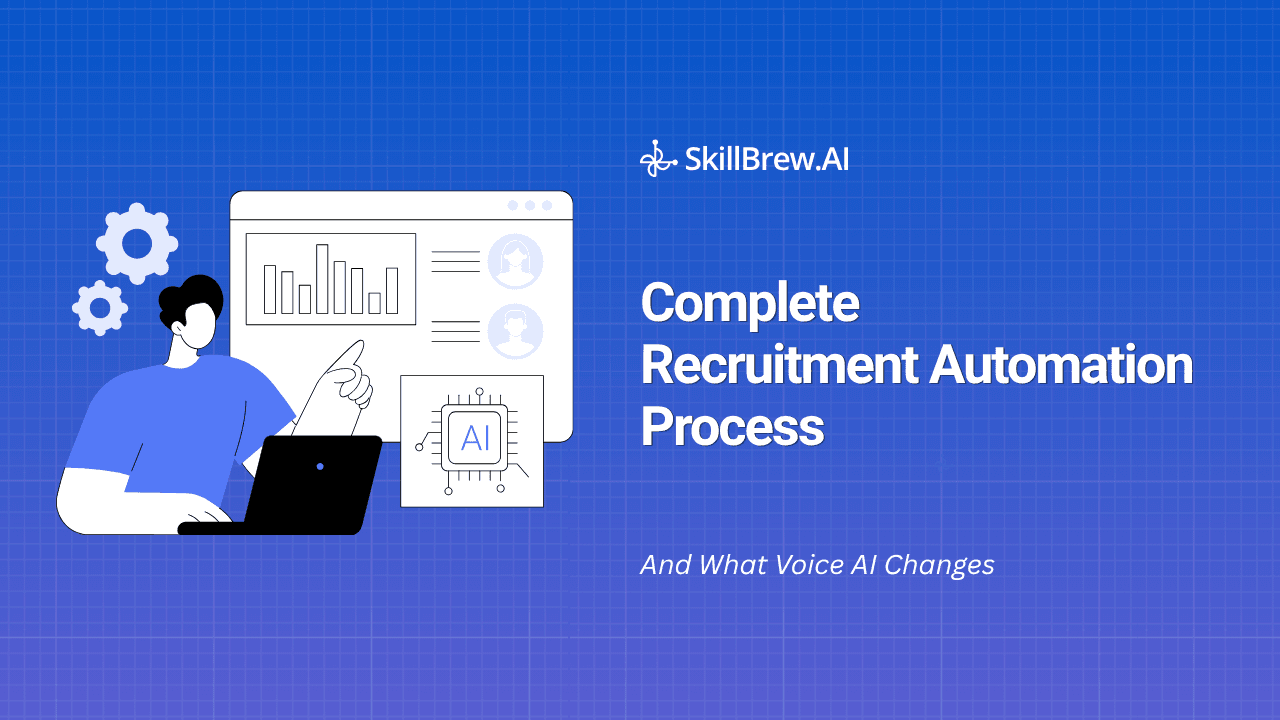
Hiring teams aren't slow because they lack effort. They're slow because too many steps in the hiring workflow still require a human to stop and manually do something repetitive.
Send a message. Make a call. Copy a note. Update a tracker.
Recruitment automation is the discipline of identifying which of those steps don't need a human at all, and eliminating the overhead for good.
When done right, teams see 3x faster shortlists, 70% reduction in screening time, and 28+ recruiter hours saved per hire.
This guide walks through each stage of the recruitment automation process, what to automate at each step, and where AI voice calling for hiring makes the most meaningful operational difference.
Table of Contents
- What is the recruitment automation process?
- Stage 1 of the recruitment automation process: job posting and sourcing
- Stage 2 of the recruitment automation process: AI resume screening
- Stage 3 of the recruitment automation process: automated voice screening
- Meet Rhea: SkillBrew's AI voice bot for HR
- Stage 4 of the recruitment automation process: AI interviews and assessments
- Stage 5 of the recruitment automation process: scheduling and communication
- Stage 6 of the recruitment automation process: pipeline tracking and offers
- Recruitment automation process mistakes that kill ROI
- Frequently Asked Questions
What is the recruitment automation process?
The recruitment automation process is the systematic replacement of manual hiring tasks with software, AI agents, and workflow rules, so recruiters focus on judgment, not administration.
It covers every stage of hiring, from the moment a job requisition opens to the point a candidate accepts an offer.
The goal is not to remove humans from hiring decisions. It's to remove humans from everything that doesn't require a decision.
Done well, it compresses a process that takes weeks into one that takes days, without sacrificing evaluation quality or candidate experience.
Stage 1 of the recruitment automation process: job posting and sourcing
What stays manual: Writing the job description. Defining role requirements. Setting compensation bands.
What automation handles:
- Multi-board job distribution from a single source
- JD parsing to auto-generate screening criteria
- Resume collection, deduplication, and pipeline ingest
The bottleneck that appears here isn't sourcing, it's processing. You get applications fast. The question shifts to: how do you evaluate them fast enough?
HireFlow, SkillBrew's always-free orchestration layer, handles distribution, inbound resume capture, and WhatsApp and email candidate communication automatically. Candidates enter the pipeline acknowledged and informed, not waiting in silence.
Stage 2 of the recruitment automation process: AI resume screening
What stays manual: Setting minimum qualification thresholds. Reviewing flagged edge cases.
What automation handles:
- Resume parsing against JD-defined criteria
- Knockout question scoring across experience, location, and certifications
- Ranked shortlist generation
AI resume screening compresses what takes a recruiter 3-5 hours of daily reading into a 15-minute review of a scored, ranked shortlist.
The critical mistake most teams make here: automated shortlisting is not the same as automated screening.
Resumes tell you what someone wrote about themselves. They don't tell you whether the candidate can communicate the role clearly, whether their availability matches, or whether the basics line up before investing interview time.
That gap is exactly where voice screening should step in, and where most teams still go manual.
Stage 3 of the recruitment automation process: automated voice screening
This is the highest-friction stage in the entire process for most Indian TA teams.
Here's what the manual version looks like: a shortlist of 200 to 500 candidates. A team of recruiters spends the next week making outbound calls. Some candidates pick up. Some don't. Callbacks happen on weekends. Notes are inconsistent.
Strong candidates who don't get a call within 72 hours have already accepted elsewhere.
By the time the screened list is ready, time-to-hire has stretched by 7 to 10 days. And evaluation quality varies by recruiter, by time of day, and by how fatigued the person on their 47th call of the day is.
Automated telephonic screening eliminates this entirely.
An AI voice bot for HR calls candidates at scale, 500+ outbound calls per day, asks structured, role-relevant questions, evaluates responses in real time, and delivers scored reports to the recruiter. No coordinator needed. No callback loops.
| Hiring Activity | Manual phone screening | Automated voice screening |
| Daily capacity | 15-20 calls per recruiter | 500+ calls per day |
| Evaluation scoring | Recruiter notes | Structured 3-signal report |
| Screening window | 5-7 days | Same day |
| Recruiter involvement | High | Zero for screening |
| Language flexibility | Single recruiter language | 10+ Indian regional languages |
| Audit trail | Inconsistent notes | Full transcript and score |
Meet Rhea: SkillBrew's AI voice bot for HR
Rhea is the AI recruiter persona behind BrewVoice, the voice your candidates interact with during automated telephonic screening.
She's built specifically for the Indian hiring context: 10+ regional languages, accent-aware conversation handling, and delivery via both telephonic calls and WhatsApp depending on candidate access.
How a Rhea-powered screening works
Trigger. A candidate clears AI resume shortlisting in HireFlow and enters the screening queue automatically.
Outbound call. Rhea initiates contact on the candidate's preferred channel. No coordinator. No scheduling. Calls go out immediately.
Adaptive conversation. Rhea introduces herself, explains the role, and begins structured screening. When answers are vague, she follows up, not with a fixed script, but with contextual probing. "You mentioned 2 years in field sales, was that primarily inbound or outbound?" That level of depth.
3-signal report. Within hours, the recruiter receives a structured report covering:
- Role fit - availability, location match, experience alignment, role understanding
- Technical signal - demonstrated knowledge relevant to the job description
- Communication clarity - confidence, articulation, and language proficiency for the role
Pipeline action. Rhea's report feeds directly into HireFlow's Kanban. Candidates move to the next stage, get flagged for review, or are marked not shortlisted — with supporting evidence attached.
Recruiters review a scored, ranked list. The first human call they make is a second-round interview, not a first-round screening call.
Why it matters for India specifically
Most global voice screening tools are optimized for American or British English.
Indian TA teams, hiring across Tamil Nadu, Maharashtra, Rajasthan, Uttar Pradesh, West Bengal, need a voice screening tool India can actually deploy. A platform that treats regional accents as degraded input isn't a solution.
Rhea is trained on Indian English and regional language patterns. A candidate from Coimbatore screening for a manufacturing role doesn't get penalized for how they speak. They get evaluated on what they say.
Stage 4 of the recruitment automation process: AI interviews and technical assessments
Once voice screening is complete, shortlisted candidates move to structured evaluation.
AI interviews run autonomously, 24/7, with no recruiter scheduling required. SkillBrew's AI interview avatar is resume-aware, it knows the candidate's background before the session starts and asks adaptive, role-relevant questions rather than a fixed script. Output is a structured 3-signal candidate report.
Technical assessments generate directly from the JD. Paste a job description and the platform creates a curated, role-specific assessment in under 2 minutes, covering technical competencies, behavioral signals, and cognitive ability.
BrewShield proctoring runs inside every interview and assessment, tracking 13 integrity signals: camera, screen, keystrokes, voice, tab-switching, and more. Evaluation data is reliable, not gameable.
Stage 5 of the recruitment automation process: scheduling and communication
What automation handles:
- Interview slot offers via WhatsApp or email based on candidate availability
- Automated reminders at 24 hours and 1 hour before
- No-show detection with automatic rescheduling prompts
- Status updates pushed to candidates at each pipeline stage
What stays human: High-stakes communication, offer negotiations, rejection calls for senior candidates, anything where empathy and context matter.
HireFlow handles all routine candidate communications automatically. Candidates receive timely updates through WhatsApp, the channel most Indian candidates are actually on, rather than email they don't check.
Stage 6 of the recruitment automation process: pipeline tracking and offer workflows
What automation handles:
- Real-time Kanban dashboards showing candidates at each stage, conversion rates, and drop-off points
- Time-to-stage and time-to-hire tracking
- Offer letter generation from approved templates
- Document collection prompts post-offer
What stays human: Final hiring decisions, offer negotiations, and exception handling outside standard workflow.
HireFlow's Kanban gives TA leads a live view of every drive in progress, candidates moving through stages, stuck applications flagged automatically, funnel conversion tracked without any manual reporting.
Recruitment automation process mistakes that kill ROI
Automating voice screening last instead of first
Teams typically automate sourcing and scheduling before they touch screening. This is backwards.
Voice screening is where volume hits hardest in the recruitment automation process. Automated telephonic screening should be the third step in your workflow, not the seventh.
Using global tools built for English-only markets
A voice screening tool that stumbles on Tamil, Telugu, or Marathi candidates doesn't save time. It creates a new problem. Accuracy drops, candidates feel the friction, and your screening data is unreliable.
Evaluate tools on Indian language performance before anything else.
Treating the recruitment automation process as a full replacement for human judgment
The goal is human-in-the-loop hiring, not fully automated hiring. Automation handles volume and repetition. Human judgment handles evaluation and decisions.
TA teams that try to automate every touchpoint lose the quality signals that only human judgment provides.
Running disconnected tools without a unified pipeline
A standalone voice screening tool that doesn't connect to your ATS, resume screener, and interview platform creates a new coordination problem. You've replaced one manual task with another.
The value of a platform like SkillBrew is that BrewVoice, AI interviews, assessments, and HireFlow orchestration operate as a single connected workflow, not five tools that need manual handoffs.
See Rhea in action on your next drive
If your team is processing more than 200 candidates per month and still running manual first-round screening calls, it's time to close the gap in your recruitment automation process.
SkillBrew is pay-as-you-go. No subscriptions. No seat licenses. No expiring balances. HireFlow is always free.
Frequently Asked Questions
What is the recruitment automation process?
The recruitment automation process is the systematic use of software, AI agents, and workflow rules to handle repetitive hiring tasks, sourcing, resume screening, voice screening, scheduling, and communication, so recruiters focus their time on evaluation and decision-making. The goal is not to replace human judgment but to remove humans from every step that doesn't require it.
What are the stages of the recruitment automation process?
A complete recruitment automation process covers six core stages: job posting and sourcing, AI resume screening and shortlisting, automated voice screening, AI interviews and technical assessments, scheduling and candidate communication, and pipeline tracking with offer workflows. Most teams have automated the first, second, and fifth stages, the highest-impact gap in most recruitment automation processes is the third stage: first-round voice screening.
How does AI voice calling for hiring work?
AI voice calling for hiring uses automated voice agents to conduct first-round telephonic screening at scale. The AI agent calls candidates, asks structured role-relevant questions, evaluates responses in real time, and delivers a scored report to the hiring team. Recruiters receive a ranked shortlist without making a single screening call themselves.
What is Rhea and how is she different from a robocall?
Rhea is SkillBrew's AI recruiter persona, built into the BrewVoice platform. Unlike IVR systems or robocalls that follow fixed scripts, Rhea conducts adaptive conversations, following up on incomplete answers, adjusting based on candidate responses, and probing for role-relevant detail. She is specifically designed for Indian TA workflows, with support for 10+ regional languages and diverse accent profiles.
Which stage of the recruitment automation process benefits most from voice AI?
First-round telephonic screening delivers the highest ROI from voice AI. It carries the heaviest manual load, the most recruiter burnout risk, and the most candidate drop-off when response times are slow. Automating it compresses a 5-7 day screening window into same-day results.
Is there a voice screening tool built for India specifically?
Most global voice screening tools underperform on Indian English, regional accents, and multilingual candidate pools. BrewVoice by SkillBrew is built specifically for the Indian hiring context, supporting 10+ regional languages, trained on Indian accent profiles, and delivered via telephonic and WhatsApp channels.
How does automated telephonic screening connect to the rest of the recruitment automation process?
With SkillBrew, BrewVoice feeds directly into HireFlow. Candidates who complete voice screening move to the next pipeline stage automatically based on score thresholds. The full recruitment automation process, sourcing, shortlisting, voice screening, AI interviews, assessments, scheduling, and offer management, runs inside a single connected workflow.
What is SkillBrew's pricing model?
SkillBrew uses a strict pay-as-you-go model. You pay for voice screening calls, AI interviews, or assessments as you use them, with no monthly subscription, no seat licenses, and no expiring balances. HireFlow is always free.
See AI-powered hiring in action
Discover how SkillBrew helps hiring teams cut time-to-hire by 60% with skill-validated assessments and AI-ranked shortlists.
Book a free demoNo commitment required · 30 minutes
Continue reading
View All Posts