AI Interview
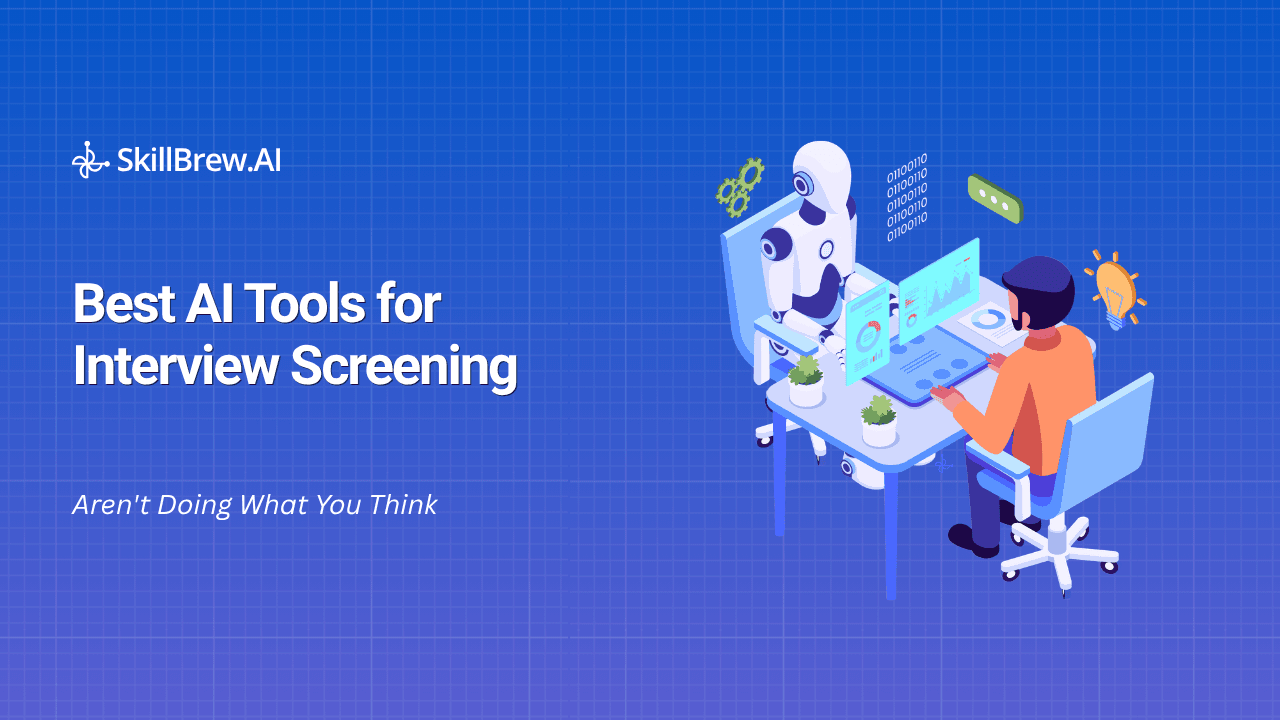
The Best AI Tools for Interview Screening Aren't Doing What You Think
Most platforms called "AI interview tools" are doing something much simpler than they advertise. They're recording video. They're transcribing answers. They're running sentiment analysis on tone of voice. And they're giving you a transcript or a vague "communication score" that tells a recruiter almost nothing actionable. This is why so many TA teams try AI video interviews once, get mediocre signal, and go back to manual calls, without ever finding the best ai tools for interview screening th

Most platforms called "AI interview tools" are doing something much simpler than they advertise.
They're recording video. They're transcribing answers. They're running sentiment analysis on tone of voice. And they're giving you a transcript or a vague "communication score" that tells a recruiter almost nothing actionable.
This is why so many TA teams try AI video interviews once, get mediocre signal, and go back to manual calls, without ever finding the best ai tools for interview screening that actually fit their volume.
The best ai tools for interview screening work differently. They conduct adaptive conversations. They probe incomplete answers. They score candidates against a job description, not a generic rubric. And they hand recruiters a ranked shortlist, not a queue of videos to rewatch.
This guide covers what to actually look for, which platforms genuinely deliver on that standard, and how SkillBrew AI Interviews fits into the picture for high-volume TA teams.
Table of Contents
- Why Most AI Interview Tools Produce Weak Signal
- What Good Looks Like: 5 Criteria for the Best AI Tools for Interview Screening
- The 7 Best AI Tools for Interview Screening, Ranked
- SkillBrew AI Interviews: What Makes It Different
- Comparison: AI Video Interviews vs. Manual Screening
- Who Should Use Which of the Best AI Tools for Interview Screening
- Frequently Asked Questions
Why Most AI Interview Tools Produce Weak Signal
The problem isn't that AI interview technology doesn't work. The problem is that most platforms were designed to solve a scheduling problem, not an evaluation problem.
They automate the logistics of getting a candidate on a call and getting them to answer a set of questions. But the actual evaluation, what you learn about the candidate, is still shallow.
Here's why:
Fixed scripts don't surface real depth. When every candidate answers the same five questions in the same order, the platform is measuring how well candidates answer those five questions. That's a proxy, not signal.
Sentiment analysis isn't evaluation. Scoring candidates on tone, pace, or "confidence markers" sounds scientific. In practice, it's measuring communication style, not capability. And it introduces its own bias patterns.
Transcripts aren't conclusions. Giving a recruiter a transcript of a candidate's answers and calling it an evaluation shifts the analysis burden back to the human. The bottleneck hasn't moved.
The AI interview platforms worth evaluating, the best ai tools for interview screening, in other words, are the ones that have actually solved the evaluation problem, not just the scheduling problem.
What Good Looks Like: 5 Criteria for the Best AI Tools for Interview Screening
Before you evaluate any platform, align your team on what separates the best ai tools for interview screening from the rest.
1. Adaptive questioning. Does the platform probe incomplete or interesting answers, or does it mechanically move to question two? Resume-aware, conversational follow-up is the differentiator between a recording tool and an interview tool.
2. Structured scoring output. Recruiters need a scored report mapped to job requirements, not a video library or a pile of transcripts. The platform should produce a shortlist-ready output.
3. Built-in integrity monitoring. At scale, you will encounter candidates gaming the system. AI tools for interviews with native proctoring, not a separate add-on, are significantly more defensible.
4. Setup speed. A platform that takes two weeks to configure an interview flow will sit unused. JD-to-interview automation (paste a job description, get a structured interview) is the standard you should expect.
5. Pricing that scales with volume. Subscription models charge you whether you're hiring or not. Pay-as-you-go models align cost with actual hiring activity. For teams with variable volume, this matters, and it's a key reason it shows up across most rankings of the best ai tools for interview screening.
The 7 Best AI Tools for Interview Screening, Ranked
1. SkillBrew AI Interviews
Category: Autonomous adaptive interview platform
Best for: High-volume TA teams, campus drives, technical screening, RPOs
SkillBrew AI Interviews tops most lists of the best ai tools for interview screening for one reason: the interview adapts to the candidate, not the other way around.
Before each session, the AI avatar reads the candidate's resume. During the conversation, it generates follow-up questions based on what the candidate actually says, probing for depth when answers are vague, exploring claims that merit clarification, and surfacing the kind of signal that a strong human interviewer would surface.
The output is a 3-signal report:
- Role fit - mapped directly against the job description
- Technical signal - depth and accuracy of domain knowledge
- Communication and confidence - clarity, structure, articulation
BrewShield proctoring runs natively inside every session, monitoring 13 integrity signals without a separate configuration or licensing requirement.
Key features:
- Resume-aware adaptive avatar
- JD-to-interview in under 2 minutes
- 3-signal structured report per candidate
- BrewShield, 13-signal integrity monitoring built in
- 24/7 autonomous delivery with no recruiter scheduling
- Pay-as-you-go pricing, no monthly minimums
- Free HireFlow pipeline orchestration layer
2. HireVue
Category: Enterprise video interview and assessment platform
Best for: Large organizations with enterprise procurement processes
HireVue is consistently named among the best ai tools for interview screening at the enterprise level. It offers on-demand video interviews, game-based cognitive assessments, language proficiency testing, and technical evaluations within a single ecosystem.
Organizations with complex enterprise tech stacks and compliance requirements (including FedRAMP-certified environments) find HireVue's integration depth valuable.
Strengths: Breadth of assessment modalities, 40+ language support, enterprise compliance certifications.
Consideration: One-way video interviews don't adapt to candidate responses. Evaluation depth depends more on the volume and quality of questions configured than on adaptive conversation logic.
3. Interviewer.AI
Category: AI video screening with explainability focus
Best for: Structured intake screening, university admissions, staffing
Interviewer.AI is regularly shortlisted among the best ai tools for interview screening for its explainability-first scoring approach, every candidate evaluation includes the dimensions assessed and why the score was assigned.
Multi-language support (10+ languages) and ATS integration via Zapier make it viable for global hiring programs.
Strengths: Explainable AI scoring, resume fraud detection, structured reporting.
Consideration: Adaptive follow-up questioning is more constrained than platforms built around conversational AI.
4. BrightHire
Category: Interview intelligence platform
Best for: Structured human interview panels, documentation-heavy processes
BrightHire is a fundamentally different kind of AI interview tool, it doesn't replace human interviewers, it makes them better. The platform records and analyzes human interviews, generates structured notes, surfaces key moments, and produces data-backed candidate comparisons across a panel.
If your hiring process involves panel interviews or structured behavioral assessments with human interviewers, BrightHire reduces bias and improves documentation quality significantly.
Strengths: Human interview documentation, skills-based methodology, defensible hiring decisions.
Consideration: Not an autonomous screening tool. Requires human interviewers in the loop.
5. Vervoe
Category: Skills-first video interview and assessment platform
Best for: Work-sample methodology, role-specific practical evaluation
Vervoe combines video interview responses with practical work-sample tasks—giving teams a candidate experience that blends what candidates say with what they can actually do. Auto-ranked shortlists reduce recruiter review time after assessment completion.
Strengths: Work-sample methodology, practical evaluation alongside video response, auto-ranking.
Consideration: Technical screening depth for engineering roles may need supplemental tooling. Assessment library quality varies by industry.
6. Final Round AI
Category: Candidate-facing interview preparation platform
Best for: Candidate coaching, mock interview preparation
Final Round AI is primarily a candidate tool, offering AI mock interview simulations, resume optimization, and real-time coaching for job seekers preparing for live interviews. Some TA teams use platforms like this to prep referred or internal candidates before panel interviews.
Strengths: Comprehensive candidate preparation, real-time answer coaching, AI mock interview simulation.
Consideration: Candidate-facing by design. Not a recruiter screening or shortlisting platform.
7. Paradox (Olivia)
Category: Conversational AI scheduling and engagement platform
Best for: Frontline and hourly hiring with high scheduling complexity
Paradox handles the scheduling and engagement layer of high-volume hiring better than almost any other platform. Where it's less strong is evaluation depth—the screening component is lightweight compared to purpose-built AI interview platforms.
Think of Paradox as a workflow and candidate communication tool with screening capabilities, rather than an interview evaluation platform with workflow capabilities.
Strengths: Scheduling automation, candidate engagement at scale, strong for retail and hospitality.
Consideration: Screening depth is limited. For evaluation-heavy hiring, pair with a more robust interview assessment layer.
That's the field, seven platforms that come up consistently when TA teams research the best ai tools for interview screening.
SkillBrew AI Interviews: What Makes It Different
The difference between SkillBrew AI Interviews and most AI video interview tools comes down to one design decision: the conversation adapts to the candidate.
Most platforms configure a list of questions. Every candidate gets the same questions in the same order. The platform records and scores the answers.
SkillBrew reads the candidate's resume before the session begins. When a candidate mentions a project, the avatar can ask about it. When an answer is technically thin, the avatar probes. When something doesn't match the CV, it surfaces the gap.
This isn't a marginal difference. It's the difference between asking every candidate the same five questions and actually interviewing them, and it's why SkillBrew consistently ranks among the best ai tools for interview screening for high-volume hiring.
| Capability | Standard AI Video Interview Tools | SkillBrew AI Interviews |
| Question logic | Fixed pre-set list | Resume-aware, adaptive follow-ups |
| Scoring | Sentiment/transcript | 3-signal report (role fit, technical, communicat |
| Integrity monitoring | Optional add-on or none | BrewShield built in (13 signals) |
| Setu | Manual configuration | JD-to-interview in under 2 minutes |
| Availability | Scheduled | 24/7 autonomous delivery |
| Pricing | Subscri | Pay-as-you-go (no expiring credits) |
| Pipeline layer | Separate tool | HireFlow included free |
Comparison: AI Video Interviews vs. Manual Screening
| Hiring stage | Manual screening | AI interview tools |
| Scheduling overhead | High — recruiter coordinates each slot | Zero - candidate self-selects, 24/7 |
| Daily throughput | 5-10 interviews | Hundreds, concurrently |
| Evaluation consistency | Varies by interviewer | Standardized rubric, every candidate |
| Time to shortlist | Days to weeks | Hours |
| Bias risk | Interviewer-dependent | Significantly reduced |
| Integrity monitoring | Not applicable | Real-time, native |
| Recruiter hours per hire | 28+ hours | Under 10 hours |
Who Should Use Which of the Best AI Tools for Interview Screening
If you're still weighing the best ai tools for interview screening against your own hiring volume, here's a quick decision guide: → SkillBrew AI Interviews or HireVue
You need structured documentation for human panel interviews: → BrightHire
You need explainable, audit-ready AI scoring: → Interviewer.AI
You need to prep candidates before they reach your interview panel: → Final Round AI (AI mock interview functionality)
Your bottleneck is scheduling, not evaluation: → Paradox (Olivia)
You want practical skills evidence alongside video responses: → Vervoe
See What the Best AI Tools for Interview Screening Actually Produce
SkillBrew runs live demos with a real JD from your pipeline. You'll see the avatar adapt in real time, review a live 3-signal candidate report, and watch BrewShield flag integrity events, all in a single 30-minute session.
No commitment required · 30 minutes
Frequently Asked Questions
What are the best ai tools for interview screening in 2026?
The best ai tools for interview screening in 2026 are SkillBrew AI Interviews (adaptive, autonomous screening with built-in proctoring), HireVue (enterprise video interview and assessment programs), Interviewer.AI (explainable AI scoring for audit-sensitive environments), and BrightHire (human interview intelligence and documentation). The right pick from the best ai tools for interview category depends on whether you're solving an evaluation problem, a consistency problem, or a scheduling problem.
What is the difference between AI video interviews and recorded video screening?
Recorded video screening captures a candidate's answer to pre-set questions for a recruiter to review later. AI video interviews go further, an AI system conducts a live session, probes responses, evaluates in real time, and delivers a scored output. The best platforms, like SkillBrew AI Interviews, use resume-aware avatars that adapt to what the candidate actually says rather than following a fixed script.
How do interviews with AI compare to phone screening?
Interviews with AI scale to hundreds of concurrent sessions with zero scheduling overhead, produce consistent scored outputs for every candidate, and reduce time-to-shortlist from days to hours. Phone screening is capped by recruiter availability, produces inconsistent notes, and is impossible to audit at volume. For first-round screening above 30-40 candidates per role, AI interviews are significantly more efficient.
What should AI tools for interviews actually produce as output?
At minimum: a structured report with scores mapped to the job description. Strong platforms produce multi-dimensional evaluations covering role fit, domain knowledge depth, and communication clarity. Outputs should be shortlist-ready, actionable for a recruiter who hasn't watched the interview video.
Can AI to help with interviews replace first-round recruiter calls?
For most roles above an entry threshold of complexity, yes. AI interview platforms are now capable of conducting adaptive first-round sessions that surface the same signal a recruiter call would, at 100x the throughput. The key is choosing a platform with adaptive questioning rather than static question lists, which produce shallower signal.
What is an AI mock interview vs. a recruiter-facing AI interview tool?
An AI mock interview is a practice session designed for job seekers preparing for real interviews, platforms like Final Round AI and Google Interview Warmup offer this. The best ai tools for interview screening, by contrast, are recruiter-facing: they're designed to screen and shortlist applicants at scale, generating scored reports for TA teams. They solve fundamentally different problems.
How does SkillBrew's BrewShield proctoring work?
BrewShield runs natively inside every SkillBrew AI interview session. It monitors 13 integrity signals in real time, including camera presence, screen activity, secondary audio sources, tab-switching patterns, and keystroke anomalies. Unlike standalone proctoring tools, it doesn't require a separate license, configuration, or integration. Every interview on the platform has integrity monitoring enabled by default.
Is pay-as-you-go pricing better than subscription pricing for AI interview tools?
For teams with variable hiring volume, yes. Subscription models charge a flat fee regardless of how many interviews you run, meaning you pay during slow periods and may hit caps during hiring spikes. Pay-as-you-go models like SkillBrew's align cost with actual hiring activity, with no expiring credits and no minimum monthly commitment.
What makes SkillBrew one of the best ai tools for interview screening for Indian TA teams?
SkillBrew is purpose-built for Indian hiring conditions: high applicant volumes, regional language diversity, campus drives across Tier 2 colleges, and frontline hiring at scale. Combined with adaptive AI interviews, native BrewShield proctoring, and flexible pay-as-you-go pricing, it's a strong fit when evaluating the best ai tools for interview screening for the Indian market specifically.
See AI-powered hiring in action
Discover how SkillBrew helps hiring teams cut time-to-hire by 60% with skill-validated assessments and AI-ranked shortlists.
Book a free demoNo commitment required · 30 minutes
Continue reading
View All Posts