Recruitment Automation & Workflow
What Breaks in Your Hiring Workflow at 50+ Applications Per Week
Most hiring workflows work fine at 10 or 15 applications a week. At 50+, they start breaking, not dramatically, but in slow, expensive ways that show up as missed SLAs, burned-out recruiters, delayed hiring decisions, and candidates who disappear before anyone gets to them. This isn't a one-off issue, either. The problem isn't usually recruiter effort. It's that most workflows were built for lower volumes and never redesigned when hiring demand increased, which is exactly how hiring workflow hi
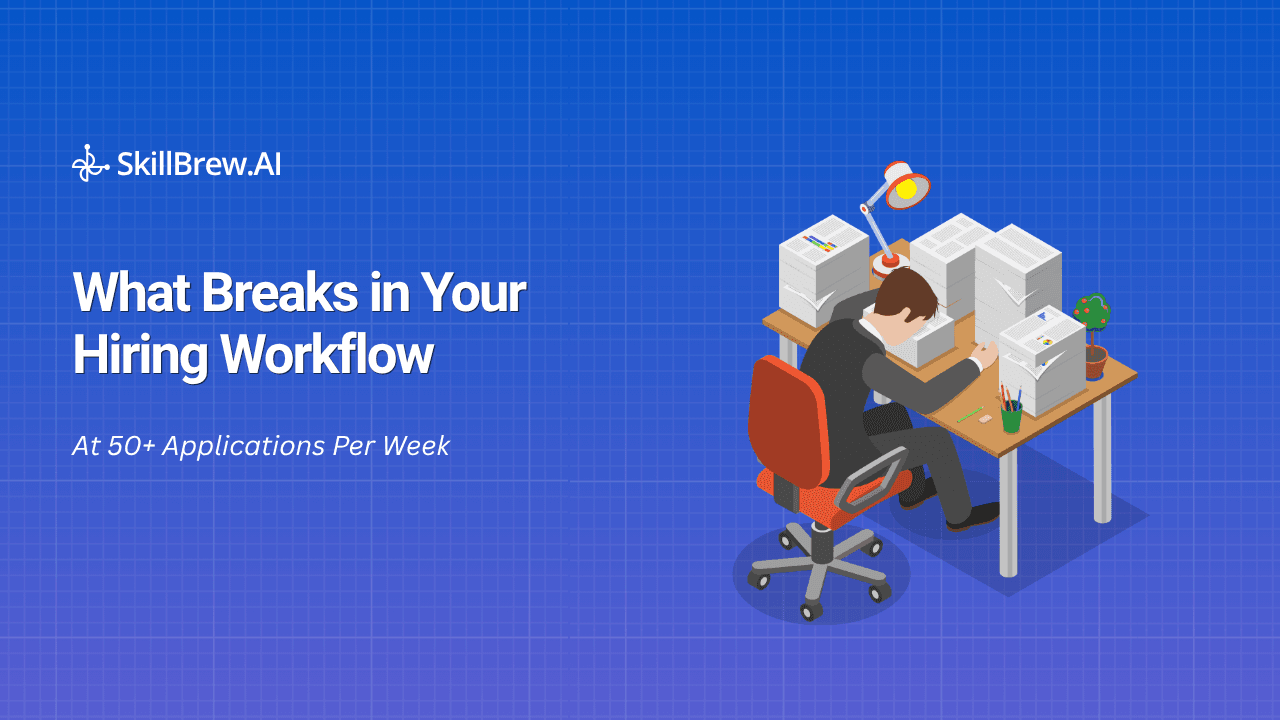
Most hiring workflows work fine at 10 or 15 applications a week. At 50+, they start breaking, not dramatically, but in slow, expensive ways that show up as missed SLAs, burned-out recruiters, delayed hiring decisions, and candidates who disappear before anyone gets to them.
This isn't a one-off issue, either. The problem isn't usually recruiter effort. It's that most workflows were built for lower volumes and never redesigned when hiring demand increased, which is exactly how hiring workflow high volume problems start compounding quietly.
This guide breaks down exactly where hiring workflow high volume problems come from, why they show up there, and what TA leaders can do about it. If your team is processing 50 or more applications a week with the same process it used for 20, at least one of these bottlenecks is already affecting your hiring outcomes.
Table of Contents
- Why High-Volume Hiring Breaks Differently
- Break Point #1: The Inbox Becomes the Tracking System
- Break Point #2: Screening Time Doesn't Scale
- Break Point #3: Interview Coordination Collapses
- Break Point #4: Candidate Experience Degrades
- Why Adding Recruiters Doesn't Solve Hiring Workflow High Volume Problems
- The Four Metrics That Reveal Workflow Bottlenecks
- FAQs on Hiring Workflow High Volume Problems
- Final Thoughts
Why High-Volume Hiring Breaks Differently
A hiring process that works at low volume often fails at scale because every manual step compounds. That compounding effect is the core mechanic behind most hiring workflow high volume problems.
At 15 applications a week, a recruiter can manually review resumes, schedule interviews through email, and track progress in spreadsheets. At 50 or 100 applications a week, those same activities create delays that ripple through the entire hiring funnel.
The result is predictable: time-to-shortlist increases, interview scheduling slows down, candidate communication turns inconsistent, recruiters spend more time coordinating than evaluating, and qualified candidates accept competing offers before reaching the final stage.
The challenge isn't handling more applications. It's preventing the workflow from becoming the bottleneck.
Break Point #1: The Inbox Becomes the Tracking System
The first failure usually shows up in candidate intake. Many teams still route applications through a shared inbox, where recruiters manually review submissions, update spreadsheets, and assign candidates to hiring managers.
At low volume this feels manageable. At 50+ applications per week, it creates a delay of 48-72 hours before a candidate even receives meaningful attention, one of the earliest and most visible hiring workflow high volume problems teams run into.
The issue isn't recruiter productivity. The issue is that email was never designed to function as a hiring workflow system. When applications live inside inboxes, ownership goes unclear, status tracking becomes manual, workload balancing gets difficult, and delays stay invisible until candidates start following up. A recruiter on leave or overloaded with other roles can create an immediate backlog.
What fixes it? A structured intake process. Applications should automatically enter a centralized system, get assigned to reviewers, receive acknowledgment immediately, and trigger alerts when untouched for more than 24 hours. Most ATS platforms support these capabilities. Most teams simply never configure them.
Break Point #2: Screening Time Doesn't Scale With Volume
Resume screening is where most recruiter bandwidth disappears, and it's the single biggest driver of hiring workflow high volume problems across almost every team we've seen.
At 50 applications per week, even a conservative review time can consume dozens of recruiter hours. The result is one of two outcomes: reviews get rushed and inconsistent, or reviews stay thorough but delayed. Neither is good for hiring quality.
This shows up constantly because screening is often manual, subjective, undocumented, and dependent on individual recruiter judgment. Without a standardized process, two recruiters reviewing identical candidates may reach completely different conclusions.
The real fix isn't more recruiters. Most teams respond to volume by adding headcount. The better solution is introducing structure. A simple screening scorecard that evaluates candidates against predefined criteria can reduce screening time, improve consistency, create an audit trail, and increase shortlist quality.
Teams that introduce structured screening criteria often reduce time-to-shortlist by 40-50% without increasing recruiter headcount. When application volume consistently exceeds 100 per week, additional screening layers such as technical assessments, automated shortlisting, or async interviews become increasingly valuable in solving hiring workflow high volume problems. But automation only works when evaluation criteria are already clear. Automating an inconsistent process simply creates inconsistent outcomes faster.
Break Point #3: Interview Coordination Collapses
Many teams assume screening is the hardest part. Often, coordination is harder.
Once candidates are shortlisted, recruiters must align hiring managers, interview panels, candidate availability, multiple open roles, and feedback collection. At higher volumes, coordination becomes a full-time activity, and it's where hiring workflow high volume problems get expensive rather than just annoying.
The failure is rarely process-related. It's usually a visibility problem. Hiring managers don't know candidate status. Interviewers don't know who has already spoken to a candidate. Feedback sits in inboxes instead of the ATS. Recruiters become project managers instead of recruiters.
The hidden cost: most recruiters spend six to eight hours every week chasing interview feedback and scheduling confirmations. Those hours generate no additional hiring value. They just keep the process moving.
What fixes it? Two changes typically produce immediate results: feedback SLAs (interviewers submit feedback within 24 hours of the interview), and centralized visibility, where everyone involved can see candidate stage, previous interviewer notes, outstanding actions, and decision status. The less time recruiters spend asking for updates, the more time they spend evaluating talent.
Break Point #4: Candidate Experience Degrades Silently
High-volume hiring workflows often fail from the candidate's perspective long before recruiters notice. This is the version of hiring workflow high volume problems that costs you the candidate without ever showing up in an internal dashboard.
Inside the team, everything feels normal: applications are queued, interviews are being scheduled, recruiters are working through tasks. But candidates see something different: no updates for a week, multiple scheduling emails, slow responses, limited communication, long gaps between stages. To candidates, this feels disorganized, and disorganization drives drop-off.
The metric that matters: time-to-first-response. Best practice for high-volume hiring is under 48 hours. Many manual workflows run 5-7 days instead. Candidates who wait longer than 72 hours for a response are significantly more likely to disengage or accept another opportunity.
This isn't a branding problem. It's a workflow problem.
What fixes it? Every application should trigger immediate acknowledgment, clear next steps, defined response timelines, and escalation if no action occurs within 48 hours. Candidates don't expect instant hiring decisions. They do expect visibility.
Why Adding Recruiters Doesn't Solve Hiring Workflow High Volume Problems
When application volume rises, the default response is hiring more recruiters. It works temporarily. Then the workflow breaks again.
More recruiters create more inboxes, more communication channels, more evaluation styles, and more coordination requirements. The underlying process remains unchanged, which is exactly why headcount alone never resolves genuine hiring workflow high volume problems.
The teams that scale effectively aren't always larger. They're more structured. They know where candidates are, what each stage measures, which SLAs matter, and when a process stalls. The difference is operational discipline, not recruiter count.
The Four Metrics That Reveal Workflow Bottlenecks
If you want to identify where your hiring workflow is breaking, start with these four numbers:
- Average Time From Application to First Recruiter Action - measures intake efficiency
- Average Time From Shortlist to First Interview - measures scheduling effectiveness
- Candidate Drop-Off Rate Before Offer Stage - measures process friction and delays
- Interview Feedback SLA Compliance - measures stakeholder responsiveness
Together, these metrics show exactly where hiring momentum is being lost. Most teams tracking real hiring workflow high volume problems discover their biggest bottleneck is either screening delays or interview coordination delays. Both are fixable once they become visible.
FAQs on Hiring Workflow High Volume Problems
Q1. What is considered high-volume hiring?
Most organizations consider hiring volumes of 50+ applications per week per recruiter to be high volume. Campus hiring, frontline hiring, seasonal hiring, and customer support recruitment often exceed this threshold, which is where hiring workflow high volume problems first become visible.
Q2. What is the biggest bottleneck in high-volume hiring?
Screening is usually the first major bottleneck. Manual review processes struggle to scale and often create delays that affect every downstream stage.
Q3. How quickly should recruiters respond to new applicants?
Best practice is within 48 hours. Automated acknowledgment should happen immediately after application submission.
Q4. When should hiring teams automate screening?
When application volume consistently exceeds what recruiters can review within target SLAs. For many teams, this threshold appears around 75-100 applications per week, right where hiring workflow high volume problems tend to accelerate.
Q5. Why do candidates drop out before interviews?
The most common reasons are slow communication, delayed scheduling, and uncertainty about next steps. Candidate drop-off is often a symptom of hiring workflow high volume problems rather than a sourcing issue.
Q6. Can adding recruiters solve workflow bottlenecks?
Only temporarily. Without structured processes, additional recruiters increase coordination complexity and often recreate the same bottlenecks at a larger scale.
Final Thoughts: High-Volume Hiring Requires Workflow Discipline, Not More Effort
Most hiring workflows don't break because recruiters stop working hard. They break because the process was never designed for the volume it's handling.
The warning signs are usually clear: time-to-shortlist exceeds five days, candidate response times keep growing, interview feedback requires constant follow-up, recruiters spend more time coordinating than evaluating. Left unaddressed, these are the exact symptoms of hiring workflow high volume problems compounding month over month.
The solution isn't working harder. It's building a workflow that scales.
SkillBrew.AI helps TA teams manage high-volume hiring without rebuilding their ATS. HireFlow automates candidate intake, workflow tracking, and stage management, while AI-powered assessments and AI Interviews reduce manual review effort and surface qualified candidates faster.
If application volume is increasing and recruiter bandwidth is becoming the bottleneck, book a short walkthrough to see exactly where your hiring workflow high volume problems are hiding and what can be automated without disrupting existing hiring processes.
See AI-powered hiring in action
Discover how SkillBrew helps hiring teams cut time-to-hire by 60% with skill-validated assessments and AI-ranked shortlists.
Book a free demoNo commitment required · 30 minutes
Continue reading
View All Posts