AI Interview
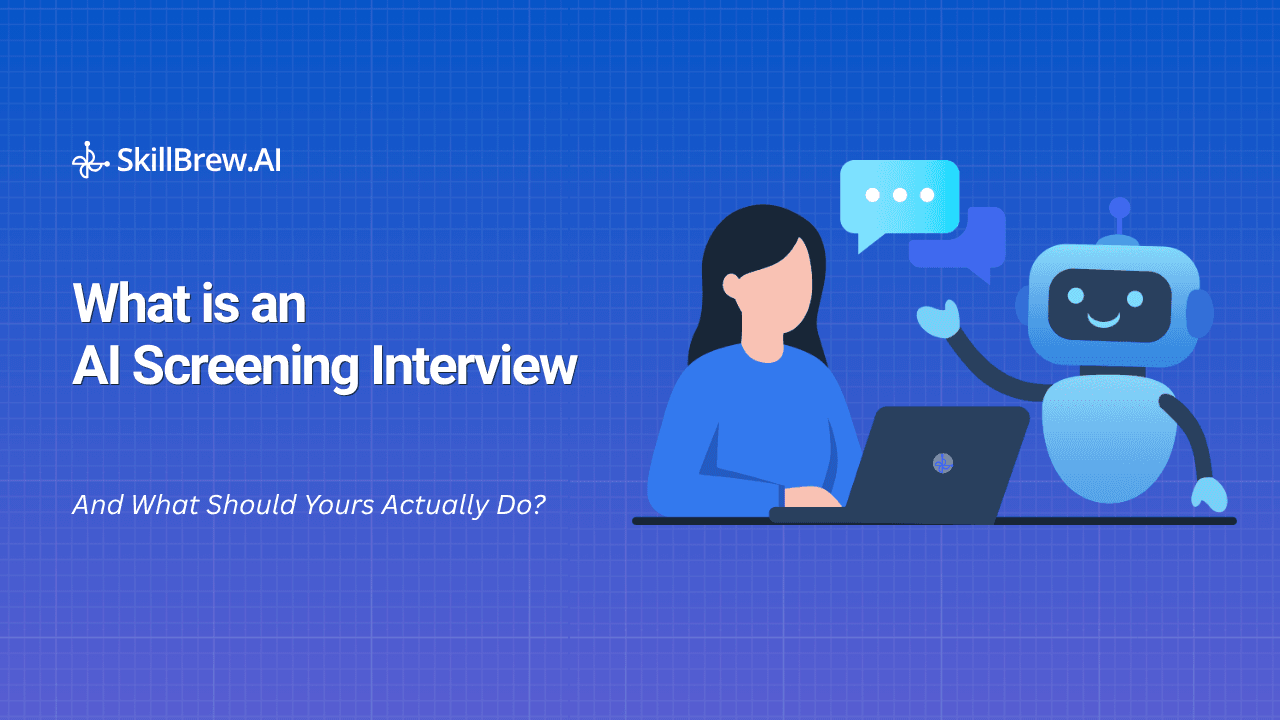
What is an AI Screening Interview And What Should Yours Actually Do?
Recruiters aren't running out of candidates. They're running out of time to evaluate them. When a single job posting generates 300 to 500 applications, the math breaks fast. Your team can realistically conduct 15 to 20 first-round interviews a day. Everyone else waits and the best ones don't wait long. AI screening interviews exist to close that gap. But "AI interview" has become one of the most overused phrases in HR tech, attached to everything from basic chatbots to genuinely adaptive inter

Recruiters aren't running out of candidates. They're running out of time to evaluate them.
When a single job posting generates 300 to 500 applications, the math breaks fast. Your team can realistically conduct 15 to 20 first-round interviews a day. Everyone else waits and the best ones don't wait long.
AI screening interviews exist to close that gap. But "AI interview" has become one of the most overused phrases in HR tech, attached to everything from basic chatbots to genuinely adaptive interview platforms.
This guide breaks down what an AI screening interview actually is, what separates a capable tool from a glorified form, and what TA teams should demand before signing on.
Table of Contents
- What Is an AI Screening Interview?
- AI Screening Interview vs. AI Mock Interview: Not the Same Thing
- What a Real AI Interview Tool Should Do
- How SkillBrew's AI Interviews Work
- Comparing Manual vs. AI Screening Interview Workflows
- What to Evaluate Before Adopting an AI Interview Tool
- Frequently Asked Questions
What Is an AI Screening Interview?
An AI screening interview is an autonomous, structured conversation between an AI system and a job candidate, conducted without a recruiter in the room.
The AI asks questions, listens to responses, adapts the line of questioning based on what it hears, and produces a scored report. Recruiters receive that report and use it to decide which candidates advance.
This is not:
- A candidate filling out a form with typed answers
- A one-way video recording reviewed by a human later
- A chatbot that routes candidates to a scheduling link
The distinction matters because many platforms marketed as "AI interviews" are simply automating intake, not evaluating candidates. A true AI screening interview generates a hiring signal, not just a transcript.
AI Screening Interview vs. AI Mock Interview: Not the Same Thing
These two phrases often appear together in search results but refer to very different use cases.
An AI mock interview is a practice tool typically for job seekers who want to rehearse before the real thing. The AI plays the role of interviewer, gives feedback, and helps candidates improve their delivery.
An AI screening interview is a hiring tool used by recruiters to evaluate candidates at scale and produce a shortlist.
| Feature | AI Mock Interview | AI Screening Interview |
| Used by | Job seekers | Recruiters and TA teams |
| Purpose | Practice and preparation | Candidate evaluation and shortlisting |
| Output | Feedback for improvement | Scored report for hiring decisions |
| Stakes | Low (no hiring outcome) | High (filters the pipeline) |
| Typical context | Pre-application, career prep | Post-application, first-round screening |
If you're a recruiter evaluating tools, what you want is a screening interview platform, not a mock interview product packaged as a hiring solution.
What a Real AI Interview Tool Should Do
Not all AI interview tools are built for recruiting. The ones that are share a set of capabilities that differentiate them from intake forms and scheduling bots.
Adaptive Questioning
The AI should respond to what the candidate actually says, not follow a fixed list regardless of the answer. If a candidate gives a vague response, the tool should probe. If they claim five years of experience in a domain, it should ask them to demonstrate it.
Fixed-script tools produce consistent data. Adaptive tools produce useful data.
Resume-Aware Conversations
The strongest platforms parse the candidate's resume before the interview begins. This allows the AI to personalize questions asking about specific roles, gaps, or credentials listed on the CV rather than starting from scratch for every candidate.
Structured, Scored Output
Recruiters don't have time to read interview transcripts. The output should be a scored report - role fit, technical signal, communication clarity delivered in a format that enables fast decisions.
Raw transcripts shift the evaluation burden back to the recruiter. That defeats the purpose.
Integrity Controls
Any AI interview tool used for hiring should include proctoring. Without it, you have no way to verify that the person you're evaluating is the person who applied.
24/7 Availability
The tool should be able to run interviews any time a candidate is available not just during business hours. This is particularly important for roles with distributed or high-volume applicant pools.
How SkillBrew's AI Interviews Work
SkillBrew's AI Interviews module runs fully autonomous candidate conversations available 24/7, with no recruiter involvement required at the interview stage.
Three interview modes, matched to the use case:
| Mode | Best For | What It Evaluates |
| Standard | Volume screening - fresher intake, BPO, lateral hiring | Role fit, communication, confidence |
| Deep | Mid-to-senior roles where depth matters | Stated experience vs. demonstrated ability |
| Structured | Campus drives, RPO, multi-role programs | Fixed rubric scoring across all candidates |
What happens during a session:
The avatar reads the candidate's resume before the interview starts. It conducts a natural, conversational interview asking follow-up questions when answers are incomplete, probing gaps, and adjusting question depth based on the candidate's responses. There is no fixed script.
After the session, recruiters receive a structured report covering:
- Role fit score - how well the candidate's background aligns with the JD
- Technical signal - demonstrated competency in the skills the role requires
- Communication score - clarity, structure, and confidence in responses
BrewShield proctoring runs throughout every session, flagging integrity events, camera behaviour, tab-switching, audio anomalies, so recruiters know the result reflects the actual candidate.
All interview activity feeds into HireFlow, SkillBrew's free orchestration layer, which tracks candidates across stages without requiring a separate ATS for the screening workflow.
Comparing Manual vs. AI Screening Interview Workflows
| Hiring Activity | Manual First-Round Interviews | AI Screening Interviews |
| Interview setup | Recruiter schedules each slot individually | Candidate self-schedules or is auto-assigned |
| Daily capacity | 15-20 interviews per recruiter | Hundreds simultaneously |
| Availability | Business hours only | 24/7 |
| Evaluation consistency | Varies by recruiter | Standardized across all candidates |
| Report quality | Manual notes, subjective | Structured scoring dashboard |
| Time to shortlist | 3-10 business days | Hours to 1 business day |
| Recruiter involvement | Full session attendance | Report review only |
| Candidate drop-off | High (scheduling friction) | Significantly lower |
The shift isn't incremental. It's a different operating model.
Teams that replace manual first-rounds with AI screening interviews typically cut time-to-shortlist by 3x and reclaim 28+ recruiter hours per hire, hours that go back into closing, offer management, and candidate experience work that actually requires human judgment.
What to Evaluate Before Adopting an AI Interview Tool
The market is crowded and the terminology is inconsistent. Use these criteria to cut through the noise.
Adaptive vs. scripted: Ask the vendor to show you what happens when a candidate gives a short or evasive answer. If the AI just moves to the next question, it's scripted.
Resume integration: Does the system read the candidate's CV before the interview begins? If not, every candidate gets the same questions regardless of their background.
Output format: Request a sample report. If it's a transcript or a vague sentiment score, it's not a hiring tool, it's a recording tool.
Proctoring depth: Ask how many integrity signals the system monitors. Weak systems check camera presence. Strong ones like BrewShield track 13 signals including tab-switching, screen behaviour, keystrokes, and audio anomalies.
Language and localization: For Indian TA teams, the tool should handle regional accents and the languages your candidate pool actually speaks. A system optimized for North American English will produce inconsistent results for Tier 2 city candidates.
Pricing model: Subscription pricing is misaligned with variable hiring volume. Look for usage-based models that match what you actually need in a given month.
Frequently Asked Questions
What is an AI screening interview?
An AI screening interview is an autonomous, AI-conducted conversation with a job candidate that produces a scored report for the recruiter. It replaces the manual first-round interview by evaluating candidates at scale without requiring recruiter availability.
How is an AI screening interview different from an AI mock interview?
An AI mock interview is a practice tool for candidates preparing for real interviews. An AI screening interview is a hiring tool used by recruiters to evaluate and shortlist candidates. They serve opposite sides of the hiring process.
What does an AI interview report show?
A strong AI interview report includes a role fit score, a technical signal score, and a communication evaluation, plus any proctoring flags raised during the session. It should be structured for quick recruiter review, not raw transcript output.
Can AI screening interviews handle Indian regional accents?
Platforms built specifically for the Indian market like SkillBrew's AI Interviews are calibrated for Indian English and regional candidate profiles. Generic global platforms may underperform with Tier 2 city candidates or non-standard accent profiles.
Is proctoring included in AI screening interviews?
It depends on the platform. SkillBrew's AI Interviews include BrewShield proctoring as a built-in layer, not an add-on. It monitors 13 integrity signals throughout every session.
How many candidates can an AI screening interview platform handle simultaneously?
SkillBrew is built for high-volume hiring drives campus placements, lateral hiring spikes, and RPO operations and supports simultaneous sessions at scale without degradation in quality.
What's the ROI of switching to AI screening interviews?
Teams using SkillBrew's AI Interviews report a 70% reduction in screening time and recover 28+ recruiter hours per hire. Shortlist turnaround moves from days to hours, and candidate drop-off from scheduling friction drops significantly.
See how AI screening interviews perform on your actual JD. Book a live demo
See AI-powered hiring in action
Discover how SkillBrew helps hiring teams cut time-to-hire by 60% with skill-validated assessments and AI-ranked shortlists.
Book a free demoNo commitment required · 30 minutes
Continue reading
View All Posts