BrewVoice
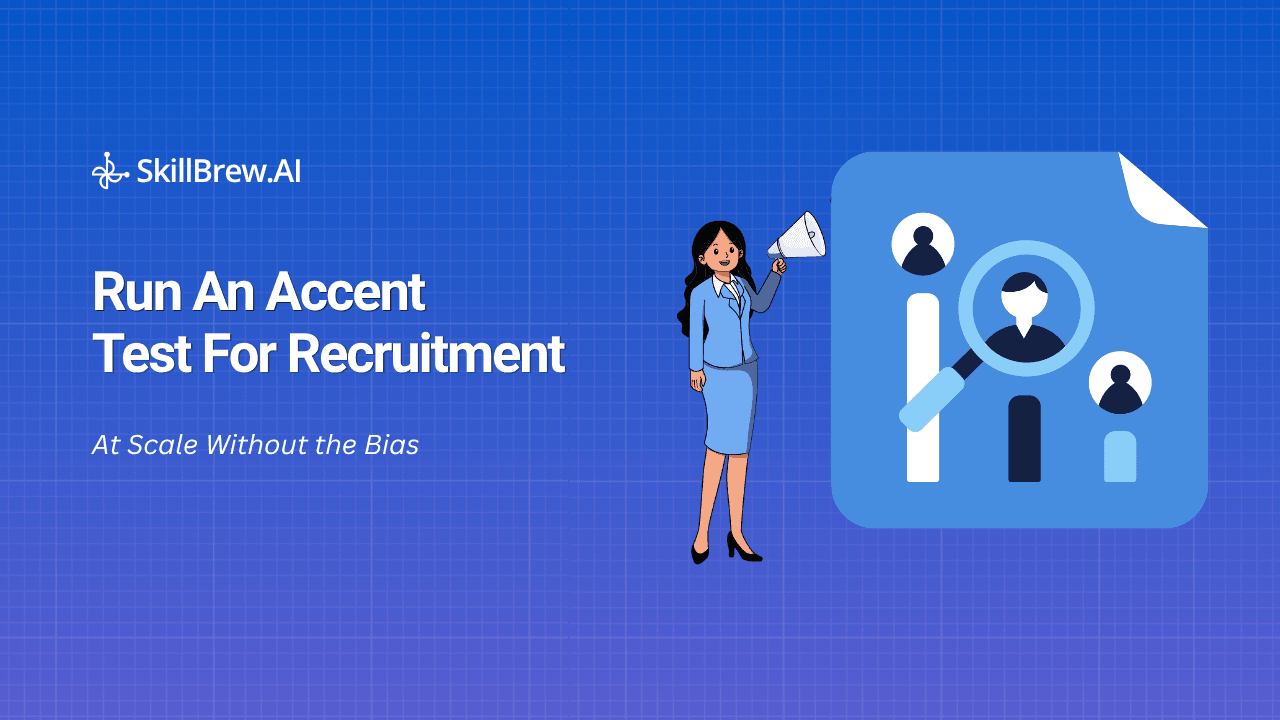
How to Run an Accent Test for Recruitment at Scale (Without the Bias)
When hiring for voice processes, customer support roles, campus recruitment programs, or high-volume sales teams, communication skills often become one of the very first screening criteria. In practice, most organizations already run an accent test for recruitment even if they don't formally call it one. The problem is that most of these evaluations happen informally. A recruiter spends thirty seconds on a phone call and decides whether a candidate "sounds good enough" to move forward. At scale

When hiring for voice processes, customer support roles, campus recruitment programs, or high-volume sales teams, communication skills often become one of the very first screening criteria. In practice, most organizations already run an accent test for recruitment even if they don't formally call it one.
The problem is that most of these evaluations happen informally. A recruiter spends thirty seconds on a phone call and decides whether a candidate "sounds good enough" to move forward. At scale, this creates inconsistency, introduces bias, and often eliminates qualified candidates for reasons that have nothing to do with job performance.
A properly built accent test for recruitment shouldn't measure whether someone sounds a particular way. It should evaluate whether candidates can communicate clearly, understand questions, and perform effectively in the role they're applying for.
This guide walks through how to build a fair, scalable, and standardized accent testing process for modern recruitment.
Table of Contents
- What Is an Accent Test for Recruitment?
- Why Traditional Accent Screening Fails at Scale
- Step 1: Define What You're Actually Scoring
- Step 2: Standardize the Screening Process
- Step 3: Automate the First Round
- Step 4: Review the Shortlist, Not the Slush Pile
- Manual Screening vs. AI Voice Assessment
- Best Practices for Fair Accent Testing
- Frequently Asked Questions
- Scale Your Next Hiring Drive with BrewVoice
What Is an Accent Test for Recruitment?
An accent test for recruitment is a structured communication assessment used to evaluate a candidate's ability to communicate effectively in spoken conversations.
Contrary to common misconceptions, the goal of a well-designed accent test for recruitment is not to judge regional accents or language backgrounds. A fair assessment focuses on communication outcomes: clarity, comprehension, fluency, and conversational effectiveness.
Organizations commonly run an accent test for recruitment when hiring for:
- Customer support roles
- BPO and contact center positions
- Voice process recruitment
- Sales and business development roles
- Campus hiring programs
- High-volume hiring campaigns
The purpose is to determine whether a candidate can successfully communicate in real workplace scenarios, not whether they sound "neutral" or similar to the interviewer.
Why Traditional Accent Screening Fails at Scale
Many recruitment teams rely on recruiter-led screening calls to evaluate communication skills. That might work for a small number of candidates, but it becomes increasingly unreliable as hiring volume grows, which is exactly where an ad-hoc accent test for recruitment starts to break down.
Subjective Judgments Recruiters often make communication assessments based on instinct rather than a defined scoring framework.
Inconsistent Standards One recruiter may score a candidate highly, while another evaluates the same conversation completely differently.
Accent Familiarity Bias Candidates with unfamiliar regional accents may get disadvantaged despite communicating effectively.
Recruiter Fatigue During large campus drives or volume recruitment campaigns, recruiters can conduct dozens of calls a day, making consistency almost impossible to maintain.
As applicant volumes increase, these challenges create a screening process that becomes harder to defend, audit, or improve.
Step 1: Define What You're Actually Scoring
Before conducting any screening calls, organizations should establish a clear evaluation rubric. This is the single most important step in building a fair accent test for recruitment.
A structured communication assessment typically measures:
Intelligibility - Can customers, colleagues, or stakeholders understand the candidate without excessive effort?
Comprehension - Does the candidate understand questions correctly and provide relevant responses?
Conversational Flow - Can they maintain a natural conversation with appropriate pacing and minimal hesitation?
Role-Specific Communication Requirements
Different roles require different communication standards. For example:
- A US voice process may require stronger English proficiency.
- A regional sales role may require fluency in a local language.
- Customer support positions may emphasize clarity and active listening.
What Should Not Be Scored
A fair accent test for recruitment should never penalize candidates for:
- Regional accents
- Native-language influences
- Geographic background
- Speaking styles unrelated to job performance
The goal is communication effectiveness, not accent conformity.
Step 2: Standardize the Screening Process
Even the best rubric becomes ineffective if different candidates experience different interviews. To build a reliable accent test for recruitment:
Ask the Same Core Questions - Every candidate should receive the same foundational interview questions.
Use Structured Scoring - Replace subjective feedback like "good communication" with measurable rating scales. For example:
| Score | Communication Quality |
| 1 | Significant communication challenges |
| 2 | Limited clarity and comprehension |
| 3 | Adequate communication ability |
| 4 | Strong communication skills |
| 5 | Excellent communication effectiveness |
Record and Review Calls - Call recordings provide transparency and let teams review decisions when necessary.
Calibrate Interviewers - Before large hiring campaigns, recruiters should evaluate sample interviews together to make sure scoring stays consistent.
When the same standards apply to candidate #5 and candidate #1,500, the process becomes significantly more reliable.
Step 3: Automate the First Round
This is where many recruitment teams hit a practical limit. A hiring team cannot consistently screen thousands of candidates in a short timeframe while maintaining identical evaluation standards, no matter how good the rubric is. Automation is what actually solves this.
Why Automation Matters for an Accent Test at Scale
AI-powered voice screening ensures that:
- Every candidate receives the same interview experience.
- Every response is evaluated using the same framework.
- Screening can happen 24/7 without scheduling challenges.
- Recruiter workload is significantly reduced.
How BrewVoice Supports First-Round Screening
BrewVoice, SkillBrew.AI's AI voice recruiter, automates first-round voice assessments directly from the hiring dashboard. It can:
- Automatically call inbound applicants
- Conduct structured voice interviews
- Evaluate communication quality consistently
- Understand diverse Indian accents
- Generate standardized candidate summaries
- Return ranked results for recruiter review
This lets organizations scale a fair accent test for recruitment without sacrificing consistency.
Step 4: Review the Shortlist, Not the Slush Pile
The purpose of automating an accent test for recruitment is not to replace recruiters, it's to remove repetitive screening tasks so recruiters can focus on higher-value work.
Rather than making hundreds of preliminary communication judgments, recruiters receive a structured shortlist backed by evaluation data. This creates several advantages:
- Faster hiring cycles
- Improved recruiter productivity
- Reduced bias in first-round screening
- Better candidate experience
- More consistent hiring decisions
Human judgment stays exactly where it matters most: final interviews, candidate evaluation, and hiring decisions.
Manual Screening vs. AI Voice Assessment
The benefits of a structured, AI-powered accent test for recruitment become especially clear during large-scale hiring.
| Factor | Manual Screening | AI Voice Assessment |
| Consistency | Depends on recruiter | Standardized |
| Screening Capacity | Limited | High-volume |
| Bias Risk | Higher | Reduced |
| Candidate Experience | Varies | Consistent |
| Reporting | Subjective notes | Structured insights |
| Speed | Slower | Automated |
| Auditability | Limited | Transparent |
For organizations hiring at scale, AI-driven voice assessment creates a more repeatable and measurable screening process than any manually run accent test for recruitment ever could.
Best Practices for Fair Accent Testing
To keep communication assessments inclusive and effective, follow these guidelines whenever you're running an accent test for recruitment:
Evaluate Communication, Not Accent - Focus on whether candidates can perform the communication requirements of the role.
Use Structured Rubrics - Clearly define evaluation criteria before interviews begin.
Match Assessments to Job Requirements - Different roles require different communication abilities.
Ensure Consistency Across Candidates - Every applicant should experience the same screening process.
Combine AI with Human Review - Use automation for consistency while keeping final hiring decisions with recruiters.
Frequently Asked Questions
How do you run a fair accent test in high-volume hiring?
Use a standardized rubric that evaluates clarity, comprehension, conversational flow, and role-specific communication requirements. Every candidate should get the same questions and the same evaluation criteria.
Can AI handle thousands of first-round screening calls?
Yes. AI voice screening systems can run thousands of structured interviews while maintaining the same evaluation standards across every candidate, something a manual accent test for recruitment simply can't do at that volume.
Does accent testing discriminate against regional candidates?
It can, if the assessment focuses on accent preferences rather than communication ability. A properly designed accent test for recruitment evaluates communication effectiveness and understands diverse regional accents without penalizing them.
What should an accent test measure?
A candidate's ability to communicate clearly, understand questions, respond appropriately, and engage in effective conversations relevant to the role.
Does AI voice screening replace recruiters?
No. AI automates the repetitive screening tasks so recruiters can focus on interviewing, evaluating, and engaging shortlisted candidates.
Scale Your Next Hiring Drive with BrewVoice
Manual accent testing gets harder to run fairly as hiring volume grows. The shortcuts teams take to keep up with demand are often the exact shortcuts that introduce bias and inconsistency into the process.
BrewVoice helps organizations run a structured, accent-aware, and scalable accent test for recruitment without adding to recruiter workload. By combining automated voice interviews, consistent evaluation frameworks, and support for diverse Indian accents, BrewVoice helps hiring teams identify qualified candidates faster while running a more equitable screening experience.
Book a BrewVoice walkthrough → and see how AI-powered voice screening can transform your next campus hiring drive, volume recruitment campaign, or customer-facing hiring process.
See AI-powered hiring in action
Discover how SkillBrew helps hiring teams cut time-to-hire by 60% with skill-validated assessments and AI-ranked shortlists.
Book a free demoNo commitment required · 30 minutes
Continue reading
View All Posts