Campus Placement Drive
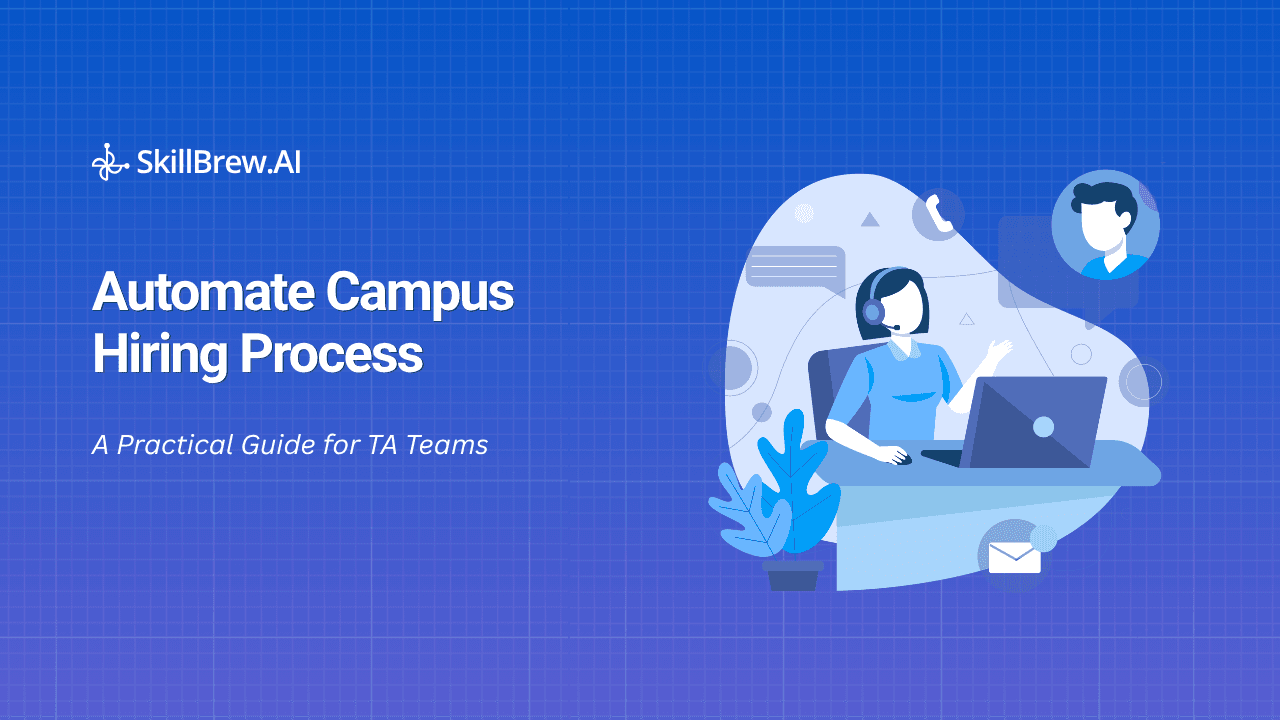
Automate Campus Hiring Process: A Practical Guide for TA Teams
Campus hiring has always been a volume game. A single recruitment drive can generate thousands of applications, hundreds of assessments, and dozens of interviews within a few weeks. Yet many Talent Acquisition (TA) teams are still running that volume through manual processes built for a fraction of the load. The result is predictable: recruiter burnout, inconsistent candidate evaluation, delayed hiring decisions, and a poor candidate experience. Campus hiring automation isn't about replacing r
Campus hiring has always been a volume game. A single recruitment drive can generate thousands of applications, hundreds of assessments, and dozens of interviews within a few weeks. Yet many Talent Acquisition (TA) teams are still running that volume through manual processes built for a fraction of the load.
The result is predictable: recruiter burnout, inconsistent candidate evaluation, delayed hiring decisions, and a poor candidate experience.
Campus hiring automation isn't about replacing recruiters. It's about removing the repetitive administrative work so recruiters can focus on candidate engagement, evaluation, and hiring decisions, the parts of the job that actually need a human.
This guide breaks down where this automation delivers the biggest impact, which hiring stages should stay human-led, how to calculate ROI, and how TA leaders can roll out automation in phases without disrupting existing workflows.
Table of Contents
- What Is Campus Hiring Automation?
- Why Campus Recruitment Teams Need Automation
- Stage 1: Automating Resume Screening
- Stage 2: Automating Assessments at Scale
- Stage 3: Using Async Interviews for Candidate Screening
- Stage 4: Recruitment Workflow Automation
- Stage 5: Candidate Management and Pipeline Visibility
- Campus Hiring Automation Optimization Framework
- Campus Hiring Automation ROI: Costs vs. Benefits
- How to Start Small and Scale Successfully
- Frequently Asked Questions
- Transform Campus Hiring with SkillBrew.AI
What Is Campus Hiring Automation?
Campus hiring automation refers to using technology to eliminate repetitive, manual tasks throughout the recruitment lifecycle. The goal isn't to automate every decision, it's to automate the activities that don't require human judgment, while keeping recruiters exactly where they add the most value.
What Campus Hiring Automation Does Well
Campus hiring automation is highly effective for:
- Resume screening and ranking
- Online assessments
- Interview scheduling
- Candidate communications
- Pipeline management
- Status updates and notifications
- Reporting and analytics
What Should Remain Human
Campus hiring automation should support recruiters, not replace them, in areas such as:
- Final interviews
- Hiring decisions
- Candidate relationship building
- Offer discussions
- Campus engagement activities
The most successful hiring teams automate the operational work while preserving human involvement in every decision that actually matters.
Why Campus Recruitment Teams Need Automation
As hiring volumes increase, manual recruitment processes become nearly impossible to scale.
Consider a campus drive receiving 4,000 applications for 500 openings. Without campus hiring automation, recruiters must:
- Review thousands of resumes
- Coordinate assessments
- Schedule interviews
- Track candidate progress
- Send reminders and updates
- Generate reports for stakeholders
These activities consume hundreds of hours while creating plenty of room for delays and inconsistencies.
Common Challenges in Manual Campus Hiring
- Slow resume screening
- Delayed candidate communication
- Interview scheduling bottlenecks
- Limited recruiter bandwidth
- Poor hiring visibility
- Inconsistent candidate evaluation
It removes these bottlenecks while maintaining process quality and candidate experience, which is exactly why it's become the default strategy for high-volume TA teams.
Stage 1: Automating Resume Screening
Resume screening is often the easiest and highest-impact place to start campus hiring automation.
Why Resume Screening Should Be Automated
A recruiter reviewing 2,000 applications manually can spend hundreds of hours identifying qualified candidates. Automation lets organizations:
- Score resumes against job requirements
- Rank candidates consistently
- Surface top applicants automatically
- Reduce recruiter workload significantly
Manual vs. Automated Resume Screening
| Factor | Manual Screening | Automated Screening |
| Time Required | Very High | Low |
| Consistency | Varies (Subjective) | Standardized |
| Scalability | Limited | High |
| Recruiter Effort | Significant | Minimal |
| Ranking Accuracy | Subjective | Criteria-based |
How HireFlow Supports Resume Screening
HireFlow automatically evaluates incoming applications against job requirements and generates ranked candidate shortlists, letting recruiters start with qualified candidates instead of wading through raw resume volume. It's the foundation layer of any serious automation rollout, and it's always free with SkillBrew.AI.
Stage 2: Automating Assessments at Scale
Once candidates are shortlisted, assessments become the next major operational challenge in campus hiring automation.
Why Assessment Automation Matters
Large campus drives often require hundreds or thousands of candidates to complete assessments within a tight window. Manual test creation, distribution, and scoring become impossible to manage at that scale.
What an Online Assessment Platform Should Provide
A strong campus hiring assessment platform should:
- Generate assessments automatically
- Support coding, aptitude, and psychometric testing
- Deliver assessments in bulk
- Score responses automatically
- Provide ranked candidate results
Benefits of Automated Assessments
- Faster evaluation cycles
- Consistent candidate scoring
- Reduced administrative effort
- Improved hiring visibility
How SkillBrew.AI's Technical Assessments Help
SkillBrew.AI's Technical Assessments generate role-specific tests directly from job descriptions and produce ranked candidate scorecards without requiring manual question creation, a core piece of any automation strategy operating at real volume.
Stage 3: Using Async Interviews for Candidate Screening
Interview scheduling is one of the biggest bottlenecks in campus recruitment. A shortlist of 60 candidates alone can create dozens of scheduling conflicts, rescheduling requests, and interviewer coordination headaches.
What Is an Async Interview Platform?
An asynchronous interview platform lets candidates complete interviews independently, without a live interviewer on the other end. Candidates participate on their own time, while recruiters review structured reports afterward.
Benefits of Async Interviews
- Eliminate scheduling bottlenecks
- Reduce interviewer workload
- Increase candidate flexibility
- Create consistent interview experiences
- Generate structured evaluation reports
How SkillBrew.AI's AI Interviews Work
SkillBrew.AI's AI Interviews create adaptive interview experiences tailored to each candidate's profile and role requirements, generating detailed evaluation reports for hiring teams, the interview layer of a complete automation stack.
Stage 4: Recruitment Workflow Automation
Many hiring teams focus heavily on screening and interviews but overlook workflow automation entirely. This is often exactly where candidate experience problems start.
Why Workflow Automation Matters
Between every hiring stage, candidates need communication, updates, and next-step instructions. Manual handoffs create delays and raise the risk of candidate drop-off.
What Recruitment Workflow Automation Can Do
- Send application confirmations automatically
- Trigger assessment invitations
- Deliver interview instructions
- Update candidate statuses
- Notify stakeholders
- Initiate offer workflows
By removing administrative delays, campus hiring automation creates a faster, more predictable experience for every candidate in the pipeline.
Stage 5: Candidate Management and Pipeline Visibility
As hiring volume grows, managing candidate data becomes increasingly difficult without a central system.
A candidate management system centralizes all recruitment information into a single platform, the backbone that makes every other piece of the automation actually usable at scale.
What a Candidate Management System Should Track
- Applications
- Assessment results
- Interview reports
- Hiring stage progression
- Offer status
- Candidate communications
Key Metrics for TA Leaders
A modern campus hiring platform should give visibility into:
- Conversion rates by campus
- Assessment completion rates
- Offer acceptance rates
- Offer-to-joining rates
- Source effectiveness
- Hiring cycle duration
These insights help TA leaders continuously sharpen future hiring campaigns.
Campus Hiring Automation Optimization Framework
Before rolling out automation, organizations should map which stages require human judgment and which don't.
Recommended Campus Hiring Automation Framework
| Hiring Stage | Automation Level |
| Resume Screening | Fully Automated |
| Assessments | Fully Automated |
| First-Round Interviews | Automated |
| Offer Documentation | Automated |
| Panel Interviews | Human-Led |
| Final Selection | Human-Led |
| Offer Discussions | Human-Led |
The goal isn't maximum automation. It's maximum efficiency without compromising decision quality.
Campus Hiring Automation ROI: Costs vs. Benefits
One of the most common questions from CHROs and hiring leaders is whether campus hiring automation delivers measurable returns.
The answer is yes, but not necessarily through headcount reduction.
Where the ROI Comes From
Campus hiring automation typically improves:
- Hiring speed
- Recruiter productivity
- Candidate experience
- Offer acceptance rates
- Offer-to-joining rates
Typical Metrics to Track
| Key Performance Indicator (KPI) | Target Improvement | Impact |
| Hiring Cycle Time | 20–30% Faster | Improved Time-to-Hire, reduced drop-off |
| Recruiter Hours | 30–40% Reduction | Increased productivity, higher focus on strategy |
| Offer Acceptance Rate | 5–10% Increase | Enhanced talent attraction and brand perception |
| Offer-to-Joining Rate | 10–15% Increase | Higher retention and organizational commitment |
The biggest value from automation often comes from letting recruiters manage higher hiring volumes without sacrificing candidate quality.
How to Start Small and Scale Successfully
One of the biggest mistakes organizations make is trying to automate every hiring process simultaneously. A phased approach to campus hiring automation is significantly more effective.
Recommended Implementation Strategy
Phase 1: Resume Screening - Begin with automated shortlisting to reduce recruiter workload immediately.
Phase 2: Assessments - Introduce role-specific assessments and automated scoring.
Phase 3: Interview Automation - Implement asynchronous interviews for first-round screening.
Phase 4: Workflow Automation - Automate communications and candidate movement across hiring stages.
Phase 5: Reporting and Optimization - Use hiring analytics to continuously improve recruitment outcomes.
By rolling this out incrementally, teams can measure results, build stakeholder confidence, and scale what's actually working.
Frequently Asked Questions
What is campus hiring automation?
Campus hiring automation uses technology to automate repetitive recruitment tasks such as resume screening, assessments, scheduling, communications, and reporting.
Which stage should organizations automate first?
Resume screening is typically the easiest and highest-impact starting point for campus hiring automation because it reduces recruiter workload immediately.
Can automation replace recruiters?
No. Campus hiring automation handles repetitive operational work while recruiters focus on evaluation, interviews, relationship building, and hiring decisions.
How much can recruitment automation improve hiring speed?
Organizations commonly reduce campus hiring cycle times by 20-30% after implementing automation across key recruitment stages.
How do I measure campus hiring automation ROI?
Track hiring cycle time, recruiter hours saved, offer acceptance rates, offer-to-joining rates, and candidate conversion rates.
Transform Campus Hiring with SkillBrew.AI
The most successful campus recruitment teams aren't necessarily the ones with the largest headcount. They're the ones that remove unnecessary manual work and let recruiters focus on what actually drives hiring outcomes.
SkillBrew.AI helps organizations run campus hiring automation across every major stage:
- HireFlow for resume screening and pipeline management
- Technical Assessments for role-specific testing at scale
- AI Interviews for structured, asynchronous candidate screening
Together, these tools help teams cut hiring cycle times, improve candidate experience, and boost recruitment efficiency without sacrificing decision quality.
If your campus hiring process is slowing down because of manual work, start by automating the stage creating the most friction and build from there.
Book a demo → and see what a full campus hiring automation stack looks like on your next drive.
See AI-powered hiring in action
Discover how SkillBrew helps hiring teams cut time-to-hire by 60% with skill-validated assessments and AI-ranked shortlists.
Book a free demoNo commitment required · 30 minutes
Continue reading
View All Posts