Campus Placement Drive
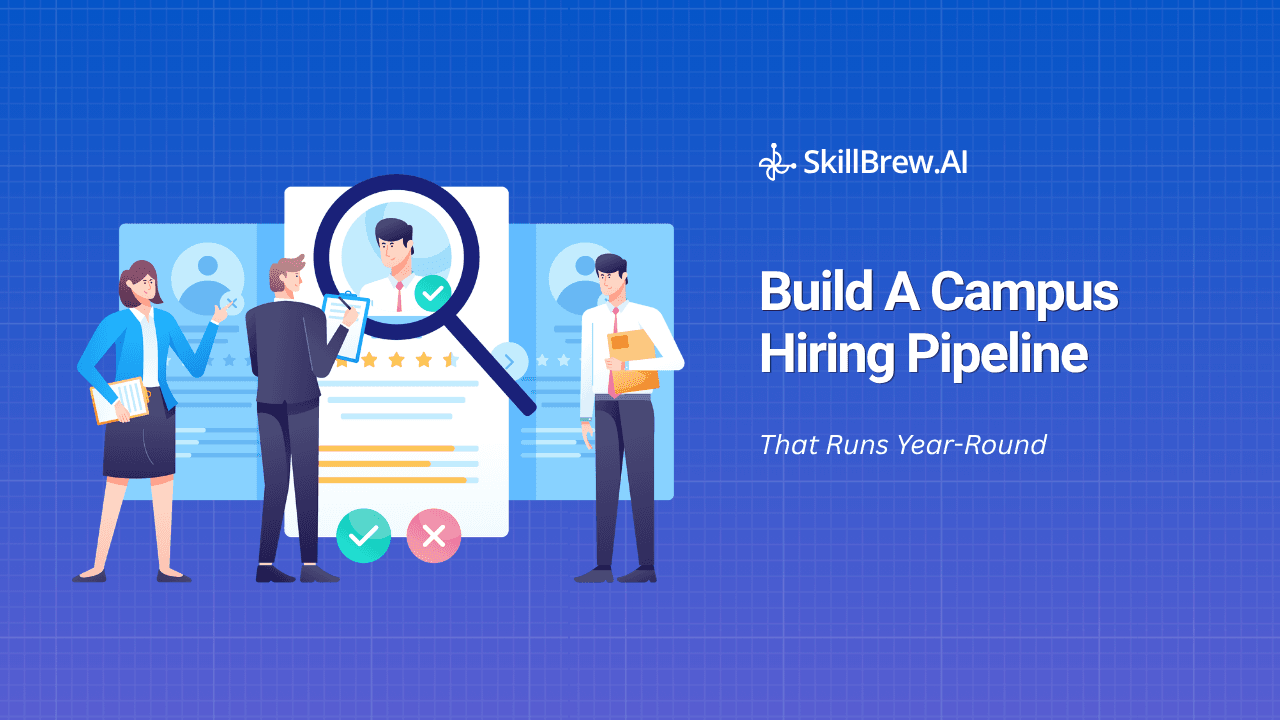
How to Build a Campus Hiring Pipeline That Runs Year-Round
Most organizations don't have a campus hiring pipeline. They have a campus hiring event. For a few weeks every placement season, recruitment teams scramble to visit campuses, run assessments, conduct interviews, and roll out offers. Then everything goes quiet until the next hiring cycle begins. The result is predictable: * Rushed hiring decisions * Inconsistent candidate quality * High offer drop-off rates * Poor campus relationships * Repeated planning effort every year The most succes
Most organizations don't have a campus hiring pipeline. They have a campus hiring event.
For a few weeks every placement season, recruitment teams scramble to visit campuses, run assessments, conduct interviews, and roll out offers. Then everything goes quiet until the next hiring cycle begins.
The result is predictable:
- Rushed hiring decisions
- Inconsistent candidate quality
- High offer drop-off rates
- Poor campus relationships
- Repeated planning effort every year
The most successful organizations approach campus recruitment differently. Instead of treating hiring as a seasonal activity, they build a year-round campus hiring pipeline that continuously strengthens relationships, improves hiring quality, and creates a predictable talent flow.
This guide explains how to build a campus recruitment strategy that operates throughout the year, helping Talent Acquisition (TA) teams improve hiring outcomes while reducing last-minute hiring pressure.
Table of Contents
- Why Year-Round Campus Recruitment Outperforms Seasonal Hiring
- What a Campus Hiring Pipeline Looks Like Across 12 Months
- Building a Campus Recruitment Strategy
- Standardizing the College Hiring Process
- Creating a Campus Engagement Program
- Campus Placement Preparation Before Hiring Season
- Scaling a Bulk Hiring Strategy Without Losing Quality
- Campus Hiring Metrics That Matter
- Frequently Asked Questions
- Build a Stronger Campus Hiring Pipeline with SkillBrew.AI
Why Year-Round Campus Recruitment Outperforms Seasonal Hiring
Many organizations treat campus hiring as a short-term project.
The hiring team becomes active only when placement season begins, attempting to accomplish months of preparation within a few weeks.
Challenges of the Seasonal Hiring Model
When everything happens simultaneously:
- Campus relationships remain underdeveloped
- Assessments are rushed
- Interview processes become inconsistent
- Recruiters experience higher workloads
- Candidate engagement suffers
- Offer acceptance rates decline
The problem is not effort. The problem is timing.
The Advantage of a Year-Round Approach
A year-round campus recruitment model allows organizations to:
- Build stronger placement office relationships
- Improve employer branding
- Refine assessment strategies
- Analyze hiring outcomes
- Strengthen pre-joining engagement
- Improve offer-to-joining conversion rates
The goal is not to increase workload throughout the year. It is to distribute the workload more effectively so hiring season becomes execution rather than improvisation.
What a Campus Hiring Pipeline Looks Like Across 12 Months
A successful fresher hiring pipeline operates continuously, with each phase supporting the next.
January - March: Post-Hiring Analysis
Review the previous hiring cycle.
Key questions include:
- Which campuses produced the strongest hires?
- Which assessments predicted performance most accurately?
- Where did candidates drop out of the funnel?
- Which campuses delivered the highest retention rates?
The outcome should be a prioritized campus target list for the next hiring cycle.
April - June: Campus Relationship Building
This phase focuses on visibility rather than hiring.
Activities may include:
- Guest lectures
- Industry sessions
- Career workshops
- Placement office meetings
- Employer branding initiatives
Organizations that remain active during this period enter placement season with stronger awareness and credibility.
July - August: Hiring Preparation
Before hiring begins, teams should finalize:
- Job descriptions
- Assessment frameworks
- Interview scorecards
- Hiring panel availability
- Pre-placement presentation materials
The objective is simple: eliminate last-minute decision-making during active hiring.
September - November: Campus Hiring Execution
This is when recruitment activities occur at scale.
Typical activities include:
- Application collection
- Resume screening
- Online assessments
- Interview processes
- Offer management
Organizations with strong preparation spend this period executing established processes rather than building them.
December - March: Pre-Joining Engagement
This phase is often overlooked.
Accepted candidates may not join for several months after receiving offers.
Without engagement, offer drop-offs increase significantly.
Effective engagement includes:
- Learning resources
- Community groups
- Manager introductions
- Company updates
- Virtual onboarding experiences
Strong engagement improves joining rates and reduces hiring uncertainty.
Building a Campus Recruitment Strategy
Not all colleges deliver the same hiring outcomes.
Many organizations focus heavily on brand rankings while overlooking more meaningful performance indicators.
How to Select the Right Campuses
Campus selection should be based on historical hiring performance rather than reputation alone.
Evaluate:
- 90-day retention rates
- One-year attrition rates
- Promotion velocity
- Manager feedback
- Offer acceptance rates
- Offer-to-joining conversion rates
Additional Campus Selection Criteria
Consider:
- Program-to-role alignment
- Geographic hiring goals
- Placement office effectiveness
- Candidate quality trends
- Long-term hiring potential
The most valuable campus is not always the highest-ranked campus. It is the one that consistently produces successful employees.
Standardizing the College Hiring Process
One common challenge in campus recruitment is inconsistency.
Different campuses often experience different hiring processes, creating uneven evaluation standards.
Why Standardization Matters
Without standardization:
- Assessment difficulty varies
- Interview expectations differ
- Hiring quality becomes inconsistent
- Decision-making becomes subjective
What Should Be Standardized?
Every campus should follow the same framework:
| Hiring Component | Standardization Requirement |
| Job Description | Same role requirements |
| Assessment | Same evaluation criteria |
| Interview Scorecard | Same scoring methodology |
| Offer Process | Same approval workflow |
| Hiring Metrics | Same reporting structure |
Consistency ensures that every candidate is evaluated against the same hiring standards.
How SkillBrew Supports Standardized Hiring
SkillBrew's AI Assessments automatically generate JD-linked evaluations that can be deployed across campuses while maintaining identical scoring standards and candidate ranking systems.
Creating a Campus Engagement Program
Students often begin evaluating employers months before placement season starts.
Organizations that remain visible throughout the year typically achieve stronger application quality and higher offer acceptance rates.
Components of an Effective Campus Engagement Program
Industry Sessions and Guest Lectures
Share expertise and build brand awareness.
Campus Events and Competitions
Participate in hackathons, business competitions, and student events.
Graduate Success Stories
Showcase recent hires and career growth journeys.
Dedicated Campus Hiring Resources
Create fresher-focused career content that helps students understand roles and growth opportunities.
Consistent engagement builds familiarity, and familiarity increases application intent.
Campus Placement Preparation Before Hiring Season
Preparation is one of the strongest predictors of campus hiring success.
The most efficient hiring teams make major decisions before recruitment season begins.
Essential Preparation Checklist
Job Description Approval
All role requirements should be finalized and approved before hiring starts.
Assessment Design
Question formats, evaluation criteria, and passing thresholds should be tested in advance.
Interview Panel Alignment
Interviewers should understand role expectations and scoring methodologies.
Offer Management Preparation
Offer structures, approval processes, and templates should be ready for immediate deployment.
Pre-Joining Communication Planning
Candidate engagement plans should be designed before offers are issued.
Teams that prepare thoroughly during the off-season experience significantly fewer operational issues during hiring season.
Scaling a Bulk Hiring Strategy Without Losing Quality
Bulk campus hiring introduces a common challenge: increasing hiring speed without lowering candidate quality.
The solution is selective automation.
What Should Be Automated?
Organizations should automate:
- Resume screening
- Candidate ranking
- Assessment administration
- First-round screening
- Workflow management
What Should Remain Human?
Organizations should retain human involvement for:
- Final interviews
- Hiring decisions
- Offer discussions
- Candidate relationship management
Recommended Bulk Hiring Framework
| Recruitment Activity | Automation Level |
| Resume Screening | Automated |
| Assessments | Automated |
| First-Round Interviews | Automated |
| Final Interviews | Human-Led |
| Hiring Decisions | Human-Led |
| Candidate Engagement | Hybrid |
This approach enables organizations to scale hiring without sacrificing evaluation quality.
Campus Hiring Metrics That Matter
A campus hiring pipeline should be measured continuously.
Without data, improvement becomes difficult.
Offer Acceptance Rate
Measures how many candidates accept offers.
Offer-to-Joining Conversion Rate
Tracks how many accepted offers become actual hires.
90-Day Retention Rate
Provides an early indicator of hiring quality.
Time-to-Offer
Measures hiring efficiency.
Assessment-to-Performance Correlation
Determines whether hiring assessments accurately predict employee success.
Recommended Campus Hiring Dashboard
| Metric | Why It Matters |
| Offer Acceptance Rate | Measures employer attractiveness |
| Offer-to-Joining Rate | Measures engagement effectiveness |
| 90-Day Retention | Measures hiring quality |
| Time-to-Offer | Measures hiring efficiency |
| Performance Correlation | Measures assessment effectiveness |
Tracking these metrics by campus helps teams continuously refine recruitment strategy.
Frequently Asked Questions
What is a campus hiring pipeline?
A campus hiring pipeline is a structured, year-round approach to campus recruitment that includes relationship building, employer branding, hiring execution, and pre-joining engagement.
Why is year-round campus recruitment important?
Year-round recruitment improves campus relationships, hiring quality, offer acceptance rates, and overall recruitment efficiency.
How can organizations reduce offer drop-offs in campus hiring?
Consistent pre-joining engagement through learning programs, community building, and regular communication significantly improves joining rates.
What metrics should TA leaders track?
Key metrics include offer acceptance rate, offer-to-joining conversion, retention rate, time-to-offer, and assessment effectiveness.
How can automation improve campus hiring?
Automation reduces manual effort in screening, assessments, interview scheduling, and workflow management, allowing recruiters to focus on candidate engagement and hiring decisions.
Build a Stronger Campus Hiring Pipeline with SkillBrew.AI
The best campus hiring outcomes are rarely achieved during placement season alone.
They are built through continuous engagement, structured planning, standardized evaluation, and data-driven decision-making throughout the year.
SkillBrew.AI helps organizations strengthen every stage of the campus hiring pipeline:
- HireFlow for application intake and resume shortlisting
- AI Assessments for consistent candidate evaluation at scale
- AI Interviews for structured asynchronous screening
- Automated workflows for candidate engagement and pipeline management
If your campus hiring process feels reactive every year, the solution is not working harder during placement season. It is building a system that works long before the first application arrives.
See AI-powered hiring in action
Discover how SkillBrew helps hiring teams cut time-to-hire by 60% with skill-validated assessments and AI-ranked shortlists.
Book a free demoNo commitment required · 30 minutes
Continue reading
View All Posts