Campus Placement Drive
Bulk Hiring Process: Screen 500+ Applicants Without Bottlenecks
When 500 applications land in your ATS over a weekend, your bulk hiring process either holds up or falls apart and most fall apart. Recruiters spend the next two weeks in spreadsheets, and half the good candidates ghost before anyone calls them. This post gives you a working framework to screen high-volume pipelines without adding headcount or blowing your time-to-offer. You'll walk away with a clear stage structure, the three filters that actually predict quality at scale, and the numbers you
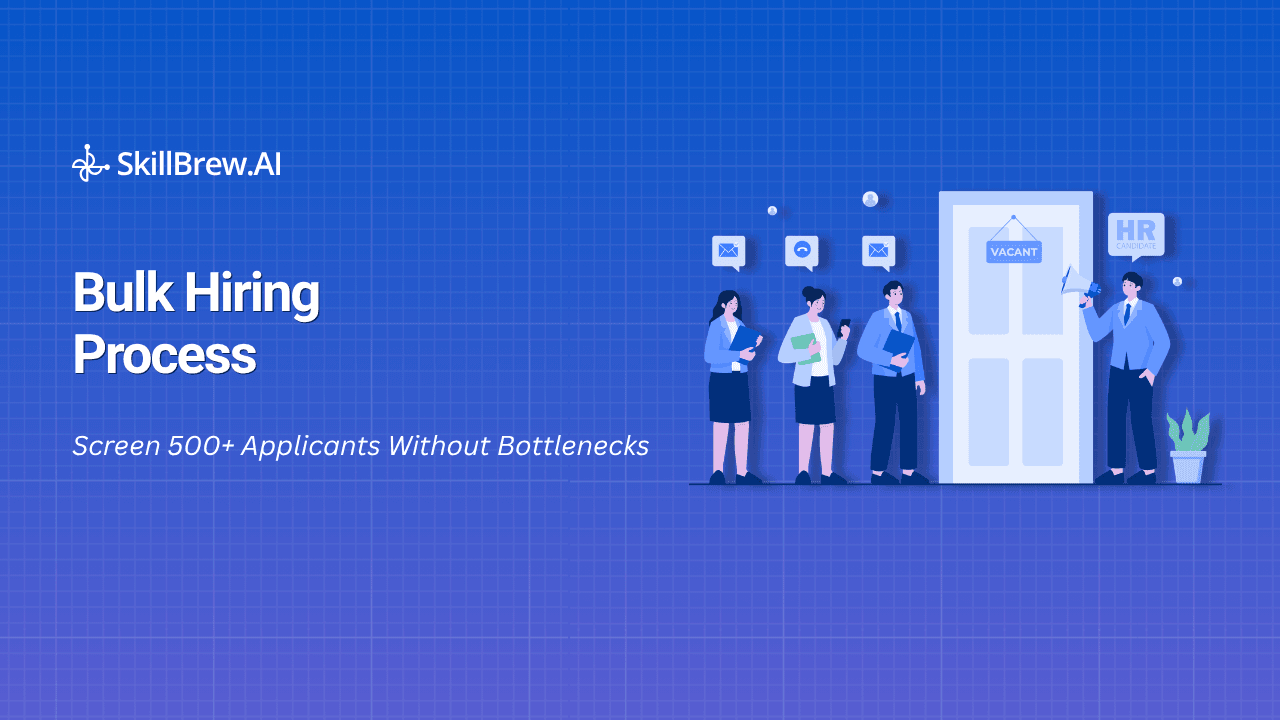
When 500 applications land in your ATS over a weekend, your bulk hiring process either holds up or falls apart and most fall apart. Recruiters spend the next two weeks in spreadsheets, and half the good candidates ghost before anyone calls them.
This post gives you a working framework to screen high-volume pipelines without adding headcount or blowing your time-to-offer. You'll walk away with a clear stage structure, the three filters that actually predict quality at scale, and the numbers you need to make the case for automation internally.
No theory. Just what works when the volume is real.
Table of Contents
- Why Most Bulk Hiring Processes Break at the Screening Stage
- The Three-Stage Structure That Keeps the Bulk Hiring Process Moving
- The Screening Criteria That Actually Predict Quality in Bulk Hiring
- How to Build the Screening Process Before the Drive Opens
- The Numbers Every TA Leader Should Know Before Signing Off on a Bulk Drive
- What Breaks at 1,000+ Applicants (and How to Adjust)
- Culture Fit and the Hiring Manager's Role in Bulk Screening
- What to Ask Your Assessment Vendor Before a Bulk Drive
- Running the Post-Drive Review That Improves Every Cycle
- FAQ: Bulk Hiring Process
- Conclusion
Why Most Bulk Hiring Processes Break at the Screening Stage
The bottleneck is almost never sourcing. At 500+ applicants, the top of the funnel fills fast job boards, campus drives, and referral pushes do their job. The process breaks in the 48-72 hours after applications close, when a two or three person team has to decide who moves forward.
Manual screening at 500 applicants takes roughly 250 hours of recruiter time, assuming 30 minutes per application. That's more than six weeks of one recruiter doing nothing else. Most teams don't have that runway, so they either screen too fast and miss strong candidates or screen too slowly and lose them to competing offers.
The problem is not recruiter effort. It's the screening model.
Most teams still use resume review as the primary screen. At scale, resumes are inconsistent, difficult to compare, and poor predictors of actual job performance. High-performing Talent Acquisition (TA) teams replace resume review with structured assessments as the first filter.
The goal is simple: reduce the working pool before recruiter time is spent.
The Three-Stage Structure That Keeps the Bulk Hiring Process Moving
A bulk hiring process that works at scale follows three distinct stages, each with a clear pass/fail threshold.
Stage 1: Automated Skills Screen (Day 1-2)
Every applicant completes a role-specific assessment immediately after applying.
The assessment measures the two or three competencies that actually predict performance in the role. Results are scored automatically, and the bottom 60-70% are filtered out.
The outcome:
- 500 applicants become 150-200 candidates
- No recruiter time is required
- Evaluation is consistent across the entire pool
This stage exists to eliminate volume, not make final hiring decisions.
Stage 2: Structured Shortlist Review (Day 3-5)
Candidates who clear the assessment move into a structured review process.
This can be:
- An async video interview
- An AI Interview
- A recruiter review using a predefined scorecard
The critical requirement is a fixed rubric.
Every candidate is evaluated on the same criteria using the same scoring system. No freeform notes. No "good feeling" decisions.
This stage narrows the pool from 150-200 candidates to roughly 30-40 finalists.
Stage 3: Final Interviews (Day 6-10)
By this point, baseline capability has already been verified.
Hiring managers spend their time evaluating:
- Role fit
- Team fit
- Problem-solving approach
- Growth potential
Instead of interviewing hundreds of applicants, they're interviewing the most promising few dozen.
A well-run bulk hiring process moves from 500 applicants to final interviews within 10 days.
Many manual processes take four to six weeks to achieve the same outcome.
The Screening Criteria That Actually Predict Quality in Bulk Hiring
One of the most common mistakes in high-volume recruitment is adding more filters.
More questions.
More rounds.
More scorecards.
Every additional step increases drop-off and slows hiring.
The most effective bulk hiring processes focus on three screening criteria.
1. Role-Relevant Task Performance
The strongest predictor of future performance is current capability.
A role-specific assessment provides more hiring signal than resume review because candidates demonstrate skills rather than describe them.
The assessment should reflect actual job requirements, not generic aptitude alone.
2. Completion and Response Rate
Candidates who complete assessments quickly and respond promptly to communications tend to remain engaged throughout the hiring process.
At scale, responsiveness becomes an important predictor of:
- Interview attendance
- Offer acceptance
- Joining rates
Engagement is a hiring signal.
3. Minimum Qualification Thresholds
Certain roles require:
- Degrees
- Certifications
- Licenses
- Experience minimums
These should be configured as automatic filters at application intake.
Recruiters should not spend time reviewing candidates who cannot legally or practically perform the role.
Applied in sequence, these three filters create a defensible shortlist without requiring manual review of every application.
How to Build the Screening Process Before the Drive Opens
Most bulk hiring failures happen because the screening process is designed after applications arrive.
At that point, the team is reacting instead of operating.
Before applications open, three things must already exist.
Define the Assessment Cutoff Score
Agree on the passing threshold before anyone sees the results.
Changing the bar after reviewing candidate performance creates inconsistency and inflates the shortlist.
Create the Shortlisting Rubric
Build a simple scoring framework:
| Criteria | Score Range |
| Communication | 1–3 |
| Problem Solving | 1–3 |
| Role Fit | 1–3 |
| Motivation | 1–3 |
Every reviewer uses the same framework.
If reviewers consistently arrive at similar scores, the rubric is working.
Set SLAs for Every Stage
For example:
| Stage | Target SLA |
| Assessment Completion | 48 Hours |
| Shortlist Review | 72 Hours |
| Final Interview Scheduling | 48 Hours |
| Offer Release | 24-48 Hours |
Defining these timelines before launch prevents bottlenecks later.
Four hours of planning before a drive can save dozens of hours during execution.
The Numbers Every TA Leader Should Know Before Signing Off on a Bulk Drive
Bulk hiring decisions should be measured against clear benchmarks.
Time-to-Offer
A structured process typically delivers offers within:
10-14 days
Manual workflows often take:
25-40 days
Longer hiring cycles consistently reduce offer acceptance rates.
Recruiter Hours Per Hire
Manual screening:
8-12 hours per hire
Assessment-first screening:
2-4 hours per hire
For a 50-hire campaign, that difference represents hundreds of recruiter hours.
Quality-of-Hire Proxy
Organizations using structured skills assessments often report:
- Lower early attrition
- Better onboarding outcomes
- Higher manager satisfaction
The assessment becomes a stronger predictor than resume review alone.
Cost Per Hire at Scale
Reducing hiring timelines creates measurable productivity gains.
At scale, even a 20-day reduction in hiring cycle time can represent significant operational savings.
What Breaks at 1,000+ Applicants (and How to Adjust)
The same framework works up to roughly 700 applicants.
Beyond that, two new bottlenecks emerge.
Assessment Platform Capacity
Some assessment systems struggle under heavy concurrent usage.
Before launch, confirm:
- Maximum concurrent users
- Load testing history
- Platform uptime guarantees
Stage-Two Review Becomes the New Bottleneck
Even after filtering, reviewing 300 candidates manually takes time.
The solution is adding an additional automated layer between assessment and recruiter review.
A short async video interview or AI Interview can reduce the pool from 300 candidates to 100 before recruiters become involved.
The process stays the same.
The automation layer gets stronger.
Culture Fit and the Hiring Manager's Role in Bulk Screening
One question comes up in almost every bulk hiring discussion:
Where should culture fit be assessed?
Not in stage one.
Not in stage two.
Culture fit evaluations at scale tend to introduce inconsistency and bias.
The first two stages should focus entirely on capability.
Culture fit belongs in the final interview.
Hiring managers should contribute in two areas:
Before the Drive
- Define role-relevant assessment criteria
- Agree on final interview questions
During Final Selection
- Evaluate team fit
- Evaluate working style alignment
- Make final hiring decisions
Beyond that, involving hiring managers earlier often slows the process without improving outcomes.
What to Ask Your Assessment Vendor Before a Bulk Drive
Not every assessment platform is designed for bulk hiring.
Before committing to a vendor, ask:
Can the platform handle our expected volume?
Request a specific concurrent user limit.
If the answer is vague, that's your answer.
How long does the assessment take?
Anything longer than 45 minutes typically causes completion rates to fall sharply.
Can cutoff scores be automated?
Manual score review defeats the purpose of high-volume screening.
Is the experience mobile-friendly?
For campus hiring, a majority of candidates often complete assessments on mobile devices.
Does the platform integrate with our ATS?
Manual exports and imports create unnecessary administrative work.
The vendor should fit into the workflow, not create a new one.
Running the Post-Drive Review That Improves Every Cycle
Every bulk hiring campaign should end with a structured review.
Track these five metrics:
- Total applications
- Stage-one pass rate
- Stage-two pass rate
- Time-to-offer
- 90-day retention rate
These metrics identify where the process succeeded and where it failed.
For example:
- Stage-one pass rate below 20% usually means the assessment is too difficult.
- Stage-one pass rate above 50% usually means the assessment is too easy.
- Time-to-offer above 14 days typically points to interview scheduling or shortlist review delays.
The goal is not simply hiring people.
The goal is improving the process every time it runs.
FAQ: Bulk Hiring Process
Q1. What is a bulk hiring process?
A bulk hiring process is a structured recruitment approach designed to manage large applicant volumes efficiently. It typically uses automated screening, standardized assessments, and structured interviews to reduce recruiter workload while maintaining hiring quality.
Q2. How many applications qualify as high-volume hiring?
There is no universal threshold, but most TA teams start experiencing process strain once application volume exceeds 50-100 candidates per week for a single role or hiring campaign.
Q3. Why is resume screening ineffective in bulk hiring?
Resumes are difficult to compare consistently at scale and often provide limited predictive value. Structured assessments and standardized screening methods generally produce more reliable hiring outcomes.
Q4. How long should a bulk hiring process take?
A well-structured process should move from application close to offer within 10-14 days. Longer timelines increase candidate drop-off and reduce offer acceptance rates.
Q5. What role does AI play in bulk hiring?
AI can automate resume shortlisting, assessment scoring, async interviews, candidate ranking, and recruiter workflow management. The goal is to reduce manual effort while maintaining consistency and speed.
Q6. Should hiring managers participate in early-stage screening?
Generally no. Hiring managers should define assessment criteria and participate in final-stage interviews. Involving them too early often creates bottlenecks and slows hiring.
The Best Bulk Hiring Processes Remove Work Before It Exists
The strongest bulk hiring processes don't scale by adding recruiters. They scale by removing unnecessary recruiter work.
That means:
- Structured assessments instead of resume review
- Automated filtering instead of manual sorting
- Consistent scorecards instead of subjective screening
- Defined SLAs instead of reactive follow-up
When 500 applications arrive, the question isn't whether your team can review them all.
The question is whether your process requires them to.
SkillBrew.AI helps Talent Acquisition teams automate high-volume screening through structured assessments, AI-powered interviews, and intelligent shortlisting workflows. If your bulk hiring process is still taking three weeks or more to move candidates through screening, a walkthrough of your current workflow will quickly show where the bottlenecks are and how to remove them.
See AI-powered hiring in action
Discover how SkillBrew helps hiring teams cut time-to-hire by 60% with skill-validated assessments and AI-ranked shortlists.
Book a free demoNo commitment required · 30 minutes
Continue reading
View All Posts