Campus Placement Drive
Volume Hiring vs Lateral Hiring: How Your Screening Process Must Change
Volume hiring and lateral hiring need completely different screening processes. Here’s what changes and why getting it wrong costs you both
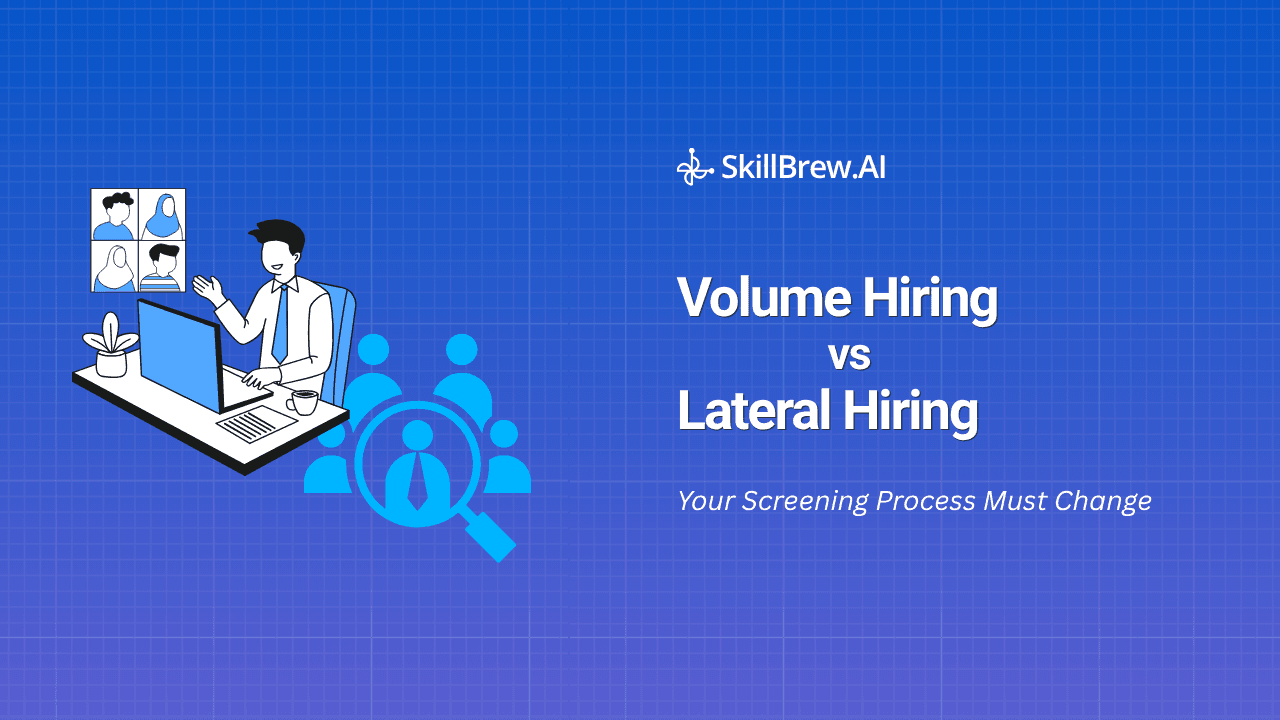
TA teams that try to force volume hiring and lateral hiring into one workflow eventually pay for it on both sides. Most TA teams run volume hiring and lateral hiring through the same recruitment pipeline. Same application form. Same screening stages. Same interview format. Same approval workflow.
It looks efficient on paper. In reality, running volume hiring and lateral hiring as one process creates problems for both.
Volume hiring and lateral hiring solve fundamentally different problems. Volume hiring needs speed, consistency, and scalability. Lateral hiring needs depth, context, and careful evaluation. When both get forced into the same process, campus drives become bottlenecks and experienced hiring gets rushed, which is why many organizations struggle with high-volume recruitment while simultaneously losing strong lateral candidates to competitors.
This guide breaks down the differences between volume hiring and lateral hiring, compares the screening requirements for each, explains where automation fits, and shows how TA leaders can build separate processes that actually work.
Table of Contents
- Why Volume Hiring and Lateral Hiring Need Different Processes
- What the High-Volume Recruitment Process Is Designed to Do
- What Makes Lateral Hiring Different
- Volume Hiring vs Lateral Hiring: Side-by-Side Comparison
- Bulk Screening Methods That Scale Without Sacrificing Quality
- Structured Interviews in Volume and Lateral Hiring
- Candidate Assessment at Scale: What to Measure
- Managing Recruiter Bandwidth Across Both Hiring Models
- Quality of Hire Metrics for Volume vs Lateral Hiring
- Where AI Screening Fits in Both Models
- FAQs on Volume Hiring and Lateral Hiring
- Build Different Processes for Different Hiring Problems
Why Volume Hiring and Lateral Hiring Need Different Processes
The biggest mistake organizations make is assuming hiring volume is the only difference between campus recruitment and experienced hiring. The reality is the objectives are completely different.
Volume hiring focuses on identifying the strongest group from a large pool of candidates in the shortest possible time. Lateral hiring focuses on determining whether a specific individual can succeed in a specific role, team, and business context. One process optimizes for scale. The other optimizes for precision.
Trying to solve both problems with the same workflow usually creates delays, inconsistent evaluations, recruiter burnout, and poor hiring outcomes, exactly why volume hiring and lateral hiring need to be treated as two separate disciplines, not one shared process with two names.
What the High-Volume Recruitment Process Is Designed to Do
Campus drives, bulk hiring initiatives, graduate recruitment programs, and seasonal hiring campaigns all begin with the same challenge: too many applicants and not enough time. A single campus drive can generate hundreds of eligible applicants within days.
The goal isn't finding the perfect candidate. The goal is identifying the strongest shortlist quickly, fairly, and consistently. A successful high-volume process requires clearly defined evaluation criteria before applications arrive, automated screening and ranking mechanisms, consistent assessment methods across all candidates, structured shortlisting workflows, and fast turnaround between stages. Without these, recruiter workload increases exponentially while shortlist quality decreases.
What Makes Lateral Hiring Different
Lateral hiring starts with a very different challenge. Instead of hundreds of candidates, recruiters may evaluate only a handful. The focus shifts from filtering large pools to deeply understanding individual candidates.
Experienced hiring requires detailed resume review, career trajectory analysis, domain expertise validation, leadership assessment, culture and team-fit evaluation, and stakeholder alignment. Unlike volume hiring, where speed is critical, lateral hiring often benefits from additional diligence. Moving too slowly can lose candidates. Moving too quickly can create expensive hiring mistakes. The process has to balance speed with depth, which is the core tension that makes volume hiring and lateral hiring incompatible as a single workflow.
Volume Hiring vs Lateral Hiring: Side-by-Side Comparison
| Dimension | Volume Hiring | Lateral Hiring |
| Applicant Volume | Hundreds to thousands | Single digits to dozens |
| Primary Goal | Build a quality shortlist quickly | Evaluate individual fit deeply |
| Screening Method | Automated and scalable | Manual and structured |
| Timeline | Days | Weeks or months |
| Evaluation Focus | Potential, aptitude, learning ability | Experience, expertise, impact |
| Interview Style | Structured and standardized | Role-specific and exploratory |
| Offer Timeline | Fast, often within 48 hours | More flexible |
| Major Risk | Process bottlenecks | Candidate drop-off due to delays |
| Success Metric | Cohort quality | Individual quality of hire |
Bulk Screening Methods That Scale Without Sacrificing Quality
This is where the split between volume hiring and lateral hiring becomes operationally real, not just theoretical. Manual resume review breaks down quickly in volume hiring. The challenge isn't just workload, it's consistency. A recruiter reviewing the first 50 resumes will evaluate differently than someone reviewing the last 200 after a full day of screening. The solution is structured screening across three stages.
Stage 1: Resume Shortlisting. Applications get evaluated against predefined job criteria. SkillBrew.AI HireFlow automatically scores resumes against the job description and generates a ranked shortlist before recruiters begin reviewing candidates.
Stage 2: Assessments. Candidates complete role-specific assessments measuring aptitude, technical skills, or behavioral indicators. SkillBrew.AI Assessments generate tests directly from the job description and rank candidates automatically.
Stage 3: First-Round Screening. Rather than coordinating hundreds of interview slots, candidates complete asynchronous interviews. SkillBrew.AI Interviews generate structured reports that recruiters and hiring managers review later.
This approach dramatically reduces recruiter workload while improving consistency, exactly the design principle that separates volume hiring and lateral hiring workflows in the first place.
Structured Interviews in Volume and Lateral Hiring
Structured interviews matter in both hiring models, but they serve different purposes.
In volume hiring, the goal is consistency. Every candidate should be evaluated using the same framework. Structured interviews here ensure fair comparisons, reduced interviewer bias, faster decision-making, and better calibration across campuses and locations.
In lateral hiring, the goal is depth. The structure still matters, but questions become more tailored, past accomplishments, leadership situations, business judgment, technical expertise, team dynamics. Consistency remains important, but flexibility becomes equally valuable. This distinction alone explains why volume hiring and lateral hiring can't share a single interview template.
Candidate Assessment at Scale: What to Measure
Many hiring teams try to evaluate too many things at once. Effective assessment focuses on measuring specific signals at specific stages.
For volume hiring, measure aptitude, domain knowledge, learning ability, communication skills, and problem-solving capability. Avoid trying to evaluate long-term leadership potential during the first screening stage.
For lateral hiring, measure relevant experience, role-specific expertise, stakeholder management, strategic thinking, and cultural alignment. The deeper evaluation happens because the candidate volume is manageable.
Managing Recruiter Bandwidth Across Both Hiring Models
One of the biggest challenges for TA teams is balancing recruiter capacity when volume hiring and lateral hiring both demand attention in the same quarter. Volume hiring creates urgent operational work: application review, candidate communication, scheduling, follow-ups, pipeline management. Lateral hiring demands focused recruiter attention and stakeholder coordination.
When both processes remain manual, volume hiring usually consumes most available bandwidth. The result: campus hiring becomes inconsistent, experienced hiring slows down, and candidate experience suffers across the board.
The fix is process separation. Volume hiring should lean heavily on automation and structured workflows. Lateral hiring should preserve recruiter involvement where judgment matters most.
Quality of Hire Metrics for Volume vs Lateral Hiring
Many organizations make the mistake of measuring both hiring models with identical KPIs. The metrics should be different.
Volume hiring metrics: 90-day retention, 6-month performance ratings, offer-to-joining rate, first-year attrition, promotion readiness. These evaluate the strength of the cohort.
Lateral hiring metrics: time to productivity, hiring manager satisfaction, business impact, 12-month retention, internal mobility and growth. These evaluate the success of individual hires.
Where AI Screening Fits in Both Models
AI delivers the highest value where scale creates bottlenecks, which is exactly why its role looks different across volume hiring and lateral hiring.
In volume hiring, AI can automate resume screening, candidate ranking, assessment delivery, first-round interviews, candidate communication, and pipeline management. SkillBrew.AI combines HireFlow for automated shortlisting and pipeline management, AI Assessments for role-based candidate evaluation, AI Interviews for asynchronous screening, and BrewShield for integrity monitoring and audit-ready reports.
In lateral hiring, AI serves as a support layer rather than a replacement. It helps with scheduling, status tracking, candidate communication, documentation, and evaluation frameworks. Final hiring decisions stay human-led.
FAQs on Volume Hiring and Lateral Hiring
What is the difference between volume hiring and lateral hiring?
Volume hiring focuses on evaluating large numbers of candidates quickly and consistently. Lateral hiring focuses on deeply evaluating a smaller number of experienced professionals.
Why does volume hiring require automation?
Manual screening becomes difficult once applicant numbers reach hundreds or thousands. Automation helps maintain consistency, speed, and fairness across the candidate pool.
Should AI be used in lateral hiring?
Yes, but differently. AI works best for administrative workflows and structured support in lateral hiring. Human judgment stays essential for evaluating experienced candidates.
What's the biggest risk in volume hiring?
Process inconsistency caused by manual screening, interviewer variation, and recruiter overload.
What metrics should CHROs track for volume hiring?
Offer-to-joining rate, retention, quality of hire, assessment effectiveness, recruiter productivity, and campus conversion rates.
Can one TA team run volume hiring and lateral hiring at the same time without one damaging the other?
Yes, but only with process separation. Volume hiring needs to run on automation so it doesn't consume all available recruiter bandwidth, freeing up the focused time lateral hiring actually requires.
Build Different Processes for Different Hiring Problems
Volume hiring and lateral hiring solve fundamentally different recruitment challenges. Volume hiring needs speed, consistency, and scalable evaluation. Lateral hiring needs depth, context, and human judgment.
Organizations that separate these processes consistently outperform those trying to manage everything through a single workflow.
SkillBrew.AI is built specifically for high-volume hiring environments. HireFlow automates intake and shortlisting, AI Assessments create structured evaluation at scale, AI Interviews deliver first-round screening without recruiter coordination, and BrewShield keeps every screening stage transparent and defensible.
When the process matches the hiring problem, recruiter workload decreases, candidate quality improves, and hiring outcomes become far more predictable.
Running volume hiring and lateral hiring through the same broken process? Book a demo with SkillBrew.AI to see what separating them actually looks like.
See AI-powered hiring in action
Discover how SkillBrew helps hiring teams cut time-to-hire by 60% with skill-validated assessments and AI-ranked shortlists.
Book a free demoNo commitment required · 30 minutes
Continue reading
View All Posts