Campus Placement Drive
How to Standardize Campus Hiring Across Multiple Colleges
Running campus hiring at one college is manageable. Running drives across eight, ten, or twenty campuses at once is where most Talent Acquisition (TA) teams start to feel the strain. Different campus coordinators follow different processes. Shortlists arrive in different formats. Screening standards vary by location. By the time candidates reach the interview stage, recruiters are often struggling to compare them fairly. The challenge was never hiring volume, most campus recruitment teams can
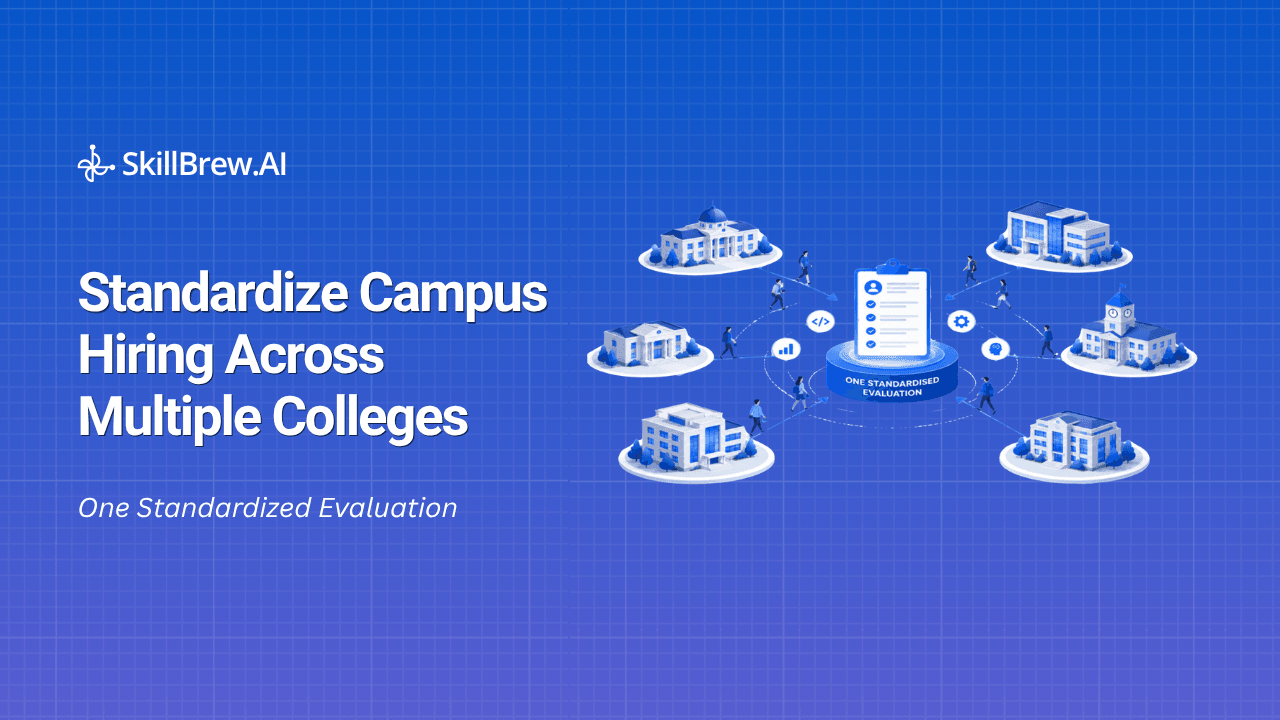
Running campus hiring at one college is manageable. Running drives across eight, ten, or twenty campuses at once is where most Talent Acquisition (TA) teams start to feel the strain.
Different campus coordinators follow different processes. Shortlists arrive in different formats. Screening standards vary by location. By the time candidates reach the interview stage, recruiters are often struggling to compare them fairly.
The challenge was never hiring volume, most campus recruitment teams can handle large applicant numbers just fine. The real challenge is consistency.
When candidates from different colleges get evaluated against different standards, hiring quality becomes unpredictable. Strong candidates get missed, weak candidates move forward, and hiring managers lose confidence in campus recruitment as a talent source. This is exactly why organizations need a clear plan to standardize campus hiring multiple colleges at once.
This article lays out a practical framework to standardize campus hiring multiple colleges through a single evaluation rubric, a unified screening process, and consistent hiring metrics.
Table of Contents
- Why Campus Hiring Becomes Inconsistent at Scale
- The Hidden Costs of an Unstructured Campus Recruitment Process
- Building One Evaluation Framework for Every Campus
- Why a Shared Assessment Layer Changes Everything
- Creating a Repeatable Process for Campus Coordinators
- Managing Tier 2 and Tier 3 Colleges Without Lowering Standards
- Campus Hiring Metrics That Actually Matter
- What a Standardized Campus Hiring Process Looks Like
- Frequently Asked Questions
- Building Consistency Across Campus Hiring with SkillBrew.AI
Why Campus Hiring Becomes Inconsistent at Scale
Many organizations assume campus hiring challenges come down to volume. In reality, the bigger problem is variation.
As the number of campuses grows, so does the number of variables:
- Different campus coordinators
- Different screening methods
- Different communication styles
- Different evaluation expectations
- Different shortlist formats
Without a structured framework built to standardize campus hiring multiple colleges from the start, every campus drive turns into its own independent hiring process. The result is a final candidate pool that lacks consistency, making it nearly impossible to compare candidates objectively across colleges.
The Hidden Costs of an Unstructured Campus Recruitment Process
Most hiring teams that haven't yet moved to standardize campus hiring multiple colleges notice the obvious problems first.
High Offer Rejection Rates - Candidates who looked promising during campus screening fail to meet internal hiring expectations later in the process, a pattern that fades once organizations standardize campus hiring multiple colleges.
Longer Hiring Cycles - Recruiters spend extra time reviewing and validating campus shortlists because evaluation standards vary.
Reduced Hiring Manager Confidence - When hiring outcomes are inconsistent, managers start questioning the effectiveness of campus recruitment programs entirely.
Increased Cost Per Hire - Organizations often compensate for poor campus hiring outcomes by leaning harder on experienced hiring, which typically costs more.
The longer inconsistency stays baked into the process, the more expensive campus hiring becomes, which is the core financial case for choosing to standardize campus hiring multiple colleges early rather than later.
Building One Evaluation Framework for Every Campus
One of the most common mistakes organizations make when they try to standardize campus hiring multiple colleges is letting evaluation criteria shift based on college reputation. For example:
- Tier 1 colleges receive rigorous assessments.
- Tier 2 colleges receive lighter screening.
- Tier 3 colleges get evaluated primarily through academic filters.
This might feel practical, but it quietly creates different hiring standards for the exact same role.
Shift From College-Based Evaluation to Role-Based Evaluation
Instead of asking "Which college is this candidate from?", ask "Does this candidate meet the requirements for the role?" This single mindset shift is the foundation of any real effort to standardize campus hiring multiple colleges.
A standardized evaluation framework should focus on:
Aptitude and Problem Solving - Logical reasoning, analytical ability, numerical aptitude.
Role-Specific Skills - Technical knowledge, domain expertise, functional competencies.
Minimum Qualification Thresholds - Every role should have a clearly defined performance floor. Candidates either meet the standard or they don't. The standard should stay consistent regardless of campus.
Why a Shared Assessment Layer Changes Everything
When campus coordinators use different screening approaches, any attempt to standardize campus hiring multiple colleges falls apart before it starts. One coordinator prioritizes GPA. Another prioritizes project work. A third runs informal screening conversations. The result: inconsistent shortlists that recruiters can't trust.
Introduce a Unified Pre-Screening Assessment
The simplest way to standardize campus hiring multiple colleges is to evaluate every candidate using the same assessment before any campus-specific activities begin. Benefits include:
Comparable Candidate Data - Candidates are evaluated using the same criteria regardless of institution.
Reduced Subjectivity - Shortlisting decisions become evidence-based rather than relationship-based.
Faster Review Cycles - Recruiters spend less time normalizing data from multiple campuses.
Better Talent Discovery - Strong candidates from lesser-known colleges become visible through performance, not reputation.
For organizations running multiple campus drives simultaneously, a shared assessment layer is often the single biggest driver of consistency across the whole program.
Creating a Repeatable Process for Campus Coordinators
Many multi-campus hiring programs that never set out to standardize campus hiring multiple colleges quietly become dependent on recruiter intervention. Every scheduling issue, communication delay, or candidate query eventually lands back on the central hiring team. That doesn't scale.
Build a Process, Not a Dependency
Campus coordinators should operate from a standardized playbook that includes:
- Standardized Job Descriptions - Every campus receives identical role information.
- Consistent Presentation Materials - Pre-placement presentations follow a common structure and message.
- Shared Assessment Workflow - The same assessment link, instructions, and timelines apply everywhere.
- Automated Shortlist Generation - Shortlists are generated through predefined criteria, not manual coordinator decisions.
- Centralized Reporting - All campuses feed data into a single dashboard using identical reporting formats.
When coordinators follow a structured process built to standardize campus hiring multiple colleges, recruiters spend less time managing logistics and more time actually making hiring decisions.
Managing Tier 2 and Tier 3 Colleges Without Lowering Standards
A common concern with any plan to standardize campus hiring multiple colleges is whether it disadvantages candidates from emerging institutions. It doesn't, as long as it's done right.
The objective is never to lower hiring standards. It's to create equal evaluation standards.
Keep the Threshold Constant - Candidates should be assessed against the same performance benchmark regardless of college.
Adjust Support, Not Standards - Organizations can improve outcomes by providing preparation materials, hosting assessment workshops, running pre-placement sessions, and sharing sample evaluation formats. These help candidates prepare without changing hiring expectations.
Apply the Same Logic to Off-Campus Hiring - Candidates applying through career portals, job boards, employee referrals, or direct applications should be evaluated using the same framework as campus candidates. Consistency matters more than sourcing channel, the same principle that drives any effort to standardize campus hiring multiple colleges should extend to every channel.
Campus Hiring Metrics That Actually Matter
Once you standardize campus hiring multiple colleges, the metrics finally mean something. Many organizations focus heavily on metrics like offers issued, candidates hired, and drive attendance rates. Useful, but these numbers rarely explain hiring quality on their own.
Score-to-Offer Correlation - Do higher-scoring candidates perform better throughout the hiring process? This validates the effectiveness of your assessment framework.
Shortlist-to-Hire Conversion Rate - Measures how accurately your screening process identifies strong candidates.
Campus Performance Comparison - Which campuses consistently produce successful hires? This informs future campus selection decisions.
Coordinator Effectiveness - Assessment completion rates and candidate engagement levels often reveal operational issues unrelated to candidate quality.
Tracking these metrics across multiple hiring cycles gives you a far more reliable basis for decisions than raw offer counts.
What a Standardized Campus Hiring Process Looks Like
The most efficient programs that standardize campus hiring multiple colleges run on a repeatable structure.
Before Hiring Season - Job descriptions finalized, assessment criteria approved, evaluation thresholds defined, campus coordinator playbooks distributed.
Before Each Drive - Candidates receive the same assessment, results are scored automatically, shortlists are generated using predefined criteria.
During Interviews - Structured scorecards are used, interviewers follow consistent evaluation frameworks, candidate feedback is captured uniformly.
After Hiring - Hiring metrics are consolidated, campus performance is analyzed, assessment effectiveness is reviewed, future campus strategies are refined.
Once this structure is in place, expanding from five campuses to fifteen becomes a scaling exercise, not a process redesign project, which is exactly what it looks like when you finally standardize campus hiring multiple colleges properly.
Frequently Asked Questions
How do organizations standardize campus hiring across multiple colleges?
By implementing a shared evaluation framework, common assessment process, standardized interview scorecards, and centralized reporting system.
Should different colleges have different hiring criteria?
No. Hiring criteria should be role-specific, not college-specific. Candidates should be evaluated against the same performance standards everywhere.
How can organizations compare candidates from different campuses fairly?
A common assessment layer creates comparable performance data that lets recruiters evaluate candidates consistently — the core mechanism behind any effort to standardize campus hiring multiple colleges.
What metrics should campus hiring teams track?
Important metrics include score-to-offer correlation, shortlist-to-hire conversion, campus performance trends, assessment completion rates, and offer acceptance rates.
Can the same process work for off-campus hiring?
Yes. Applying identical evaluation standards across both campus and off-campus recruitment improves consistency and hiring quality.
Building Consistency Across Campus Hiring with SkillBrew.AI
The strongest campus hiring programs aren't necessarily the ones visiting the most colleges. They're the ones applying the same hiring standards everywhere.
SkillBrew.AI helps TA teams standardize campus hiring multiple colleges through:
- Technical Assessments for consistent candidate evaluation
- HireFlow for centralized shortlisting and pipeline management
- AI Interviews for structured screening at scale
- Unified analytics for cross-campus hiring visibility
When every campus follows the same evaluation framework, hiring decisions become easier to defend, easier to scale, and significantly more effective.
The goal was never to hire from more campuses. It's to identify the best candidates, regardless of where they come from.
Book a demo → and see how to standardize campus hiring multiple colleges on your next drive.
See AI-powered hiring in action
Discover how SkillBrew helps hiring teams cut time-to-hire by 60% with skill-validated assessments and AI-ranked shortlists.
Book a free demoNo commitment required · 30 minutes
Continue reading
View All Posts