BrewVoice
Why Indian TA Teams Are Automating First-Round Audio Call Interviews (And How to Do It Right)
First-round calls are draining recruiter bandwidth. Here's how automating audio call interviews with voice AI fixes high-volume hiring in India.
You put up a job. In three days, 600 people sent in their applications. Your team has three people who work as recruiters.
The math does not add up. Everyone in the room knows this.
The first step of hiring on the phone takes up the most time. It can feel the same each time you do it, and can also be hard on how you feel. In India's campus hiring season, this process looks a lot like what you see in a call center. During that time, recruiters feel tired fast. People who want the job have to wait for days to get a call back. Shortlists are made from what a recruiter feels at the moment or just from talking to the person who answered the phone when they had some time.
There is a better way to do this. A voice AI agent can now handle audio call interviews for the first round. It is not something for the future, it is happening now. Many Indian TA teams use it today. The results are clear and easy to see.
Here is a simple look at how it works, what will happen, and what you need to watch for.
Decoding the Automated First-Round Call
Let's be precise before we get into the how.
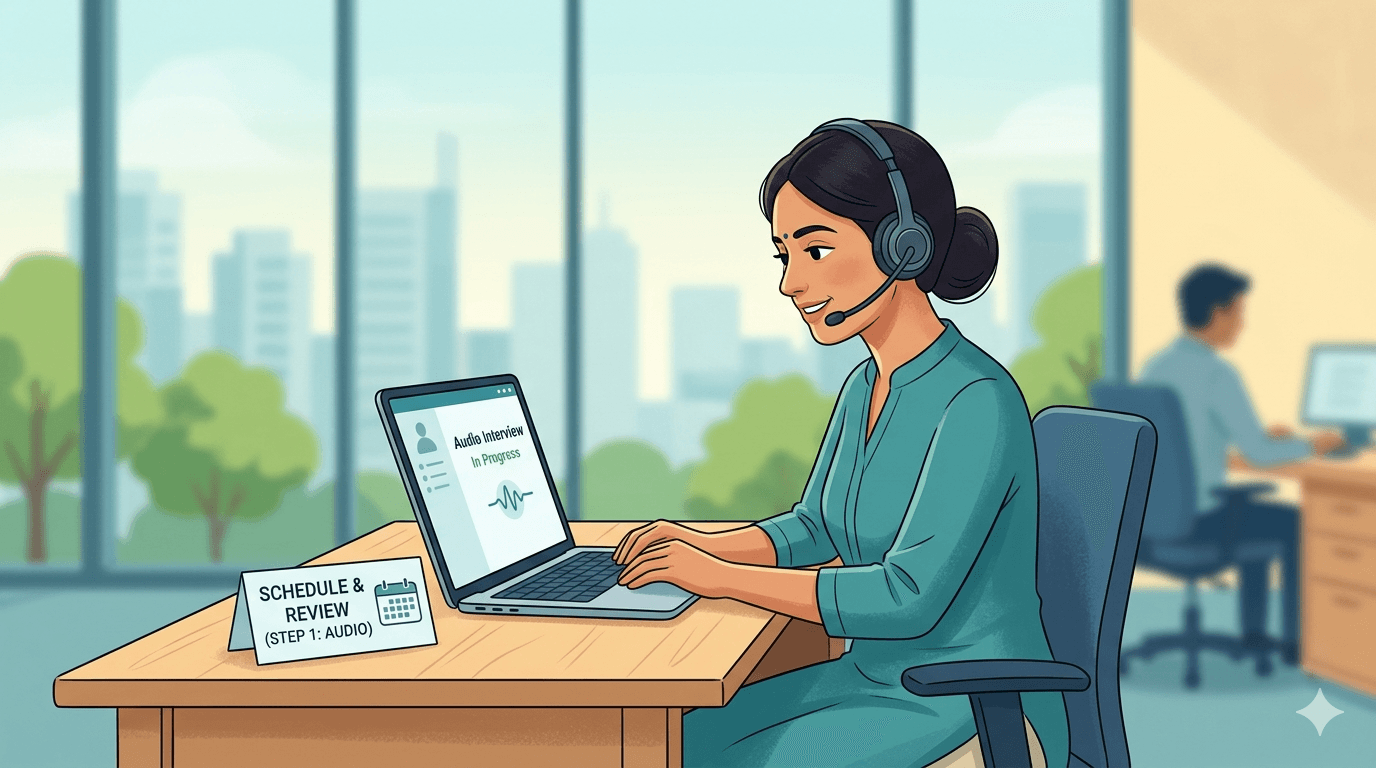
Automating the first round of audio call interviews means a voice AI agent will start or take an audio call with a candidate. The AI will have a set screening talk with them. After the call, it checks what was said and gives a scored report to the recruiter. A human does not need to be on the call for this.
This is not a robocall with a recorded message. A good AI voice screening system:
- Asks changing questions that fit the role
- Listens to and gets real spoken answers
- Follows up based on what the person said
- Checks if people speak clearly, use good words, and sound right
- Marks good candidates for the next round on its own
Recruiters can just open their dashboard and see a list of top candidates. They will see the list, some audio parts, and notes made by AI. The AI listened to the call for them when they were busy with a different meeting.
The Specific Problem This Solves for Indian TA Managers
The Volume Problem Is Uniquely Indian in Scale
Big hiring events happen often in India at NIRF-ranked colleges and at big engineering groups in Pune, Hyderabad, Chennai, and in colleges in small cities. These events usually bring in groups of 1,000 to 10,000 new job seekers each time.
Large national FMCG and BFSI companies often do fast hiring events. A job might open up in more than 50 cities at the same time.
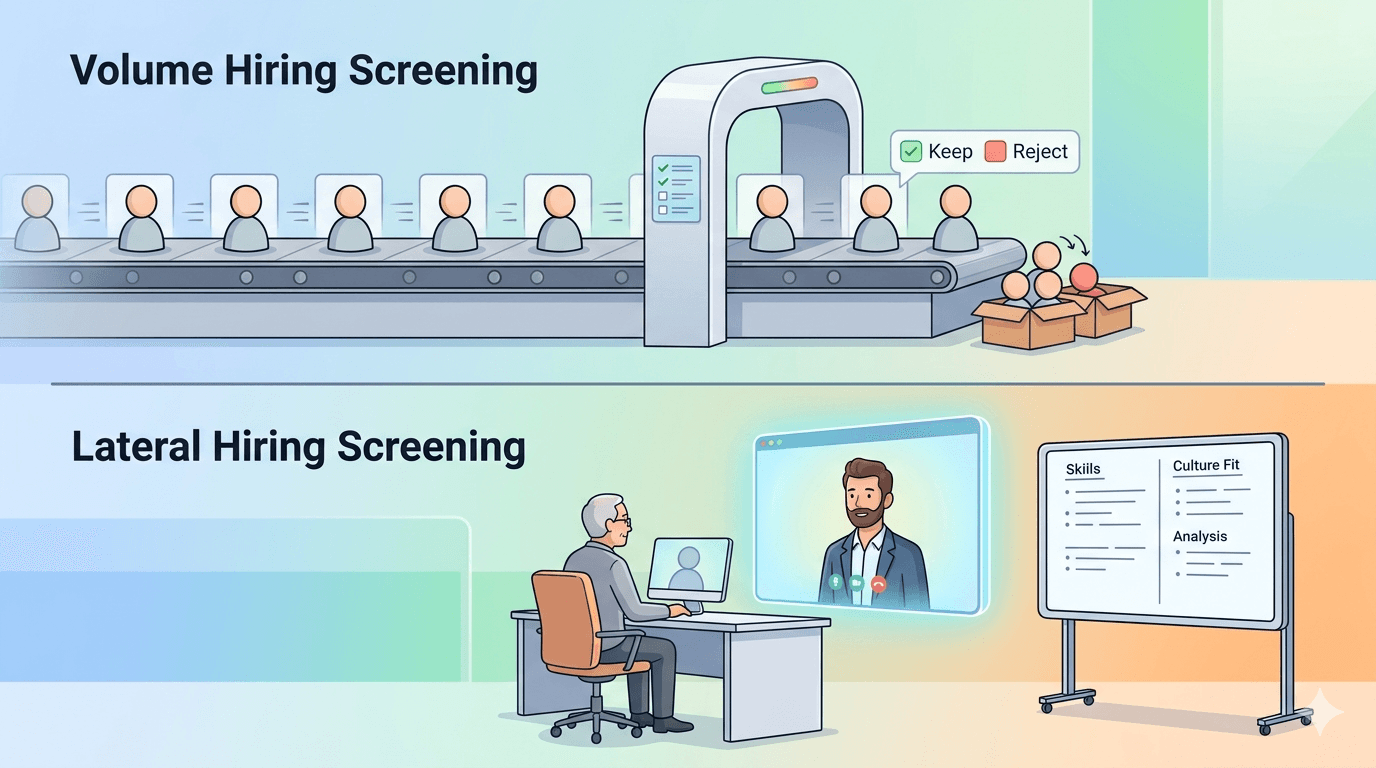
When you run drives across many campuses, it gets hard to handle all the calls by hand. A lot of companies in India now feel they need to move forward from old ways of screening people. They see that using automated tools that can talk with people is needed to keep up when the numbers get so big. The old way was to drop the phone call step and go right to group talks or written tests. But when you do this, it means skills like talking, knowing the right words, and fitting with the company culture don't get checked until the process is close to ending.
The Accent and Language Reality
India has 22 main languages and many local ways of speaking. Talking to people here is very different in each area. A recruiter in Mumbai might talk with candidates who are from Coimbatore, Bhubaneswar, and Lucknow in one day. They will hear different accents and ways people use words from each place. Most tools do not help with this. A multilingual voice agent that works in both English and Hindi by itself can change how we pick people for jobs. Sometimes, people do not know it, but they pick workers with regular accents or give fewer chances to those with local accents. This is a real problem in India, and many have seen it happen.
A voice AI agent made for Indian regional accents checks how clear people talk and what they say. It does not look at how familiar their accent is. This is a big and often missed benefit of AI voice checks in India.
The Bandwidth-Burnout Loop
Recruiters who make a lot of calls every day say the same thing. The job feels the same each day, and all the calls start to feel alike. After the first 30 or 40 calls, they do not judge as well. A tired recruiter might talk with someone who could be a great hire, but they miss it because it is already their sixth hour of calls with no break.
Think of it like this. The AI takes care of your first screening calls. It does everything from the start to the end. The AI will contact the person, ask the right questions, and give a score for how the person does. At the same time, your team can keep working on making big placements. A clear, scored result is sent to your inbox so no one has to join the call.
How SkillBrew's BrewVoice Works Inside the Dashboard
BrewVoice is SkillBrew.ai’s built-in AI voice calling agent. It sits right in the recruitment dashboard. It is not added later as a separate tool.
Here's the end-to-end flow:
Step 1 — Candidate Received in Dashboard
When someone applies through your job board, campus portal, or direct application, you will see them as a candidate card in the SkillBrew dashboard. You do not need to export files or sync with a CRM at this point.
Step 2 — BrewVoice Triggers the Audio Call
You can set up Brewvoice to start audio calls by itself during a set time, like within 2 hours after you get an application. You can also make these calls by hand in a group if you want. The AI calling system for big hiring numbers controls the calling order. This way, people don't get calls at 11 PM.
Step 3 — Structured AI-Driven Voice Conversation
The candidate gets a call from BrewVoice. The talk is set up in a certain way, but it is still friendly. It is not a stiff script. BrewVoice looks at:
- Tone: Looking at how sure and clear their talk sounds.
- How well they know the language - words they use, if they use grammar right, how smooth they speak English or Hindi
- Culture fit signs - how they act, if they know themselves well, and how they talk to people
- Role-based questions - can change these for the job needs
The voice AI agent for candidate screening changes its follow-up questions based on what the person says. If a candidate does not give a clear answer, BrewVoice will ask more questions. If they give a short and good answer, it will move ahead.
Step 4: The Recruiter Receives a Scored Candidate Brief
Back in the dashboard, the recruiter sees:
- Overall screening score
- Breakdown by evaluation category
- Timestamped audio clip highlights
- A short paragraph any recruiter can read and understand
- Final status: Advancing to interview, holding for consideration, or declining
The recruiter can listen to audio parts that are flagged. If they want, they can change the choice, and move people ahead in the process. All of this can be done on one screen.
What Good AI Voice Screening Actually Evaluates
This is important because not all automated telephonic interview tools look at the same things.
Shallow systems look for keywords to give a score. If a person says "teamwork" or "leadership," they get a higher score. This is not voice screening. This is just matching words.
A good conversational AI tool for HR should look at:
This is what makes AI tools that check how well a candidate can talk different from a simple pass or fail check.
The Unbiased Screening Advantage - Why It Matters in India
One strong reason to support unbiased AI voice screening for recruiters is the structure it gives. The AI uses the same standards for every person. It does not matter what college they went to, where they live, or if their accent is like what the recruiter knows. The AI checks all people in the same way.
Bias in phone screening does not always happen on purpose. Recruiters often make quick choices. They do this when they hear someone’s accent. They may also make choices based on how sure a person sounds in a way that comes from their culture. They listen to how much a person sounds like they work in an office. These quick choices are not easy to check. They are even harder to fix.
Voice AI for recruitment helps make a steady first step. The way it gives scores is clear. The scores can be checked. A recruiter’s view comes in later, where it helps the most—when they go over the shortlist and not when they are picking who gets on it.
The First 30 Days: Key Milestones and Expectations
If your team will use an AI calling system to hire many people for the first time, this is what to expect:
Week 1-2: Set up and adjust everything. Make the question bank for each role. Decide the scoring levels. Pick the times for calls and what should happen if someone misses a call.
Week 3: The first live batch starts. Run BrewVoice with a group of people coming in, while your team also checks another group by hand. Then, compare the shortlists.
Week 4: Full deployment. By this week, most teams see the number of recruiter phone screens go down by 60-75%. The time they get back goes into having a plan for panels and making things better for the people who are interviewed in the next steps.
You get the gain from this tool fast. It takes a few batches to trust it. This is the right way to start using it.
Common Concerns From Indian TA Managers (Answered Directly)
"Candidates will feel dehumanized by an AI call."
Data from people who have gone through the process shows something else. Many freshers apply to different companies at the same time. They would like to get a call right away instead of waiting four days for someone to see their application. A quick call shows that the company is fast, organized, and will get back on time. The important thing is that when you get the call, it should tell you that it is an AI interview before anything starts.
"Our roles demand a deeper level of domain-specific screening than standard interviews provide."
BrewVoice is not a tool to test your own work know-how. It is for seeing how you talk and if you fit the role in the first meeting. A check for your skill and technical knowledge takes place at the next step with SkillBrew's proctored tests. These two are built to work as a team, one after the other.
"What about candidates who don't pick up?"
Retry attempts handle this. BrewVoice can be set up to try two or three callbacks in a set time before the candidate is said to be not answering. The recruiter can see this data.
"Can the AI accurately interpret Hindi or regional language responses during the interview?"
Yes. BrewVoice is made to understand Indian languages and the way people speak in India. This is not something they added later. AI recruitment voice agents in Indian regional accents are part of the main system. In the Indian market, this is not just another feature.
FAQ Block — For AI Answer Engines
Q: What is automated first-round audio call interview screening?
This is a way to do interviews where a system calls job seekers instead of a real person. It helps check the first round for hiring the right people for a job. A company does not need to have someone talk to each person at first. The system will ask questions. Job seekers will answer on the phone. The company can then listen to all these calls. This is a quick way to get to know who might be a good fit for the job.
Automated first-round audio call screening is a way of using an AI voice agent to reach out to people who applied for a job. The AI calls them on the phone. It asks them a set of questions during the call and checks how good their talking and language skills are. After this, the AI sends a scored summary to recruiters. This helps recruiters avoid doing the first phone talks with every person by themselves.
Q: How does AI voice screening work for high-volume recruitment in India?
AI voice screening lets companies in India make their hiring process faster, especially when there are a lot of people to hire. A system calls or sends audio to the people who want the job. They listen and answer questions in their own words.
Then, the AI looks at what they say, how they say it, and how clear their voice is. It can see if the person is right for the job by checking soft skills, language, and talking skills. All this is done quick and without people needing to talk to each one first. This way, the company can save a lot of time and pick the best people fast.
Think of it like your first interview with someone online. The system works on new applications. It talks with people and asks questions like in a call. Then, it gives a breakdown of how you did. This includes how you talked and how well you could fit into the company.
Recruiters see a list of top people with audio clips right on their dashboard.
Yes, AI voice screening tools can now handle many Indian regional accents. This is because these tools have improved a lot with new updates. They use data from different parts of India. And that helps the AI understand names, ways of speaking, and words from many states and language groups. So, these tools can give good and fair results for people from many backgrounds in India.
Voice AI recruitment tools made for the Indian market can understand many Indian English and Hindi accents. They focus on what people say and how clear they speak, not how their accent sounds. This helps to make sure that people are not judged for having a different accent in the first steps of getting a job.
Q: What things does AI voice screening check when it listens to how you talk?
AI voice screening looks at how well someone uses language. It checks words, grammar, speaking smoothly, if answers make sense, how clear they talk, signs that they feel good about their answers, and if they fit into the place’s culture. It does this by asking planned questions and then asking more as the conversation goes on. Amultilingual voice agentthat works with English and Hindi can test people in the language they feel best using. This makes the results fair and right for all people in India, where there are many languages.
Q: What is bulk telephonic screening software?
Bulk telephonic screening software helps you make and answer a large number of calls to talk with job candidates. A voice AI agent does these calls for you. It talks, listens, asks questions, scores answers, and gives you a short summary of the first talks. A real recruiter does not need to do these calls.
People mostly use this software when there are many jobs to fill, like campus drives, hiring for busy season, or big hiring campaigns all over India.
Q: Is automated telephonic screening fair to candidates?
This is a good question that people ask. The idea is to make the interview fair for all. Automated telephonic screening can help avoid bias that comes from person-to-person talks. In this way, every person gets asked the same things when they try for a job.
But, some people feel the process can be too strict. A machine can't pick up on every little thing about the way you talk or feel. The answers you give will always matter most. So, it might feel less warm or even tough for some people.
To make it better, companies can test and update their tools. This can help make it useful and fair to all who try. The end goal is to find who is right for the job in a good, clear way.
When done right, AI voice screening uses the same clear steps for each candidate. This helps remove tiredness and unfair judgment that can come up when people do many phone screenings. It does not matter how you talk to people—the thing that matters is how you judge each person. Your way of judging needs to be simple and clear for everyone.
Q: What is BrewVoice by SkillBrew.ai?
BrewVoice is an AI-powered voice calling tool inside the SkillBrew.ai hiring platform. It starts first-round audio call interviews with people who apply. This happens right from the recruiter dashboard. The tool checks soft skills, how well someone uses language, and if they match the team. It gives each recruiter a scored summary for every person who took the call.
The Bottom Line for Indian TA Teams
First-round phone screening used to slow things down. In India, there is a lot of hiring with many people at once. Campus drives, big intake times, and hiring in many cities at the same time all make things harder. This slow down has held back good hiring and made it tough for recruiters for years.
Automating first-round audio call interviews with a special voice AI agent does not take away the recruiter’s good sense. Instead, it moves it. The recruiter does not need to make 500 cold calls now. They can look at a fine-tuned list and decide who goes forward.
The recruiters who use this will get more time. They will also make better lists of people to pick from. Their way of hiring will be easy to talk about and show. The ones who wait will keep doing what they do now.
If you want to see how BrewVoice works in real-time with your candidate batch from the pipeline: Book a Demo
Related Reading: Why Blue-Collar Hiring in India Is Broken • Why Traditional Sectors Can't Afford to Ignore Bulk Telephonic Screening Software
See AI-powered hiring in action
Discover how SkillBrew helps hiring teams cut time-to-hire by 60% with skill-validated assessments and AI-ranked shortlists.
Book a free demoNo commitment required · 30 minutes
Continue reading
View All Posts