Recruitment Automation & Workflow
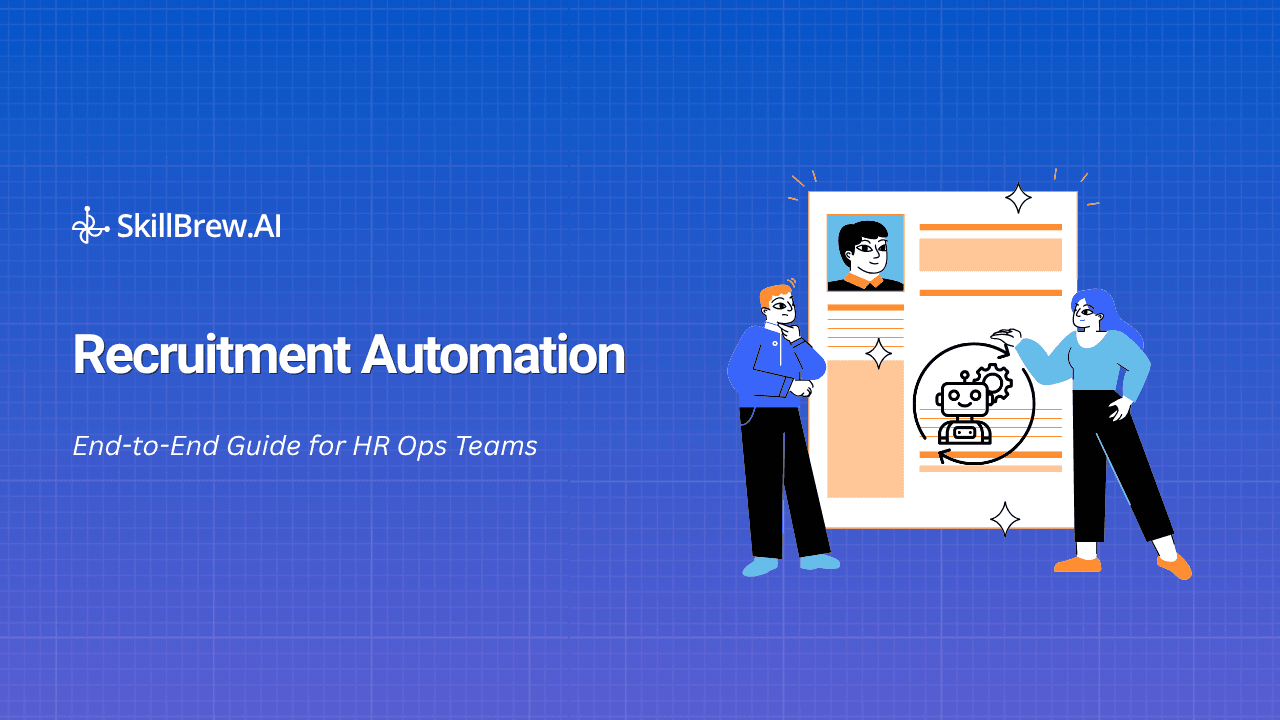
Recruitment Automation: End-to-End Guide for HR Ops Teams
Most HR operations teams aren't losing candidates to competitors. They're losing them to slow processes. Manual screening, recruiter handoffs, interview coordination, and delayed communication can add days, sometimes weeks, to your hiring process. In competitive talent markets, those delays quietly cost organizations their strongest candidates. That's why more HR ops teams are investing in recruitment automation HR ops strategies built to actually fix the funnel, not just paper over it. But
Most HR operations teams aren't losing candidates to competitors.
They're losing them to slow processes.
Manual screening, recruiter handoffs, interview coordination, and delayed communication can add days, sometimes weeks, to your hiring process. In competitive talent markets, those delays quietly cost organizations their strongest candidates.
That's why more HR ops teams are investing in recruitment automation HR ops strategies built to actually fix the funnel, not just paper over it.
But successful recruitment automation HR ops isn't about bolting on more tools. It's about removing unnecessary manual work from the hiring process while preserving the decisions that genuinely require human judgment.
In this guide, you'll learn:
- What recruitment automation HR ops means in practice
- Which stages of the hiring process should be automated first
- The five workflow areas that deliver the highest ROI
- Common mistakes that derail automation initiatives
- How to build a recruitment automation HR ops workflow your team can actually maintain
Table of Contents
- What Recruitment Automation HR Ops Actually Means
- Why Recruitment Automation HR Ops Matters More Than Ever
- The Five Stages That Deliver the Highest Automation ROI
- Where Most HR Ops Teams Get Automation Wrong
- How to Build an Automation Workflow Your Team Can Maintain
- What Results Recruitment Automation HR Ops Actually Produces
- Frequently Asked Questions
What Recruitment Automation HR Ops Actually Means
Recruitment automation isn't a single platform or software category. It's a set of workflow decisions that determine which hiring tasks require human involvement and which can be handled automatically.
Good recruitment automation HR ops isn't about replacing recruiters. It's about stripping out repetitive administrative work so recruiters can focus on high-value activities like:
- Candidate engagement
- Hiring manager collaboration
- Interview evaluation
- Offer management
- Strategic hiring decisions
Which Tasks Should Be Automated?
As a rule of thumb, tasks that follow predictable rules are the best candidates for automation. Think:
- Application intake
- Candidate qualification checks
- Screening questionnaires
- Interview scheduling
- Candidate status updates
- Recruitment reporting
These activities eat significant recruiter time without necessarily improving hiring outcomes — which makes them the natural starting point for any recruitment automation HR ops initiative.
The Real Cost of Manual Processes
Consider a recruiter managing 15 open positions. If each role pulls in 200 applications, that recruiter could spend more than 150 hours a month just reviewing resumes, qualifying candidates, and coordinating logistics.
Much of that work can be automated. Done right, recruitment automation HR ops produces faster hiring cycles, sharper recruiter productivity, and a noticeably better candidate experience.
Why Recruitment Automation HR Ops Matters More Than Ever
Hiring teams today face rising pressure to:
- Fill positions faster
- Improve candidate experience
- Reduce operational costs
- Maintain hiring quality at scale
Meanwhile, application volumes keep climbing. Without automation, recruiting teams tend to respond by throwing more manual effort at the problem, and more effort doesn't automatically create better outcomes. Often, it creates:
- Longer response times
- Increased recruiter burnout
- Higher candidate drop-off rates
- Inconsistent screening decisions
This is exactly the gap recruitment automation HR ops is built to close: it lets teams scale hiring without scaling administrative workload right alongside it.
The Five Stages That Deliver the Highest Automation ROI
Not every part of the recruitment process pays off equally when automated. These five stages consistently generate the biggest operational impact for any recruitment automation HR ops rollout.
1. Applicant Intake and Initial Candidate Triage
Most ATS platforms can filter candidates on basic criteria like location, years of experience, certifications, or education requirements. But hiring decisions rarely come down to keywords alone.
Modern intake automation should evaluate candidates against weighted role requirements and rank applicants by fit, not just pass-or-fail filtering. Instead of forcing recruiters to review hundreds of applications by hand, automation surfaces the top candidates for human review.
Benefits of Intake Automation
- Faster candidate review
- Improved shortlist quality
- Reduced recruiter workload
- More consistent evaluation criteria
2. Automated Screening and Structured Assessments
Initial screening consumes a huge share of recruiter time. Most first-round conversations only exist to check whether candidates meet basic requirements — which is precisely the kind of work structured screening automation eliminates.
Examples include:
- Qualification questionnaires
- Pre-screening assessments
- One-way video interviews
- Skills validation exercises
When screening criteria are defined upfront, candidates get evaluated consistently and objectively, every single time.
Benefits of Screening Automation
- Higher-quality shortlists
- Reduced recruiter screening time
- Better interview-to-hire ratios
- More consistent candidate evaluation
3. Interview Scheduling and Coordination
Scheduling is one of the most overlooked bottlenecks in hiring. Finding availability, coordinating calendars, sending invites, and managing reschedules can add days to your timeline.
Self-service scheduling tools strip out most of that friction. Candidates pick an available slot, and calendar invites generate automatically.
Benefits of Scheduling Automation
- Faster interview setup
- Reduced coordination effort
- Shorter time-to-hire
- Better candidate experience
4. Candidate Communication and Status Updates
Many organizations struggle to keep communication consistent throughout the hiring process. The issue usually isn't intent, it's capacity. When recruiters are juggling dozens of open requisitions, candidate updates slide down the priority list fast.
Automated communication workflows fix this. Candidates get updated automatically as they move between stages.
Benefits of Automated Communication
- Reduced candidate ghosting
- Improved employer brand perception
- Higher candidate engagement
- Lower application abandonment rates
Candidates are far more likely to stay engaged when they actually know where they stand.
5. Recruitment Reporting and Pipeline Analytics
Many TA leaders are making decisions on incomplete data. Without consistent capture, the metrics that matter most become impossible to trust, things like:
- Time-to-screen
- Screening-to-interview ratio
- Interview-to-offer ratio
- Offer acceptance rate
- Time-to-hire
Automation ensures hiring data gets captured consistently at every stage of the funnel.
Benefits of Automated Reporting
- Improved decision-making
- More accurate forecasting
- Better hiring process visibility
- Easier performance measurement
Where Most HR Ops Teams Get Automation Wrong
Recruitment automation HR ops projects rarely fail because of the technology. They fail because of how they're implemented.
Mistake #1: Automating Scheduling Before Screening
Many teams start with interview scheduling because it's the easiest thing to implement. Scheduling automation improves efficiency, sure — but it does nothing for candidate quality. The result: more candidates move through the funnel, hiring managers sit through more interviews, and interview-to-hire ratios actually get worse. Hiring gets faster, not better.
The Better Approach: Automate screening first. Then optimize scheduling and coordination. Quality should always come before speed.
Mistake #2: Failing to Establish Baseline Metrics
Before rolling out automation, HR ops teams need a clear read on current performance. Track:
- Time-to-screen
- Time-to-hire
- Candidate drop-off rate
- Interview-to-hire ratio
- Recruiter workload
Without a baseline, there's no way to prove whether recruitment automation HR ops actually improved anything.
Mistake #3: Over-Automating Too Quickly
Some organizations try to automate every stage at once. That usually creates confusion and makes troubleshooting a nightmare. Instead:
- Automate screening.
- Measure results.
- Refine workflows.
- Expand gradually.
Successful recruitment automation HR ops is iterative, not a one-time overhaul.
How to Build an Automation Workflow Your Team Can Maintain
Sustainable recruitment automation HR ops doesn't require ripping out your ATS. It requires clearly defining which decisions belong to people and which belong to systems.
Step 1: Map Your Existing Hiring Funnel
Document every stage from Application Received → Offer Accepted. For each stage, identify human decisions, administrative tasks, and workflow bottlenecks. Administrative tasks are your automation opportunities.
Step 2: Define Automation Rules
Every automation should have three parts:
- Trigger - What event starts the workflow? (Application submitted, assessment completed, interview feedback submitted.)
- Action - What happens automatically? (Send candidate communication, trigger assessment, schedule interview.)
- Exception Path - What happens when the workflow doesn't go as expected? (Candidate doesn't respond, screening score is borderline, interview feedback is incomplete.)
Defining exception paths up front prevents workflow breakdowns down the line.
Step 3: Monitor and Optimize
No automation workflow is perfect on day one. Review performance regularly for the first three months and ask:
- Are qualified candidates reaching recruiters?
- Are screening criteria too strict?
- Are candidates completing assessments?
- Are hiring managers satisfied with shortlist quality?
Adjust based on real hiring data, not assumptions.
What Results Recruitment Automation HR Ops Actually Produces
Organizations that automate end-to-end recruitment workflows tend to see measurable improvements across every key hiring metric.
Faster Hiring Cycles - Many teams cut time-to-hire by 30-45% after implementing structured automation.
Better Recruiter Productivity - Recruiters spend less time on admin and more time on strategic hiring work.
Improved Hiring Manager Experience - Sharper candidate filtering means hiring managers spend less time interviewing unqualified candidates.
Greater Hiring Capacity - A team running automated screening and scheduling can often absorb significantly higher application volumes without adding headcount.
More Consistent Decision-Making - Automation applies hiring criteria consistently across every single candidate.
That said, recruitment automation HR ops only performs as well as the criteria behind it. Poor screening criteria applied at scale just produces poor outcomes faster. That's why defining qualification standards should always come before implementation.
Conclusion
Recruitment automation HR ops is no longer a nice-to-have. It's becoming table stakes for organizations that need to hire efficiently at scale.
The highest-impact starting point isn't scheduling or communication. It's screening.
By automating candidate evaluation before optimizing downstream workflows, HR ops teams can improve hiring quality, reduce recruiter workload, and shorten time-to-hire, all at once.
Start by identifying your biggest hiring bottleneck. Define the criteria that determine candidate quality. Then automate the process that applies those criteria consistently. Everything else gets easier from there.
Ready to Automate Candidate Screening?
If your HR ops team is still manually reviewing hundreds of applications a month, SkillBrew.AI's Technical Assessments automate candidate evaluation and surface the strongest applicants before a recruiter reviews a single resume, and HireFlow, SkillBrew.AI's always-free orchestration layer, keeps every stage of the workflow moving without extra manual effort.
Book a demo → and see what a real recruitment automation HR ops rollout looks like on your own pipeline.
Frequently Asked Questions
What is recruitment automation in HR operations?
Recruitment automation HR ops refers to using technology to automate repetitive hiring tasks — screening, scheduling, candidate communication, reporting, and workflow management — so recruiters can focus on higher-value work.
Which recruitment process should HR ops teams automate first?
Most organizations should start with candidate screening, since it's typically the most time-consuming and repetitive stage in the funnel.
Does recruitment automation replace recruiters?
No. Recruitment automation HR ops removes administrative work and frees recruiters to focus on candidate relationships, hiring strategy, and decision-making.
How much can recruitment automation reduce time-to-hire?
Many organizations report reductions of 30-45% in time-to-hire after implementing structured recruitment automation HR ops workflows.
What metrics should HR ops teams track before automation?
Key baseline metrics include time-to-screen, time-to-hire, interview-to-hire ratio, candidate drop-off rate, recruiter workload, and offer acceptance rate.
Can recruitment automation work with an existing ATS?
Yes. Most modern recruitment automation HR ops solutions, including SkillBrew.AI, are designed to integrate with existing ATS platforms rather than replace them.
See AI-powered hiring in action
Discover how SkillBrew helps hiring teams cut time-to-hire by 60% with skill-validated assessments and AI-ranked shortlists.
Book a free demoNo commitment required · 30 minutes
Continue reading
View All Posts