BrewVoice
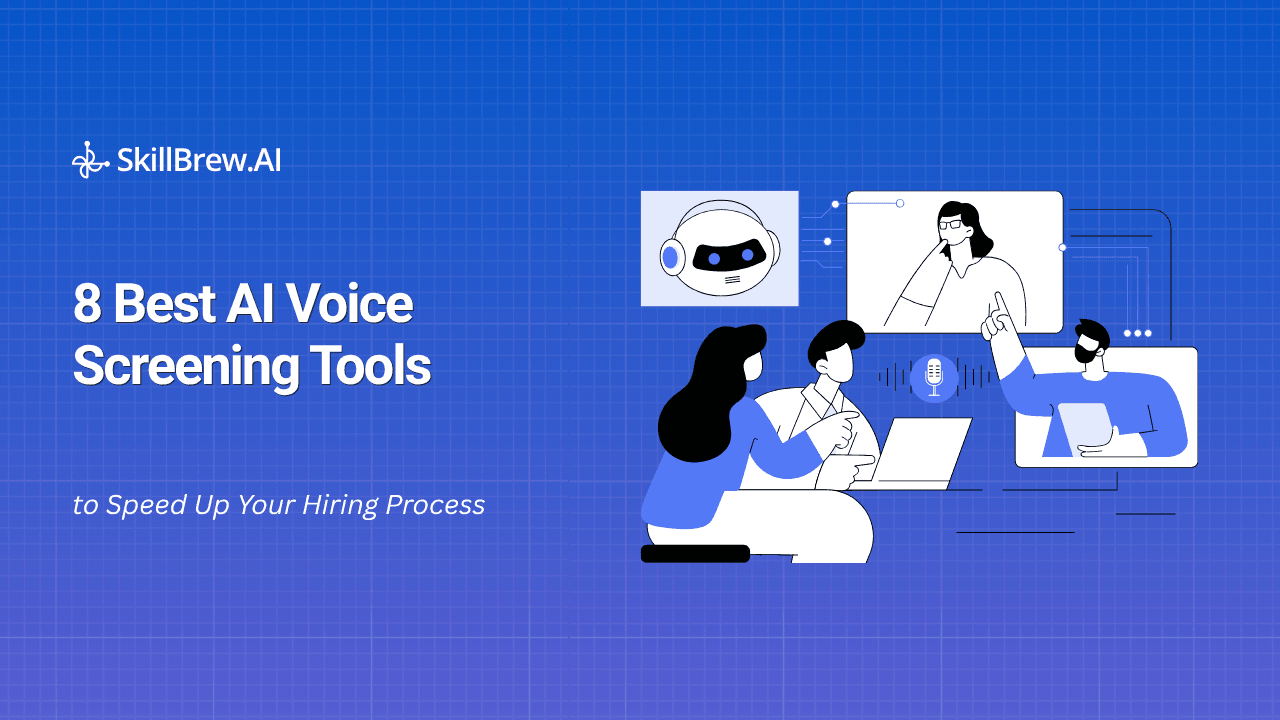
8 Best AI Voice Screening Tools to Speed Up Your Hiring Process
Recruiters aren't slow. The process is. When a hiring drive opens with 800 applicants and your team can realistically screen only 15 to 20 candidates a day, you're not running recruitment, you're managing a backlog. And the first stage to break is almost always the phone screen. Either your recruiters rush through calls to keep up with volume, and your shortlist quality tanks. Or screening gets delayed, and your best candidates ghost you before they ever reach an interview. This is exactly wh

Recruiters aren't slow. The process is.
When a hiring drive opens with 800 applicants and your team can realistically screen only 15 to 20 candidates a day, you're not running recruitment, you're managing a backlog. And the first stage to break is almost always the phone screen.
Either your recruiters rush through calls to keep up with volume, and your shortlist quality tanks. Or screening gets delayed, and your best candidates ghost you before they ever reach an interview.
This is exactly why conversational AI for smoother hiring has become one of the fastest-growing categories in recruitment technology. Instead of forcing recruiters to manually dial every applicant, these platforms run structured, human-like screening conversations at scale, score the responses, and hand recruiters a ready-to-act report in minutes, not weeks.
In this guide, we break down the best AI call screening tools available today, what each one does best, and exactly what TA leaders should look for before signing a contract.
Table of Contents
- Why Conversational AI for Smoother Hiring Actually Matters
- What Makes a Great AI Call Screening Tool?
- The 8 Best AI Call Screening Tools for HR Teams in 2026
- What to Demand Before You Sign a Contract
- The ROI of Conversational AI for Smoother Hiring
- Frequently Asked Questions
Why Conversational AI for Smoother Hiring Actually Matters
Most TA teams already have solutions for resume screening and technical assessments. What they usually lack is a scalable way to evaluate communication and candidate intent, before a recruiter ever picks up the phone.
A resume tells you where someone worked. An assessment tells you whether they have the skills. Neither tells you:
- Can the candidate clearly communicate their experience?
- Do they actually understand the role they applied for?
- Are there early red flags a resume won't reveal?
- Is the candidate genuinely interested and available?
This is the gap that conversational AI for smoother hiring is built to close. Modern voice screening platforms run structured conversations with every applicant and generate actionable hiring insights before recruiters invest a single hour in live interviews. For teams hiring at scale, that alone can shrink a screening timeline from weeks to days.
What Makes a Great AI Call Screening Tool?
Not every voice screening platform delivers real conversational AI for smoother hiring, plenty are just glorified IVR bots wearing an "AI" label. Before you evaluate conversational AI for smoother hiring vendors, the strongest solutions share a few non-negotiable traits:
Adaptive Conversations The platform should probe deeper when a response is vague, instead of blindly marching through a fixed script.
Structured Reporting Recruiters need scored outputs and clear recommendations, not raw transcripts they have to sit and interpret.
High-Volume Capacity It should handle hundreds, or thousands, of simultaneous screening conversations without any drop in quality.
Multi-Language Support Especially in India, language flexibility directly impacts candidate participation and completion rates.
ATS and Workflow Integration Screening results should flow straight into your hiring workflow, not sit in a CSV waiting to be manually uploaded.
The 8 Best AI Voice Screening Tools for HR Teams
1. SkillBrew.AI - BrewVoice (Rhea)
Category: AI Voice Agent
Best For: High-volume hiring, campus recruitment, staffing firms, frontline hiring, the Indian market
BrewVoice is SkillBrew.AI's flagship platform for conversational AI for smoother hiring, purpose-built for TA teams operating at real scale.
Unlike most global platforms optimized primarily for English-speaking markets, BrewVoice is engineered for Indian hiring workflows, supporting 10+ regional languages and a wide range of accent profiles. Candidates can be screened over telephonic calls or WhatsApp, whichever gets you the highest completion rate.
BrewVoice runs structured but genuinely adaptive conversations and hands recruiters a three-signal report covering:
- Role fit
- Technical signal
- Communication clarity
Rather than just recording answers, Rhea (BrewVoice's voice agent) probes deeper whenever a response needs clarification, giving recruiters a far richer candidate profile than a static call script ever could. This is conversational AI for smoother hiring in its purest form: the conversation adapts to the candidate, not the other way around.
Key Features
- 500+ outbound calls per day
- Support for 10+ Indian languages
- WhatsApp and telephonic delivery
- Structured 3-signal candidate reports
- Strict pay-as-you-go pricing — no subscriptions, no expiring balances
- Free HireFlow orchestration layer included
Potential Limitation Teams hiring globally should evaluate regional language coverage beyond the Indian market before committing.
2. Paradox (Olivia)
Category: Conversational AI Assistant
Best For: Retail, hospitality, hourly hiring
Olivia is one of the most recognized names offering conversational AI for smoother hiring, with real strength in candidate engagement, scheduling, and workflow automation. Voice capabilities keep expanding, but the platform is still strongest in highly standardized hiring environments rather than deep, adaptive screening.
3. HireVue Voice Screening
Category: Enterprise Assessment Platform
Best For: Large enterprises
HireVue folds voice screening into a much broader ecosystem of assessments, interviews, and evaluation tools. Organizations already invested in HireVue tend to treat the voice module as an extension of an existing workflow rather than a standalone conversational AI for smoother hiring solution.
4. Sense
Category: Talent Engagement Platform
Best For: Staffing agencies and talent re-engagement
Sense is built around candidate relationship management and reactivating dormant talent pools. Its voice functionality is genuinely useful for outreach and re-engagement, but it's generally positioned as a complement to a primary screening system, not a replacement for one.
5. Interviewer.AI
Category: AI Assessment Platform
Best For: Communication analysis
Interviewer.AI evaluates recorded candidate responses and analyzes signals like clarity, tone, pace, and vocabulary. Its strength is scoring pre-recorded responses rather than running live, adaptive voice conversations.
6. Talview
Category: Assessment and Proctoring Platform
Best For: Enterprise assessment programs
Talview bundles assessments, interviews, and proctoring into one platform. Organizations that prioritize assessment integrity often shortlist Talview specifically for its monitoring capabilities.
7. Willo
Category: Asynchronous Interview Platform
Best For: Small and mid-sized businesses
Willo strips out scheduling headaches by letting candidates record responses on their own time. It's effective for cutting coordination overhead, but it doesn't offer real-time conversational screening.
8. VoiceForm
Category: Voice Data Collection Platform
Best For: Accessibility-focused candidate intake
VoiceForm turns traditional forms into voice-based experiences. It isn't a full recruitment screening platform, but it can reduce friction in environments where typing creates a barrier.
What to Demand From Any Voice Screening Tool Before You Sign
Choosing the right platform means looking past the marketing deck. Here's what actually determines whether a tool can support real-world hiring volume, and deliver genuine conversational AI for smoother hiring rather than a scripted call bot in disguise.
| Evaluation Criteria | Minimum Standard | Why It Matters |
| Daily call capacity | 300+ simultaneous | Prevents bottlenecks during hiring spikes |
| Language support | Matches candidate demographics | Improves participation and completion rates |
| Conversation adaptability | Dynamic follow-up questions | Produces richer candidate insights |
| Report structure | Scored outputs, not transcripts | Enables faster recruiter decision-making |
| Delivery channel | Telephonic or WhatsApp support | Reduces candidate drop-off |
| Pricing model | Usage-based or flexible | Better aligns with hiring volume fluctuations |
Traditional Screening vs. Conversational AI for Smoother Hiring
Most TA teams don't grasp the real operational impact of voice automation until they see the two workflows side by side.
| Hiring Activity | Traditional Screening | Conversational AI for Smoother Hiring |
| Candidate outreach | Recruiter calls individually | Automated outbound conversations |
| Daily screening capacity | 20–40 candidates | Hundreds or thousands |
| Scheduling effort | High (back-and-forth emails) | Minimal (automated calendar sync) |
| Evaluation consistency | Recruiter dependent | Standardized framework |
| Candidate reporting | Manual notes | Structured scoring dashboard |
| Time to shortlist | Days or weeks | Hours or days |
| Recruiter workload | High | Significantly reduced |
The ROI of Conversational AI for Smoother Hiring
The return on investment here is often easier to calculate than for most other recruitment tech.
Take a hiring drive that requires 500 first-round screening calls. At roughly 20 minutes per conversation, recruiters would need to burn over 160 hours just making calls. An AI voice agent can run those same conversations overnight and hand back structured reports by the next business day.
Even after budgeting time for recruiter review, organizations typically compress screening timelines from multiple weeks down to a few days. That's not a marginal efficiency gain, it's a fundamentally different operating model, powered end-to-end by conversational AI for smoother hiring. Once TA teams see those numbers, going back to manual calling feels almost impossible.
Conclusion
The real challenge in high-volume hiring was never attracting candidates, it's evaluating them fast enough to keep your best applicants engaged. AI call screening tools automate one of the most time-consuming stages in the funnel while improving consistency, cutting recruiter workload, and speeding up hiring decisions.
For teams running campus drives, staffing operations, frontline hiring, or large-scale recruitment campaigns, conversational AI for smoother hiring is quickly becoming one of the highest-impact automation investments a TA leader can make.
Frequently Asked Questions
What should an AI voice screening tool provide after a call?
The best platforms deliver structured reports, candidate scores, and shortlist recommendations, not just raw transcripts you have to interpret yourself.
What's the difference between a voice bot and conversational AI screening?
Traditional voice bots follow fixed scripts. True conversational AI for smoother hiring adapts dynamically, asks intelligent follow-up questions, and produces far richer candidate evaluation data.
Which AI voice screening tools work best in India?
Teams hiring across India should prioritize platforms with strong regional language support, accent coverage, and WhatsApp-based delivery, exactly what makes BrewVoice a strong fit for Indian TA teams.
How does an AI voice screening tool differ from an ATS?
An ATS manages candidate workflows and application tracking. Conversational AI for smoother hiring actively evaluates candidates through structured, adaptive conversations, the ATS just tracks what happens next.
Is AI voice screening accurate enough for shortlisting?
When properly configured, AI voice screening platforms can achieve strong alignment with recruiter screening outcomes while dramatically cutting screening time.
How much does AI voice screening cost?
Pricing varies by platform. Many modern solutions, including SkillBrew.AI, run on usage-based, pay-as-you-go pricing that scales with your hiring volume, no subscriptions, no expiring balances.
See conversational AI for smoother hiring in action
Watch BrewVoice run a live voice screen against your actual JD, in the language of your choice, and walk through the 3-signal output in real time.
See AI-powered hiring in action
Discover how SkillBrew helps hiring teams cut time-to-hire by 60% with skill-validated assessments and AI-ranked shortlists.
Book a free demoNo commitment required · 30 minutes
Continue reading
View All Posts