Campus Placement Drive
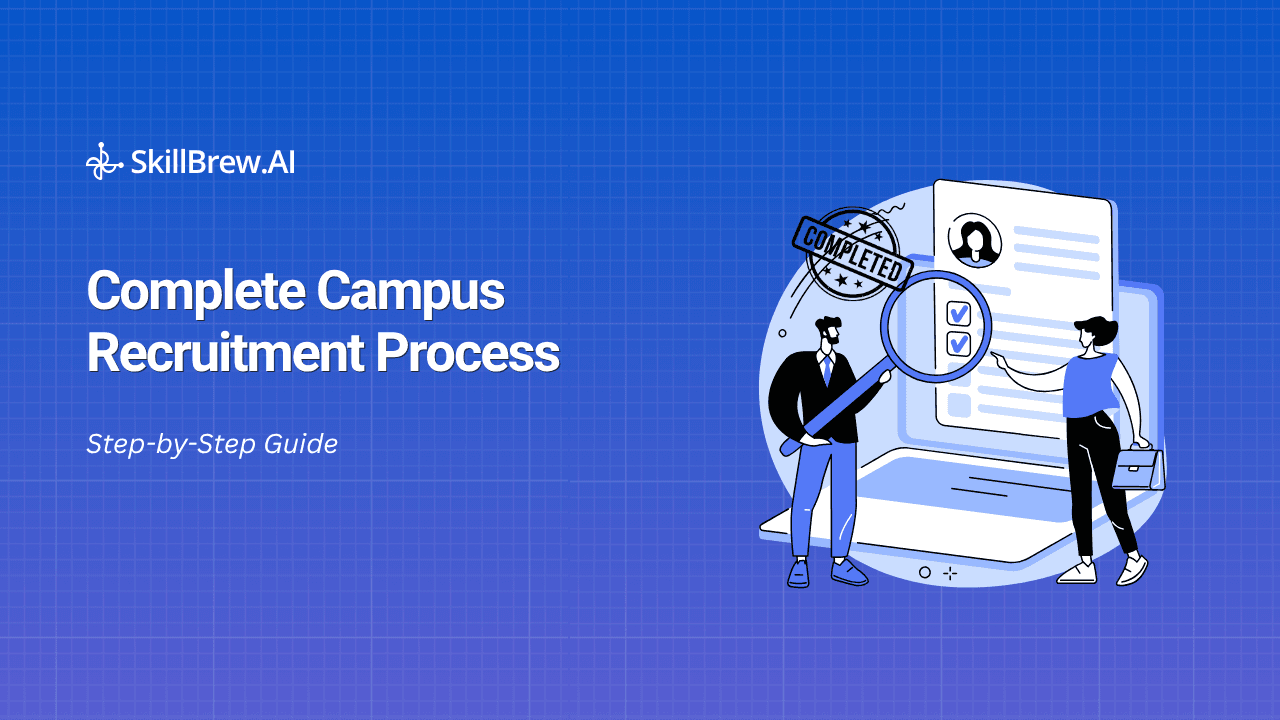
The Complete Campus Recruitment Process: Step-by-Step Guide
A complete guide to the campus recruitment process, from planning to offer rollout. Built for TA leaders who hire at scale from colleges.
Hiring graduates directly from colleges and universities has evolved far beyond conducting interviews during campus placement drives.
Today's campus recruitment process is a strategic talent acquisition function that requires careful planning, data-driven decision-making, structured candidate evaluation, and long-term engagement. Organizations that consistently hire high-performing graduates rarely succeed by chance. They build repeatable systems that help them identify, assess, and retain young talent for entry-level positions at scale.
Many campus hiring initiatives do not fail during interviews. The real challenges often emerge weeks earlier. Poor campus selection, unclear hiring requirements, inconsistent assessments, delayed offer rollouts, and weak candidate engagement can all reduce hiring success before candidates even reach the final stage.
When managed effectively, campus recruitment remains one of the most efficient ways to build a future-ready workforce. It gives organizations access to a diverse talent pool, strengthens employer branding among emerging professionals, and creates a sustainable pipeline of future leaders.
This guide breaks down the campus recruitment process step by step, covering everything from workforce planning and campus selection to onboarding and performance measurement.
Table of Contents
- What Is the Campus Recruitment Process?
- Why Campus Recruitment Matters in 2026
- Step 1: Pre-Drive Planning
- Step 2: Campus Selection
- Step 3: Pre-Placement Talks
- Step 4: Assessments and Screening
- Step 5: Interviews
- Step 6: Offer Rollout
- Step 7: Pre-Joining Engagement
- Step 8: Onboarding
- Campus Recruitment Metrics That Matter
- Running Campus Hiring at Scale
- The Role of AI in Campus Recruitment
- Frequently Asked Questions
- Final Thoughts
What Is the Campus Recruitment Process?
The campus recruitment process is a structured hiring approach through which organizations identify, assess, and hire students directly from colleges and universities for entry-level positions.
Rather than sourcing experienced professionals from the broader job market, companies engage with educational institutions to build a pipeline of future employees before they formally enter the workforce.
A typical campus recruitment process includes:
- Workforce planning
- Campus selection
- Pre-placement engagement
- Candidate assessments
- Interviews
- Offer management
- Pre-joining engagement
- Onboarding and retention
The primary objective is to create a reliable talent pool of young talent while maintaining hiring quality, controlling acquisition costs, and supporting long-term workforce growth.
Why Campus Recruitment Matters in 2026
Campus hiring remains a critical talent strategy across technology, consulting, financial services, manufacturing, healthcare, retail, and emerging digital industries.
However, the environment has changed significantly.
Students today evaluate employers differently than previous generations. They seek meaningful work, career development opportunities, flexibility, learning pathways, and transparent communication throughout the recruitment journey.
At the same time, Talent Acquisition teams face growing pressure to hire larger volumes without sacrificing quality.
Several trends are shaping modern campus recruitment strategies:
Skills-Based Hiring Is Becoming More Important
Academic performance still matters, but organizations increasingly prioritize practical skills, learning agility, problem-solving ability, communication, and adaptability.
AI Is Reshaping Recruitment Operations
Recruiters are using AI-powered tools to streamline screening, assessments, scheduling, candidate communication, and analytics. This allows hiring teams to focus more on decision-making and candidate experience.
Competition for Top Graduates Is Increasing
High-performing students often receive multiple opportunities simultaneously. Organizations that move quickly and communicate clearly gain a significant advantage.
Candidate Experience Impacts Employer Brand
Students share experiences across peer groups, alumni networks, and social platforms. A positive recruitment experience can strengthen employer reputation for future hiring cycles.
For organizations planning sustainable workforce growth, campus recruitment remains one of the most scalable methods for attracting and developing future talent.
Step 1: Pre-Drive Planning, Where Successful Campus Recruitment Begins
Many organizations assume campus hiring starts when recruiters arrive on campus.
In reality, the most important decisions are made weeks before the first placement drive takes place.
Strong campus recruitment outcomes are usually the result of deliberate planning. Weak outcomes often trace back to unclear objectives, poor coordination, or unrealistic hiring expectations established during the planning phase.
Ideally, preparation should begin six to eight weeks before the recruitment cycle.
Determine Workforce Requirements
The first question is straightforward:
How many hires are actually needed?
Talent Acquisition teams should work closely with business leaders to establish approved hiring targets across departments.
This includes identifying:
- Required headcount
- Functional roles
- Location requirements
- Hiring timelines
- Expected joining periods
Without a clear workforce plan, recruitment efforts become reactive rather than strategic.
Hiring "as many good candidates as possible" may sound flexible, but it often creates budget, onboarding, and workforce planning challenges later.
Define the Ideal Candidate Profile
Fresh graduates typically have limited professional experience.
As a result, organizations must identify alternative indicators that predict future success.
Potential evaluation criteria may include:
- Academic performance
- Technical competencies
- Communication skills
- Leadership activities
- Internship experience
- Problem-solving ability
- Learning agility
Establishing clear standards early helps maintain consistency across multiple campuses and interview panels.
Align Stakeholders Before the Drive
Campus hiring involves more stakeholders than many teams initially anticipate.
Key participants often include:
- Talent Acquisition teams
- Hiring managers
- Business leaders
- Learning and Development teams
- College placement coordinators
- HR operations teams
Every participant should understand their responsibilities before recruitment activities begin.
Organizations that define ownership clearly typically experience faster decision-making and fewer delays.
Build a Recruitment Timeline
Campus placement schedules are often competitive.
Many leading institutions finalize recruitment calendars months in advance.
Organizations should work backward from target joining dates to establish deadlines for:
- Campus registrations
- Pre-placement talks
- Assessments
- Interviews
- Offer approvals
- Candidate engagement activities
A structured timeline reduces last-minute bottlenecks and ensures hiring goals remain achievable.
Establish Success Metrics Early
Before visiting campuses, determine how success will be measured.
Common campus recruitment KPIs include:
- Applications received
- Assessment pass rates
- Interview conversion rates
- Offer acceptance rates
- Joining rates
- Retention rates
- Time-to-hire
Defining metrics in advance creates accountability throughout the hiring process.
Step 2: Campus Selection, Choosing the Right Colleges and Universities
Not every institution produces the same talent outcomes.
One of the most overlooked aspects of campus recruitment strategy is campus selection itself.
Many organizations repeatedly visit the same colleges because of historical relationships rather than current hiring needs.
A more effective approach evaluates campuses based on measurable outcomes and role alignment.
Analyze Historical Hiring Data
Organizations that have previously hired from a campus possess valuable data.
Review metrics such as:
- Interview-to-offer conversion rates
- Offer acceptance rates
- Joining rates
- First-year retention
- Performance ratings
- Promotion velocity
A campus consistently producing successful employees often delivers greater value than one with a stronger brand name but weaker hiring outcomes.
Match Academic Programs to Role Requirements
Different institutions have different strengths.
For example:
- Engineering programs may be suitable for technical hiring.
- Business schools may support management trainee recruitment.
- Specialized institutions may offer stronger talent for design, healthcare, finance, or analytics roles.
The objective is not simply to recruit from prestigious institutions.
The objective is to recruit from institutions that consistently produce candidates aligned with role requirements.
Consider Geographic Diversity
Campus hiring also presents an opportunity to broaden workforce diversity.
Limiting recruitment to a small number of metropolitan institutions can reduce exposure to talented candidates from emerging educational hubs.
Regional colleges and universities often provide access to highly motivated graduates with strong long-term retention potential.
Invest in Long-Term Campus Relationships
Strong relationships with placement offices create operational advantages.
Consistent engagement can improve:
- Drive scheduling
- Candidate participation
- Employer visibility
- Communication efficiency
- Future hiring opportunities
Many successful employers maintain relationships throughout the year rather than only during recruitment season.
Evaluate Employer Brand Presence
Students increasingly research employers before applying.
Organizations should assess how they are perceived across target campuses and identify opportunities to strengthen awareness through:
- Alumni engagement
- Career workshops
- Industry talks
- Internship programs
- Student partnerships
Campus selection should support both immediate hiring goals and long-term employer branding objectives.
Step 3: Pre-Placement Talks, Building Interest Before Applications Open
Pre-placement talks often determine whether top students apply in the first place.
Yet many organizations treat them as routine presentations rather than strategic employer branding opportunities.
Students compare employers extensively during recruitment season.
The organizations that communicate clearly, answer questions honestly, and provide realistic role expectations often attract stronger applicants.
Explain the Role Clearly
One of the most common mistakes during pre-placement talks is relying on vague descriptions.
Students want clarity.
They want to understand:
- What the role involves
- Who they will work with
- What responsibilities they will have
- How performance is measured
- What the first year looks like
The more specific the explanation, the easier it becomes for suitable candidates to self-select into the process.
Be Transparent About Compensation and Growth
Transparency builds credibility.
Candidates evaluating entry-level positions want to understand:
- Compensation structure
- Fixed and variable pay components
- Learning opportunities
- Promotion pathways
- Performance review cycles
Clear communication reduces misunderstandings and improves offer acceptance rates later in the process.
Showcase Company Culture Authentically
Students are increasingly interested in workplace culture.
Rather than relying on generic statements, organizations should share practical examples of:
- Team collaboration
- Learning programs
- Mentorship initiatives
- Employee development opportunities
- Career progression stories
Authentic examples create stronger engagement than polished marketing language.
Encourage Meaningful Q&A Sessions
The most valuable portion of a pre-placement talk is often the question-and-answer session.
Students commonly ask about:
- Career growth
- Work-life balance
- Hybrid work arrangements
- Learning opportunities
- Team culture
- Leadership accessibility
Organizations that answer directly often build stronger trust with prospective candidates.
Communicate the Recruitment Process Clearly
Candidates should leave the session understanding:
- Assessment stages
- Interview rounds
- Evaluation criteria
- Timelines
- Communication expectations
Clear expectations improve candidate experience and reduce confusion throughout the recruitment process.
By the end of the pre-placement phase, students should have enough information to determine whether the opportunity aligns with their goals and aspirations.
Step 4: Assessments and Screening, The Foundation of Scalable Campus Hiring
As application volumes grow, assessments become one of the most important stages in the campus recruitment process.
A campus drive with 500 to 1,000 eligible students can generate hundreds of applications for a single role. Without a structured screening framework, Talent Acquisition teams quickly become overwhelmed, and hiring decisions become inconsistent.
The objective of assessments is not simply to eliminate candidates. It is to identify the applicants most likely to succeed in the role while creating a fair and standardized evaluation process.
A well-designed assessment framework improves hiring quality, reduces interviewer workload, and creates a defensible basis for selection decisions.
Why Structured Assessments Matter
Many organizations still rely heavily on resume screening during campus recruitment.
This approach has limitations.
Fresh graduates often have similar educational backgrounds, comparable academic records, and limited work experience. Resume reviews alone rarely provide enough information to accurately predict future performance.
Structured assessments help recruiters evaluate candidates based on demonstrated capabilities rather than assumptions.
Benefits include:
- Consistent evaluation across campuses
- Faster shortlisting decisions
- Improved hiring quality
- Reduced interviewer bias
- Better data for hiring managers
- Stronger compliance and audit readiness
When implemented correctly, assessments create a ranked candidate pool rather than a simple pass-or-fail list.
Aptitude Assessments
Aptitude tests remain one of the most widely used evaluation methods in campus hiring.
These assessments typically measure:
Quantitative Reasoning
Evaluates numerical problem-solving ability, analytical thinking, and comfort with data.
Logical Reasoning
Measures pattern recognition, critical thinking, and decision-making skills.
Verbal Ability
Assesses reading comprehension, written communication, and language proficiency.
The weighting of each component should align with role requirements.
For example:
- Finance roles may emphasize quantitative reasoning.
- Consulting roles may prioritize analytical thinking.
- Customer-facing positions may require stronger verbal communication skills.
The most effective aptitude tests measure capabilities directly related to job performance rather than testing obscure academic concepts.
Technical Assessments
For engineering, product, analytics, cybersecurity, and technical roles, role-specific assessments are often essential.
These evaluations may include:
- Coding challenges
- Technical multiple-choice questions
- Case studies
- Data interpretation exercises
- Problem-solving scenarios
- Domain-specific simulations
The goal is not to create the most difficult assessment possible.
The goal is to differentiate candidates who possess the foundational skills required for success.
Assessments that are excessively complex can unintentionally favor candidates who have practiced test-taking techniques rather than those with genuine capability.
Communication and Writing Assessments
Communication skills are increasingly important across industries.
Even highly technical roles often require collaboration across teams, stakeholder management, documentation, and presentations.
Short writing exercises can reveal:
- Clarity of thought
- Structured communication
- Attention to detail
- Problem-solving approach
- Business awareness
For many organizations, a brief communication assessment provides insights that resumes cannot.
Building a Candidate Ranking Framework
One of the most effective approaches is assigning weighted scores across assessment categories.
Instead of a binary pass-or-fail model, organizations can create candidate rankings based on:
- Aptitude performance
- Technical capability
- Communication skills
- Academic background
- Relevant project experience
This provides hiring managers with richer information and supports more informed interview decisions.
The Growing Role of AI in Assessments
Many organizations are adopting AI-powered assessment platforms to manage larger candidate volumes.
These systems can help automate:
- Test creation
- Candidate scoring
- Performance benchmarking
- Shortlisting recommendations
- Assessment analytics
For organizations conducting campus hiring across multiple locations, automation can improve consistency while reducing administrative effort.
The most successful implementations combine AI-driven efficiency with human oversight during final hiring decisions.
Step 5: Interviews, Turning Assessment Data into Hiring Decisions
After assessments, shortlisted candidates move into the interview stage.
This is where organizations validate assessment results, evaluate role fit, and identify candidates with long-term potential.
Unfortunately, interviews are also where inconsistency often enters the process.
When different interviewers evaluate candidates using different standards, hiring quality suffers.
The most effective campus recruitment programs rely on structured interviews rather than subjective impressions.
What Makes a Good Campus Interview Process?
A strong interview framework should be:
- Consistent
- Role-specific
- Score-based
- Easy to compare across candidates
- Aligned with business requirements
The objective is not to identify the most confident speaker.
The objective is to identify candidates who demonstrate the skills, behaviors, and potential required for success.
Group Discussions
Many organizations use Group Discussions (GD) as an early-stage evaluation tool.
Group discussions can be useful for assessing:
- Communication skills
- Team interaction
- Leadership potential
- Listening ability
- Structured thinking
However, their effectiveness depends on the role.
For positions involving customer interaction, consulting, sales, or stakeholder management, group discussions may provide valuable insights.
For highly technical individual contributor roles, they may contribute less predictive value.
If used, evaluations should be based on predefined criteria rather than general impressions.
Technical Interviews
Technical interviews remain one of the most important stages for role-specific hiring.
Interviewers should focus on:
- Problem-solving approach
- Technical fundamentals
- Practical application of knowledge
- Learning ability
- Curiosity and adaptability
For fresh graduates, the emphasis should be on foundational understanding rather than years of practical experience.
Interviewers often gain more useful insights by exploring how candidates think through problems than by focusing exclusively on correct answers.
HR Interviews
HR interviews help evaluate factors that may not emerge during technical assessments.
Areas commonly explored include:
- Communication style
- Career motivation
- Learning mindset
- Adaptability
- Workplace expectations
- Professional maturity
Behavioral questions often generate more useful responses than generic interview prompts.
Scenario-based discussions can reveal how candidates approach challenges, feedback, teamwork, and decision-making.
Hiring Manager Interviews
For many organizations, hiring manager participation significantly improves hiring quality.
Managers can assess:
- Functional fit
- Team alignment
- Long-term growth potential
- Problem-solving style
- Role expectations
This stage is particularly valuable when managers will be directly responsible for onboarding and performance development.
Standardized Scorecards Improve Decision Quality
One of the simplest ways to improve campus hiring outcomes is implementing structured interview scorecards.
Scorecards create consistency across:
- Campuses
- Interview panels
- Hiring managers
- Recruitment cycles
Common scoring categories include:
- Technical capability
- Communication
- Problem-solving
- Learning agility
- Role fit
- Overall recommendation
Structured scoring reduces bias and provides a clearer foundation for final hiring decisions.
AI-Assisted Interviewing in Campus Recruitment
As applicant volumes increase, some organizations are exploring AI-assisted interview workflows.
These solutions may support:
- Initial candidate screening
- Asynchronous interview evaluation
- Communication analysis
- Structured reporting
- Candidate benchmarking
While automation can improve efficiency, final hiring decisions should continue to involve human judgment, particularly for evaluating cultural and team fit.
Step 6: Offer Rollout, The Most Overlooked Stage of Campus Recruitment
Many organizations invest significant time and effort in sourcing, assessments, and interviews, only to lose candidates during the offer stage.
In competitive campus hiring markets, speed and clarity often determine whether candidates ultimately join.
The offer process is not an administrative task.
It is a critical conversion stage.
Why Offer Rollout Matters
Top candidates frequently receive multiple opportunities.
A delayed or confusing offer process can create uncertainty and encourage candidates to accept alternative opportunities.
Organizations that move efficiently often gain an advantage even when competing against larger employers.
Send Offers Promptly
One of the most common mistakes in campus recruitment is excessive delay between interview completion and offer issuance.
Candidates who receive verbal confirmation typically expect formal documentation quickly.
Extended delays can lead to:
- Candidate uncertainty
- Reduced engagement
- Increased offer declines
- Higher dropout rates
Establishing clear approval workflows before recruitment season begins helps reduce these bottlenecks.
Ensure Offer Letters Are Easy to Understand
For many graduates, this is their first professional offer.
Offer letters should clearly explain:
- Compensation structure
- Fixed and variable components
- Benefits
- Role details
- Joining timeline
- Documentation requirements
Clarity improves trust and reduces unnecessary back-and-forth communication.
Maintain Consistent Communication
Receiving an offer should not be the final interaction until joining day.
Candidates often have questions regarding:
- Relocation
- Team structure
- Training programs
- Work arrangements
- Documentation processes
Responsive communication reinforces confidence in the organization.
Create a Positive Acceptance Experience
The acceptance process should be straightforward and professional.
Organizations that simplify:
- Offer review
- Documentation submission
- Candidate communication
- Next-step instructions
often experience stronger conversion rates.
Establish a Dedicated Candidate Contact
Assigning a single point of contact can significantly improve candidate experience.
Graduates should know exactly who to contact for:
- Clarifications
- Documentation questions
- Joining logistics
- Process updates
This simple step often reduces confusion and improves engagement throughout the pre-joining period.
Technology Can Streamline Offer Management
Modern recruitment platforms increasingly support:
- Automated offer generation
- Approval workflows
- Candidate communication
- Document collection
- Offer acceptance tracking
For organizations managing large hiring cohorts, automation can improve efficiency while reducing manual administrative work.
However, technology should support the process, not replace human communication.
Candidates remember how organizations make them feel during the recruitment journey. Timely communication, transparency, and responsiveness continue to play a major role in shaping acceptance and joining decisions.
Step 7: Pre-Joining Engagement, The Key to Improving Joining Rates
Many organizations assume the campus recruitment process ends when a candidate accepts an offer.
In reality, one of the most important stages begins after offer acceptance.
The period between acceptance and joining can span several months, particularly in campus hiring programs where students complete their academic requirements before entering the workforce.
Without structured engagement during this period, organizations risk losing candidates they have already invested significant time and resources in recruiting.
Why Pre-Joining Engagement Matters
Offer acceptance does not guarantee joining.
Graduates may:
- Receive competing offers
- Reconsider career plans
- Pursue higher education opportunities
- Lose confidence due to lack of communication
- Experience uncertainty about the role
Organizations that actively engage candidates throughout the pre-joining period generally achieve stronger joining rates and a more positive candidate experience.
Create a Structured Communication Plan
Consistent communication helps maintain momentum.
Rather than sending generic updates, organizations should provide meaningful information that keeps candidates connected to the company.
Examples include:
- Team introductions
- Company updates
- Learning resources
- Industry insights
- Joining preparation materials
- Frequently asked questions
Communication should feel informative rather than promotional.
The goal is to reinforce commitment and reduce uncertainty.
Provide Learning and Development Resources
Many graduates are eager to begin preparing for their future roles.
Organizations can support this by sharing:
- Recommended reading materials
- Product knowledge resources
- Technical learning modules
- Industry fundamentals
- Company orientation content
Early learning opportunities create engagement while helping candidates build confidence before joining.
Build Community Before Day One
One of the most effective engagement strategies is helping future employees connect with one another.
Organizations may facilitate:
- Virtual networking sessions
- Candidate communities
- Alumni interactions
- New-hire discussion groups
- Informal meet-and-greet events
These interactions help candidates feel part of a cohort rather than isolated individuals waiting to start work.
Simplify Documentation Requirements
Administrative complexity can create unnecessary frustration.
Candidates should receive clear guidance regarding:
- Required documents
- Submission timelines
- Verification processes
- Joining procedures
Simple instructions reduce confusion and create a more professional experience.
Maintain a Human Connection
Technology can automate reminders and updates, but personal communication remains valuable.
Periodic check-ins from recruiters, hiring managers, or future team members often strengthen candidate commitment and reinforce enthusiasm about joining.
Step 8: Onboarding, Turning New Hires into Productive Employees
The campus recruitment process does not end on joining day.
Recruitment delivers value only when new hires become productive, engaged, and retained employees.
This is particularly important for campus hires because many graduates are entering a professional environment for the first time.
Unlike experienced professionals, they often require additional guidance, support, and structured development.
Why Campus Hire Onboarding Is Different
Fresh graduates face unique challenges.
They must learn:
- Professional communication
- Workplace expectations
- Team collaboration
- Time management
- Organizational processes
- Performance standards
Without structured support, even talented hires can struggle during their first months.
Assign Mentors or Buddies
A dedicated mentor or buddy can significantly improve the onboarding experience.
Mentors help graduates:
- Navigate organizational culture
- Ask questions comfortably
- Build internal relationships
- Gain confidence more quickly
The relationship should be active and intentional rather than symbolic.
Regular check-ins help maximize value.
Create Structured Learning Pathways
Many graduates possess strong theoretical knowledge but limited practical experience.
Structured learning programs can accelerate development.
Examples include:
- Technical training
- Product education
- Business process training
- Communication workshops
- Role-specific certifications
Learning opportunities help employees transition from academic environments into professional roles.
Establish Clear 30-60-90 Day Goals
Graduates perform better when expectations are explicit.
A structured onboarding plan should outline:
First 30 Days
- Orientation
- Team integration
- Foundational learning
First 60 Days
- Initial project contributions
- Skill development milestones
- Manager feedback sessions
First 90 Days
- Performance evaluation
- Increased ownership
- Development planning
Clear milestones reduce uncertainty and create measurable progress.
Build Regular Feedback Loops
Frequent feedback is particularly important during the first year.
Organizations should schedule:
- Weekly check-ins
- Monthly reviews
- Learning discussions
- Development conversations
Early feedback helps identify challenges before they become retention risks.
Measure Onboarding Success
Effective onboarding should contribute to:
- Faster productivity
- Stronger engagement
- Higher retention
- Better performance outcomes
When onboarding is treated as an extension of the recruitment process, organizations typically achieve stronger long-term hiring results.
Campus Recruitment Metrics That Actually Matter
Many organizations focus heavily on volume metrics.
While application numbers and hiring totals are useful, they do not provide a complete picture of recruitment effectiveness.
The most valuable metrics connect hiring activity to business outcomes.
Conversion Rate by Campus
Track progression through each stage:
- Applications
- Assessments
- Interviews
- Offers
- Acceptances
- Joinings
This helps identify which colleges and universities consistently produce successful outcomes.
Time-to-Offer
Measure the time between final interview completion and offer issuance.
Faster decision-making often improves candidate conversion rates during competitive recruitment cycles.
Offer Acceptance Rate
This metric indicates how attractive and competitive the organization's value proposition is within the market.
Joining Rate
Accepted offers that convert into actual joiners provide one of the clearest indicators of recruitment effectiveness.
90-Day Retention Rate
Early retention often highlights whether recruitment and onboarding strategies are aligned with candidate expectations.
Six-Month and Twelve-Month Performance
Long-term performance data helps organizations refine:
- Campus selection
- Assessment frameworks
- Interview processes
- Candidate profiles
Over time, these insights create a more predictive and effective hiring strategy.
Running Campus Recruitment at Scale
Managing one or two campus hiring programs can often be coordinated through spreadsheets and manual workflows.
Managing dozens of campuses across multiple locations is a different challenge entirely.
As hiring volumes increase, complexity grows rapidly.
Common Challenges at Scale
Inconsistent Evaluation Standards
Different recruiters and interviewers may apply different evaluation criteria, leading to uneven hiring outcomes.
Delayed Decision-Making
Approval bottlenecks often slow down interviews, offers, and communication.
Limited Process Visibility
When information is spread across emails, spreadsheets, and multiple systems, tracking candidate progress becomes difficult.
Candidate Drop-Off
Lack of engagement during the recruitment journey can increase withdrawal and no-show rates.
Administrative Overload
Scheduling, communication, assessments, and documentation become increasingly difficult to manage manually.
Building a Scalable Campus Recruitment Framework
Organizations that successfully scale campus hiring typically focus on:
- Standardized assessments
- Structured interviews
- Centralized candidate data
- Automated workflows
- Real-time reporting
- Consistent communication
The goal is not simply to process more candidates.
The goal is to maintain hiring quality while increasing operational efficiency.
How AI Is Transforming the Campus Recruitment Process in 2026
Artificial intelligence is becoming an increasingly important component of modern campus hiring strategies.
While AI does not replace recruiters or hiring managers, it can help organizations manage complexity more effectively.
AI-Powered Candidate Screening
AI systems can analyze applications and identify candidates who meet predefined criteria, reducing manual screening effort.
Automated Assessments
Organizations can generate role-specific assessments more quickly while maintaining evaluation consistency.
Interview Intelligence
AI-assisted interviewing solutions can help structure evaluations, summarize candidate responses, and support decision-making.
Recruitment Analytics
Advanced analytics help organizations identify patterns related to:
- Campus performance
- Candidate quality
- Offer acceptance
- Retention outcomes
Candidate Engagement Automation
Automated communication workflows help maintain candidate engagement throughout the hiring journey.
The Future of Campus Recruitment Technology
As recruitment technology evolves, organizations are increasingly looking for platforms that combine:
- Talent sourcing
- Candidate engagement
- Assessment management
- Interview workflows
- Analytics
- Automation
For teams prioritizing scalable hiring operations, AI-driven recruitment platforms such as SkillBrew.AI and other modern talent acquisition solutions are becoming part of broader workforce planning strategies.
The most effective implementations combine automation with human judgment, ensuring efficiency without sacrificing candidate experience.
Frequently Asked Questions
Q1. What is the campus recruitment process?
The campus recruitment process is a structured hiring approach through which organizations recruit students directly from colleges and universities for entry-level positions. It typically includes planning, campus selection, assessments, interviews, offer management, onboarding, and retention tracking.
Q2. Why is campus recruitment important?
Campus recruitment helps organizations build a long-term talent pool of young talent, reduce hiring costs, strengthen employer branding, and create a pipeline of future employees.
Q3. What are the main stages of campus recruitment?
The major stages include workforce planning, campus selection, pre-placement talks, assessments, interviews, offer rollout, pre-joining engagement, onboarding, and performance tracking.
Q4. How long does the campus recruitment process take?
The timeline varies by organization and hiring volume, but most campus recruitment cycles span several weeks to several months, beginning before placement season and continuing through onboarding.
Q5. How can organizations improve campus hiring success rates?
Organizations can improve outcomes through better campus selection, structured assessments, faster offer rollouts, stronger candidate communication, and comprehensive onboarding programs.
Q6. What metrics should HR teams track during campus recruitment?
Important metrics include conversion rates, offer acceptance rates, joining rates, time-to-offer, retention rates, and long-term employee performance.
Q7. How does AI support campus recruitment?
AI can assist with resume screening, assessments, interview workflows, candidate engagement, reporting, and recruitment analytics, helping teams manage larger hiring volumes more efficiently.
Q8. What is the difference between campus recruitment and lateral hiring?
Campus recruitment focuses on hiring students and recent graduates for entry-level positions, while lateral hiring targets experienced professionals with prior industry experience.
Final Thoughts
A successful campus recruitment process is built on far more than interviews and offer letters.
The organizations that consistently attract and retain high-performing graduates typically excel at planning, campus selection, candidate evaluation, engagement, and onboarding. They view campus hiring as a long-term talent strategy rather than a seasonal recruitment activity.
As competition for skilled graduates continues to increase, organizations must balance efficiency with candidate experience. Structured processes, data-driven decision-making, and thoughtful engagement will play an increasingly important role in attracting the next generation of talent.
Technology is also reshaping how organizations manage campus hiring. AI-powered recruitment solutions, automation platforms, and advanced analytics are helping Talent Acquisition teams scale operations while maintaining consistency and quality. For organizations exploring modern recruitment workflows, platforms like SkillBrew.AI represent the broader shift toward AI-assisted talent acquisition, candidate engagement, and scalable hiring operations.
Ultimately, the most effective campus recruitment strategies are those that transform a large talent pool into productive, engaged, and long-term employees. Organizations that achieve this consistently will be better positioned to build resilient workforces and sustainable growth in the years ahead.
Ready to Transform Your Campus Recruitment Process?
The most successful campus hiring programs combine structured processes, meaningful candidate engagement, data-driven decision-making, and the right technology.
Whether you're managing a few campus placement drives or running large-scale hiring campaigns across multiple colleges and universities, having a centralized recruitment platform can help your team improve efficiency, enhance candidate experience, and make better hiring decisions.
Book a demo with SkillBrew to see how your organization can streamline campus recruitment workflows, automate repetitive tasks, engage top student talent, and build a stronger pipeline for entry-level hiring.
Discover how SkillBrew helps Talent Acquisition teams attract, assess, and hire the right candidates faster while creating a seamless experience for recruiters, hiring managers, and students.
See AI-powered hiring in action
Discover how SkillBrew helps hiring teams cut time-to-hire by 60% with skill-validated assessments and AI-ranked shortlists.
Book a free demoNo commitment required · 30 minutes
Continue reading
View All Posts