Campus Placement Drive
Why Campus Hiring Is Harder Than It Looks (And What to Fix)
Every TA leader eventually runs into the same set of campus hiring challenges. Campus hiring looks easy from the outside. Visit a few colleges, run assessments, conduct interviews, make offers, and build next year's talent pipeline. Then placement season actually begins. Suddenly, TA teams are juggling thousands of applications, multiple campuses, overlapping placement calendars, interviewer availability issues, and offer acceptance rates that look very different from joining rates. The reali
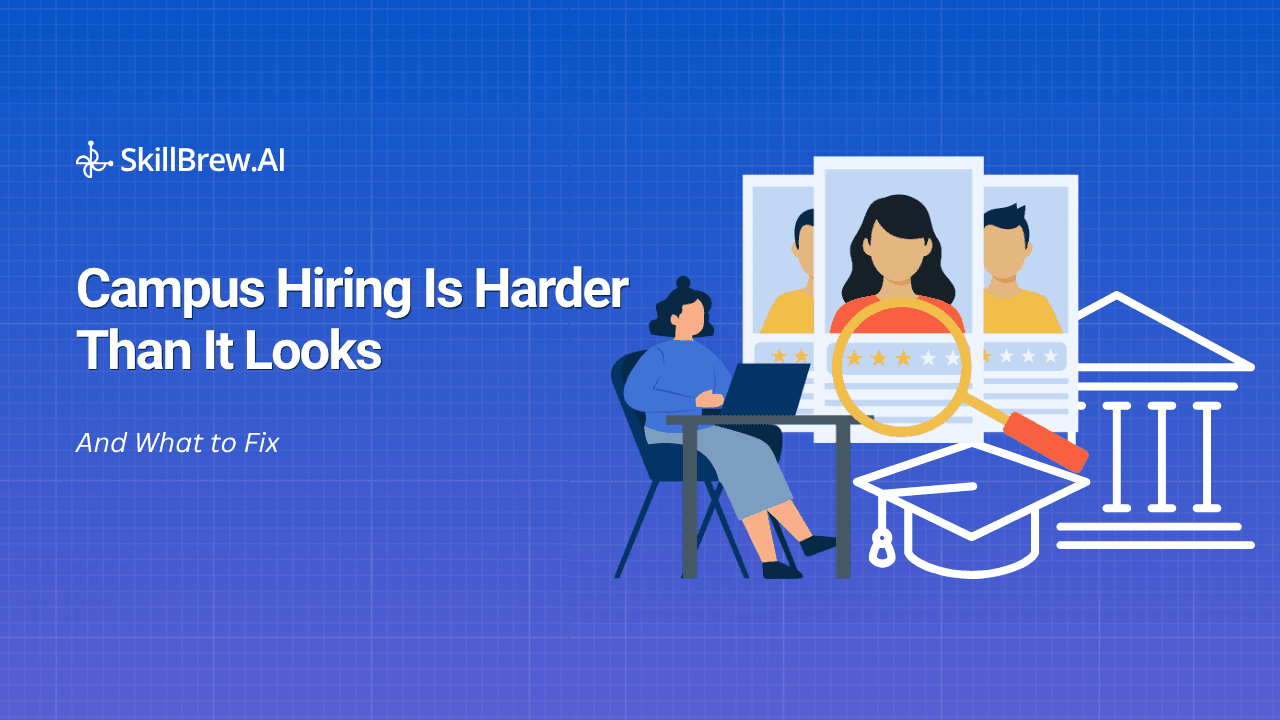
Every TA leader eventually runs into the same set of campus hiring challenges. Campus hiring looks easy from the outside. Visit a few colleges, run assessments, conduct interviews, make offers, and build next year's talent pipeline.
Then placement season actually begins.
Suddenly, TA teams are juggling thousands of applications, multiple campuses, overlapping placement calendars, interviewer availability issues, and offer acceptance rates that look very different from joining rates.
The reality is that most campus hiring challenges are predictable. They show up in the same places every year and create the same bottlenecks for recruiters, hiring managers, and placement teams. This guide breaks down the biggest campus hiring challenges, why they happen, and what to do about each one at scale.
Table of Contents
- Why Campus Recruitment Becomes Difficult at Scale
- Challenge #1: Too Much Volume
- Challenge #2: No Clear Evaluation Standard for Freshers
- Challenge #3: Interviewer Overload
- Challenge #4: Offer Drop-Offs Between Acceptance and Joining
- Challenge #5: The Speed vs. Quality Dilemma
- Challenge #6: Choosing the Wrong Campuses
- Challenge #7: Missing Hiring Data
- Why Pre-Placement Talks Matter More Than You Think
- Building a Campus Hiring Process That Scales
- FAQs on Campus Hiring Challenges
Why Campus Recruitment Becomes Difficult at Scale
Campus recruitment is unique because hiring happens in concentrated bursts. Applications don't arrive steadily over months, they arrive all at once, across multiple colleges, often within the same placement window. What works for hiring 20 candidates breaks quickly at 200.
Most campus hiring challenges ultimately trace back to four root issues: too much volume, inconsistent evaluation, interview bottlenecks, and poor process visibility. The organizations that hire successfully at scale are rarely the ones working harder. They're the ones running a more structured process.
Challenge #1: Too Much Volume
Campus applications arrive in waves. At 200 applications per campus and 15 campuses, recruiters are suddenly reviewing 3,000 resumes while managing the rest of the hiring pipeline.
Manual screening creates two problems here: screening quality drops as reviewer fatigue increases, and strong candidates wait longer for decisions. The result is inconsistent shortlists and delayed hiring, one of the most common campus hiring challenges on this list and usually the first one teams hit.
This particular challenge, of all the campus hiring challenges here, is the one automation fixes fastest.
How to fix it: the answer isn't more recruiters on the screening desk. Use structured application filters, implement automated resume ranking with HireFlow, define screening criteria before applications arrive, and prioritize candidates using standardized scoring. The goal is to start with a ranked shortlist rather than a queue of resumes.
Challenge #2: No Clear Evaluation Standard for Freshers
One interviewer values academic performance. Another prioritizes communication skills. A third focuses on internship experience. Without standardized evaluation criteria, candidate quality becomes subjective, and this is one of the most persistent campus hiring challenges in fresher recruitment specifically.
The result: strong candidates get rejected on interviewer preference, average candidates advance because they interview confidently, and campus-to-campus hiring quality becomes inconsistent.
How to fix it: every candidate needs to be measured against the same standard regardless of location or interviewer, standardized assessments, consistent scoring rubrics, and interview scorecards used across every campus. We cover the full framework for this in a dedicated breakdown of structured screening for campus recruitment if this is the piece breaking down for your team right now.
Challenge #3: Interviewer Overload
Campus hiring demands large amounts of interviewer time in a very short window, but hiring managers and technical interviewers still have their regular jobs to do. The result: interviews get delayed, schedules constantly shift, and recruiters spend more time coordinating calendars than evaluating talent. Of all the campus hiring challenges covered here, this is the one that burns out your best interviewers fastest.
How to fix it: reduce live interviews at the top of the funnel. Structured assessments, async video interviews, and automated first-round screening let interviewers spend time only with the strongest candidates instead of every shortlisted applicant.
Challenge #4: Offer Drop-Offs Between Acceptance and Joining
One of the most frustrating campus hiring challenges is offer attrition: a student accepts an offer in December and disappears before joining in July.
Most organizations assume compensation is the problem. Often, it isn't, the real issue is engagement. The gap between offer acceptance and joining can run six to eight months. During that stretch, students receive competing offers, communication becomes infrequent, and employer recall declines.
Fixing this one has more ROI than fixing most other campus hiring challenges combined.
How to fix it: maintain engagement through the pre-joining period with regular updates, onboarding checklists, community groups, scheduled touchpoints, and automated reminders. Organizations with structured pre-joining engagement consistently report higher joining rates.
Challenge #5: The Speed vs. Quality Dilemma
Every high-volume campus hiring program faces the same tension: move fast enough to secure talent, move carefully enough to hire the right people. When deadlines tighten, teams often skip scorecards, reduce evaluation rigor, rush approvals, and compress interview rounds. Hiring targets get met, but quality becomes uncertain, arguably the highest-stakes of all the campus hiring challenges because it's invisible until the cohort underperforms a year later.
How to fix it: The answer isn't slowing down, it's removing manual work from the process. Structured assessments, automated ranking, and standardized workflows let organizations move quickly without sacrificing hiring quality.
Challenge #6: Choosing the Wrong Campuses
Many organizations return to the same campuses year after year, not because they produce the best hires, but because they've always been part of the strategy. This creates a hidden problem: a prestigious campus may generate high application volume but poor retention, while a lesser-known institution consistently produces stronger long-term performers.
This is a slower fix than the other campus hiring challenges, but it compounds year over year.
How to fix it: build campus selection criteria around outcomes, retention rates, performance ratings, promotion velocity, program-to-role alignment, and geographic coverage. Past hiring performance should drive future campus strategy, not name recognition.
Challenge #7: Missing Hiring Data
Most recruiting teams can tell you application count, offer count, and hire count. Few can tell you offer acceptance rate by campus, offer drop rate by campus, 90-day retention, or quality of hire after one year. Without that data, improvement is guesswork, and this is arguably the quietest of all the campus hiring challenges since it doesn't create an obvious fire to put out.
The metrics worth tracking, conversion rate by stage, time-to-offer, offer drop rate, 90-day retention, and 12-month performance, give a far clearer picture of recruitment effectiveness than hiring volume alone. We go deep on all eight of these in our campus hiring metrics guide if you want the full breakdown.
Why Pre-Placement Talks Matter More Than You Think
Students often decide whether to engage seriously with a company before the first assessment begins, and that decision is heavily influenced by the pre-placement talk (PPT). Many organizations still treat PPTs as a branding exercise rather than a recruiting tool, which quietly feeds several of the campus hiring challenges already covered here.
An effective PPT includes real role expectations, team structure, career progression opportunities, compensation transparency, hiring process timelines, and an open Q&A session. When students understand what they're applying for, application quality improves and candidate drop-off decreases.
Building a Campus Hiring Process That Scales
Volume overload. Interviewer bottlenecks. Inconsistent evaluations. Offer drop-offs. Missing hiring data. These problems look different on the surface, but they share the same root cause: the hiring process was built for smaller volumes and never evolved.
The organizations that consistently solve campus hiring challenges don't rely on individual effort to hold the process together. They build systems that scale: structured screening, standardized assessments, automated workflows, consistent evaluation criteria, clear candidate communication, and data-driven decision-making.
The result is a campus hiring process that keeps performing even as volume increases.
FAQs on Campus Hiring Challenges
Q1. What are the biggest campus hiring challenges?
The most common ones: high application volume, inconsistent candidate evaluation, interview scheduling bottlenecks, offer drop-offs before joining, lack of hiring data and analytics, and poor campus selection strategies. Most organizations hit several of these at once during placement season.
Q2. Why is campus hiring difficult at scale?
Campus hiring happens within a limited placement window where applications, assessments, interviews, and offers all occur simultaneously across multiple institutions. That compressed timeline creates pressure on recruiters, hiring managers, and interview panels, making manual processes hard to sustain.
Q3. How can recruiters manage thousands of campus applications?
The most effective approach combines automated resume screening, structured assessments, candidate ranking systems, and standardized evaluation criteria. These tools reduce manual workload while improving consistency and hiring speed.
Q4. What causes offer drop-offs in campus recruitment?
The biggest cause is lack of candidate engagement after offer acceptance. When students get little communication between accepting an offer and joining, they become more likely to pursue competing opportunities. Regular communication and pre-joining engagement programs meaningfully reduce this.
Q5. What metrics should campus recruitment teams track to address these challenges?
Application-to-offer conversion rate, offer acceptance rate, offer drop rate, time-to-offer, 90-day retention, 12-month performance, and campus-wise hiring effectiveness. These reveal which campuses and practices produce the strongest long-term outcomes.
Q6. How do you improve campus hiring quality?
Define hiring criteria before recruitment begins, use structured assessments, standardize interviewer scorecards, review hiring outcomes by campus, and measure retention and performance after joining. Quality improves when decisions rest on consistent evidence instead of subjective impressions.
Solve Your Campus Hiring Challenges with SkillBrew.AI
Every challenge on this list traces back to the same root cause: a process built for smaller volumes that never evolved. HireFlow automates intake and resume ranking so volume stops being the bottleneck. SkillBrew.AI Assessments and AI Interviews standardize evaluation and take the load off interviewer calendars, addressing two of the most common campus hiring challenges in one move.
Ready to fix your campus hiring challenges before the next placement season hits? Book a demo with SkillBrew.AI.
See AI-powered hiring in action
Discover how SkillBrew helps hiring teams cut time-to-hire by 60% with skill-validated assessments and AI-ranked shortlists.
Book a free demoNo commitment required · 30 minutes
Continue reading
View All Posts