© 2026 Skillbru AI Pvt Ltd. All rights reserved.
SkillBrew.AI


BrewVoice
Recruitment teams are expected to do more with less time. A single job opening can attract hundreds of applications, and recruiters must contact candidates, understand their experience, check basic requirements, coordinate interviews, and keep applicants informed. Repeating these tasks for every applicant can slow down hiring and leave less time for meaningful conversations. This is where Voice AI in Recruitment is becoming useful. AI-powered voice assistants can call candidates, ask structured

Recruitment teams are expected to do more with less time. A single job opening can attract hundreds of applications, and recruiters must contact candidates, understand their experience, check basic requirements, coordinate interviews, and keep applicants informed. Repeating these tasks for every applicant can slow down hiring and leave less time for meaningful conversations.
This is where Voice AI in Recruitment is becoming useful. AI-powered voice assistants can call candidates, ask structured screening questions, capture responses, and organize information for recruiters to review. They can help teams manage the first stage of hiring more efficiently, particularly when application volumes are high.
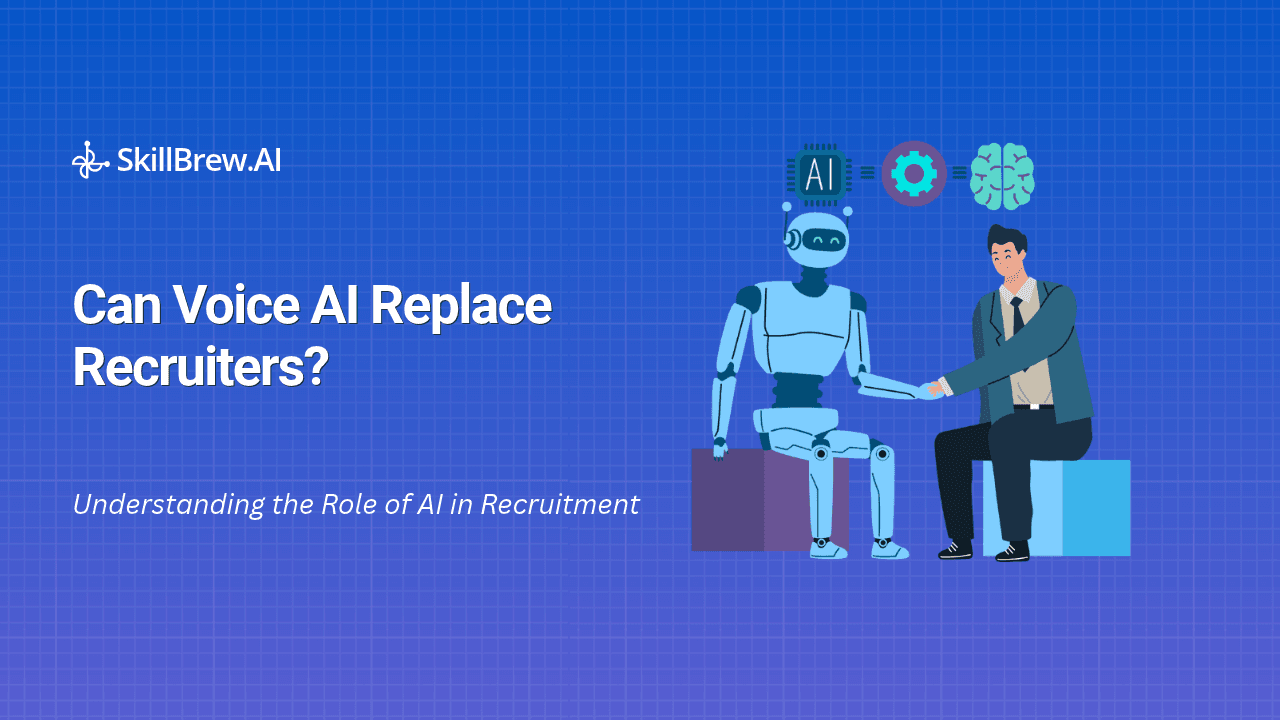
But does that mean Voice AI can replace recruiters? Not entirely. Voice AI can automate specific, repeatable tasks, but recruitment also requires judgment, relationship-building, negotiation, and an understanding of people and business needs. The most effective approach is to use technology to support recruiters rather than remove the human role from hiring.
Voice AI in Recruitment refers to the use of artificial intelligence to communicate with job candidates through spoken conversations. A voice assistant can make outbound calls or handle inbound calls, depending on the platform and its configuration, understand a candidate's responses, ask relevant questions within its configured workflow, and convert the conversation into structured information.
In recruitment, these systems are commonly used for early-stage activities such as:
Unlike a simple prerecorded message, a conversational voice assistant is designed to respond to what a candidate says. Its exact capabilities depend on the platform and how the screening workflow is configured.
Voice AI in Recruitment is particularly relevant for organizations that receive large numbers of applications for similar roles. Instead of asking recruiters to make hundreds of introductory calls, an AI assistant can conduct the first conversation and help organize the resulting information.
The short answer is no. Voice AI can take over selected tasks within the recruitment process, but it cannot fully replace the broader responsibilities of a recruiter.
Recruiters do much more than ask screening questions. They interpret candidate motivations, understand career decisions, explain role expectations, manage sensitive discussions, coordinate with hiring managers, negotiate offers, and help candidates make informed decisions. These responsibilities involve context and human judgment that cannot be reduced to a screening score.
Voice AI in Recruitment is better understood as an operational support tool. It can manage predictable interactions at scale, while recruiters focus on conversations and decisions that require human involvement.
For example, an AI assistant may confirm that a candidate has the required experience and is available to work from a particular location. A recruiter can then speak with shortlisted candidates to explore their achievements, expectations, concerns, and suitability in greater depth.
Automation can help determine which candidates should receive attention first, but it should not become the only basis for deciding who gets hired.
Voice AI in Recruitment can support several stages of hiring, especially where communication is repetitive and follows a defined structure.
The first screening conversation often covers a standard set of questions. A voice assistant can contact applicants and ask about role-related details such as experience, qualifications, skills, location, salary expectations, and availability.
This can reduce the time recruiters spend making introductory calls. Recruiters can review the captured information and decide which candidates should move to the next stage.
For more on screening approaches, see SkillBrew's guide to technical screening and candidate screening methods.
When a company is hiring for multiple locations or hundreds of similar positions, manually contacting every applicant can become difficult. Voice AI in Recruitment can help teams conduct first-touch calls in parallel, subject to the platform's capacity and configured calling process.
This is useful in campus hiring, customer support recruitment, sales hiring, and other volume-based recruitment drives. Recruiters can spend less time repeating introductory questions and more time reviewing candidates who meet the initial requirements.
Different recruiters may phrase questions differently or interpret answers using slightly different standards. A configured voice screening workflow can ask candidates a consistent set of questions, making it easier to compare responses against the same role requirements.
Consistency does not automatically guarantee fairness. Questions and evaluation criteria still need to be relevant to the job, clearly defined, and reviewed for unintended bias.
Candidates may miss calls, need another time to speak, or want clarification about the next step. Depending on the system, a voice assistant can support outreach, retries, and basic process communication.
This can help recruitment teams maintain contact with applicants without requiring a recruiter to manually initiate every routine interaction. More sensitive questions or unusual requests should be transferred to a human team member.
After a screening call, recruiters need to understand what was discussed. Voice AI in Recruitment can turn conversations into summaries, structured responses, or screening reports.
These summaries can help recruiters compare candidates, but they should support review rather than replace it. Recruiters need access to relevant context and should be able to question or override an automated recommendation.
Voice AI and human recruiters serve different purposes. One is suited to repeatable, structured interactions; the other brings judgment, empathy, and decision-making to the hiring process.
| Recruitment activity | Voice AI | Human recruiter |
| Initial outreach | Can make configured calls at scale | Can make personal, context-aware outreach |
| Standard screening questions | Can ask a consistent set of questions | Can adapt questions and explore answers |
| Availability checks | Can collect basic availability information | Can discuss constraints and alternatives |
| Repetitive follow-ups | Can automate supported reminders or retries | Can handle unusual situations personally |
| Understanding motivation | Can capture what candidates say | Can explore intent, context, and career goals |
| Candidate engagement | Can handle structured conversations | Can build deeper personal relationships |
| Sensitive conversations | Should escalate to a person | Can respond with empathy and discretion |
| Final hiring decision | Can provide supporting information | Accountable hiring stakeholders make the decision |
The comparison shows why Voice AI in Recruitment should be viewed as a complement to recruiters. It can reduce repetitive work, but it does not carry the full responsibility for selecting and hiring people.
When implemented carefully, Voice AI in Recruitment can improve the operational side of hiring.
Recruiters do not need to personally conduct every introductory call. AI-assisted outreach can help teams contact applicants sooner and organize initial screening information more quickly.
AI voice screening can help recruiters manage routine first-stage conversations, allowing them to focus on candidate evaluation and meaningful interactions.
A structured workflow can ensure that candidates for the same role are asked comparable questions. This supports a more standardized first-stage process.
For organizations managing large applicant pools, automated calls can reduce the manual effort involved in reaching candidates and collecting basic information. AI voice screening can be particularly useful when teams need to coordinate initial conversations across multiple roles or locations.
When routine screening is supported by automation, recruiters can devote more time to interviews, candidate engagement, hiring-manager discussions, and offer management.
Call summaries and role-related scores can make it easier to identify candidates who may need further evaluation. Recruiters should still review the underlying responses and consider information that an automated system may not capture.
Voice AI in Recruitment is not suitable for every conversation or hiring decision. Organizations should understand its limitations before making it part of their recruitment process.
A candidate's answer may need clarification. Someone changing careers, returning after a break, or describing an unusual work arrangement may not fit a standard response pattern. Human recruiters are better placed to explore these situations.
Speech recognition may be affected by background noise, network quality, speaking pace, accents, or language switching. Organizations should test systems with the languages and candidate populations they actually recruit from.
Some applicants may be uncomfortable speaking with an AI assistant, particularly if they do not understand why they are receiving the call or how their answers will be used. Clear disclosure and an accessible route to human assistance help build trust.
A score or ranking is only as useful as the criteria behind it. If questions are poorly designed or the evaluation model does not reflect job requirements, the output can mislead recruiters. Automated results should be reviewed and monitored, not treated as unquestionable decisions.
Recruitment calls may involve personal information. Employers should explain the purpose of the call, handle recordings and transcripts according to applicable requirements, limit access to candidate data, and follow appropriate retention and security practices.
Voice AI in Recruitment is most useful when the hiring process includes a high volume of similar, repeatable screening conversations.
It may be suitable for:
It may be less suitable as the only screening method for senior leadership roles, highly specialized positions, or situations where the first conversation requires nuanced judgment. In these cases, direct recruiter involvement should remain central.
The goal should not be to automate every interaction. A better approach is to decide which tasks benefit from automation and where human involvement is necessary.
A well-designed process uses Voice AI in Recruitment to make the first stage more manageable, while preserving human accountability throughout selection.
One practical application of this approach is using AI voice assistants to automate first-touch candidate screening while keeping recruiters responsible for subsequent evaluation and selection.
SkillBrew.AI offers BrewVoice, an AI-powered voice screening solution designed to contact candidates and conduct structured first-round phone conversations. Its AI voice assistant, Rhea, can call candidates, ask configured screening questions, and generate call reports covering intent, technical and role fit, communication, confidence, and other configured screening indicators.
Recruiters can upload candidate lists through Excel or CSV files, configure role-related screening details, and review the resulting reports and ranked shortlist. BrewVoice also supports multiple languages and accents, helping teams conduct initial screening conversations across different candidate groups.
BrewVoice focuses on first-touch candidate screening through AI-powered voice conversations. For later-stage evaluations, SkillBrew offers its separate AI Interviews solution, which supports structured interview assessments. Together, these solutions help organizations automate different stages of the hiring process while keeping recruiters involved in candidate evaluation and final selection.
Teams can also use AI Assessments to evaluate role-specific skills and HireFlow to organize recruitment workflows. These capabilities address different parts of the hiring process rather than treating one AI tool as a replacement for the recruitment team.
Voice AI in Recruitment is likely to become more useful as speech recognition, conversational systems, and recruitment platforms improve. Voice assistants may handle more role-specific questions, support a wider range of languages, and provide better summaries of candidate conversations.
However, adoption will depend on more than technical capability. Employers will need to build transparent processes, evaluate systems for accuracy and fairness, protect candidate information, and make sure applicants can speak to a person when needed.
The future is therefore unlikely to be a choice between AI and recruiters. Instead, recruitment teams will combine automation for repetitive work with human expertise for evaluation, relationships, and decisions.
No. Voice AI can automate tasks such as initial outreach, structured screening questions, and routine follow-ups. Recruiters remain important for evaluating context, engaging candidates, managing complex conversations, and making hiring decisions.
Voice AI in Recruitment is used to contact candidates through phone conversations, ask predefined or configured questions, collect role-related information, and prepare summaries for recruiter review. It is commonly applied to first-stage screening and high-volume hiring.
Yes. It can help organizations manage repetitive first-touch calls across large applicant pools. Its suitability depends on call capacity, language support, question design, candidate experience, and the availability of human review.
They should be clearly informed. Employers should disclose that the caller is an AI assistant and provide a way to contact a human recruiter if the candidate has questions or needs assistance.
A voice assistant can ask role-related questions and analyze responses according to configured criteria. However, its output should be treated as supporting information. Recruiters should review the responses and use other relevant evaluation methods where needed.
BrewVoice is designed for first-touch candidate screening through AI-powered phone conversations. AI Interviews is a separate SkillBrew solution for later-stage structured interview evaluations. They support different stages of the recruitment process.
Recruiters can use Voice AI for routine screening and information collection, then personally engage candidates who move forward or need additional support. Transparent communication, clear escalation paths, and human review help maintain a candidate-focused process.
Voice AI is changing how recruitment teams manage candidate communication and initial screening, but it is not a substitute for the full role of a recruiter. It can make repetitive processes faster and more consistent, especially when organizations are hiring at scale.
When AI handles repetitive screening and recruiters focus on people, organizations can build hiring processes that are faster, more scalable, and still centered on human judgment.
Discover how SkillBrew helps hiring teams cut time-to-hire by 60% with skill-validated assessments and AI-ranked shortlists.
Book a free demoNo commitment required · 30 minutes