AI Interview
AI Interviews vs Traditional Interviews: Which is better for hiring?
AI interviews use artificial intelligence to conduct or assist candidate interviews and evaluate responses using predefined criteria. AI interviews are faster and more scalable, while traditional interviews offer deeper human judgment for later hiring stages. If your calendar is full of first-round interviews that go nowhere, you already know the problem this article is about. Recruiting teams are running the AI interviews vs traditional interviews debate right now because the old model is brea

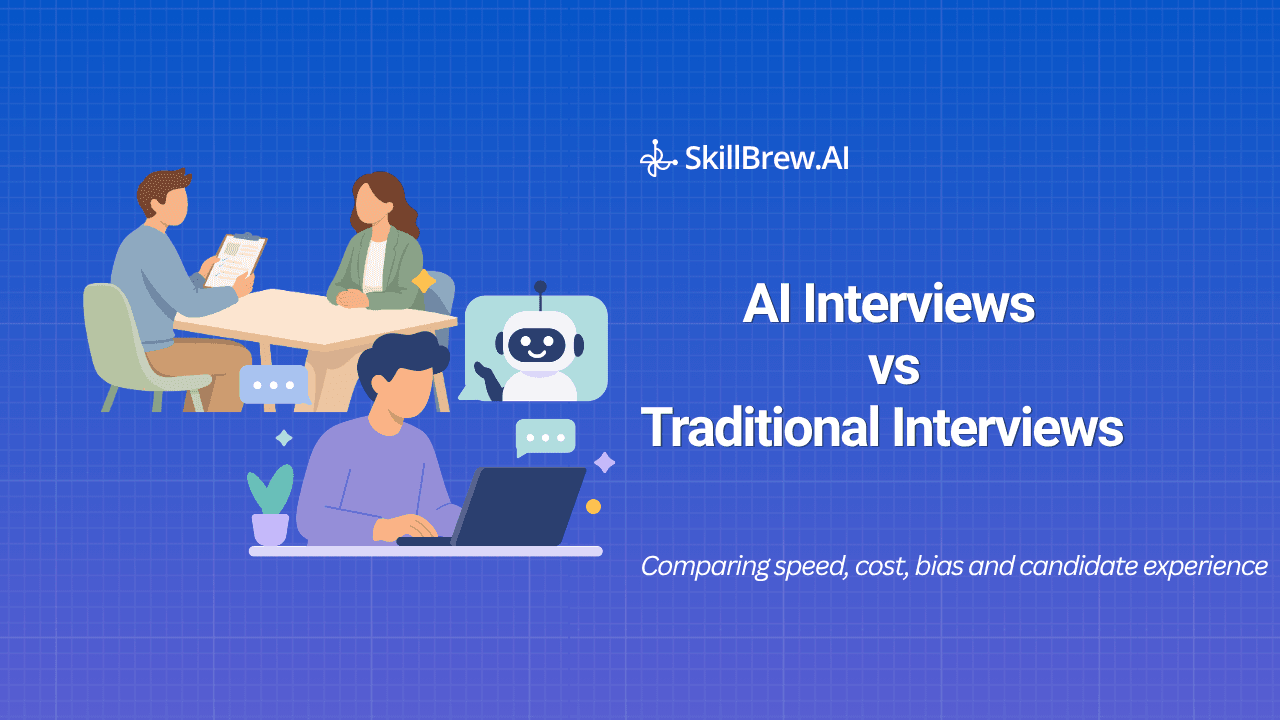
AI interviews use artificial intelligence to conduct or assist candidate interviews and evaluate responses using predefined criteria. AI interviews are faster and more scalable, while traditional interviews offer deeper human judgment for later hiring stages.
If your calendar is full of first-round interviews that go nowhere, you already know the problem this article is about. Recruiting teams are running the AI interviews vs traditional interviews debate right now because the old model is breaking under volume, not because AI is trendy. AI use across HR functions jumped from 26% to 43% of organizations in a single year, and recruiting is the single most common use case. The math on recruiter hours, candidate drop-off, and time-to-fill simply stopped working.
This piece breaks down what each format does well, where it fails, and how to combine them so you're not choosing blind.
Table of Contents
- What Are AI Interviews?: How automated interviews work
- What Is a Traditional Interview?: Structured vs unstructured, defined
- AI Interviews vs Traditional Interviews: Key Differences Side-by-side comparison table
- Speed and Scalability: How fast each format screens candidates
- Consistency and Standardization: Why most interviews aren't standardized
- Candidate Experience: What candidates think of AI screening
- Bias Reduction: What actually reduces bias
- Cost: What each format costs per hire
- Hiring Quality: Matching method to what you measure
- When AI Interviews Are the Better Choice: Conditions that favor automation
- When Traditional Interviews Are Still Valuable: Conditions that favor humans
- Why Combining AI Interviews With Structured Interviews Wins: Sequencing both formats
- How Interview Automation Improves High-Volume and Technical Hiring: Where automation helps most
- Best Practices for Implementing AI Interviews: A rollout checklist
- FAQs: Quick answers for recruiters
- Conclusion: A Quick Summary and Next Steps
What Are AI Interviews?
AI interviews are typically used during the early stages of hiring to evaluate communication, role fit, and basic competencies before candidates move to recruiter or hiring manager interviews.
An AI interview uses an automated system, often an adaptive, resume-aware avatar or voice agent, to conduct a structured conversation with a candidate without a human interviewer present. The system asks role-relevant questions, follows up on vague answers, and scores the response against a defined rubric.
Modern AI for interview tools go well beyond the early one-way video assessments that just recorded a candidate answering static prompts. Today's systems run on natural conversation, ask context-aware probing questions, and are available 24/7, so a candidate can interview at 9 PM instead of waiting two weeks for a recruiter's calendar to open up.
Understanding this format is the starting point for any AI interviews vs traditional interviews comparison, since it's the newer half of the equation most hiring teams are still evaluating.
AI interviews typically fall into three depth tiers:
- Standard: Fast, role-fit screening for high-volume roles
- Deep: Longer, more exploratory conversations for skill-heavy or senior roles
- Structured: Fixed question sets scored against a rubric, built for consistency and compliance
Many recruiters now use AI for interview screening before scheduling a structured interview with hiring managers, using the automated round to filter volume and the human round to confirm the shortlist.
What Is a Traditional Interview?
A traditional interview is a live conversation between a candidate and a human interviewer, conducted in person, over video, or by phone. It can be unstructured (an open conversation with no fixed script) or a structured interview, where every candidate gets the same job-related questions, asked in the same order, scored against the same rubric.
This distinction matters more than most hiring teams treat it. "Let's just chat and see how it goes" is still the most common way interviews get run, but it's also the weakest at actually forecasting who'll succeed on the job. Measured on predictive validity, a score of how well a selection method forecasts real job performance, unstructured interviews score low. Structured interviews, with a fixed question set and rubric, score close to double the predictive power.
The takeaway: "traditional interview" isn't one thing. A structured traditional interview and an unstructured one produce very different hiring outcomes, even though both involve a human on the call. Keep this in mind through the rest of this AI interviews vs traditional interviews comparison, since "traditional" doesn't automatically mean less rigorous.
AI Interviews vs Traditional Interviews: Key Differences
| Factor | AI Interviews | Traditional Interviews |
| Availability | 24/7, candidate-scheduled | Limited to recruiter/interviewer calendar |
| Speed to complete a round | Minutes to hours | Days to weeks |
| Consistency | Same rubric, every candidate | Varies by interviewer unless structured |
| Scalability | Handles thousands of candidates in parallel | Bound by human headcount |
| Bias exposure | Lower when the model and rubric are audited | Higher in unstructured formats |
| Candidate rapport | Limited, though voice and avatar formats are improving | Strong, especially for senior or relationship-driven roles |
| Cost per screen | Low and largely fixed | High, recruiter hours plus scheduling overhead |
| Nuanced judgment (culture, leadership signal) | Weaker | Stronger |
| Best used for | First-round screening, high-volume roles, technical validation | Final-round decisions, senior hiring, culture fit |
Speed and Scalability
In the AI interviews vs traditional interviews comparison, this is where the gap is widest. A recruiter can realistically run six to eight live interviews a day. An AI interview system can run thousands in parallel, at any hour, with zero scheduling coordination.
That speed compounds. AI-powered recruitment tools can cut time-to-hire by up to 25 to 40%, depending on the source and the role mix, largely because the first-round bottleneck disappears. For a team hiring at volume, that's not a marginal efficiency gain, it's the difference between filling 500 seasonal roles on time and missing the season entirely.
Scalability isn't just about headcount either. It's about what happens when applications spike. A campus drive that pulls in 4,000 applicants, or a product launch that needs 200 support reps in six weeks, breaks a purely human screening process. It doesn't break an AI one.
Consistency and Standardization
Consistency is one of the clearest dividing lines in the AI interviews vs traditional interviews debate. Every AI interview asks the same core questions, in the same way, scored against the same rubric. There's no version of the process where one candidate gets a sharp, focused interviewer and another gets someone rushing between back-to-back calls.
Traditional interviews only get this consistency if they're deliberately structured, and most aren't. Some of the most cited hiring research documents companies moving from freeform interviewing to structured, rubric-scored formats specifically because the freeform version wasn't predicting performance reliably. Most companies never make that shift. Roughly two-thirds of employers report using structured evaluation at all, meaning a third are still relying on interviewer instinct as their primary filter.
Candidate Experience
This is the category where AI interviews have the most work to do, and the data is blunt about it. Nearly two-thirds of US job seekers, 63%, say they've already experienced an AI interview in the past six months. But only 26% of applicants say they trust AI to evaluate them fairly, and 67% of job seekers report feeling uneasy about AI-led hiring systems.
That gap is usually caused by three fixable things: candidates not being told AI is involved, interviews that feel robotic instead of conversational, and no clear path to a human if something goes wrong. Platforms using adaptive, resume-aware conversation instead of static one-way recordings, with upfront disclosure, see meaningfully better candidate sentiment than the legacy format that gave AI screening its bad reputation in the first place.
Traditional interviews, done well, still win on rapport and relationship-building, especially for candidates evaluating a company as much as the company is evaluating them. For senior and client-facing roles, that human warmth is doing real work, and it's a factor worth weighing heavily in any AI interviews vs traditional interviews decision.
Bias Reduction
Unstructured human interviews carry documented bias risk: halo effects, similarity bias, first-impression anchoring. Structured formats, whether human or AI-run, cut that risk substantially. Research on structured interviewing shows the bias effect size shrinks from d=.59 in unstructured formats to d=.23 in structured ones, a reduction of more than half.
AI interviews inherit whatever rubric and training data they're built on. Audited and well-governed, they apply that rubric identically to every candidate. Unaudited, or trained on historical hiring data that already reflects bias, they can encode and scale that bias instead of removing it. This is the single biggest governance risk in AI hiring, and it's why the EU AI Act now classifies recruitment AI as high-risk, with enforcement beginning August 2026.
The honest framing: AI doesn't remove bias by default. Structure does. AI just makes it possible to apply that structure at scale, provided the system is audited. That nuance gets lost whenever the AI interviews vs traditional interviews question gets flattened into "which one is fairer."
Cost
Cost is one of the more concrete ways to settle the AI interviews vs traditional interviews question for finance and leadership stakeholders. Traditional interviews carry a heavy hidden cost: recruiter hours, interviewer hours, scheduling coordination, and the opportunity cost of slots given to candidates who were never going to be a fit. The average U.S. cost per hire runs roughly $4,700 for non-executive roles.
AI interviews shift that cost curve. The per-screen cost is low and largely fixed, whether you're screening 50 candidates or 5,000. For high-volume hiring, this is usually the line item that gets a pay-as-you-go screening model approved internally, since it replaces variable recruiter hours with predictable, usage-based cost instead of a flat subscription you pay whether you're hiring or not.
Hiring Quality
The AI interviews vs traditional interviews question ultimately comes down to quality. It isn't about which format is inherently "better." It's about matching the method to what you're trying to measure.
- Role-fit and technical validation: AI interviews and structured assessments are strong here. They test the same competencies against the same bar for every candidate, without fatigue by candidate 40 of the day.
- Leadership signal and cultural nuance: Human interviewers, especially in a structured format, still outperform. These are the dimensions hardest to rubric-score reliably.
- Consistency at scale: Structured formats of either kind beat unstructured human interviews. The research isn't ambiguous here.
The highest-quality pipelines usually aren't "AI only" or "human only." They use AI to handle the volume and structure the funnel, then reserve human judgment for the decisions that actually need it.
When AI Interviews Are the Better Choice
Weighing AI interviews vs traditional interviews for a specific role gets easier once you look at the conditions rather than the format itself. AI interviews are the stronger fit when:
- You're hiring at volume: campus drives, seasonal hiring, frontline and blue-collar roles, high-turnover functions
- Speed to shortlist matters more than deep relationship-building at the screening stage
- You need standardized technical or role-fit validation across hundreds of candidates
- Recruiter hours are the bottleneck, not final-round decision-making
- You're screening across multiple languages or regional accents, where human bias against unfamiliar accents is a known problem
When Traditional Interviews Are Still Valuable
The other side of the AI interviews vs traditional interviews decision matters just as much. Human interviews remain the right call when:
- The role is senior, client-facing, or leadership-track, where relationship and judgment carry real weight
- You're assessing culture fit or team dynamics that don't reduce cleanly to a rubric
- The candidate pool is small enough that recruiter time isn't the constraint
- Final-stage decisions need a human to build the relationship that gets an offer accepted
- Regulatory or union requirements mandate human involvement in the decision
Why Combining AI Interviews With Structured Interviews Wins
The best-performing pipelines don't pick a side in the AI interviews vs traditional interviews debate. They sequence the two by what each is good at:
- AI interview automation for first-round screening, filtering role fit and baseline competency in minutes instead of days
- Structured technical assessment to validate hard skills against a job-specific rubric
- Structured human interview for the shortlist, focused on judgment, culture, and final-round decision-making
This sequencing cuts the volume reaching human interviewers, so the interviews that do happen get more attention and less fatigue-driven inconsistency, while keeping a human in the loop exactly where nuance matters. "Interview automation" and "human judgment" aren't competitors. Automation's job is to get the right five candidates in front of the right person, not replace that final conversation.
Where AI Interviews Fit in the Hiring Funnel
A common question recruiters ask is where an AI interview actually sits relative to everything else. In a typical automated pipeline, it looks like this:
Application
    ↓
Skill Assessment
    ↓
AI Interview
    ↓
Hiring Manager Interview
    ↓
Final Round
    ↓
Offer
The AI interview sits early, right after assessments, doing the job a first-round interviews used to do: confirming role fit and baseline communication before anyone's calendar gets involved. Everything after that, the hiring manager interview, the final round, stays human, because those stages are about judgment and fit, not volume.
How Interview Automation Improves High-Volume and Technical Hiring
The AI interviews vs traditional interviews gap shows up most clearly in two hiring scenarios that expose the limits of a purely manual process: high-volume drives and technical roles.
High-volume hiring breaks down once weekly applications cross roughly 50 to 100 per open role. Manual resume review and phone screening can't keep pace past that point, and drop-off climbs as candidates wait too long between steps. Interview automation, paired with automated WhatsApp or email communication, keeps candidates engaged instead of losing them to faster competitors.
Technical hiring has a different problem: precision. A generic screen doesn't tell you whether a candidate can actually do the job. Automated systems that generate role-specific technical, behavioral, and cognitive questions directly from a job description close that gap without adding days to the process. Pairing that with an integrity layer that flags camera, screen, voice, and tab-switching anomalies keeps the results trustworthy as more of the process moves online and unsupervised.
This is the exact structural gap SkillBrew.AI's platform is built to close. AI-powered interviews handle adaptive, resume-aware first-round screening around the clock, technical assessments turn a job description into a scored test in minutes with built-in proctoring, and HireFlow keeps the whole pipeline, from Kanban tracking to candidate messaging, in one place instead of five disconnected tools.
Best Practices for Implementing AI Interviews
Getting the AI interviews vs traditional interviews mix right in practice depends less on the format and more on implementation discipline:
- Disclose AI involvement upfront. Trust gaps get worse, not better, when candidates find out after the fact.
- Audit the rubric and model regularly. Bias reduction only happens if someone checks for it.
- Keep a human review path. Automated scoring should flag and shortlist, not make final rejections with zero oversight.
- Match interview depth to role complexity. A five-minute screen is wrong for a senior hire; a deep interview is overkill for a volume role.
- Use structured questions in the AI layer too. Predictive validity gains from structure apply whether the interviewer is human or automated.
- Pair screening with integrity controls. Proctoring protects the credibility of results as more of the process moves unsupervised.
- Track drop-off between stages. Automation should reduce abandonment, not add friction.
- Reserve human interviews for decisions that need judgment. Don't automate the final call where relationship and leadership signal matter most.
Common Misconceptions About AI Interviews
"AI interviews replace recruiters." They replace the repetitive, high-volume parts of screening. Recruiters still own relationship-building, final decisions, and offer negotiation.
"AI interviews are only for enterprise hiring." Any team facing volume against limited headcount benefits, including seasonal, campus, and mid-market hiring.
"AI interviews can't evaluate technical skills." Paired with a structured technical assessment, they validate hard skills against a job-specific rubric just as rigorously as a human panel, often more consistently.
"AI interviews always make the final hiring decision." In well-designed pipelines, AI interviews shortlist and flag. A human still makes the call on who gets an offer.
FAQs
Q1. Are AI interviews better than traditional interviews?
In the AI interviews vs traditional interviews debate, neither wins outright. AI interviews win on speed, scale, cost, and consistency for high-volume and technical screening. Traditional interviews still win for senior roles, culture fit, and final-stage relationship-building.
Q2. Do AI interviews reduce hiring bias?
Only if the underlying model and rubric are audited. Structured formats, human or AI-run, cut bias substantially versus unstructured conversations, but AI doesn't remove bias automatically.
Q3. What is the difference between a structured and unstructured interview?
A structured interview asks every candidate the same job-related questions in the same order, scored against a fixed rubric. An unstructured interview is free-form, with no fixed script, and research shows it's a weaker predictor of job performance.
Q4. What is a structured interview?
A structured interview is an interview format where every candidate is asked the same set of job-relevant questions, in the same order, and scored against the same rubric. It's the format both AI interviews and well-run human interviews rely on for consistency.
Q5. Can AI interviews replace human recruiters?
No. AI interviews replace the repetitive, high-volume parts of screening, not judgment-heavy final decisions. Recruiters shift toward reviewing shortlists and managing the calls that need human context.
Q6. Is interview automation suitable for technical hiring?
Yes, when it's paired with a structured technical assessment. Interview automation validates communication and role fit; the assessment layer validates hard skills. Used together, they cover what a single generic screen can't.
Q7. How much faster is AI interview automation than traditional screening?
Organizations using AI-powered screening commonly report time-to-hire reductions in the 25 to 40% range, driven mainly by eliminating scheduling delays and running first-round screens in parallel.
Q8. Do candidates prefer AI interviews?
Not universally. Adoption has outpaced trust. Most candidates have now experienced an AI interview, but a majority report discomfort with AI-led hiring decisions, largely due to lack of transparency about when AI is involved. Candidates generally respond better when AI involvement is disclosed upfront and the format is conversational rather than a static one-way recording.
Q9. What roles are best suited for AI interviews?
High-volume, frontline, campus, and technical roles where role-fit and skill validation matter more than deep relationship assessment. Senior and client-facing roles still benefit more from human interviews at later stages.
Q10. Is interview automation only useful for large companies?
No. Any team running seasonal or campus drives, or facing high applicant volume against limited recruiter headcount, sees a direct return from automating the screening layer, regardless of company size. Company size changes the scale of the AI interviews vs traditional interviews tradeoff, not whether it applies.
Conclusion
AI interviews vs traditional interviews isn't a fight either format wins outright. AI interviews are faster, cheaper, and more consistent at screening scale. Traditional interviews, run as structured conversations rather than freeform chats, still carry judgment no rubric fully replicates. The teams getting this right sequence both: AI and structured assessments to handle volume and consistency, human interviews reserved for decisions that need a person in the room.
If first-round screening is still eating recruiter hours that should be going toward closing candidates, that's the part worth fixing first.
Looking to reduce recruiter hours without compromising hiring quality? SkillBrew.AI combines AI interviews, structured assessments, and interview automation to help hiring teams screen candidates faster while keeping recruiters in control. Book a demo to see how it works.
See AI-powered hiring in action
Discover how SkillBrew helps hiring teams cut time-to-hire by 60% with skill-validated assessments and AI-ranked shortlists.
Book a free demoNo commitment required · 30 minutes
Continue reading
View All Posts