BrewVoice
How to Evaluate AI Candidate Call Summaries
Recruiters often have to make sense of a large amount of information after candidate screening calls. A single conversation can cover experience, availability, salary expectations, role interest, communication, and other job-specific requirements. AI-powered voice screening can turn these conversations into structured summaries, helping recruiters review candidate information without replaying every call. But a summary is only useful if the information is accurate, relevant, complete, and prese

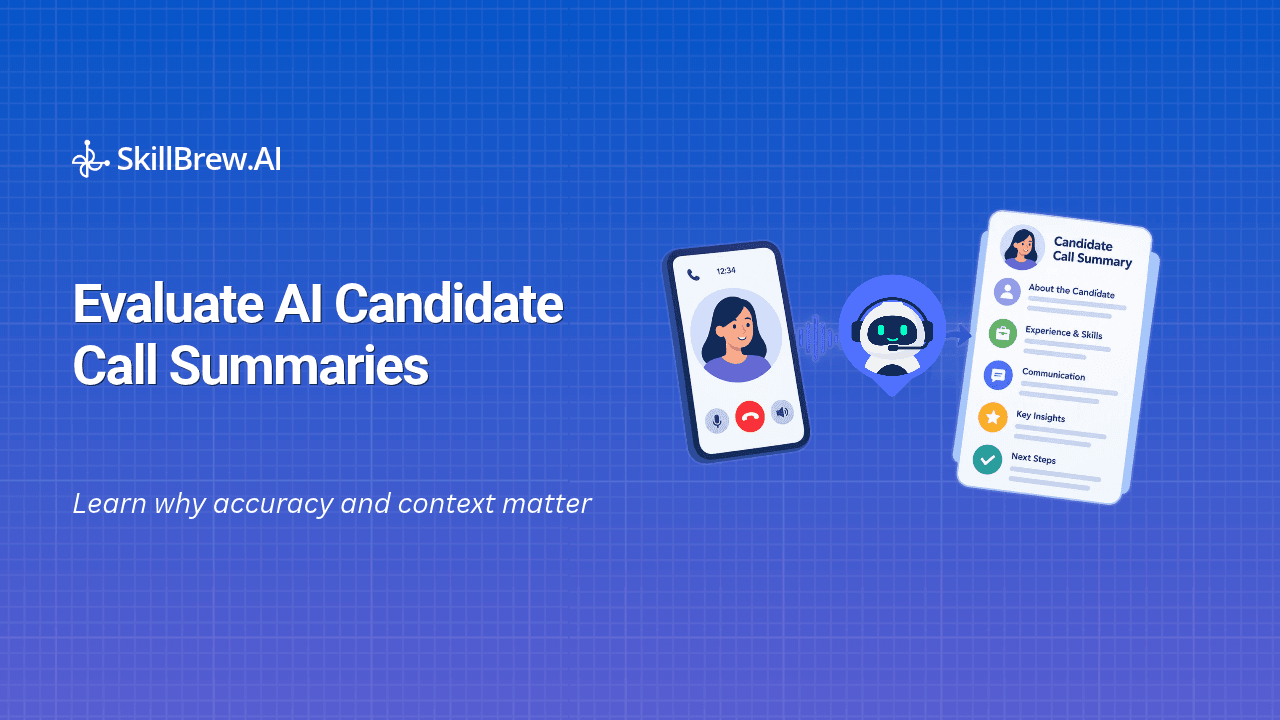
Recruiters often have to make sense of a large amount of information after candidate screening calls. A single conversation can cover experience, availability, salary expectations, role interest, communication, and other job-specific requirements.
AI-powered voice screening can turn these conversations into structured summaries, helping recruiters review candidate information without replaying every call. But a summary is only useful if the information is accurate, relevant, complete, and presented with enough context.
This is why recruiters need a practical way to evaluate AI call summaries before using them in their screening workflow.
Table Of Content
- What Are AI Candidate Call Summaries: Understand what AI-generated call summaries contain.
- Why Evaluating AI Call Summaries Matters: Learn why accuracy and context matter.
- What Should an AI Call Summary Include: Explore the key details recruiters need.
- How to Evaluate AI Call Summaries: Follow a simple framework for reviewing summaries.
- How to Compare a Summary With the Original Conversation: Learn how to verify important details.
- Common Problems With AI-Generated Call Summaries: Identify common summary issues.
- How to Improve AI Call Summary Quality: Learn how to improve summary usefulness.
- How AI Call Summaries Fit Into Recruitment Workflows: See how summaries support screening.
- How BrewVoice Supports Candidate Screening: Learn how Rhea supports voice screening.
- Frequently Asked Questions: Get answers to common questions.
- Conclusion: Learn how to combine AI summaries with human review.
What Are AI Candidate Call Summaries?
AI call summaries are structured overviews generated from candidate conversations conducted through an AI-powered voice system.
Depending on the screening workflow, a summary can include:
- Candidate experience
- Relevant skills
- Screening responses
- Availability or notice period
- Salary expectations
- Work-mode or location preferences
- Candidate interest in the role
- Candidate questions or concerns
- Role-specific qualification signals
The purpose of AI call summaries is to help recruiters review candidate information more efficiently.
Instead of listening to every conversation from beginning to end, recruiters can use a structured summary to quickly identify relevant information and determine whether additional review is needed.
This can be particularly useful for recruitment teams handling a large number of screening conversations.
Why Evaluating AI Call Summaries Matters
Automated summaries can save recruiters time, but their usefulness depends on the quality of the information they contain.
A summary may be short and well-formatted while still leaving out an important response, misunderstanding what a candidate said, or removing context from an answer.
When reviewing AI call summaries, recruiters should ask:
- Did the summary capture the important parts of the conversation?
- Are the candidate's responses represented accurately?
- Is the information relevant to the role?
- Is enough context included to understand the response?
- Can the recruiter understand the key points without replaying the entire call?
Evaluating summaries this way helps teams use AI-generated information as reliable screening support rather than automatically treating every summary as complete or correct.
What Should an AI Call Summary Include?
A useful AI call summary should focus on information that helps recruiters evaluate the candidate against the initial screening criteria.
Candidate and Role Information
The summary should clearly identify the candidate and the position being discussed so recruiters can understand the context.
Relevant Experience
Important experience, previous roles, industries, and responsibilities discussed during the conversation should be captured when they relate to the position.
Screening Responses
Responses to the questions used during the initial screening should be summarized accurately.
Availability and Logistics
Details such as notice period, availability, location, relocation preferences, or work-mode requirements may be important depending on the role.
Candidate Interest
The summary can capture relevant information about the candidate's interest in the position, expectations, or concerns.
Role-Specific Qualification Signals
The summary should highlight information connected to the actual screening criteria.
For example, a customer support role may require customer-facing experience or specific language capabilities, while a technical position may require experience with particular technologies.
The most useful AI call summaries are therefore not necessarily the longest. They are the ones that organize the information recruiters actually need.
How to Evaluate AI Call Summaries
A practical evaluation framework should focus on five areas: accuracy, completeness, relevance, context, and actionability.
1. Check Accuracy
First, verify whether the summary correctly represents what the candidate said.
Look for potential errors involving:
- Years of experience
- Technical skills
- Salary expectations
- Notice period
- Location
- Availability
- Previous employers or roles
For example, if a candidate says they have three years of experience with a particular technology but the summary records two years, that could affect how the candidate is evaluated.
2. Check Completeness
A summary does not need to include every sentence from a conversation, but it should capture the information that matters for screening.
Ask:
Are any important candidate responses missing?
For example, a summary might correctly capture a candidate's experience but leave out their availability or response to a required skill question.
Completeness should therefore be judged against the screening criteria rather than the length of the summary.
3. Check Relevance
A useful summary should prioritize information related to the role.
If a screening call contains a long discussion about several topics, the summary should help recruiters quickly identify what matters for the position.
Relevant information may include:
- Required skills
- Relevant experience
- Role-specific responses
- Availability
- Work preferences
- Candidate expectations
Irrelevant details can make AI call summaries harder to review and reduce their practical value.
4. Check Context
Individual statements can sometimes be misleading when removed from the surrounding conversation.
For example, a candidate might say:
"I haven't worked with this technology."
The summary should provide enough context to show whether this means the candidate has no experience with the technology at all, has used an alternative technology, or has only limited exposure.
Without context, a technically accurate statement can still create an incomplete picture.
5. Check Actionability
Finally, ask whether the summary gives the recruiter enough useful information to determine the appropriate next step.
A useful summary should help the recruiter:
- Identify areas that need follow-up
- Understand whether additional screening is required
- Support decisions about the candidate's next stage
- Identify information that requires verification
- Organize candidates for further review
The goal is not for the summary to make the hiring decision. It should give the recruiter clear, relevant information to support that decision.
How to Compare a Summary With the Original Conversation
For important or ambiguous information, recruiters should compare the summary with the original call recording or transcript.
This is particularly useful when reviewing:
- Salary expectations
- Notice period
- Years of experience
- Technical skills
- Location or relocation preferences
- Work-mode requirements
- Candidate availability
- Answers that could affect screening eligibility
A simple verification process can be:
AI call → Summary → Identify important claims → Compare with original conversation → Confirm information → Continue recruiter review
Recruiters do not necessarily need to replay every call in full. Instead, they can focus verification on information that is particularly important, unclear, or likely to affect the next stage of screening.
This creates a practical balance between automation and human review.
Common Problems With AI-Generated Call Summaries
Even useful AI call summaries can have limitations. Some common problems include:
Missing Important Details
An AI-generated summary may leave out a response that was discussed during the conversation.
This is why recruiters should compare the summary against the screening criteria rather than judging it only by how readable it looks.
Incorrect Interpretation
Speech recognition or contextual interpretation can sometimes result in information being represented incorrectly.
Names, technical terminology, numbers, accents, and ambiguous statements can require additional verification.
Too Much Information
A summary can also become less useful when it contains excessive detail.
Recruiters generally need the information that supports screening, not a rewritten version of the entire conversation.
Lack of Role Context
A generic summary may not clearly show why a candidate's response matters for a particular position.
Role-specific screening criteria can help make summaries more useful.
Overreliance on the Summary
Another important risk is treating the summary as the complete representation of the candidate.
AI call summaries should support recruiter review rather than replace the recruiter's responsibility to evaluate candidates.
How to Improve AI Call Summary Quality
The quality of an AI-generated summary is closely connected to the quality of the screening workflow behind it.
Use Role-Specific Questions
Screening questions should reflect the actual requirements of the position.
This gives the AI system clearer information to summarize and helps recruiters get more relevant output.
Define What Recruiters Need to Know
Before creating a screening workflow, identify the information recruiters need to make the next-stage decision.
This might include experience, skills, availability, location, salary expectations, or role-specific requirements.
Use Structured Screening Criteria
Consistent criteria make it easier to compare summaries across candidates.
Instead of relying on broad questions, teams can define specific areas that should be covered during every initial screening.
Review Summary Accuracy Regularly
Recruitment teams should periodically compare summaries against original conversations to identify recurring issues.
This can help reveal problems with unclear questions, terminology, speech recognition, or summary structure.
Keep Humans in the Review Loop
AI can organize information and reduce repetitive work, but recruiters should remain involved in evaluating candidates and making hiring decisions.
How AI Call Summaries Fit Into Recruitment Workflows
The value of AI call summaries increases when they are connected to a broader recruitment workflow.
A typical process can look like:
Candidate list → AI voice screening → Candidate conversation → Call summary → Recruiter review → Next hiring stage
In this workflow, recruiters can define screening requirements, provide a candidate list, and use an AI voice agent to conduct initial conversations.
The resulting information can then be organized for recruiter review.
This can reduce manual note-taking and make it easier for recruiters to focus on relevant candidate information, particularly when screening large applicant volumes.
The summary becomes one part of the workflow rather than the final hiring decision.
How BrewVoice Supports Candidate Screening
BrewVoice helps recruitment teams automate first-round candidate conversations using Rhea, SkillBrew.AI's AI voice recruiter.
Rhea can conduct structured screening conversations, ask role-specific questions, collect candidate responses, and organize the resulting screening information for recruiter review.
Learn more about Rhea and BrewVoice, and how an AI voice recruiter can support multilingual screening.
When evaluating information generated through an AI voice screening workflow, recruiters should still verify important details and keep human judgment involved in candidate evaluation.
The goal is not to automate the hiring decision. It is to make the information-gathering and review process more efficient.
Frequently Asked Questions
Q1. What are AI call summaries in recruitment?
AI call summaries are structured overviews of candidate conversations generated by an AI-powered voice screening system. They can capture relevant experience, screening responses, availability, role-specific information, and other details discussed during the call.
Q2. What should recruiters look for in an AI call summary?
Recruiters should evaluate accuracy, completeness, relevance, context, and actionability. Important or ambiguous information should be verified against the original conversation when necessary.
Q3. Can AI call summaries replace recruiter notes?
They can reduce the need for manual note-taking, but they should not replace recruiter review. Recruiters remain responsible for evaluating candidate information and making hiring decisions.
Q4. Are AI call summaries accurate?
AI call summaries can be useful, but their accuracy varies based on speech recognition, audio quality, accents, terminology, and how clearly information was communicated. Recruiters should verify important or ambiguous information against the original conversation.
Q5. How can recruiters use AI call summaries?
Recruiters can use them to quickly review screening conversations, identify relevant candidate information, find areas that need follow-up, and determine the appropriate next stage of the recruitment process.
Conclusion
AI-generated summaries can make candidate screening easier to manage, particularly when recruitment teams handle a large number of voice conversations.
However, the value of AI call summaries depends on how accurately and clearly they represent the candidate conversation.
Recruiters should evaluate summaries for accuracy, completeness, relevance, context, and actionability rather than assuming that every generated summary is automatically correct.
The best approach is to use AI to reduce repetitive documentation and information-gathering work while keeping recruiters involved in candidate evaluation and hiring decisions.
If your team is exploring AI-powered voice screening, BrewVoice can help automate structured first-round candidate conversations and organize screening information for recruiter review.
Ready to see how AI-powered voice screening can fit into your hiring workflow? Schedule a demo with SkillBrew.AI.
See AI-powered hiring in action
Discover how SkillBrew helps hiring teams cut time-to-hire by 60% with skill-validated assessments and AI-ranked shortlists.
Book a free demoNo commitment required · 30 minutes
Continue reading
View All Posts