BrewVoice
8 Factors to Compare When Choosing an AI Voice Screening Tool
What aspects do recruitment teams compare when evaluating AI voice screening tools? Choosing an AI voice screening tool is not simply about whether it can make an automated call. Recruitment teams typically compare these tools across conversation quality, screening depth, language support, candidate experience, workflow fit, reporting, scalability and reliability, and pricing. These areas help recruiters understand how a platform would actually fit into their hiring process. A tool may offer au

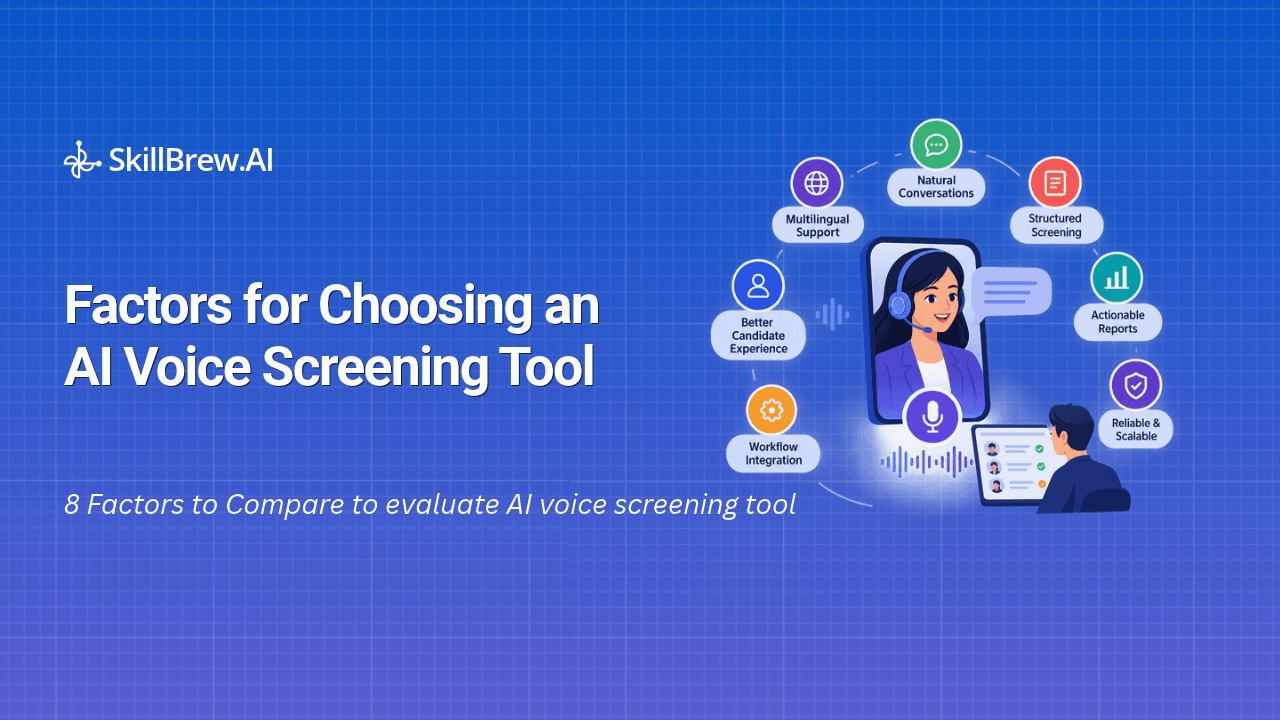
What aspects do recruitment teams compare when evaluating AI voice screening tools? Choosing an AI voice screening tool is not simply about whether it can make an automated call. Recruitment teams typically compare these tools across conversation quality, screening depth, language support, candidate experience, workflow fit, reporting, scalability and reliability, and pricing.
These areas help recruiters understand how a platform would actually fit into their hiring process. A tool may offer automated calling, but recruitment teams also need to consider how well it handles candidate conversations, captures role-specific information, supports recruiters, and connects with the rest of the hiring workflow.
The goal is to evaluate the complete screening experience rather than looking at individual features in isolation.
Table of Contents:
- What Is an AI Voice Screening Tool?: Understand what these platforms do and where they fit in the recruitment funnel.
- Why Recruitment Teams Compare Voice Screening Tools: See why use case and workflow fit matter when evaluating platforms.
- 8 Aspects to Compare When Evaluating AI Voice Screening Tools: Explore the key areas recruiters can use to assess different platforms.
- AI Voice Screening Tools: Comparison Checklist: Use a quick framework to compare the most relevant evaluation areas.
- Questions to Ask Before Choosing a Tool: Turn the comparison framework into practical vendor questions.
- How BrewVoice Approaches AI Voice Screening: See how BrewVoice fits automated voice screening into a broader candidate evaluation workflow.
- What Should Recruiters Prioritize?: Bring the comparison areas together into a practical evaluation process.
- FAQs: Get quick answers to common questions about AI voice screening.
What Is an AI Voice Screening Tool?
An AI voice screening tool uses conversational AI to conduct structured candidate conversations through voice calls. Instead of requiring a recruiter to make every initial screening call, the system can ask predefined or dynamically selected questions, capture responses, and organize the resulting information for recruiter review.
The exact workflow varies by platform. Some tools focus mainly on scripted questions, while others support more adaptive conversations based on what a candidate says.
For recruitment teams, voice screening is generally an early-stage evaluation layer. It can help collect consistent information before recruiters spend time on deeper interviews or assessments.
If you want to understand how this technology fits into the broader recruitment process, explore our guide to AI Voice Screening Tools.
Why Recruitment Teams Compare Voice Screening Tools
Two platforms can both offer automated calling while providing very different recruitment experiences.
For example, one platform may focus mainly on outbound calls, while another may combine candidate conversations with screening criteria, follow-ups, reporting, and recruiter workflows. One may support a narrow set of languages, while another may be designed for multilingual hiring.
That is why an AI voice screening tool should be evaluated against the complete hiring process, not just its ability to place a call.
Recruiters can start with eight practical comparison areas: conversation quality, screening depth, language support, candidate experience, workflow fit, reporting, scalability and reliability, and pricing.
1. Conversation Quality and Adaptability
The first thing to examine is how naturally the system handles a candidate conversation.
A useful platform should maintain conversation context rather than treating every answer as an isolated input. Recruitment teams can look at whether the system:
- Understands candidate responses accurately
- Handles follow-up questions appropriately
- Responds to unexpected answers
- Allows recruiters to define conversation rules
- Maintains a consistent screening structure
- Handles interruptions or requests for clarification
This matters because candidates do not always answer screening questions in a predictable format. A rigid experience may create unnecessary friction or fail to capture useful information.
2. Screening Criteria and Evaluation Depth
Recruiters should also compare what happens after the candidate answers a question.
An AI voice screening tool may simply record responses, or it may organize candidate information against role-specific criteria.
Teams should check whether they can evaluate areas such as:
- Role-specific experience
- Technical or functional skills
- Candidate intent and interest
- Communication
- Availability
- Location or work preferences
- Compensation expectations
- Other job-specific screening questions
The important distinction is between collecting a conversation and turning that conversation into structured information that recruiters can review.
AI-generated screening outputs should support recruiter decision-making rather than replace human review of candidates.
or a broader look at automated early-stage screening, see our guide to first-round screening software and how it can support high-volume recruitment.
3. Language and Accent Support
Language coverage can become an important consideration for distributed or high-volume recruitment.
Instead of checking only the number of languages listed on a product page, recruiters should examine how the platform actually handles multilingual conversations.
Questions to compare include:
- Which languages are supported?
- Can candidates switch languages during a conversation?
- How well does the system handle different accents?
- Can recruiters select a suitable voice or accent?
- Is the same screening workflow available across supported languages?
For organizations hiring across regions, this can affect candidate accessibility and the consistency of the screening experience.
4. Candidate Engagement and Experience
Automating screening does not automatically mean candidates will have a good experience.
Recruitment teams should evaluate the candidate journey from the initial invitation through the completion of the conversation.
An AI voice screening tool can be assessed on factors such as:
- How candidates receive the screening invitation
- Whether the instructions are clear
- Whether candidates can complete screening without recruiter assistance
- How retries or missed calls are handled
- Whether the conversation feels relevant to the role
- How candidates can ask for clarification or repeat a question
The goal is to reduce unnecessary friction while keeping the screening process structured.
5. Workflow Fit and Integrations
A voice screening platform becomes more useful when it fits into the systems recruiters already use.
Teams should compare whether the tool can connect with their ATS, candidate database, recruitment workflow, or other hiring systems.
Look for capabilities such as:
- Candidate import
- ATS integration
- Bulk candidate screening
- Automated status updates
- Workflow triggers
- Candidate-stage management
- Exportable candidate data
For example, if recruiters have to manually move every screened candidate into the next stage, the time saved through automated calls may be reduced by administrative work elsewhere.
This makes workflow fit an important part of evaluating an AI voice screening tool.
6. Reporting and Recruiter Visibility
Recruiters need a practical way to understand what happened during screening.
A platform should make it easy to review relevant candidate information without forcing recruiters to listen to every conversation from beginning to end.
When comparing an AI voice screening tool, teams can look at:
- Candidate summaries
- Screening outcomes
- Response transcripts
- Evaluation criteria
- Conversation recordings, where applicable
- Candidate prioritization and recruiter-defined screening outcomes
- Recruiter notes
- Filters for reviewing candidates
The exact format will vary between platforms. What matters is whether the output helps recruiters identify which candidates need further human evaluation.
7. Scalability and Reliability
The value of voice automation often becomes clearer when screening volume increases.
Recruitment teams should therefore ask how a platform behaves when hundreds or thousands of candidates need to be contacted within a hiring cycle.
Consider:
- Concurrent screening capacity
- Call retry handling
- Candidate response rates
- Scheduling flexibility
- Availability outside recruiter working hours
- Monitoring and failure handling
- Performance across large candidate lists
A tool that works well for a small pilot may still need to demonstrate that it can support the team's expected recruitment volume reliably.
8. Pricing and Overall Cost Structure
Price should be compared in the context of actual usage rather than as a standalone subscription number.
Recruiters should understand whether the platform charges by:
- Call
- Minute
- Candidate
- Screening completed
- Credits
- Monthly subscription
- Usage tier
It is also worth checking what happens when candidates do not answer, require multiple attempts, or spend longer than expected in a conversation.
A clear pricing model makes it easier for recruitment teams to estimate screening costs for different hiring volumes.
AI Voice Screening Tools: Comparison Checklist
Here is a simple framework recruitment teams can use when comparing platforms:
| Evaluation Area | What to Compare |
| Conversation quality | Context handling, follow-ups, interruptions, natural interaction |
| Screening depth | Role-specific criteria, structured evaluation, response analysis |
| Language support | Languages, accents, voice options, multilingual workflows |
| Candidate experience | Invitations, instructions, retries, ease of completion |
| Workflow fit | ATS integration, candidate imports, workflow automation, data transfer |
| Reporting | Summaries, transcripts, outcomes, recordings, recruiter visibility |
| Scalability & reliability | Candidate volume, concurrent calls, retries, reliability |
| Pricing | Calls, minutes, candidates, credits, subscriptions, usage costs |
This framework helps teams compare an AI voice screening tool based on how it would operate inside their recruitment process.
Questions to Ask Before Choosing an AI Voice Screening Tool
Before starting a pilot, recruitment teams can ask vendors questions such as:
- Can we customize screening questions for each role?
- Can the conversation adapt to candidate responses?
- Which languages and accents are supported?
- How are candidate responses evaluated?
- Can recruiters review transcripts or recordings?
- Does the platform integrate with our existing ATS or recruitment workflow?
- How are missed calls and retries handled?
- How does pricing change with higher screening volumes?
- What information is available to recruiters after a screening?
- Can recruiters review or override automated screening outcomes?
These questions move the evaluation from a product demonstration to a practical assessment of workflow fit.
How BrewVoice Approaches AI Voice Screening
BrewVoice is designed to help recruitment teams automate initial candidate conversations while keeping recruiters involved in the evaluation process.
It uses Rhea, SkillBrew.AI's AI voice screening agent, to conduct candidate conversations over phone and WhatsApp. Recruiters can configure screening based on the role and use the resulting candidate information to support shortlisting and next-stage decisions.
BrewVoice currently supports 10+ languages and accent options. Supported languages include Hindi, Gujarati, Telugu, Tamil, English, German, Chinese, French, and Malayalam, while the product also supports voice and accent options such as South Indian, American, and British accents.
The platform is designed to support adaptive conversations, automatic retries for unanswered calls, and structured screening outputs. It can capture information such as intent and interest, technical or role fit, communication, relevant experience, location, work mode, compensation expectations, notice period, and availability, depending on the screening setup.
BrewVoice is intended to reduce repetitive early-stage screening work without removing human judgment from the hiring process. Recruiters can review the resulting screening information and decide which candidates should move to the next stage. Want to see how this approach works in a real recruitment workflow? Explore BrewVoice to learn more about AI-powered voice screening for candidate conversations.
What Should Recruiters Prioritize?
There is no single feature that determines whether a voice screening platform fits a recruitment team.
For some teams, multilingual support may be critical. For others, ATS integration, reporting, scalability, or role-specific screening may matter more.
A practical evaluation should therefore start with the team's existing hiring workflow:
Define the use case → Identify screening criteria → Compare candidate experience → Check workflow fit → Review reporting → Evaluate scalability and cost.
This approach helps recruitment teams understand how an AI voice screening tool would work in practice, rather than evaluating features in isolation.
The more useful comparison is whether the tool fits the team's screening criteria, candidate experience, recruiter workflow, and review process.
The goal is to make early-stage screening more structured and manageable while leaving final candidate decisions with recruiters.
FAQs
Q1. What is an AI voice screening tool?
An AI voice screening tool uses conversational AI to conduct automated candidate screening conversations over voice. Depending on the platform, it can ask role-specific questions, capture responses, and organize screening information for recruiter review.
Q2. What should recruiters compare in AI voice screening tools?
Recruiters can compare conversation quality, screening depth, language support, candidate experience, workflow fit, reporting, scalability and reliability, and pricing.
Q3. Can AI voice screening replace recruiters?
Voice screening can automate repetitive parts of early-stage candidate conversations, while final hiring decisions remain with recruiters. The technology is best used to support screening and prioritization rather than replace human judgment.
Q4. Why is language support important in voice screening?
Language and accent support can help organizations screen candidates across different regions while providing a more accessible and consistent candidate experience.
Q5. How does BrewVoice support recruitment teams?
BrewVoice helps automate candidate conversations over phone and WhatsApp. It can conduct role-specific screening, handle retries, support multiple languages and accents, and provide structured candidate information that recruiters can use during the next stage of evaluation.
Conclusion
Choosing an AI voice screening tool is about more than finding a platform that can make automated calls. Recruitment teams need to consider conversation quality, screening depth, language support, candidate experience, workflow fit, reporting, scalability and reliability, and pricing.
A practical evaluation can follow this framework:
Define the use case → Identify screening criteria → Compare candidate experience → Check workflow fit → Review reporting → Evaluate scalability and cost.
The more useful comparison is whether the tool fits the team's screening criteria, candidate experience, recruiter workflow, and review process. The goal is to make early-stage screening more structured and manageable while keeping final candidate decisions with recruiters.
If you are evaluating an AI voice screening tool for your recruitment workflow, you can schedule a demo to see how BrewVoice can fit into your screening process.
See AI-powered hiring in action
Discover how SkillBrew helps hiring teams cut time-to-hire by 60% with skill-validated assessments and AI-ranked shortlists.
Book a free demoNo commitment required · 30 minutes
Continue reading
View All Posts