BrewVoice
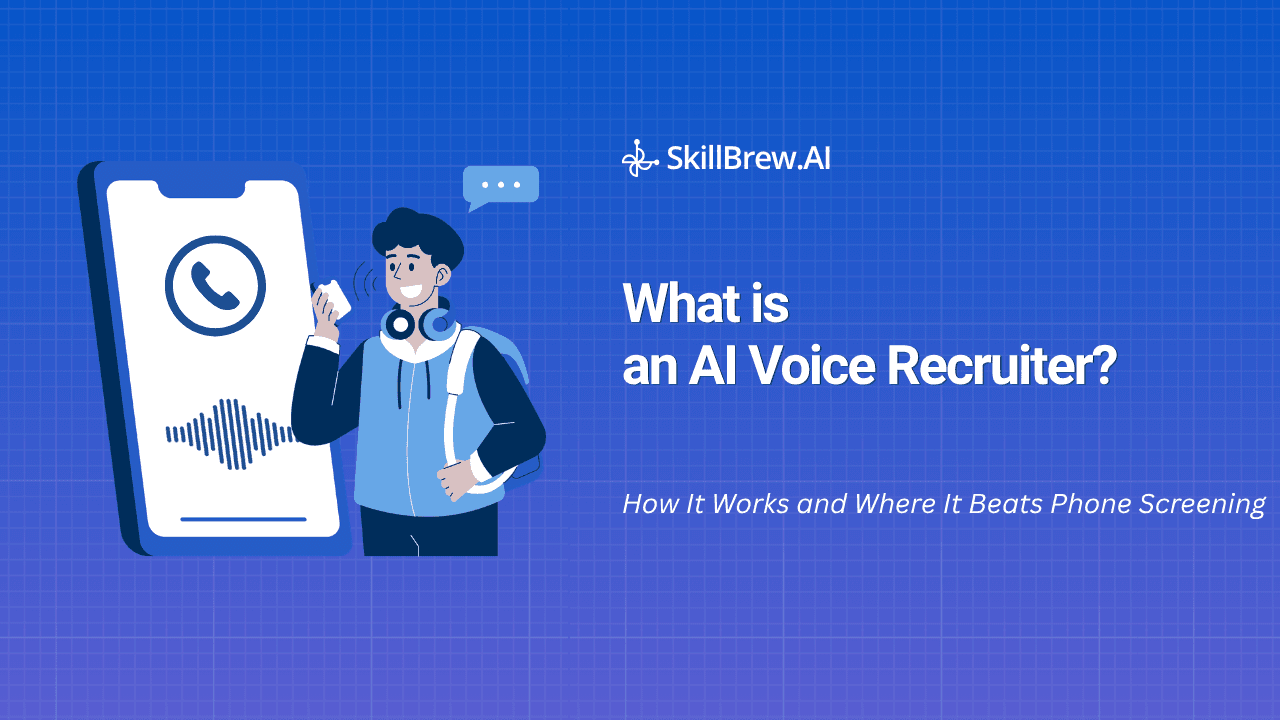
What Is An AI Voice Recruiter? How It Works and Where It Beats Phone Screening?
Phone screening was never broken because recruiters were bad at it. It broke because volume grew faster than headcount ever could. That gap is why an entirely new category of hiring software has shown up on TA leaders' radar in the last two years: the AI voice recruiter. Not a chatbot. Not an IVR that reads a script and collects keypad taps. An AI voice recruiter is software that calls candidates, has a real conversation, and reports back what it learned, at a scale no phone-based team can matc

Phone screening was never broken because recruiters were bad at it. It broke because volume grew faster than headcount ever could.
That gap is why an entirely new category of hiring software has shown up on TA leaders' radar in the last two years: the AI voice recruiter. Not a chatbot. Not an IVR that reads a script and collects keypad taps. An AI voice recruiter is software that calls candidates, has a real conversation, and reports back what it learned, at a scale no phone-based team can match.
If you're evaluating this category for the first time, this guide covers what an AI voice recruiter actually is, how an AI recruiter voice agent works under the hood, where it beats traditional phone screening, and which hiring scenarios get the most value from it.
Table of Contents
- What Is an AI Voice Recruiter?
- How an AI Recruiter Voice Agent Works
- Benefits for Recruiters and Hiring Teams
- Voice Technology for Candidate Screening: What's Actually New
- AI Voice Recruiter vs Traditional Phone Screening
- Best Use Cases for an AI Voice Recruiter
- What Makes BrewVoice by SkillBrew.AI Different
- When an AI Voice Recruiter Is Not the Right Choice
- Conclusion
- Frequently Asked Questions
What Is an AI Voice Recruiter?
An AI voice recruiter is a software system that conducts candidate screening conversations by phone or voice call, without a human recruiter on the line. It places outbound calls, asks structured and adaptive questions based on a job description, listens to open-ended answers, and produces a scored, comparable report for every candidate it screens.
The category sits between two older tools that never quite solved the problem:
- Manual telephonic screening - accurate but slow, expensive, and inconsistent recruiter to recruiter.
- IVR and one-way video screening - fast and cheap but rigid, unable to adapt, and easy for candidates to game.
A voice AI recruiter platform is built to close that gap: human-level conversational nuance at machine-level throughput. The best tools in this category don't just record a call and let a recruiter listen back later. They evaluate the conversation as it happens and hand the hiring team a decision-ready output.
It's worth being precise about what separates a genuine AI voice recruiter from a glorified auto-dialer. An auto-dialer connects calls faster. This category actually screens, meaning it asks a real question, listens to what comes back, decides whether to probe further, and scores the answer against the role requirements. That distinction is the entire value of the category.
Platforms like BrewVoice by SkillBrew.AI bring these capabilities together by combining adaptive AI voice conversations, multilingual screening, and recruiter-ready scorecards into a single first-round workflow. More on how that's built later in this guide.
How an AI Recruiter Voice Agent Works
Under the hood, an AI recruiter voice agent runs on a stack of a few connected components, and understanding them helps separate serious platforms from thin wrappers around a text-to-speech API.
1. Job description parsing. The system ingests a JD and converts role requirements into a structured question set: must-have skills, experience thresholds, and role-specific probes. This is what makes the call relevant instead of generic.
2. Speech recognition and natural language understanding. The AI recruiter voice agent transcribes spoken responses in real time and interprets meaning, not just keywords. A candidate who answers a technical question indirectly still gets evaluated on substance.
3. Adaptive dialogue management. This is the piece that separates the category from an IVR. If a candidate gives a vague or incomplete answer, the agent asks a natural follow-up, the same way a competent human interviewer would, instead of moving on with a checkbox marked complete.
4. Multi-dimensional scoring. Every response gets evaluated across more than one axis, typically role fit, technical or domain knowledge, and communication clarity. Scoring happens against the JD-derived criteria, not a generic rubric.
5. Structured output and routing. The call ends, and within a short window the hiring team gets a report, not a raw audio file. Strong platforms auto-route shortlisted candidates into the next hiring stage instead of leaving that step manual.
The result is a voice technology for candidate screening that behaves less like a recording device and more like a first-round interviewer who never gets tired, never has an off day, and never runs out of hours in the schedule.
Benefits for Recruiters and Hiring Teams
The case for an AI voice recruiter isn't just speed. It's what speed unlocks further down the funnel.
Recruiter time gets reallocated, not eliminated. Recruiters stop spending hours on first-round calls that rarely change the shortlist outcome and start spending that time on candidates who've already cleared a real bar. Teams can significantly reduce the recruiter hours spent on first-round screening once that stage moves to this kind of platform.
Screening consistency stops depending on who picked up the phone. Every candidate gets the same question depth, the same follow-up logic, and the same scoring criteria. That consistency matters more than it sounds. Inconsistent screening is one of the most common, least visible sources of bad hires.
Faster response times protect offer acceptance. Candidates who don't hear back within 48-72 hours disengage, especially at the fresher and high-volume end of the market. This kind of platform can call within minutes of an application landing, not days.
Scale stops requiring proportional headcount. A voice AI recruiter platform can run hundreds of simultaneous or same-day calls. Hiring 500 people for a role no longer means hiring more recruiters to screen for it.
Screening data becomes usable. Instead of scattered call notes in a spreadsheet, hiring teams get structured, comparable data across the full applicant pool, which makes shortlisting a ranking exercise instead of a guessing one.
Voice Technology for Candidate Screening: What's Actually New
Voice technology for candidate screening has existed in some form for years, mostly as IVR systems that route calls or collect basic yes/no responses. What changed recently is the underlying language model layer. A few components are doing most of the work.
Speech-to-text. Modern speech recognition has closed much of the gap on regional accents, code-switching, and background noise, which matters enormously in multilingual hiring markets where a single accent-trained model used to fail candidates who spoke perfectly clearly in their own context.
LLM-based reasoning. Instead of matching keywords against a checklist, the system reasons about what a candidate actually said, connects it back to the JD requirement being tested, and decides whether the answer holds up. This is the difference between "did the candidate say the word Python" and "did the candidate demonstrate they've actually used Python in production."
Intent detection. The agent has to tell the difference between a candidate answering the question, asking for clarification, going off-topic, or trying to end the call early, and respond appropriately to each without breaking the flow of the conversation.
Dynamic follow-up generation. Rather than pulling from a fixed bank of pre-written follow-ups, stronger platforms generate the next question based on the specific gap or ambiguity in the candidate's last answer, similar to how a live interviewer probes deeper on the fly.
Multilingual conversation handling. This goes beyond translation. It means running the entire structured conversation, including follow-ups and scoring, natively in the candidate's preferred language rather than translating a script written in English.
That combination is what makes today's voice technology for candidate screening fundamentally different from the phone-tree systems of a decade ago. It's also why the category is being adopted fastest in markets with high call volumes and linguistic diversity, where the gap between "screening at scale" and "screening well" used to be unbridgeable.
AI Voice Recruiter vs Traditional Phone Screening
| Factor | Traditional Phone Screening | AI Voice Recruiter |
| Calls per day (per screener) | 15-20 | 500+ |
| Question consistency | Varies by recruiter | Identical for every candidate |
| Follow-up questions | Depends on recruiter judgment and energy | Adaptive, triggered automatically |
| Time to first contact | Hours to days, queue-dependent | Minutes after application |
| Output format | Notes, memory, occasional call recording | Structured, scored report per candidate |
| Language coverage | Limited to recruiter's fluency | Scales across multiple languages natively |
| Accent or dialect bias | Present, even unintentionally | Evaluates clarity within language context, not against one accent norm |
| Cost to scale | Linear, more volume needs more headcount | Near-flat, volume doesn't require proportional hiring |
| Availability | Business hours, recruiter schedule | 24/7, candidate's schedule |
| Data for shortlisting decisions | Subjective, inconsistent | Comparable across the full pipeline |
The table isn't an argument that human judgment disappears. It's an argument about where human judgment should sit: reviewing a ranked, scored shortlist, not repeating the same fifteen-minute call five hundred times.
Best Use Cases for an AI Voice Recruiter
Not every hiring scenario needs this category. It earns its place wherever call volume, speed, or language diversity break a manual process, and in India's hiring market that covers more ground than most TA leaders initially assume.
Campus placement drives. Thousands of applicants across multiple colleges, a tight placement season window, and a need to standardize scoring across cities. An AI voice recruiter clears first-round screening in days instead of weeks and keeps every college's shortlist criteria identical. See how this plays out in a full campus hiring drive.
BPO and voice-process hiring. Roles where communication clarity on a call is the job itself. Screening candidates through a live voice conversation is a far more direct predictor of on-the-job performance than a resume or a text-based test.
Retail and hospitality hiring. High turnover, frequent seasonal hiring spikes, and candidates who are often applying from a phone, not a desktop. A call-based first round matches how these candidates already expect to be reached.
Gig and platform hiring. Onboarding volume that moves in waves, tied to demand rather than a steady hiring calendar, where a manual screening team can't flex up and down fast enough to match it.
Manufacturing and frontline industrial hiring. Roles in plants and warehouses where candidates are hired in bulk against tight production timelines, and where regional language coverage often matters more than English fluency.
Blue-collar and frontline hiring broadly. Candidates in logistics, field sales, and services roles often don't have reliable internet access or the patience for a portal login. A phone call remains the most accessible interface, and a voice AI recruiter platform can run that call at a scale no phone bank ever could.
High-volume lateral hiring. Roles with hundreds of applicants per posting, where speed-to-shortlist directly determines whether you keep your best candidates or lose them to a faster-moving competitor.
Staffing agencies and RPOs. Delivery teams running multiple client mandates at once get a shared screening layer that doesn't require staffing proportionally to every incoming drive.
What Makes BrewVoice by SkillBrew.AI Different
Most AI voice recruiter tools on the market were built for English-first, Western hiring markets and adapted afterward for everyone else. BrewVoice was built the other way around, for high-volume, multilingual hiring from the start.
Human-like, adaptive conversations. BrewVoice doesn't run a fixed script. It probes deeper when a candidate's answer needs clarification, the same way a competent human screener would, instead of moving on with a box checked.
Multilingual by design, not by translation. BrewVoice conducts full screening conversations across 10+ languages, including regional Indian languages, and evaluates communication clarity within the language the candidate is actually screened in, not against a single accent benchmark.
Recruiter-ready scorecards. Every call produces a structured report scored across role fit, technical signal, and communication clarity, not a call recording sitting in a queue waiting to be listened to.
JD-aware from the first question. BrewVoice parses the job description automatically inside HireFlow, SkillBrew.AI's always-free orchestration layer, before a single call goes out, so the screening conversation is relevant to the role from question one.
Enterprise-grade scale. BrewVoice handles 500+ automated screening calls a day, which is what makes it viable for campus drives and high-volume lateral hiring, not just pilot-sized test runs.
Real recruiter time saved. Teams running BrewVoice for first-round screening report saving 28+ recruiter hours per hiring cycle, freeing that time for the conversations that actually need a human on the line.
The output isn't a call recording sitting in a queue. Recruiters get a structured report, with shortlisted candidates routed automatically into the next stage, whether that's an AI interview, a technical assessment, or a human recruiter queue via HireFlow.
For a full walkthrough of how the BrewVoice screening flow works call by call, see Meet Rhea: SkillBrew.AI's Voice Agent for Automated Candidate Screening. If your next stage involves technical roles, SkillBrew.AI's Hiring Assessment Builder covers how JD-to-test screening works after the voice round.
SkillBrew.AI runs on a pay-as-you-go model with no monthly minimum and no onboarding project, so testing BrewVoice against a live JD doesn't require a procurement cycle first.
Book a demo and run BrewVoice against your own job description to see the scorecard in real time.
When an AI Voice Recruiter Is Not the Right Choice
This category solves a volume problem. It's worth being direct about where it isn't the right tool, because that honesty is part of using it well.
Executive and leadership hiring. These decisions rest on relationship-building, negotiation, and organizational fit that a structured screening conversation isn't designed to capture. This is a small number of high-stakes conversations, not a volume problem.
Final-round interviews. This category is built for first-round screening, not for the later-stage conversations where a hiring manager is assessing team fit, seniority-level judgment, or culture alignment.
Roles built entirely around long-term relationship management. Where the hire's success depends on rapport with a specific client, team, or stakeholder group, a human conversation earlier in the process, not just later, tends to surface more relevant signal.
Very low-volume hiring. If a role gets a handful of applicants, the efficiency gains that make this approach worthwhile at scale mostly don't apply, and a direct human conversation is just as fast.
The strongest hiring pipelines use an AI voice recruiter to clear the volume-heavy first round, then hand off to human recruiters and hiring managers for the stages where judgment, rapport, and context matter most.
Conclusion
The shift toward an AI voice recruiter isn't a novelty adoption. It's a direct response to a math problem manual phone screening was never built to solve: volume that scales faster than recruiter headcount ever can. An AI recruiter voice agent doesn't remove human judgment from hiring. It removes the bottleneck standing between an application and a decision-ready shortlist, so recruiters spend their time on candidates who've already cleared a real bar, and on the later-stage conversations that actually need a human.
If your team is fielding hundreds of applications a week and still relying on manual telephonic screening to get through them, that gap is exactly what this category exists to close.
Frequently Asked Questions
What is an AI voice recruiter?
An AI voice recruiter is a software system that places outbound calls to candidates, conducts structured screening conversations, and produces scored, comparable reports, without a human recruiter on the call.
Can AI conduct phone interviews?
Yes. An AI voice recruiter can run a full structured conversation over the phone or WhatsApp, ask adaptive follow-up questions based on what the candidate says, and evaluate the response, functioning as a genuine first-round phone interview rather than a scripted IVR.
How accurate are AI voice interviews?
Platforms built on structured, JD-derived scoring criteria tend to produce more consistent outcomes than manual screening, since every candidate is evaluated against identical criteria rather than a recruiter's individual judgment and energy on a given day. Accuracy depends heavily on how well the underlying platform's scoring model is built, so it's worth asking any vendor how their scores map back to actual hiring outcomes.
Are AI voice recruiters better than video interviews?
They serve different purposes. One-way video interviews are asynchronous and don't adapt to the candidate's answers. It runs a live, two-way conversation with real-time follow-ups, which tends to produce a more accurate first-round read, particularly for roles where verbal communication itself is part of the job.
Can AI voice recruiters screen technical candidates?
An AI voice recruiter is strongest at role fit, communication, and foundational technical signal captured through conversation. For deep technical validation like coding ability, pairing it with a dedicated technical assessment stage after the voice screen gives a more complete picture.
How does voice AI reduce time-to-hire?
By compressing the first-round screening stage from days or weeks down to hours, since calls can run in parallel at high volume instead of one recruiter working through a queue sequentially, and by routing shortlisted candidates straight into the next hiring stage without manual handoff delays.
Is voice AI suitable for campus hiring?
Yes, and it's one of the strongest use cases for the category. Campus drives generate thousands of applicants in a short window, and an AI voice recruiter can standardize scoring across every college in the drive instead of leaving it to whichever recruiter happened to run each campus's calls.
Can AI voice recruiters integrate with an ATS?
This varies by platform, so it's worth confirming directly with any vendor you're evaluating, including SkillBrew.AI, what your specific ATS setup requires before assuming integration coverage.
Does using an AI voice recruiter introduce accent bias?
It shouldn't, and a well-built platform is designed specifically to avoid it. Communication clarity should be evaluated within the language and context the candidate is screened in, not measured against a single accent as the default.
What does an AI voice recruiter platform typically cost?
Pricing models vary. Pay-as-you-go, per-call pricing without a monthly subscription is increasingly common and lets hiring teams test the category against a real JD without committing to a long-term contract upfront.
See AI-powered hiring in action
Discover how SkillBrew helps hiring teams cut time-to-hire by 60% with skill-validated assessments and AI-ranked shortlists.
Book a free demoNo commitment required · 30 minutes
Continue reading
View All Posts