© 2026 Skillbru AI Pvt Ltd. All rights reserved.
SkillBrew.AI


BrewVoice
Recruitment teams spend a considerable amount of time contacting candidates, following up on unanswered calls, conducting initial screening, and coordinating interviews. For recruitment agencies and staffing companies managing hundreds of applicants, these repetitive tasks can slow down hiring and affect the candidate experience. This is where AI voice agents for recruitment are becoming increasingly useful. These solutions use conversational artificial intelligence to automate candidate calls,

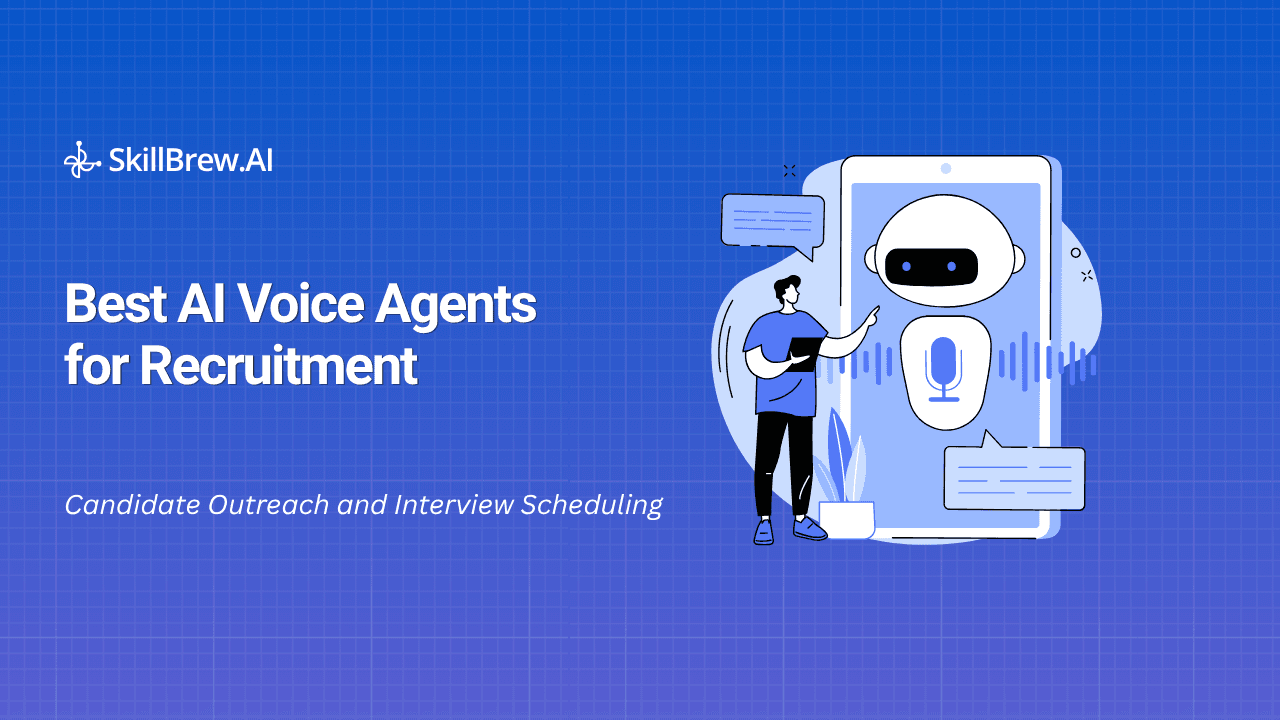
Recruitment teams spend a considerable amount of time contacting candidates, following up on unanswered calls, conducting initial screening, and coordinating interviews. For recruitment agencies and staffing companies managing hundreds of applicants, these repetitive tasks can slow down hiring and affect the candidate experience.
This is where AI voice agents for recruitment are becoming increasingly useful. These solutions use conversational artificial intelligence to automate candidate calls, collect relevant information, conduct initial screening, and support different stages of the hiring process.
Unlike traditional automated dialers that play prerecorded messages, conversational AI agents can understand candidate responses and hold interactive conversations. Some platforms also extend beyond voice calls to offer messaging, candidate engagement, and interview scheduling.
However, not every platform offers the same capabilities. Some specialize in phone screening, while others provide broader recruitment automation. Understanding these differences is important when evaluating AI voice agents for recruitment for your hiring workflow.
In this guide, we compare four platforms—BrewVoice, Paradox, Humanly, and Maki—to understand their capabilities, differences, and suitability for recruitment teams.
AI voice agents for recruitment are AI-powered systems that communicate with job applicants through automated voice conversations.
They can contact candidates, introduce job opportunities, ask screening questions, understand responses, and capture information that recruiters can use during candidate evaluation.
For example, a staffing agency hiring 200 customer support executives can use an AI calling agent to contact candidates, explain the opportunity, ask about their experience, and identify candidates interested in proceeding. This is one practical application of AI voice agents for recruitment in high-volume hiring.
Depending on the platform, these solutions can support:
The objective is not to replace recruiters. It is to automate repetitive communication so hiring teams can focus on evaluating candidates and making informed decisions.
When evaluating AI voice agents for recruitment, it is important to compare actual products rather than assuming every platform offers identical functionality.
Here are four solutions worth considering.
Best for: Automated first-touch candidate outreach and screening
BrewVoice is an AI voice screening solution from SkillBrew.AI. It uses Rhea, an AI voice assistant, to contact candidates and conduct initial screening conversations before they progress to subsequent hiring stages.
Rather than requiring recruiters to make every initial screening call manually, Rhea can initiate conversations, ask role-specific questions, and capture candidate responses. For teams exploring AI voice agents for recruitment specifically for outbound screening, this first-touch workflow is particularly relevant.
Key capabilities:
BrewVoice is particularly useful for staffing companies and recruitment agencies managing large applicant volumes or hiring across multiple regions.
Its multilingual calling capabilities can also help teams reach candidates who may be more comfortable communicating in regional languages. This makes it relevant for organizations considering AI voice agents for recruitment across geographically diverse candidate pools.
Where it fits in the recruitment workflow:
BrewVoice focuses on first-touch candidate outreach and screening. Interview scheduling is a separate stage of the recruitment workflow. Once candidates have been screened, recruiters can use scheduling tools to coordinate interviews with shortlisted applicants.
This distinction matters when evaluating whether a platform offers end-to-end recruitment automation or specializes in early-stage candidate engagement.
Want to simplify first-touch candidate outreach? Explore BrewVoice by SkillBrew.AI to see how AI-powered calling can help your recruitment team automate candidate conversations, conduct initial screening, and organize follow-ups.
Best for: Conversational hiring automation and interview scheduling
Paradox offers a conversational hiring platform powered by its AI assistant, Olivia.
The platform helps organizations automate different recruitment activities, including candidate engagement, application processes, screening, and interview scheduling.
One of its key capabilities is conversational interview scheduling. Candidates can receive available interview slots, select suitable timings, and request rescheduling through supported communication channels.
Key capabilities:
Paradox is particularly relevant for organizations managing high-volume hiring and complex interview coordination. For teams comparing AI voice agents for recruitment with broader conversational hiring platforms, its scheduling capabilities are an important distinction.
What makes it different?
Its strength lies in broader conversational recruitment automation, particularly scheduling. However, its core conversational workflows should not automatically be treated as equivalent to a dedicated outbound AI phone-screening solution.
Best for: Multichannel candidate engagement and screening
Humanly provides an AI recruiting platform designed to automate candidate engagement, screening, and interview coordination.
Its AI Recruiter can communicate with applicants through chat, SMS, and voice. It can answer candidate questions, collect information, qualify applicants, and help move suitable candidates toward the next hiring stage.
The platform also offers AI-powered interviews through chat, phone, and video.
Key capabilities:
Humanly is particularly suitable for recruitment teams looking to manage multiple stages of candidate communication through a single platform. Its multichannel approach can be useful for organizations assessing AI voice agents for recruitment alongside messaging and interview automation.
What makes it different?
Unlike solutions focused primarily on initial phone screening, Humanly offers broader candidate engagement across voice, messaging, and video. Teams should evaluate its workflows and integrations against their existing recruitment systems.
Best for: Structured AI phone screening and candidate assessment
Maki offers AI-powered recruitment assessments and conversational screening through its AI agent, Mochi.
Mochi can autonomously call candidates, ask structured questions about their experience and eligibility, and collect responses for recruiter review.
The platform also supports web-based AI screening, giving candidates another way to complete structured conversations.
Key capabilities:
Maki is useful for recruitment teams that want to combine structured candidate screening with assessment-based evaluation. It is another option worth evaluating when comparing AI voice agents for recruitment that emphasize structured conversations and candidate assessment.
What makes it different?
Maki places significant emphasis on structured screening and candidate assessment. Its phone-screening agent, Mochi, helps recruiters collect consistent information before progressing applicants through the hiring process.
The following comparison highlights the publicly documented capabilities of each platform. Features and availability may depend on configuration, integrations, and subscription plans.
| Capability | BrewVoice | Paradox | Humanly | Maki |
|---|---|---|---|---|
| AI voice calling | Yes | Verify specific workflow | Yes | Yes |
| Candidate screening | Yes | Yes | Yes | Yes |
| Multilingual support | 10+ languages | Multilingual workflows | Multichannel engagement | Multiple supported languages |
| Automated follow-ups | Yes | Yes | Yes | Yes |
| Interview scheduling | Separate workflow | Yes | Yes | Through scheduling agent |
| Candidate scoring | Yes | Screening workflows | AI-assisted insights | Yes |
| Web-based screening | Not its primary focus | Video interviewing | Yes | Yes |
| Primary strength | First-touch voice screening | Conversational hiring and scheduling | Multichannel recruitment | Structured AI screening |
The best option depends on which part of your recruitment process requires the most automation. In particular, organizations comparing AI voice agents for recruitment should distinguish between platforms built around outbound calling and those offering broader hiring automation.
The growing interest in AI voice agents for recruitment is driven by the operational challenges associated with high-volume candidate communication.
Consider a staffing agency hiring 200 customer support executives.
Recruiters may need to contact every applicant, explain the job opportunity, ask about experience, confirm interest, and arrange follow-ups.
Manually managing these conversations can consume several working hours.
With automated candidate outreach, the agency can initiate calls through an AI agent and review categorized outcomes such as:
Instead of manually tracking every interaction, recruiters can prioritize candidates who require attention. This is where AI voice agents for recruitment can improve operational efficiency.
Other benefits include:
Automated calling allows recruitment teams to contact more applicants without depending entirely on recruiter availability.
AI agents follow configured screening questions, helping recruiters collect comparable information across applicants.
Automated retries and callback tracking help prevent interested candidates from being overlooked.
Call summaries, transcripts, and structured reports reduce the need for manual documentation.
Timely communication and multilingual conversations can make the early recruitment experience more accessible.
For staffing agencies with recurring hiring requirements, these benefits can make AI voice agents for recruitment a practical way to manage repetitive communication without increasing the manual workload on recruiters.
Not all AI voice agents for recruitment are designed for the same hiring requirements. Before selecting a solution, consider these features.
Evaluating these capabilities can help recruiters identify whether a platform genuinely supports their requirements or simply offers automated calling. It is especially important when shortlisting AI voice agents for recruitment for large-scale hiring operations.
The right AI voice agents for recruitment depend on your hiring volume and the specific tasks you want to automate.
Before making a decision, ask:
For example, an agency hiring hundreds of candidates every month may prioritize automated phone screening, whereas an internal talent acquisition team may place greater importance on calendar coordination and interview scheduling.
Avoid selecting a platform simply because it offers the largest number of features. Choose one that addresses your most time-consuming recruitment tasks and fits the way your team manages candidates.
For recruitment agencies and staffing companies handling high volumes of applicants, AI voice agents for recruitment can reduce the operational effort involved in candidate outreach and initial screening.
The right platform should match your recruitment requirements, whether that means automated calling, multilingual conversations, interview coordination, or structured candidate evaluation.
BrewVoice by SkillBrew.AI is worth considering for teams that want to automate first-touch candidate engagement through multilingual AI-powered conversations. By handling repetitive outreach and initial screening, Rhea helps recruiters dedicate more time to evaluating shortlisted candidates and progressing suitable applicants through the hiring process.
The goal is not to remove human interaction from recruitment. It is to make candidate communication more efficient while allowing recruiters to focus on the decisions and conversations that matter most.
AI voice agents for recruitment are AI-powered systems that communicate with job candidates through automated voice calls. They can introduce job opportunities, conduct initial screening, collect responses, and support candidate follow-ups.
Yes. Some platforms offer interview scheduling through conversational AI, calendar integrations, and automated reminders. However, scheduling capabilities vary between providers.
An automated dialer primarily places calls using predefined rules. An AI voice agent can understand candidate responses, conduct conversations, ask screening questions, and capture relevant information.
Yes, depending on the platform. Some solutions support multiple languages and regional accents, helping recruitment teams communicate with candidates across different locations.
Yes. They can help recruitment agencies manage large candidate databases, automate initial outreach, conduct screening conversations, and organize follow-ups across multiple open positions.
Yes. BrewVoice uses Rhea, an AI voice assistant, to conduct first-touch screening calls, collect candidate responses, evaluate relevant parameters, and provide structured reports to help recruiters identify potential fits.
No. These tools are designed to automate repetitive recruitment tasks, such as initial outreach and screening. Recruiters remain responsible for evaluating candidates, conducting interviews, building relationships, and making final hiring decisions.
Discover how SkillBrew helps hiring teams cut time-to-hire by 60% with skill-validated assessments and AI-ranked shortlists.
Book a free demoNo commitment required · 30 minutes