AI Interview
How Interview Results Reports Improve Candidate Evaluation
After an interview, recruiters often have notes, scores, candidate responses, comments, and recordings spread across different places. An interview results report brings the key information together in a structured format, making it easier to review what happened during the interview and identify areas that may need further evaluation. This becomes especially useful when teams are interviewing many candidates for the same role. Instead of relying on scattered notes or memory, recruiters and hir

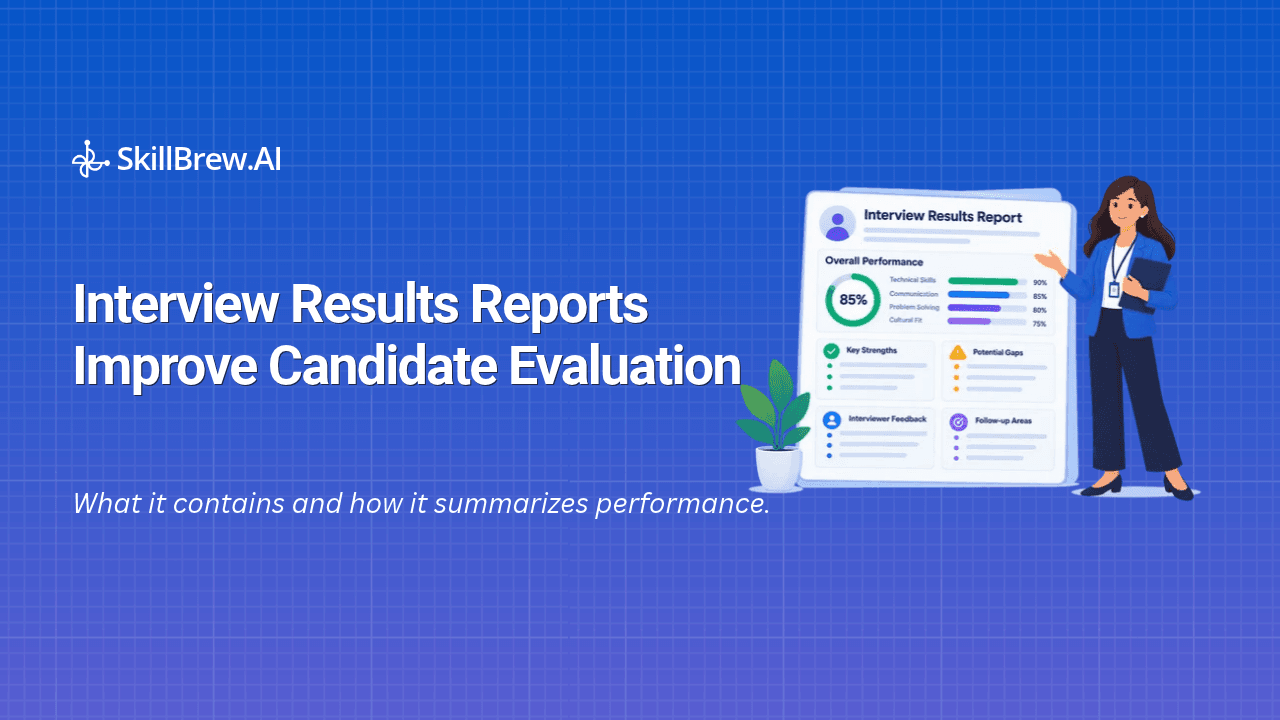
After an interview, recruiters often have notes, scores, candidate responses, comments, and recordings spread across different places. An interview results report brings the key information together in a structured format, making it easier to review what happened during the interview and identify areas that may need further evaluation.
This becomes especially useful when teams are interviewing many candidates for the same role. Instead of relying on scattered notes or memory, recruiters and hiring managers can use a consistent record of the interview.
An interview results report does not make the hiring decision. It gives the people involved in that decision relevant information they can use to evaluate the candidate more effectively.
Table Of Content
- What Is an Interview Results Report: Understand what it contains and how it summarizes performance.
- Why Structured Interview Reports Matter for Candidate Evaluation: See how structured reports simplify candidate review.
- What Should an Interview Results Report Include: Explore the key elements of a useful report.
- How Reports Improve Candidate Evaluation: Learn how reports support consistent, evidence-based evaluation.
- Interview Reports vs. Traditional Interview Notes: Compare structured reports with traditional notes.
- How AI Can Improve Interview Reporting: See how AI can organize responses and generate insights.
- How to Use Interview Reports in the Hiring Process: Learn how reports support each hiring stage.
- What Makes a Good Interview Report?: Explore what makes a report useful and actionable.
- Common Mistakes to Avoid: Learn what can make interview reports less effective.
- FAQs: Get answers to common questions about interview results reports.
What Is an Interview Results Report?
An interview results report is a structured document that summarizes important information collected during a candidate interview. It can bring together candidate responses, skills assessed, interviewer observations, scores, feedback, and areas that may require further review.
The exact format can vary depending on the organization, interview type, and role. A technical interview may focus on problem-solving and technical knowledge, while a customer-facing role may place more emphasis on communication and situational responses.
A useful report may include:
- Candidate responses
- Questions asked
- Skills or competencies assessed
- Communication observations
- Strengths and potential gaps
- Scores or ratings against defined criteria
- Interviewer feedback
- Follow-up areas
- Overall interview performance
For example, a technical candidate may demonstrate strong knowledge of a programming language but provide limited examples from real-world projects. An interview results report can capture both points, giving the hiring team a useful area to explore in a later discussion rather than treating one overall score as the final answer.
Why Structured Interview Reports Matter for Candidate Evaluation
Interviews generate a lot of information. Different interviewers may focus on different parts of a conversation, and important details can become difficult to find when they are stored only in separate notes or messages.
An interview results report helps bring these inputs into a consistent structure.
Reduces fragmented feedback
Without a structured report, interview feedback may be spread across documents, emails, spreadsheets, interview platforms, or individual notes.
A centralized report gives the hiring team one place to review the relevant information from the interview.
Helps preserve interview evidence
Interview decisions should be based on relevant information from the evaluation process rather than memory alone.
A useful report should connect candidate responses and interviewer observations to defined evaluation criteria. This gives reviewers more context when assessing how a candidate performed.
Makes handoffs easier
Hiring processes often involve multiple people. A recruiter may conduct the initial screening, a technical interviewer may assess specific skills, and a hiring manager may review the overall candidate profile.
A structured report makes it easier for the next person to understand what was discussed without going through every interview note or recording from the beginning.
Supports more consistent evaluation
When candidates are evaluated against the same job-related criteria, recruiters have a clearer basis for comparison.
This does not mean every candidate will produce identical results. It means the hiring team has a more consistent framework for reviewing the information collected during each interview.
What Should an Interview Results Report Include?
The value of an interview results report depends partly on the information it contains. A useful report should capture the details that help recruiters and hiring managers understand candidate performance without overwhelming them with unnecessary information.
| Report Element | What It Covers | Why It Helps |
| Candidate responses | What the candidate said during the interview | Preserves relevant interview evidence |
| Skills assessed | Skills and competencies evaluated | Connects the interview to role requirements |
| Evaluation results | How the candidate performed against defined criteria | Makes evaluation easier to review |
| Strengths | Relevant capabilities demonstrated during the interview | Helps identify positive signals |
| Potential gaps | Areas that may need further evaluation | Highlights follow-up areas |
| Communication observations | Clarity, structure, relevance, and communication patterns | Adds useful context |
| Interviewer feedback | Human observations and comments | Preserves interviewer perspective |
| Follow-up areas | Topics that may need further evaluation | Helps plan the next stage |
For example, imagine a backend developer candidate who performs well on technical questions but gives limited examples of working on production systems. The report can record the strong technical performance while highlighting real-world project experience as a follow-up area.
This gives the hiring team more useful information than relying on an overall score alone.
How Reports Improve Candidate Evaluation
An interview results report can improve the evaluation process in several practical ways.
Makes important information easier to find
Recruiters do not always need to reread an entire interview to answer a specific question.
A well-organized report can make it easier to find relevant responses, skills assessed, interviewer comments, and potential follow-up areas.
Helps identify follow-up questions
A report can show where the interview provided enough information and where additional context may be useful.
For example, if a candidate describes experience with a particular technology but does not explain how they used it in a real project, the hiring team can use that information to plan a follow-up question.
Supports candidate comparison
When several candidates are being considered for the same position, reviewing each interview in a similar format can make the process easier to manage.
When candidates are evaluated against the same job-related criteria, recruiters have a clearer basis for comparison without relying entirely on memory or scattered notes.
Improves collaboration
Recruitment decisions often involve several stakeholders. A recruiter, hiring manager, technical interviewer, and department lead may each contribute different observations.
A structured report gives them a common reference point for discussing the candidate.
Creates a consistent candidate record
Interview information can become difficult to reconstruct later, especially when hiring processes take several weeks.
An interview results report creates a record that can be reviewed alongside other candidate information during the hiring process.
Interview Reports vs. Traditional Interview Notes
Traditional interview notes can be useful, but their structure often depends on the person taking them. One interviewer may record detailed observations, while another may write only a few points.
A structured report can organize the same type of information into predefined sections.
| Traditional Interview Notes | Structured Interview Report |
| Format can vary between interviewers | Uses a defined structure |
| May contain scattered observations | Groups information by evaluation area |
| Can be difficult to compare | Makes comparison easier to review |
| Important details may be buried in notes | Key information is easier to locate |
| Often requires manual organization | Can be automatically structured in some systems |
| May focus heavily on personal note-taking style | Can follow predefined evaluation criteria |
A structured interview report does not have to replace interviewer notes. Instead, it can provide an organized summary that complements the interviewer's observations.
How AI Can Improve Interview Reporting
AI can help with the work involved in turning interview conversations into structured information.
For example, an AI system can analyze interview content, organize relevant responses, summarize discussions, and structure information according to predefined criteria.
It can also surface potential strengths, gaps, and areas that may warrant further review, reducing some of the manual work involved in preparing a report.
These capabilities can make interview information easier to organize, but AI-generated evaluations should still be reviewed in context rather than treated as automatically accurate or unbiased.
SkillBrew.AI's AI Interviews provide structured interview insights and skill scores, along with a PDF score report. Its interview experience can also use candidate responses to guide subsequent questions.
The purpose of using AI in interview reporting should be to help recruiters organize and review information, while keeping human judgment involved in the final evaluation.
How to Use Interview Reports in the Hiring Process
An interview results report can be useful at several points in the hiring workflow.
After the interview
The report can capture the main information from the interview while the evaluation is still fresh. This can help prevent important details from being lost between interview stages.
During hiring team review
Recruiters and hiring managers can review the report to understand candidate responses, evaluation results, strengths, and areas requiring further discussion.
Before the next interview
If a report identifies an area that was not explored deeply enough, the next interviewer can use it to prepare relevant follow-up questions.
During candidate comparison
When multiple candidates have completed the same interview process, structured reports can help the team review similar evaluation areas across candidates.
For hiring records
Reports can also provide a useful record of the evaluation process, particularly for organizations that conduct multiple interview rounds or involve several stakeholders.
What Makes a Good Interview Report?
Not every interview results report is equally useful. A good report should make relevant information easier to understand without adding unnecessary complexity.
Clear structure
The report should organize information into logical sections so reviewers can quickly find what they need.
Relevant evaluation criteria
The information should relate to the skills, competencies, and requirements being assessed for the role.
Supporting context
Scores or ratings are more useful when accompanied by relevant candidate responses or observations that explain what they represent.
Actionable follow-up areas
A report should help identify topics that may require additional discussion or verification.
Easy readability
Recruiters and hiring managers should be able to understand the report without spending unnecessary time interpreting it.
Human review
The report should support the hiring team rather than replace professional judgment. Human reviewers should consider the report alongside the broader candidate profile and other relevant hiring information.
Common Mistakes to Avoid
There are several ways an interview results report can become less useful.
Relying only on an overall score
A single number rarely explains the full context of an interview. Reviewers should be able to see the information behind the score.
Using inconsistent criteria
If different candidates are evaluated against completely different criteria, the resulting reports may be difficult to compare.
Treating AI output as final
AI-generated summaries or evaluations can help organize information, but they should be reviewed by people who understand the role and the hiring context.
Including too much irrelevant information
More information does not always make a report more useful. The report should focus on details that support the evaluation.
Removing human context
Interviewer observations can provide important context that automated analysis may not capture. A useful reporting process should preserve relevant human input.
FAQs
Q1. What is an interview results report?
An interview results report is a structured summary of a candidate's interview. It can include responses, skills assessed, evaluation results, interviewer feedback, strengths, potential gaps, and follow-up areas.
Q2. Why are interview results reports useful?
Interview results reports help organize interview information, reduce fragmented feedback, and give hiring teams a consistent record to review.
Q3. What should an interview report include?
A useful report can include candidate responses, evaluation criteria, performance results, strengths, potential gaps, communication observations, interviewer feedback, and follow-up areas.
Q4. Can AI generate an interview results report?
Yes. AI can analyze interview content and organize information into a structured interview results report. Human review is still important because AI-generated evaluations should not automatically be treated as accurate or unbiased.
Q5. Are interview results reports the same as interview notes?
Not necessarily. Interview notes are often informal and vary between interviewers, while a structured report organizes relevant information into predefined sections.
Q6. Can these reports improve candidate comparison?
Structured reports can make it easier to review candidates against the same job-related criteria, provided the underlying evaluation process is applied consistently.
Conclusion
An interview results report is not valuable simply because it produces another score. It is valuable because it organizes the information behind the evaluation.
When candidate responses, interviewer observations, relevant skills, strengths, and areas for follow-up are brought together, recruiters and hiring managers have a more useful record of the interview.
The goal is not for a report or an AI system to make the hiring decision. The goal is to give the people making that decision more relevant, consistent, and usable information.
For teams looking to make interview evaluation more structured, SkillBrew.AI's AI Interviews can help organize interview insights and generate structured reports.
Schedule a Demo to see how SkillBrew.AI can fit into your interview and candidate evaluation workflow.
See AI-powered hiring in action
Discover how SkillBrew helps hiring teams cut time-to-hire by 60% with skill-validated assessments and AI-ranked shortlists.
Book a free demoNo commitment required · 30 minutes
Continue reading
View All Posts