Technical Screening
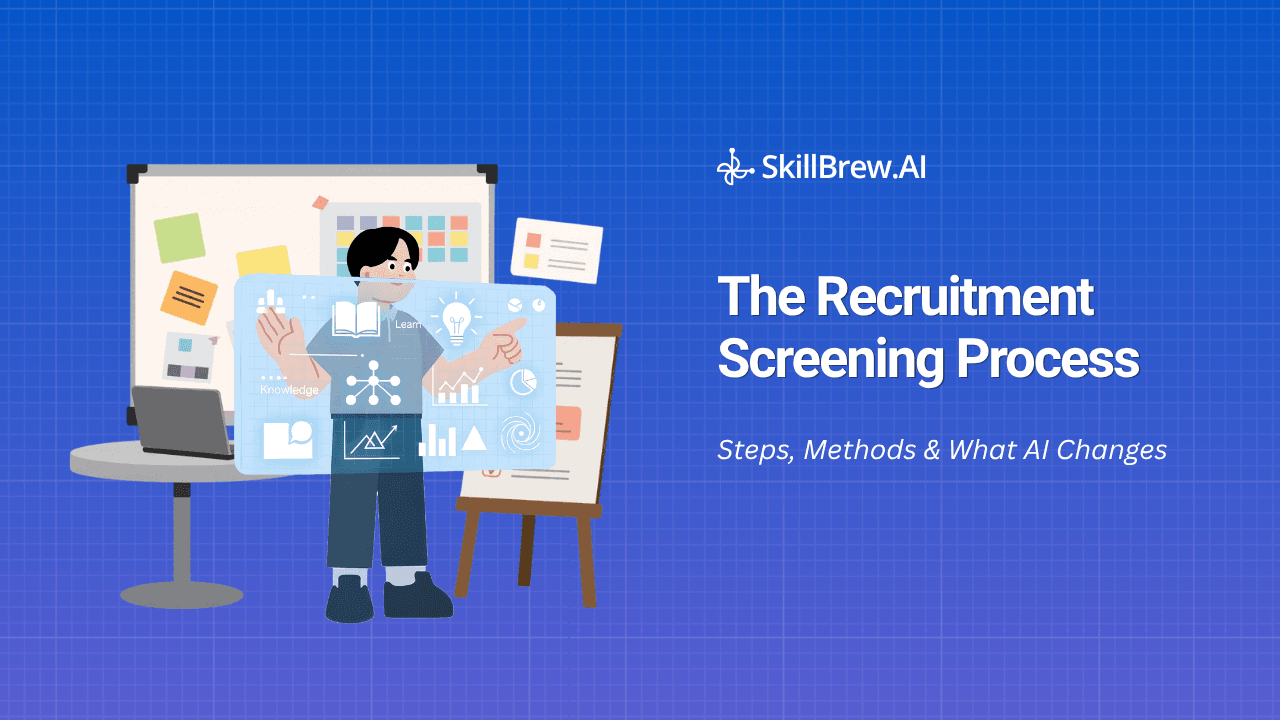
The Recruitment Screening Process: Steps, Methods & What AI Changes
What is the recruitment screening process? The recruitment screening process is the structured series of evaluations that narrows a large pool of applicants down to the shortlist that moves forward to interviews and hiring decisions. It sits between job posting and the first live interview, and getting it right is one of the highest-leverage activities in talent acquisition. Done well, this process saves time, improves hire quality, and reduces costly mis-hires. Done poorly, it filters out str
What is the recruitment screening process?
The recruitment screening process is the structured series of evaluations that narrows a large pool of applicants down to the shortlist that moves forward to interviews and hiring decisions. It sits between job posting and the first live interview, and getting it right is one of the highest-leverage activities in talent acquisition.
Done well, this process saves time, improves hire quality, and reduces costly mis-hires. Done poorly, it filters out strong candidates on superficial criteria or lets unqualified applicants consume hours of interviewer time.
| Metric | What It Tells You |
| 250+ | Average applications per corporate job opening |
| 6–10 | Candidates shortlisted for interviews |
| 30% | Of bad hires trace back to poor screening |
| $4,700 | Average cost per hire (SHRM, 2025) |
Key insight: The recruitment screening process isn't just about filtering out, it's about identifying signal inside an enormous amount of noise. The best screening processes are designed backwards, starting with the ideal candidate profile and working toward the criteria that predict it.
Table of Contents
- The 6 Key Steps in the Recruitment Screening Process
- Screening Methods: Which One Fits Your Role?
- What AI Changes in the Recruitment Screening Process, and What It Doesn't
- Common Recruitment Screening Process Mistakes
- Compliance and Bias Considerations
- FAQs on the Recruitment Screening Process
- Run a Faster, Fairer Recruitment Screening Process with SkillBrew.AI
The 6 Key Steps in the Recruitment Screening Process
An effective recruitment screening process follows a logical funnel. Each step should reduce the candidate pool meaningfully while maintaining fairness and compliance. Here are the six stages that form the backbone of most modern screening workflows.
01. Define the Screening Criteria.
Before a single application arrives, teams must align on what "qualified" means: mandatory requirements (certifications, years of experience, legal eligibility to work) and preferred attributes (specific tools, domain knowledge, culture signals). Poorly defined criteria are the root cause of an inconsistent recruitment screening process.
02. Resume and Application Review.
The first pass filters for baseline qualifications: role-relevant experience, career progression, unexplained gaps, keyword alignment with the job description. This step handles the highest volume in the recruitment screening process and is where AI tools have had the most immediate impact, both positive and controversial.
03. Pre-Screening Questionnaire or Knockout Questions.
Structured application questions automatically filter ineligible candidates before human review. Knockout questions alone can cut the review-eligible pool by 40-60% in high-volume roles. Examples: "Are you legally authorized to work in [country]?" or "Do you hold X certification?"
04. Phone or Video Screening.
A 15-30 minute screen with a recruiter verifies baseline criteria, assesses communication skills, confirms interest and availability, and explains the role and company. This step converts a document review into a human signal, a critical checkpoint in the process, and surfaces strong candidates who may not look perfect on paper.
05. Technical or Skills Assessment.
For roles with testable skills (engineering, data analysis, writing, finance modeling), a structured assessment provides objective signal beyond self-reported credentials. The best assessments mirror actual job tasks. Formats range from timed coding challenges to take-home case studies and work samples.
06. Shortlisting and Handoff to Interviews.
Screeners score and rank candidates against agreed criteria, document their decisions, and brief the interview panel. Good shortlisting includes a note on each candidate's strengths and the specific questions to probe, not just a "yes" or "no."
Screening Methods: Which One Fits Your Role?
No single method fits every role here. The right approach depends on seniority level, the skill type being assessed, applicant volume, and time-to-hire target.
| Method | Best Fit / Risk |
| Resume review | High volume, low cost. Risk: Subjective without structured criteria. |
| Phone screen | Humanizes the process; assesses motivation. Scales poorly (>100/mo). |
| Async video interview | Efficient high-volume screening; reduces scheduling friction. |
| Technical assessment | Objective signal; take-home tasks are best for senior roles. |
| Work sample / portfolio | High-validity predictor for creative/strategic roles. May deter busy talent. |
| Cognitive / psychometric | Measures reasoning/culture fit. Use sparingly; requires legal validation. |
Many organizations combine two or three methods in sequence, for example a knockout questionnaire followed by resume review and an async video screen, to balance quality signal with candidate experience and recruiter workload.
What AI Changes in the Recruitment Screening Process, and What It Doesn't
AI has moved from buzzword to operational reality in the recruitment screening process. By 2025, most enterprise ATS platforms include at least one AI-driven feature. Understanding what AI actually changes versus where human judgment stays essential is critical for TA leaders making tooling decisions.
Where AI genuinely accelerates the recruitment screening process: resume parsing and ranking at scale; scheduling and logistics automation; real-time transcription and note-taking in video screens; pattern recognition across large candidate pools; cutting time-to-shortlist from days to hours in high-volume roles.
What AI does well
AI-powered tools excel at processing high volumes of structured information quickly and consistently. Resume parsing extracts and standardizes information across thousands of documents in minutes. Ranking algorithms score candidates against defined criteria without the fatigue effects that make human screeners inconsistent over a long review session.
Conversational AI can run initial screening conversations, verifying basic criteria, answering candidate questions, collecting structured data at any hour and in multiple languages. For companies receiving thousands of applications a month, this is a genuine operational advantage at scale.
What AI doesn't change
The quality of AI screening output depends entirely on the quality of the criteria fed into it. If your screening criteria reflect historical biases, an AI system amplifies those biases at scale. Garbage in, garbage out, at speed.
AI still can't reliably assess leadership potential, creative problem-solving approach, cultural contribution, or motivation. Those signals require human conversation and judgment. Senior and specialist roles in particular shouldn't lean heavily on AI ranking for final shortlisting decisions.
Common Recruitment Screening Process Mistakes
The most expensive screening errors are rarely obvious in the moment. They compound quietly, in hires who leave within six months, in teams that never get the candidate they needed, in organizations that can't explain why they keep hiring the same kind of person.
Over-relying on keyword matching
ATS systems that screen resumes by keyword match rate will systematically miss candidates who describe the same skills in different terms. A product manager with deep "roadmap prioritization" experience may get filtered out of a search for "backlog grooming." Review criteria for jargon specificity before automating any part of it.
Screening for experience instead of capability
Years of experience is a weak proxy for ability, especially at the junior-to-mid career transition. Structured assessments and behavioral screens that evaluate actual capability are stronger predictors of performance and open the pipeline to candidates from non-traditional backgrounds.
Inconsistent scoring across screeners
Without a structured scoring rubric, two screeners reviewing the same candidate can reach opposite conclusions. Standardize your scoring rubric before the review process begins and calibrate across the team on a sample of applications.
Poor candidate communication during screening
The screening stage is often where candidate experience deteriorates fastest. Acknowledgment emails that take weeks, no updates on timeline, and rejection notices with no feedback damage employer brand at scale. Automate the touchpoints you can, and make the human moments count.
Compliance and Bias Considerations
The recruitment screening process is one of the most legally exposed areas of HR practice. Employment law across most jurisdictions prohibits screening decisions based on protected characteristics, and as AI-driven screening becomes more common, regulators are paying closer attention to how automated tools get used in hiring.
What regulators are watching
The EU AI Act (2024) classifies employment screening as a high-risk AI application, meaning organizations using AI screening tools must document how systems work, demonstrate they're tested for bias, and allow candidates to request human review of automated decisions. New York City Local Law 144 requires bias audits for automated employment decision tools. Similar legislation is advancing across several US states and other jurisdictions.
Best practice: Document your screening criteria before the role opens. Any criteria that can't be clearly connected to job-relevant performance risks both legal exposure and practical errors in your process. If you use AI-assisted tools, understand the bias audit requirements in your jurisdiction and request audit documentation from vendors.
Building for fairness by design
A structured recruitment screening process, consistent criteria, standardized scoring, documented decisions, is both the ethically sound and the legally defensible approach. Blind CV review (removing photos and graduation institution) has been shown in multiple studies to increase shortlist diversity without affecting subsequent hire performance. Skills-based assessments scored against a consistent rubric outperform holistic "gut feel" judgment on both fairness and predictive validity.
FAQs on the Recruitment Screening Process
Q1. What is the difference between screening and shortlisting?
Screening is the full recruitment screening process, every stage from resume review to phone screens and assessments. Shortlisting is the output: the ranked list of candidates selected to proceed to formal interviews. Screening is the verb; the shortlist is the noun.
Q2. How many rounds of screening is too many?
For most roles, two to three screening stages before the first live interview is the practical ceiling for a recruitment screening process. Beyond that, candidate dropout rises sharply and the marginal information gain from additional screens drops fast. Senior or highly specialized roles may justify an extra stage, but every stage should serve a specific, documentable purpose.
Q3. Should we use AI to screen CVs?
For high-volume roles (50+ applications), AI-assisted resume parsing and initial ranking can meaningfully reduce recruiter workload. Treat AI output as a first-pass signal, not a final decision, and always have a human review the top band plus a sample of the rejected pool to check for errors. Confirm your vendor can demonstrate bias testing, especially in a jurisdiction with AI employment law requirements.
Q4. What's a good time-to-screen benchmark?
For most corporate roles, completing the initial resume screen within 3-5 business days of application close is best practice. Phone screens should be offered within 5-7 business days of resume review. Time-to-shortlist should typically target under 3 weeks for non-executive roles.
Q5. How do we reduce unconscious bias in screening?
The most effective interventions combine structural and process changes: define and agree on screening criteria before reviewing applications; use a standardized scoring rubric; consider blind CV review; use structured interview guides for phone screens; and calibrate between screeners regularly. Training alone, without structural change to the process, has limited long-term impact on bias.
Run a Faster, Fairer Recruitment Screening Process with SkillBrew.AI
Every step in this playbook, resume review, knockout questions, technical assessment, shortlisting, gets faster and more consistent when it's backed by structured automation instead of manual judgment calls at every stage.
SkillBrew.AI HireFlow automates resume screening and ranking against your job description, the highest-volume step in any recruitment screening process. SkillBrew.AI Assessments turn a job description into a role-specific technical or skills test in minutes, with candidates automatically ranked by performance. SkillBrew.AI Interviews run structured, AI-led first-round screening that produces a consistent report for every candidate, closing the gap between resume review and the live interview panel.
The goal isn't removing human judgment from the recruitment screening process. It's making sure every candidate is evaluated against the same standard, with less recruiter time spent on repetitive review and more spent on the decisions that actually need a human.
Want to see a faster recruitment screening process in action? Book a demo with SkillBrew.AI.
See AI-powered hiring in action
Discover how SkillBrew helps hiring teams cut time-to-hire by 60% with skill-validated assessments and AI-ranked shortlists.
Book a free demoNo commitment required · 30 minutes
Continue reading
View All Posts