Recruitment Automation & Workflow
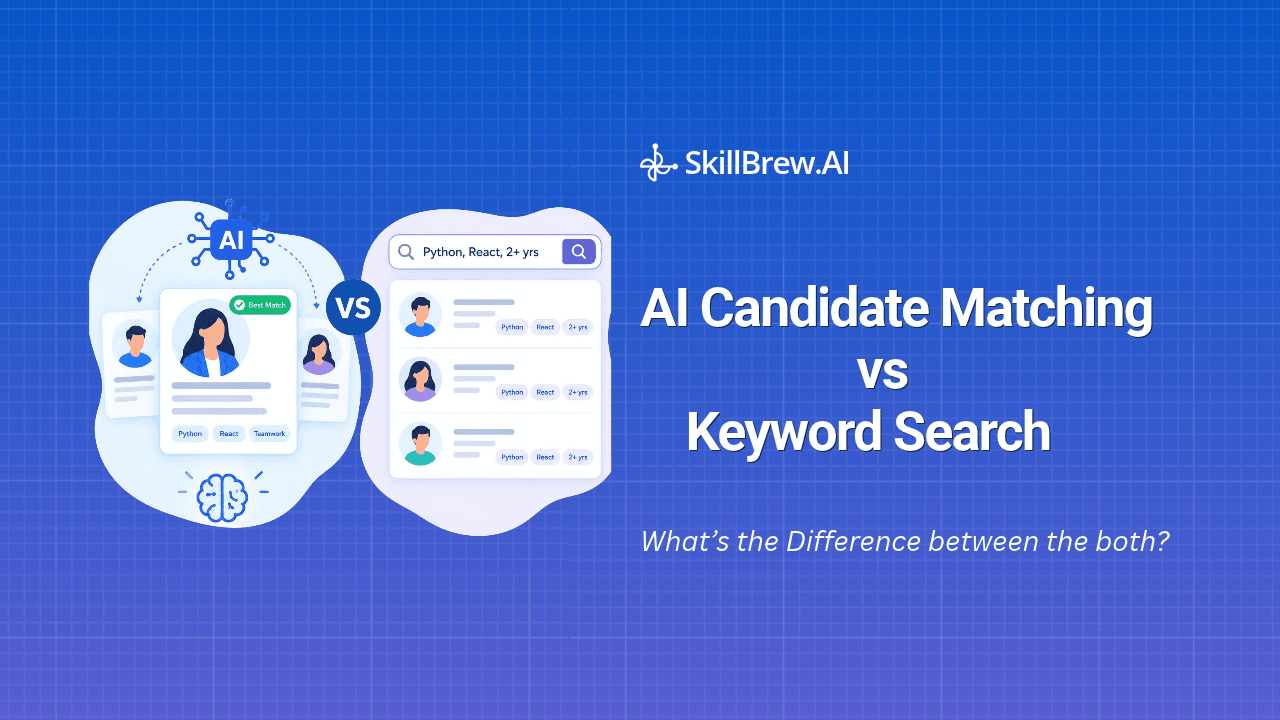
AI Candidate Matching vs Keyword Search: What’s the Difference?
Finding the right candidate is often less about how many resumes you have and more about how effectively you can search through them. As hiring databases grow, recruiters may have hundreds or thousands of candidate profiles to review. A traditional candidate search usually starts with keywords, but exact-term searches can miss relevant profiles when candidates describe similar skills or experience differently. AI candidate matching takes a broader approach. Instead of relying only on exact key

Finding the right candidate is often less about how many resumes you have and more about how effectively you can search through them.
As hiring databases grow, recruiters may have hundreds or thousands of candidate profiles to review. A traditional candidate search usually starts with keywords, but exact-term searches can miss relevant profiles when candidates describe similar skills or experience differently.
AI candidate matching takes a broader approach. Instead of relying only on exact keywords, it can analyze skills, experience, job titles, responsibilities, and other profile information to identify potential relevance.
So, what is the difference between AI candidate matching and keyword search?
This guide explains how both approaches work, where keyword-based candidate search can be useful, where AI matching can help, and how recruiters can use both approaches as part of a modern hiring workflow.
Table of Contents
- What Is Keyword-Based Candidate Search?: How keyword search finds candidates.
- How AI Candidate Matching Works: How AI analyzes candidate relevance.
- AI Candidate Matching vs Keyword Search: Key differences between both approaches.
- Where Keyword Search Works Well: When traditional search is useful.
- Where AI Matching Has an Advantage: Where AI can improve candidate discovery.
- An Example: Searching for a Software Engineer: A practical comparison of both methods.
- Does AI Matching Replace Keyword Search?: How both approaches can work together.
- How to Choose the Right Approach: Factors to consider when choosing a search method.
- Final Thoughts: Key takeaways for recruiters.
What Is Keyword-Based Candidate Search?
Keyword-based candidate search is one of the most common ways recruiters find candidates.
The concept is simple.
A recruiter enters one or more keywords, and the search system looks for those terms in candidate profiles, resumes, job titles, skills, or other searchable fields.
For example, a recruiter hiring a backend developer might search for:
- Python
- Django
- PostgreSQL
- REST API
- AWS
The system then returns profiles containing some or all of these terms, depending on how the search is configured.
This approach is straightforward and gives recruiters a significant amount of control over what they are looking for.
It can work particularly well when the recruiter already knows the exact skills or qualifications required for a role.
However, keyword-based candidate search depends heavily on the words used in the search query and the information available in the candidate profile.
That creates an important limitation.
A qualified candidate may have the right experience but describe it using different terminology.
For example, a recruiter may search for “customer success,” while a candidate's resume uses “client relationship management.”
The candidate may still be relevant, but a basic keyword search may not recognize the connection.
How AI Candidate Matching Works
AI candidate matching uses a broader approach to candidate search.
Instead of treating a resume as a collection of individual keywords, an AI-powered system can analyze relationships between different pieces of information.
For example, it may consider:
- Skills
- Previous job titles
- Work experience
- Responsibilities
- Industry experience
- Seniority
- Location
- Job requirements
- Related skills and terminology
Suppose a job description asks for experience with “cloud infrastructure.”
A candidate's resume might not contain that exact phrase. Instead, it could mention AWS, Azure, Kubernetes, Terraform, and infrastructure automation.
Depending on how the system is designed, AI matching may identify these as relevant signals rather than simply looking for the exact phrase “cloud infrastructure.”
This makes AI-based candidate search more context-aware.
The goal is not simply to find candidates who contain specific words. It is to identify candidates whose overall profile may align with the requirements of a role.
AI Candidate Matching vs Keyword Search
The biggest difference between the two approaches is how they interpret candidate information.
Keyword search primarily looks for matching terms.
AI candidate matching attempts to understand the relationship between candidate information and the requirements of the role.
| Factor | Keyword Search | AI Candidate Matching |
| Primary method | Matches search terms | Analyzes candidate-job relevance |
| Exact keywords | Very important | Less dependent on exact wording |
| Synonyms and related skills | May require additional terms | Can identify related concepts depending on the system |
| Search control | High | More automated |
| Context | Limited | More contextual |
| Candidate ranking | Usually based on search criteria | Can rank based on overall relevance |
| Query flexibility | Depends on recruiter | Can interpret more natural requirements |
| Best suited for | Specific, known criteria | Broader or complex matching |
Neither approach is automatically right for every hiring situation.
The better fit depends on the role, the size of the candidate pool, and how specific the hiring requirements are.
Where Keyword Search Works Well
Keyword-based candidate search still has several practical advantages.
1. It is easy to understand
Recruiters generally know what they are searching for.
If a role requires “Java,” “Spring Boot,” and “MySQL,” entering those terms is straightforward.
There is little ambiguity about what the search is doing.
2. It gives recruiters control
Some recruiters want to define their search criteria very precisely.
For example, if a client specifically requires experience with a particular certification or technology, searching for that exact term can be useful.
Recruiters can also combine multiple keywords to narrow down results.
3. It works well for clearly defined requirements
Consider a role where the requirements are:
- CPA certification
- 5+ years of experience
- SAP experience
- Location: Mumbai
These are relatively specific requirements.
A traditional candidate search can quickly filter profiles based on these criteria.
4. It can be useful for experienced recruiters
Recruiters who understand a particular technical or professional domain may already know the terminology candidates use.
They can create detailed Boolean searches and use combinations of keywords to find specific profiles.
The challenge appears when recruiters do not know all the possible ways a candidate might describe their experience.
Where AI Candidate Search Has an Advantage
AI-powered candidate search can be useful when the relationship between skills and experience is less obvious.
1. Different words can describe similar experience
Job seekers do not always use the same terminology as employers.
For example, a company might describe a requirement as “talent acquisition,” while a candidate might describe similar experience as:
- Recruitment
- Hiring
- Talent sourcing
- Staffing
- People acquisition
A keyword-only search may require recruiters to anticipate these variations.
AI matching can potentially recognize relationships between related terms and experiences, depending on how the system is built.
2. Candidates can have transferable skills
Consider a candidate who has worked as a “Customer Support Specialist.”
A recruiter hiring for a “Customer Success Associate” may overlook the profile if they only search for the exact job title.
However, the candidate could have experience with customer communication, account management, onboarding, and issue resolution.
AI matching can evaluate these broader signals when determining relevance.
3. Job titles are not always consistent
The same type of role can have very different titles across companies.
One organization may use:
- Software Engineer
- Application Developer
- Backend Engineer
- Product Engineer
Titles alone do not always tell the complete story.
AI-based candidate search can look beyond the title and consider the candidate's actual skills and responsibilities.
4. Large candidate pools become easier to explore
Imagine a recruiter has 20,000 existing candidate profiles.
Searching manually through every profile is unrealistic.
Keyword filters can reduce the pool, but recruiters may still need to review many results.
AI matching can help organize candidates based on their apparent relevance to a particular job, allowing recruiters to focus their attention on a smaller set of profiles first.
An Example: Searching for a Software Engineer
Consider a company hiring a backend engineer.
The job description includes:
- Python
- APIs
- Cloud infrastructure
- Database experience
- 3+ years of experience
A traditional candidate search might use:
Python AND API AND AWS AND PostgreSQL
Now consider a candidate whose profile includes:
- Python
- REST services
- Azure
- MySQL
- 4 years of backend development
| Factor | Keyword Search | AI Candidate Matching |
| Search approach | Looks for the specified terms | Considers broader candidate-job relevance |
| Candidate profile | May not match every searched term | May still appear as potentially relevant |
| Recruiter action | Review returned results | Review and validate surfaced matches |
The second candidate may have substantial overlap with the role, but a restrictive keyword search may not surface the profile.
An AI matching system could potentially identify the broader relationship between the requirements and the candidate's experience.
That does not mean the AI should automatically decide that the candidate is qualified.
Instead, it can surface the profile for recruiter review.
AI matching should support candidate search, not remove human judgment from the hiring process.
Does AI Matching Replace Keyword Search?
Not necessarily.
In many recruitment workflows, the two approaches can work alongside each other.
Keyword search is useful when recruiters need precision.
For example, a recruiter might need to find candidates who hold a specific certification, have experience with a particular technology, or meet a clearly defined location requirement.
AI matching can be useful when recruiters want to discover candidates based on broader relevance.
A combined approach can therefore be practical.
Recruiters can use structured filters for hard requirements and AI-based matching to explore candidates who may be relevant beyond exact keyword matches.
This gives recruiters more flexibility during candidate search without requiring them to abandon the search methods they already understand.
How to Choose the Right Approach
The right approach to candidate search depends largely on what you are trying to find.
Use keyword search when:
- You have highly specific requirements.
- Exact certifications matter.
- A particular technology is mandatory.
- You need strict filtering.
- You already know the terminology candidates are likely to use.
- You want direct control over search criteria.
Consider AI matching when:
- Candidates use different terminology for similar skills.
- Job titles vary significantly.
- You are searching a large talent pool.
- Transferable skills matter.
- You want to discover less obvious matches.
- Reviewing large numbers of profiles manually is taking too much time.
For many recruiting teams, the practical question is not whether AI or keywords are better.
It is whether the search process gives recruiters enough control while also helping them discover relevant candidates they might otherwise miss.
What to Look for in an AI Candidate Search Tool
Not every AI-powered candidate search tool works in exactly the same way.
Recruiters should understand what information the system considers before relying on its results.
Useful capabilities may include:
Search Based on Natural-Language Requirements
Instead of building a complex Boolean query, recruiters may be able to describe what they need in ordinary language.
For example:
“Find backend developers with at least three years of Python experience who have worked with cloud platforms and are based in Hyderabad.”
This can make searches easier to create and modify.
Candidate Ranking
A useful system should make it clear why candidates appear near the top of the results.
Recruiters may want to see relevant skills, experience, or other matching factors rather than receiving an unexplained ranking.
Filtering
AI matching should not necessarily replace structured filters.
Recruiters may still need to filter candidates by experience, location, job title, work mode, skills, company, or other criteria.
Recruiter Review
AI-generated matches should be treated as a way to prioritize profiles, not as a final hiring decision.
Recruiters still need to review resumes, verify qualifications, and evaluate candidates against the actual requirements of the role.
How AI Candidate Search Fits Into Modern Recruiting
AI candidate search does not have to exist as a standalone step.
It can be part of a broader recruitment workflow where recruiters search candidate profiles, apply filters, review match signals, and move relevant candidates through different hiring stages.
For example, SkillBrew's HireFlow combines recruitment workflow management with AI resume screening and candidate ranking, allowing recruiters to manage candidates through a multi-stage hiring process.
The important point is that candidate search is only one part of the process.
Finding a potentially relevant profile is useful, but recruiters still need to review the candidate, assess their qualifications, and decide whether they should move forward.
That makes candidate search most useful when it reduces manual discovery work without removing the recruiter from the decision-making process.
Frequently Asked Questions
Q1. What is candidate search in recruitment?
Candidate search is the process of finding relevant candidates from a resume database, talent pool, ATS, or other candidate source using search terms, filters, matching technology, or a combination of these methods.
Q2. What is the difference between keyword search and AI candidate matching?
Keyword search primarily looks for specified terms in candidate information. AI candidate matching can analyze broader relationships between a candidate's skills, experience, and a job's requirements.
Q3. Can AI candidate search understand synonyms?
It can, depending on how the AI system is designed. Some systems can identify related terminology and skills, while others may still depend heavily on the exact information available in candidate profiles.
Q4. Does AI candidate matching replace Boolean search?
Not necessarily. Boolean search can remain useful when recruiters need precise criteria, while AI matching can help with broader candidate discovery. Both approaches can be used together.
Q5. How does AI candidate search help recruiters?
AI candidate search can help recruiters explore large talent pools, identify potentially relevant profiles, and prioritize candidates for review. Recruiters still need to validate the results and make the final hiring decisions.
Final Thoughts
Keyword search gives recruiters precise control over specific terms and requirements, while AI matching can help uncover relevant candidates when skills, experience, or job titles are expressed differently.
Using both approaches can make candidate search more flexible without removing the recruiter from the decision-making process.
Ultimately, better candidate search is not about replacing the recruiter's judgment. It is about helping recruiters find relevant profiles faster and spend more time evaluating the people behind them.
Explore AI-Powered Candidate Search
See how SkillBrew can help recruiters search, filter, and prioritize candidates across their hiring workflow.
See AI-powered hiring in action
Discover how SkillBrew helps hiring teams cut time-to-hire by 60% with skill-validated assessments and AI-ranked shortlists.
Book a free demoNo commitment required · 30 minutes
Continue reading
View All Posts