Campus Placement Drive
AI Screening for Campus Hiring: A Workflow for 10,000 Applicants
10,000 applicants. Multiple campuses. A few weeks to build a shortlist that hiring managers can actually work with. That is where campus screening becomes difficult. The challenge is rarely the final interview. It is processing thousands of applications, running assessments, coordinating first-round interviews, and identifying relevant candidates without adding more manual work. SkillBrew.AI connects key stages of the campus screening workflow through HireFlow, AI Assessments, AI Interviews, a
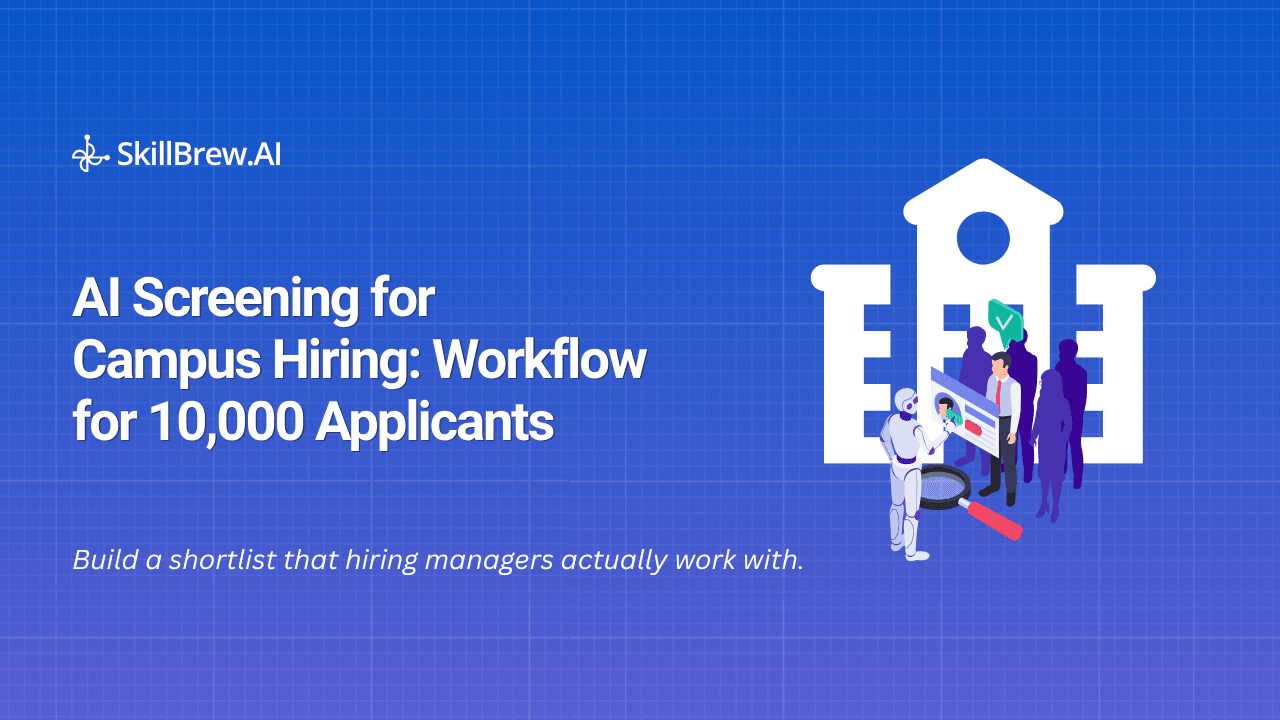
10,000 applicants. Multiple campuses. A few weeks to build a shortlist that hiring managers can actually work with.
That is where campus screening becomes difficult. The challenge is rarely the final interview. It is processing thousands of applications, running assessments, coordinating first-round interviews, and identifying relevant candidates without adding more manual work.
SkillBrew.AI connects key stages of the campus screening workflow through HireFlow, AI Assessments, AI Interviews, and BrewShield. Together, these tools help teams structure candidate intake, evaluation, interviews, and review for high-volume hiring.
This guide shows how the workflow can be structured for a 10,000-applicant campus drive and what changes operationally at each stage.
Table of Contents
- Why Campus Screening Breaks at 10,000 Applicants: Where manual screening slows down hiring.
- Resume Shortlisting with HireFlow: Organize and filter candidates.
- AI Assessments for High-Volume Hiring: Evaluate large candidate batches.
- Async AI Interviews for First-Round Screening: Screen candidates without scheduling.
- Candidate Integrity with BrewShield: Monitor assessment and interview integrity.
- Managing Multiple Campuses in One Pipeline: Track candidates across locations.
- From Scores to a Ranked Shortlist: Turn evaluation results into a shortlist.
- What the Complete Campus Screening Workflow Looks Like: See the workflow from application to shortlist.
- When to Automate Campus Screening: Identify when automation becomes useful.
- Frequently Asked Questions: Answers to common questions about high-volume campus hiring.
- Conclusion: Bringing the workflow together.
Why Campus Screening Breaks at 10,000 Applicants
At a smaller applicant volume, manual campus screening may still be manageable. At 10,000, the same process becomes a coordination problem.
Recruiters have to review resumes, check eligibility, send assessments, track completion, coordinate interviews, compare scores, and update candidate stages. When several campuses are running simultaneously, spreadsheets and manual status updates become increasingly difficult to maintain.
The result is often a slower campus screening process, inconsistent evaluation, and more recruiter time spent coordinating candidates instead of making hiring decisions.
SkillBrew.AI connects three key parts of the workflow:
- HireFlow for candidate intake and pipeline management.
- AI Assessments for role-specific candidate evaluation.
- AI Interviews for asynchronous first-round screening.
BrewShield adds integrity monitoring to supported assessment and interview sessions.
The goal is to move repetitive screening work into a structured workflow while keeping recruiters and hiring managers involved in candidate decisions.
Resume Shortlisting with HireFlow
The first step in campus screening is getting thousands of applications into a process that recruiters can manage.
HireFlow supports candidate intake through CSV/Excel imports, bulk resume uploads, and manual candidate addition. Once candidates are added, recruiters can organize them through the candidate pipeline and move them through defined hiring stages.
Instead of maintaining separate spreadsheets for each batch, the team can manage candidate information and progress from a centralized pipeline.
For a large campus drive, this makes candidate screening more structured across campuses and batches.
The same hiring workflow can be applied across the applicant pool rather than relying on separate processes for every campus or batch.
AI Assessments for High-Volume Hiring
Resume review alone does not tell a hiring team whether a fresher can perform the work.
That is where the next stage of campus screening comes in.
SkillBrew.AI's AI Assessment Builder can generate role-specific assessments from a job description. For technical roles, assessments can include coding and technical questions. For other roles, teams can create assessments based on the requirements of the position.
Once an assessment is ready, it can be distributed to a large candidate batch.
This creates a more consistent evaluation process because candidates are assessed against the same requirements rather than relying only on resume information.
Assessment results can then be reviewed through a leaderboard, giving recruiters and hiring managers a structured way to compare candidates and identify who should move to the next stage.
Async AI Interviews for First-Round Screening
The next challenge in campus screening is the first-round interview.
Scheduling hundreds or thousands of candidates can require significant coordination. Recruiters need to find available slots, send invitations, handle confirmations, and manage no-shows.
AI Interviews change this part of the workflow by allowing candidates to complete their first-round interview asynchronously.
Candidates can complete the interview without waiting for a specific interviewer or time slot. The interview uses a 3D avatar-led format, with questions based on the candidate's resume and the role.
After the interview, recruiters can review the candidate's responses and generated evaluation report.
For high-volume candidate screening, this removes the need to coordinate an individual interviewer slot for every candidate at the first-round stage.
Candidate Integrity with BrewShield
High-volume campus screening also creates an integrity challenge.
When thousands of candidates complete assessments or interviews remotely, recruiters need visibility into potential irregularities during sessions.
BrewShield provides proctoring and integrity monitoring for supported assessment and interview sessions. It can monitor camera, screen, voice, keystrokes, tab switching, and other supported integrity signals during a session.
The resulting integrity signals can be included with the candidate's evaluation information.
This gives hiring teams additional context when reviewing candidates and helps support remote screening without requiring a separate proctoring workflow.
Managing Multiple Campuses in One Pipeline
Large campus programs rarely involve a single location.
A company may run drives across multiple colleges, cities, or campuses while using the same job requirements and selection stages.
This is where centralized campus screening becomes useful.
Instead of maintaining separate spreadsheets for each location, the team can manage candidates through a common pipeline:
Application → Shortlist → Assessment → AI Interview → Hiring Manager Review
Candidates from different campuses can move through the same structured stages while recruiters track their progress from one system.
This helps reduce manual status tracking and makes it easier to understand where candidates are in the hiring process.
From Scores to a Ranked Shortlist
The purpose of campus screening is not simply to eliminate candidates. It is to help the hiring team identify who should move forward.
Assessment results can be reviewed through a ranked leaderboard, giving recruiters and hiring managers a structured way to compare candidates.
Instead of receiving thousands of candidate records and deciding where to start, the hiring team can begin with a structured view of candidates and their results.
This is particularly useful when campus screening involves large batches where manually comparing every candidate is not practical.
The final hiring decision still remains with the hiring team. Automation handles the repetitive evaluation and organization, while recruiters and hiring managers review the candidates who move forward.
What the Complete Campus Screening Workflow Looks Like
For a 10,000-applicant campus drive, the complete campus screening workflow can be structured like this:
Step 1: Application intake
Candidates enter the pipeline through CSV/Excel import, bulk resume upload, or manual addition.
Step 2: Resume screening
HireFlow helps organize candidates and move relevant profiles into the appropriate hiring stage.
Step 3: Assessment
Candidates receive a role-specific assessment generated from the job description.
Step 4: Assessment evaluation
Candidates receive scores that can be reviewed through the assessment leaderboard.
Step 5: AI Interview
Shortlisted candidates complete an asynchronous first-round interview.
Step 6: Integrity review
BrewShield provides additional session-level integrity signals where enabled.
Step 7: Final shortlist
Recruiters and hiring managers review candidate information and decide who moves forward.
What Changes at 10,000 Applicants?
The difference is not simply the number of candidates. It is the amount of coordination required at every stage.
| Stage | Manual Approach | Structured/Automated Approach |
| Resume review | Manual filtering | Centralized candidate pipeline |
| Assessment | Manual distribution and tracking | Batch assessment |
| Interviews | Individual scheduling | Async interviews |
| Integrity | Manual monitoring | Automated integrity signals |
| Shortlisting | Spreadsheet comparison | Structured results and leaderboards |
The workflow does not remove human decision-making. Instead, it reduces the amount of repetitive coordination required before a candidate reaches the hiring team.
When to Automate Campus Screening
Not every campus hiring program needs the same level of automation.
But if your team is handling thousands of applications, multiple campuses, repeated assessments, and hundreds of first-round interviews, campus screening can quickly become one of the biggest operational bottlenecks in the hiring process.
Automation becomes particularly relevant when your team is experiencing:
- Large volumes of resumes that are difficult to review manually
- Long assessment coordination cycles
- Too many first-round interviews to schedule
- Multiple spreadsheets or systems for different campuses
- Delays between assessment completion and shortlist creation
- Difficulty maintaining consistent evaluation criteria
For Talent Acquisition teams, the objective is straightforward: reduce repetitive screening and coordination work while keeping recruiters and hiring managers involved in candidate decisions.
Frequently Asked Questions
Q1. How can AI help with high-volume campus hiring?
AI can support repetitive parts of the hiring workflow, including candidate evaluation, assessment creation, interview screening, and organizing results. This can reduce the manual coordination required when hiring teams process large candidate batches.
Q2. Can SkillBrew support a 10,000-applicant campus hiring workflow?
SkillBrew can be used to structure high-volume campus hiring workflows, but actual capacity and implementation requirements depend on the hiring process, roles, candidate volume, and configuration. The 10,000-applicant example in this guide illustrates how the workflow can be organized at scale.
Q3. How does HireFlow handle candidates for campus hiring?
HireFlow supports candidate intake through CSV/Excel imports, bulk resume uploads, and manual candidate addition. Recruiters can then organize candidates through the pipeline and move them through defined hiring stages.
Q4. Can candidates complete AI interviews without scheduling?
Yes. AI Interviews are designed for asynchronous first-round screening, allowing candidates to complete their interviews without requiring an individual interviewer time slot.
Q5. Does BrewShield make the hiring decision?
No. BrewShield provides integrity signals from supported assessment and interview sessions. These signals give recruiters and hiring managers additional context during candidate review. The final hiring decision remains with the hiring team.
Q6. Does automation replace recruiters in campus hiring?
The workflow is designed to reduce repetitive screening and coordination work, not replace human decision-making. Recruiters and hiring managers can continue to review candidate results and make the final selection decisions.
Q7. What types of candidates can be evaluated through SkillBrew?
SkillBrew can support campus hiring workflows for different roles by adapting assessments and interview questions to the relevant job description and evaluation requirements. The exact assessment format depends on the role and hiring process.
Conclusion
Large campus hiring programs create operational challenges long before the final interview. For Talent Acquisition teams, the objective is straightforward: reduce repetitive screening and coordination work while keeping recruiters and hiring managers involved in candidate decisions.
For Talent Acquisition teams, the objective is straightforward: reduce repetitive screening and coordination work while keeping recruiters and hiring managers involved in candidate decisions.
If your next campus drive involves thousands of applicants, SkillBrew.AI provides a structured workflow from application and assessment to interview and shortlist.
Explore SkillBrew.AI to see how the workflow can be applied to your campus hiring process.
See AI-powered hiring in action
Discover how SkillBrew helps hiring teams cut time-to-hire by 60% with skill-validated assessments and AI-ranked shortlists.
Book a free demoNo commitment required · 30 minutes
Continue reading
View All Posts