BrewVoice
How AI Voice Screening Speeds Small Hiring Teams
Small hiring teams often face a unique recruitment challenge: every new role increases the number of candidate conversations, but the recruiting team size usually stays the same. A recruiter managing multiple open positions may need to review applications, contact candidates, conduct initial calls, collect information, schedule interviews, and update hiring records. As candidate volume grows, these repetitive tasks can quickly become a bottleneck. The challenge is that many of these activities

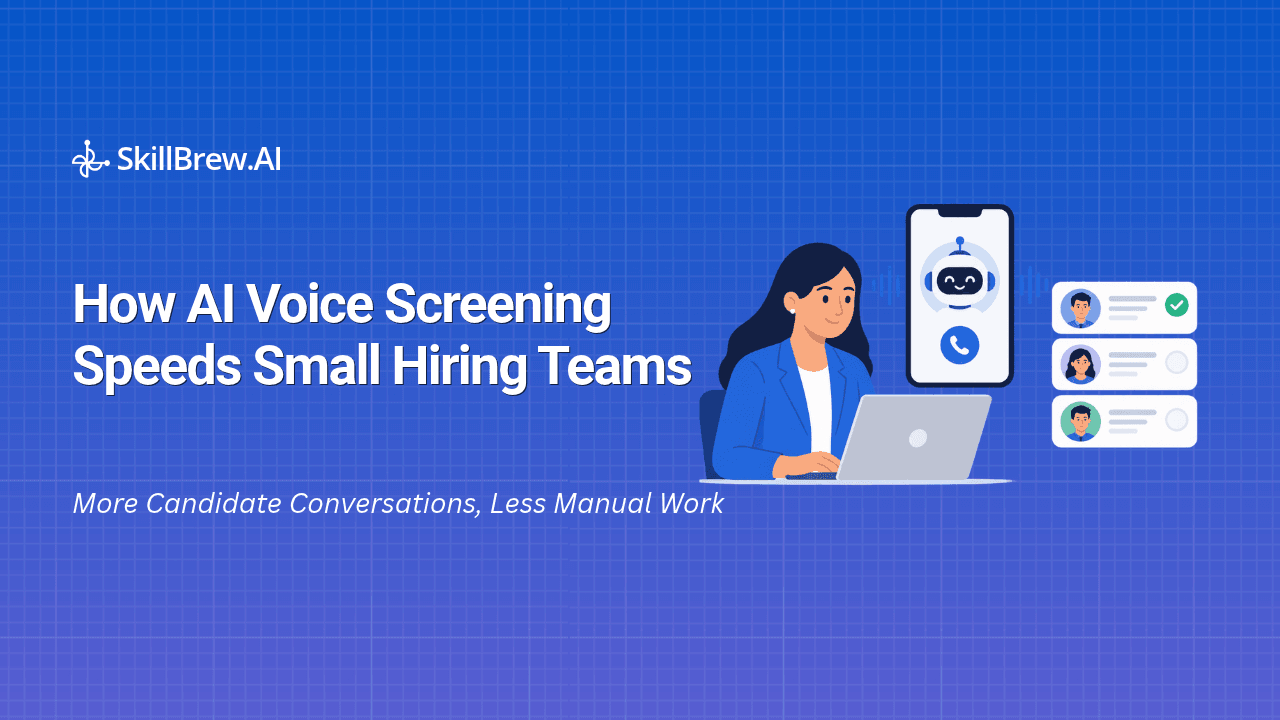
Small hiring teams often face a unique recruitment challenge: every new role increases the number of candidate conversations, but the recruiting team size usually stays the same.
A recruiter managing multiple open positions may need to review applications, contact candidates, conduct initial calls, collect information, schedule interviews, and update hiring records. As candidate volume grows, these repetitive tasks can quickly become a bottleneck.
The challenge is that many of these activities are repetitive and time-consuming, leaving recruiters with less time for work that requires human judgment, such as candidate engagement, hiring manager collaboration, and final evaluations.
This is where AI voice screening can help small hiring teams improve their early-stage recruitment workflow.
By automating initial screening conversations, AI-powered voice tools help recruiters connect with more candidates, collect structured information, and focus their efforts on candidates who meet initial role requirements.
Table of Contents
- Why Small Hiring Teams Struggle With Candidate Screening: Understand why manual screening calls become difficult to manage as candidate volume increases.
- What Is AI Voice Screening and How Does It Work?: Learn how AI-powered voice conversations support early-stage candidate screening.
- How an AI Voice Screening Workflow Works: Explore the steps involved in an automated voice screening process.
- How AI Voice Screening Helps Small Teams: Discover how automation reduces repetitive work and improves recruitment efficiency.
- AI Voice Screening vs Manual Phone Screening - Understanding the Difference: Compare traditional recruiter calls with AI-assisted screening workflows.
- Key Benefits of AI Voice Screening for Small Teams: Understand how voice-based screening improves speed, consistency, and recruiter productivity.
- How to Implement AI Voice Screening in a Small Hiring Team: Learn practical steps for introducing AI into recruitment workflows.
- How BrewVoice Helps Small Hiring Teams Scale Screening: See how Rhea supports structured candidate conversations.
- Frequently Asked Questions: Find answers to common questions about AI voice screening in recruitment.
- The Future of Small-Team Recruitment: Explore how AI and recruiters can work together.
Why Small Hiring Teams Struggle With Candidate Screening
Small recruitment teams often have limited resources but face many of the same hiring challenges as larger organizations.
A small recruiting team may need to:
- Screen candidates for multiple roles
- Conduct initial qualification calls
- Verify candidate experience
- Check availability and location
- Schedule interviews
- Follow up with applicants
The challenge is that many of these tasks are repetitive and time-consuming.
For example, even a 10-minute screening conversation across 200 applicants can require more than 30 hours of recruiter time.
That time could instead be spent interviewing qualified candidates, improving sourcing strategies, or collaborating with hiring managers.
This is why growing companies are exploring AI voice screening as a way to reduce manual screening workload while keeping recruiters involved in important hiring decisions.
What Is AI Voice Screening and How Does It Work?
AI voice screening is a recruitment technology that uses artificial intelligence to conduct structured voice conversations with candidates during the early stages of hiring.
Unlike traditional phone screening, where recruiters manually contact every applicant, AI-powered voice agents can handle initial conversations and collect relevant candidate information through automated screening calls.
A typical AI voice screening process may include:
- Candidate outreach
- Introduction to the job opportunity
- Role-specific screening questions
- Experience and availability checks
- Candidate response collection
- Structured screening summaries for recruiter review
Recruiters can use an AI voice recruiter to automate repetitive first-round conversations while keeping human recruiters responsible for candidate decisions.
Teams exploring automation options can use AI voice screening tools to streamline candidate conversations while maintaining structured recruitment workflows.
The goal of AI voice screening is not to remove recruiters from the process. Instead, it helps teams reduce repetitive tasks so recruiters can focus on higher-value hiring activities.
How an AI Voice Screening Workflow Works
A typical AI voice screening workflow includes several steps:
1. Candidate Entry Into the Screening Process
Candidates enter the screening workflow after applying or being identified through the recruitment process.
2. Automated Voice Outreach
The AI voice agent contacts candidates and introduces the purpose of the conversation.
3. Qualification Questions and Candidate Responses
The system asks predefined, role-specific questions and captures candidate responses.
These questions may cover:
- Relevant experience
- Role interest
- Availability
- Location
- Communication preferences
- Job-specific requirements
4. AI-Generated Screening Summaries
Candidate responses are organized into structured information that recruiters can review.
5. Recruiter Review and Candidate Progression
Recruiters review the screening information and decide which candidates should move forward.
This workflow helps teams automate early-stage conversations while keeping recruiters involved in final hiring decisions.
How AI Voice Screening Helps Small Recruitment Teams
Reduces Repetitive Screening Calls
Many first-round screening conversations include similar questions:
- How much experience do you have?
- What is your current location?
- What is your notice period?
- Are you comfortable with the role requirements?
For recruiters handling hundreds of applicants, repeating these questions can consume significant time.
With AI voice screening, these initial conversations can be automated through structured workflows.
For recruitment teams managing high candidate volumes, automating first-round screening can reduce repetitive recruiter workload and improve hiring efficiency.
Improves Screening Capacity
Small teams often have to prioritize which candidates they can contact because recruiter availability is limited.
Voice-based AI tools help teams support more candidate interactions without increasing manual screening workload.
Staffing agencies and organizations managing large applicant pools can use first-round screening software to handle early candidate conversations more efficiently.
Speeds Up Candidate Shortlisting
Recruiters often spend significant time reviewing candidates before identifying who should move forward.
AI voice screening helps collect early candidate information faster by automating initial conversations and organizing responses.
This allows recruiters to spend more time reviewing candidates who meet the initial role requirements instead of manually contacting every applicant.
AI Voice Screening vs Manual Phone Screening: Understanding the Difference
Traditional phone screening depends heavily on recruiter availability.
| Manual Phone Screening | AI Voice Screening |
| Recruiter conducts every initial call | AI supports initial candidate conversations |
| Limited by recruiter availability | Supports larger screening volumes |
| Questions may vary between recruiters | Uses structured screening workflows |
| Notes require manual effort | Responses can be organized automatically |
| Recruiter spends time on repetitive calls | Recruiter focuses on shortlisted candidates |
The purpose of AI voice screening is not to replace human interaction.
Instead, it helps recruiters reduce repetitive screening work while allowing them to focus on activities that require communication, judgment, and decision-making.
Key Benefits of AI Voice Screening for Small Teams
Better Use of Recruiter Time
By automating repetitive interactions, AI voice screening allows recruiters to spend more time on interviews, candidate relationships, sourcing, and hiring strategy.
Faster Candidate Engagement
Candidates can move through the initial screening stage faster instead of waiting for manual recruiter availability.
More Consistent Screening Workflows
AI-powered screening workflows allow recruiters to review candidates using predefined initial criteria and access more structured information.
Support for High-Volume Hiring
Small teams hiring for multiple roles can manage larger applicant pools without increasing repetitive manual workload.
Multilingual Candidate Communication
Multilingual voice capabilities can make early candidate interactions more accessible.
Learn more about how a multilingual AI voice recruiter supports candidate conversations across different languages.
Organizations hiring across India’s diverse regions can also explore AI recruitment voice agents supporting Indian regional accents.
How to Implement AI Voice Screening in a Small Hiring Team
Small hiring teams can gradually implement AI voice screening by following a structured approach:
1. Identify Repetitive Screening Questions
Identify common questions recruiters ask during initial calls.
2. Define Role-Specific Screening Criteria
Create screening workflows based on job requirements.
3. Create Structured Screening Conversations
Build workflows around the information recruiters need before moving candidates forward.
4. Review Screening Insights
AI should support recruiter decisions, not replace them.
5. Improve Workflows Over Time
Update screening questions based on hiring needs and outcomes.
How BrewVoice Helps Small Hiring Teams Scale Screening
BrewVoice helps recruitment teams automate first-round candidate conversations using Rhea, SkillBrew’s AI voice recruiter.
Rhea can conduct structured screening conversations through voice channels, ask role-specific questions, collect candidate responses, and provide recruiters with organized screening insights. These insights help recruiters understand candidate experience, interest, availability, and initial role alignment before deciding the next hiring step.
These conversations can help recruiters collect information about candidate interest, experience, communication, and role fit before moving candidates to the next stage.
Learn more about Rhea, SkillBrew’s AI voice recruiter.
Recruiters can also explore AI voice calling for hiring to understand how voice automation can improve early recruitment stages.
Explore the BrewVoice AI voice recruiter platform to see how AI-powered voice conversations fit into your hiring workflow.
Frequently Asked Questions
Q1. What is AI voice screening and how does it work?
AI voice screening uses artificial intelligence to conduct automated voice conversations with candidates during early hiring stages.
It helps recruiters collect candidate information, ask qualification questions, and organize screening responses before deciding which candidates should move forward.
Q2. Can AI voice screening replace recruiters?
No. AI voice screening is designed to automate repetitive screening tasks while recruiters continue handling candidate evaluation, interviews, relationship-building, and hiring decisions.
Q3. Which companies benefit from AI voice screening?
Startups, staffing agencies, and companies hiring for multiple roles can use AI voice screening to manage larger candidate volumes and reduce repetitive screening workload.
Q4. How does AI voice screening improve recruiter productivity?
AI voice screening reduces repetitive phone calls, helps collect candidate information faster, and allows recruiters to focus more time on qualified candidates.
Explore AI Voice Screening for Your Hiring Workflow
Small hiring teams can use AI voice screening to reduce repetitive candidate calls and create a more structured early-stage recruitment process.
With BrewVoice, recruiters can automate initial screening conversations while keeping human decision-making at the center.
Explore BrewVoice to improve candidate screening workflows.
The Future of Small-Team Recruitment
AI in recruitment is increasingly being used to support recruiters with automation while keeping human decision-making involved.
AI tools can help handle repetitive tasks such as initial outreach, screening conversations, and information collection.
Human recruiters can then focus on candidate relationships, complex discussions, and final hiring decisions.
AI voice screening represents one part of this shift by helping recruiters improve efficiency while keeping the human element in hiring.
Conclusion
Small hiring teams often face the challenge of managing increasing candidate volumes with limited recruiter capacity.
Manual screening calls can consume valuable time that could be spent on strategic recruitment activities.
AI voice screening provides a way to automate early-stage candidate conversations, improve screening efficiency, and help recruiters focus on candidates who meet initial role requirements.
The most effective recruitment workflows combine automation with human expertise.
By allowing AI to handle repetitive screening activities and enabling recruiters to focus on meaningful conversations and decisions, growing teams can build a faster and more scalable hiring process.
Explore how BrewVoice can help your team automate screening conversations, collect structured candidate insights, and improve your hiring workflow.
Ready to see how AI-powered voice screening can support your recruitment process? Schedule a demo with SkillBrew.
See AI-powered hiring in action
Discover how SkillBrew helps hiring teams cut time-to-hire by 60% with skill-validated assessments and AI-ranked shortlists.
Book a free demoNo commitment required · 30 minutes
Continue reading
View All Posts