© 2026 Skillbru AI Pvt Ltd. All rights reserved.
SkillBrew.AI



Recruitment Automation & Workflow
Introduction Recruiting for a position can become challenging when hundreds or thousands of applications arrive within a short period. For companies managing high-volume recruitment, reviewing every resume manually is time-consuming, difficult to standardize and often slows down the entire hiring process. This is why organizations are increasingly adopting the best resume screening tools to automate candidate evaluation, identify relevant skills and prioritize applicants based on job requirem
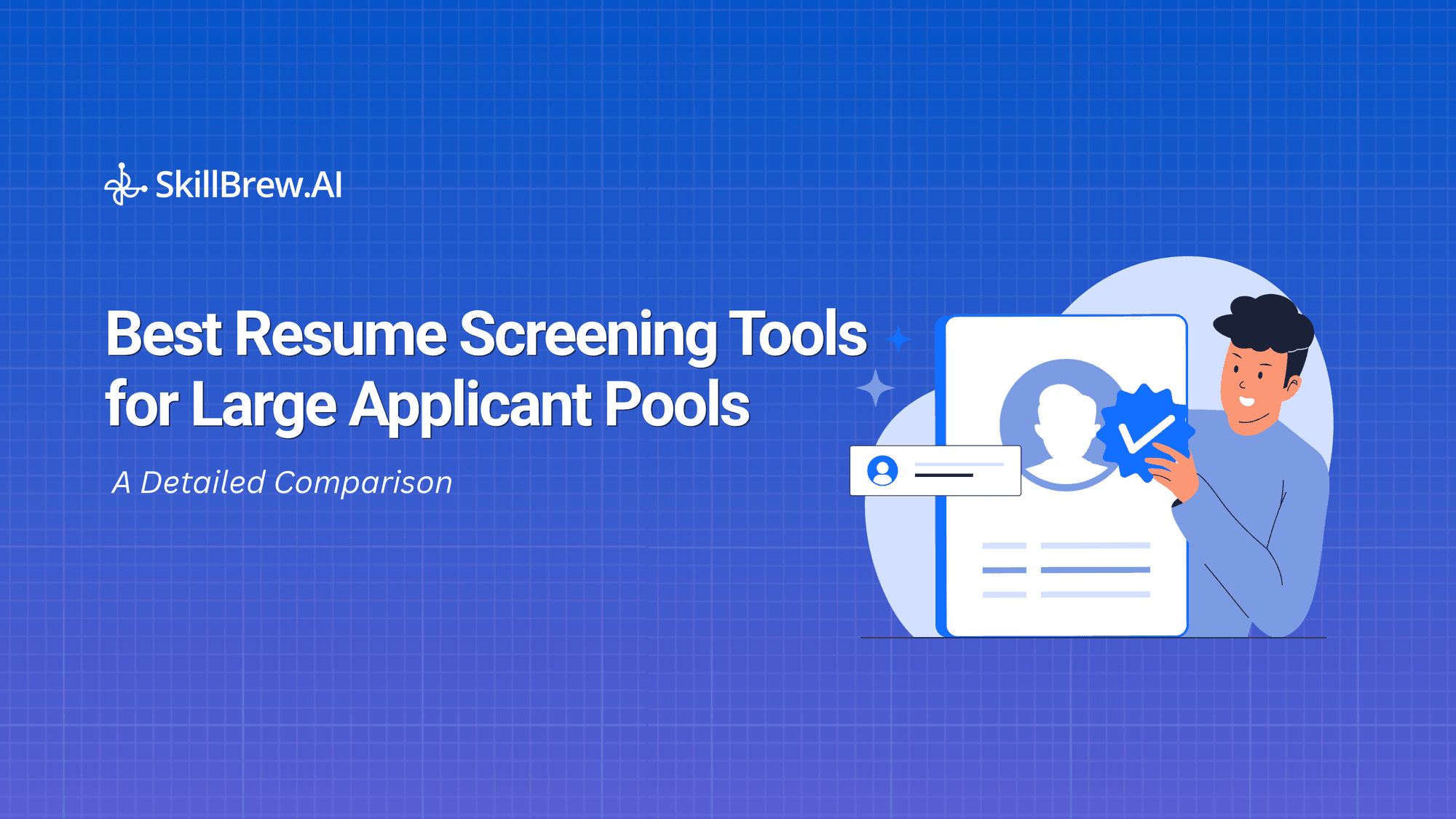
Recruiting for a position can become challenging when hundreds or thousands of applications arrive within a short period. For companies managing high-volume recruitment, reviewing every resume manually is time-consuming, difficult to standardize and often slows down the entire hiring process.
This is why organizations are increasingly adopting the best resume screening tools to automate candidate evaluation, identify relevant skills and prioritize applicants based on job requirements.
Modern resume screening software goes beyond extracting information from CVs. AI-powered platforms can analyze candidate experience, identify relevant skills, compare profiles against job descriptions and generate compatibility scores to help recruiters make more informed shortlisting decisions.
However, not every recruitment platform approaches resume screening in the same way. Some primarily focus on applicant tracking and resume parsing, while others provide AI-powered candidate matching, skill assessments, automated interviews and recruitment workflow management.
For organizations hiring at scale, choosing the right solution requires looking beyond basic resume filtering.
The important questions are:
This guide compares several resume screening and recruitment platforms, including SkillBrew.AI, Workable, Greenhouse, Zoho Recruit, Manatal, iCIMS and HireVue.
The objective is to help recruitment teams understand how these platforms differ, what hiring requirements they address and which capabilities matter most when managing large applicant pools.
1. What Is Resume Screening Software?
Resume screening software is a recruitment technology that helps organizations evaluate job applications and identify candidates whose qualifications align with specific job requirements.
Traditionally, recruiters reviewed resumes individually, checking educational qualifications, employment history, technical skills and professional experience before deciding whether a candidate should move to the next recruitment stage.
Resume screening software automates parts of this process.
It uses technologies such as resume parsing, artificial intelligence, natural language processing and candidate matching algorithms to extract information and evaluate applicant profiles.
Depending on the platform, recruiters can use these tools to:
These three terms are often used interchangeably, but they represent different stages of recruitment automation.
Resume parsing
Resume parsing extracts structured information from an uploaded resume. This can include a candidate's name, contact information, education, employment history and skills.
It converts unstructured documents into searchable candidate records.
Resume screening
Resume screening evaluates whether a candidate meets the requirements of a particular job. Recruiters can use predefined criteria such as experience, qualifications, location and required skills.
AI candidate matching
AI candidate matching goes further by evaluating the relationship between a candidate's profile and a job description.
Instead of relying exclusively on exact keyword matches, contextual matching can identify related skills, transferable experience and relevant qualifications.
An effective recruitment process can combine all three capabilities.
Parsing organizes candidate information, screening evaluates eligibility and matching helps recruiters prioritize profiles for further evaluation.
2. Why Businesses Need Automated Resume Screening
As organizations receive more applications through job portals, career websites, recruitment agencies and professional networks, managing applicant volume becomes increasingly complicated.
Manual screening may work for a small number of applications, but the process becomes harder to manage when multiple roles receive hundreds or thousands of resumes.
Automated resume screening helps address several operational challenges.
High-volume recruitment requires recruiters to process applications within limited timelines.
For example, campus recruitment drives, BPO hiring, customer support recruitment and large IT recruitment campaigns can generate significant numbers of applications.
Automated screening allows recruiters to process multiple candidate profiles using consistent evaluation criteria.
Rather than opening every resume individually, recruiters can work with structured candidate information and prioritized shortlists.
Recruiters spend considerable time reviewing repetitive information across resumes.
An automated screening platform can extract candidate details, identify relevant skills and organize applications for review.
This allows recruitment teams to spend more time on candidate conversations, technical evaluations and hiring decisions.
Manual screening can vary depending on recruiter experience, interpretation of job requirements and workload.
A structured screening process applies the same predefined criteria across applications.
AI-supported evaluation can help recruiters compare candidates using consistent parameters, although the quality of results depends on the criteria, underlying data and model design.
A candidate may have the right experience without using exactly the same terminology as the job description.
For instance, a job description may require experience with cloud infrastructure, while a candidate describes relevant work involving AWS deployment, container orchestration and infrastructure automation.
A contextual matching system may identify this relationship more effectively than a basic keyword filter.
Recruiters should still verify whether the candidate's experience genuinely meets the requirement.
Resume screening is only one stage of recruitment.
When candidate evaluation, assessments, interview scheduling and communication operate through disconnected systems, recruiters may experience delays between stages.
Platforms that connect screening with subsequent evaluation activities can help create a more organized hiring workflow.
3. How AI-Powered Resume Screening Works
AI resume screening software generally follows a structured process involving document extraction, job requirement analysis, candidate matching and recruiter review.
Candidates submit resumes through application forms, career portals or recruitment systems.
The software processes these documents and extracts information such as:
The extracted information is organized into structured candidate profiles.
The accuracy of this process can depend on document formatting, file quality, language and the capabilities of the parsing engine.
The system analyzes the job description to identify the requirements associated with the position.
These may include:
Some platforms allow recruiters to configure screening criteria manually, while AI-supported systems can assist in extracting or generating relevant requirements.
The software compares candidate information with the job requirements.
Depending on the platform, this may involve keyword matching, skill-based evaluation, contextual analysis or configurable scoring models.
The system can generate compatibility scores, candidate rankings or recommendations for recruiter review.
It is important to understand that a compatibility score represents the system's evaluation against its configured criteria. It is not proof that a candidate will perform successfully in the role.
Once profiles have been evaluated, recruiters can review prioritized candidate lists.
This helps hiring teams identify profiles that deserve further attention.
Recruiters should retain the ability to inspect the underlying qualifications, adjust criteria and override automated recommendations.
Resume screening provides an initial indication of candidate suitability, but it cannot independently establish practical competence.
For technical and skill-intensive positions, candidates may need additional evaluation through:
Combining these stages provides a more comprehensive view of candidate suitability.
4. Best Resume Screening Tools for Large Applicant Pools
The right resume screening platform depends on the organization's recruitment volume, hiring structure, existing technology and evaluation requirements.
Some solutions are designed to manage the complete recruitment lifecycle, while others specialize in candidate matching, assessments or enterprise hiring workflows.
Here are seven platforms worth evaluating in 2026.
Best for integrated AI screening and candidate evaluation
SkillBrew.AI is an AI-powered screening and assessment platform designed to help recruitment teams evaluate candidates through multiple stages of the hiring process.
Rather than limiting candidate evaluation to resume review, SkillBrew.AI brings together resume screening, skill assessments, AI interviews and recruitment workflow management.
This approach can be particularly relevant for organizations that receive large applicant volumes and need additional evaluation before scheduling recruiter interviews.
Key capabilities
One of the platform's distinguishing characteristics is its connected screening approach.
For example, a recruitment team hiring software developers can initially evaluate resumes against a job description, invite relevant candidates to technical assessments and use AI interviews to gather additional information before proceeding to human interviews.
This creates a more comprehensive screening process than resume filtering alone.
Why consider SkillBrew.AI for high-volume hiring?
For organizations handling bulk recruitment, the challenge is not simply identifying candidates who match a job description. It is evaluating whether those candidates have the skills and communication abilities required for the position.
SkillBrew.AI addresses this broader requirement by connecting resume screening with assessments and interviews.
Its website also describes support for bulk candidate invitations and campus recruitment workflows involving large applicant groups.
Ideal for:
Considerations: Organizations should evaluate resume parsing accuracy, scoring explanations, ATS integration requirements, assessment workflows and the level of recruiter control during implementation.
Website: SkillBrew.AI
4.2 Workable
Best for all-in-one recruiting and applicant tracking
Workable is a recruitment platform that combines applicant tracking, candidate management and hiring workflow automation.
It is designed for organizations that want to manage recruitment activities through a centralized system.
Workable provides AI-supported recruitment capabilities that help hiring teams with candidate evaluation and recruitment-related tasks.
Key capabilities
Workable is relevant for organizations that want resume screening to operate within a broader applicant tracking system rather than through a separate screening application.
Its candidate management capabilities also help recruiters maintain visibility across different recruitment stages.
Ideal for:
Considerations: Evaluate which AI screening capabilities are included in the selected subscription and whether additional AI usage or assessment functionality requires separate pricing.
Website: Workable
Best for structured and collaborative hiring
Greenhouse is an applicant tracking platform focused on structured recruitment and collaboration between hiring teams.
It provides tools for managing applications, interview processes, candidate feedback and recruitment workflows.
For organizations receiving large numbers of applications, structured hiring processes can help ensure that candidates are evaluated against consistent role requirements.
Key capabilities
Greenhouse is particularly relevant for organizations that want to standardize hiring processes across multiple departments and hiring managers.
Its approach places importance on structured evaluation rather than relying exclusively on automated resume scores.
Ideal for:
Considerations: Organizations should verify which AI matching features are available in their subscription and how these capabilities fit into their existing recruitment workflows.
Website: Greenhouse
Best for configurable recruitment management
Zoho Recruit is a recruitment management platform that provides applicant tracking, resume parsing and AI-supported candidate matching.
Its resume parser extracts information from candidate documents and converts it into structured records.
Recruiters can use these records to search and organize applicants based on relevant information.
Key capabilities
One useful capability is Zia Matches, which helps identify candidates for job openings using job requirements, candidate skills and other specified criteria.
Zoho Recruit also supports multiple resume formats and offers configurable parsing modes. Its documentation explains that text-based resumes generally provide better parsing results than image-heavy or scanned documents.
Ideal for:
Considerations: Resume parsing, candidate matching and deeper candidate evaluation are different capabilities. Organizations should determine whether the available features cover their complete screening requirements.
Website: Zoho
Best for recruitment agencies and growing teams.
Manatal is an AI-powered recruitment and applicant tracking platform designed to help organizations manage candidates and recruitment workflows.
It offers candidate management features alongside AI-assisted candidate recommendations.
For recruitment teams handling applications from different sources, having searchable candidate profiles and organized hiring pipelines can make applicant management easier.
Key capabilities
Manatal is worth evaluating for organizations that want candidate management and AI-supported matching within an integrated recruitment system.
Ideal for:
Considerations: Evaluate how its matching capabilities work with complex job requirements, large candidate databases and your existing recruitment technology.
Website: Manatal
Best for enterprise talent acquisition
iCIMS provides enterprise recruitment technology designed to support large-scale talent acquisition operations.
Its platform includes applicant tracking, candidate relationship management, recruitment automation and AI-supported hiring capabilities.
For enterprises hiring across departments, regions and multiple job categories, centralized candidate management can help standardize recruitment operations.
Key capabilities
iCIMS is relevant for organizations that need recruitment technology capable of supporting complex hiring structures and enterprise workflows.
Its AI capabilities, including candidate matching and recruitment agents, are part of a broader talent acquisition ecosystem.
Ideal for:
Considerations: Implementation requirements, integrations, configuration and the availability of specific AI modules should be assessed before selecting an enterprise solution.
Website: iCIMS
Best for assessments and interview-based screening
HireVue is a hiring technology platform focused on assessments, digital interviews and candidate evaluation.
While traditional resume screening primarily evaluates information provided in a candidate's CV, HireVue emphasizes additional evaluation methods that help recruiters understand candidate capabilities.
Key capabilities
HireVue may be particularly relevant when organizations want to evaluate candidates beyond their resumes.
For example, a company hiring customer support representatives may use assessments and structured interviews to understand communication and job-related competencies.
Ideal for:
Considerations: Assess whether the specific product package includes the resume screening, assessment and interview functionality your organization requires. These are not necessarily interchangeable capabilities.
Website: HireVue
Different platforms serve different recruitment requirements. The following table summarizes their primary positioning and areas of focus.
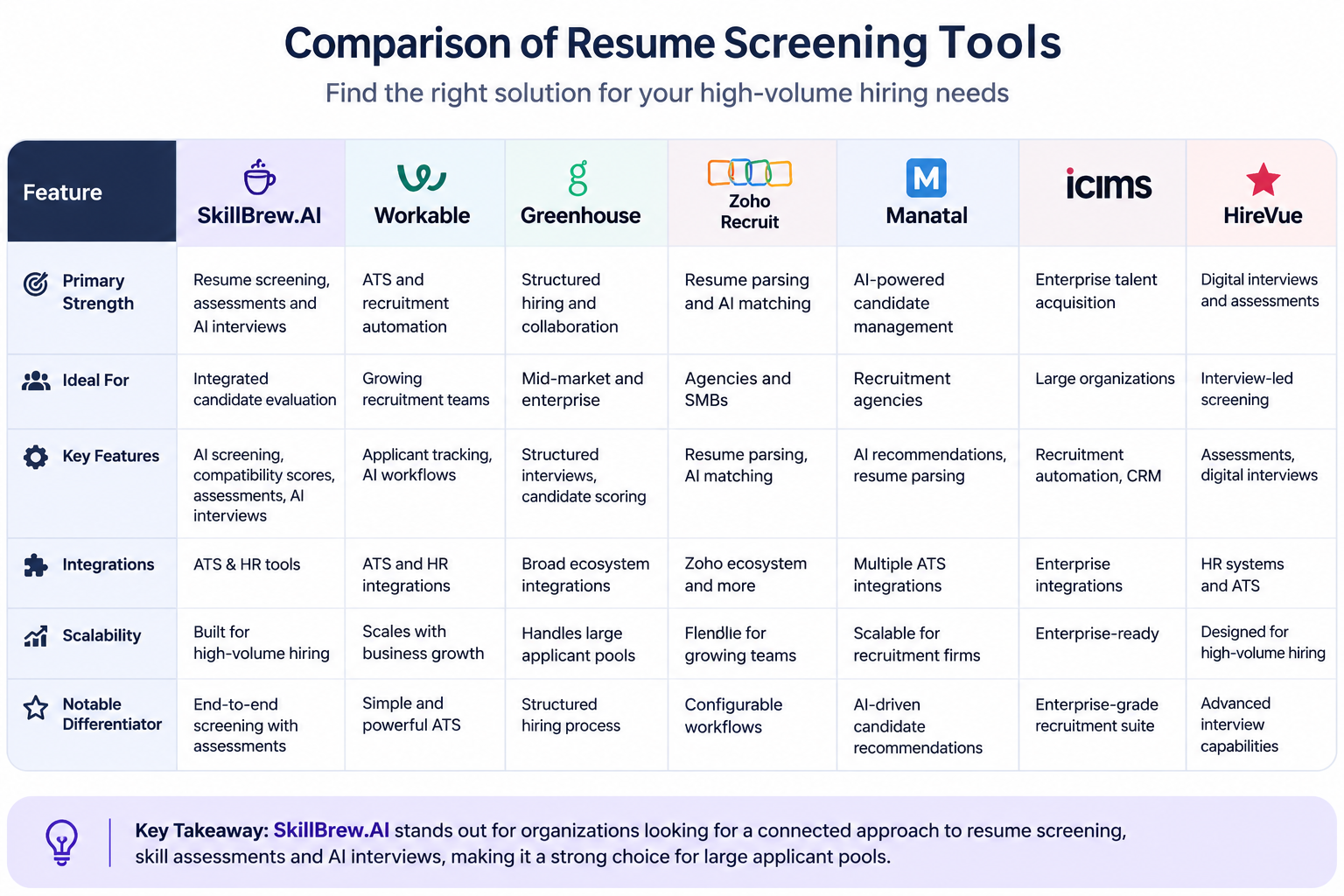
The answer depends on where your recruitment process needs the most support.
A platform should be selected based on actual workflow requirements rather than the number of AI features listed on its website.
Choosing the best resume screening tools requires evaluating more than the ability to process documents.
For high-volume hiring, organizations should consider the following capabilities.
The ability to process multiple resumes is essential for organizations receiving large applicant volumes.
A suitable platform should support bulk uploads, structured data extraction and efficient candidate organization.
Recruiters should test how the software handles different file formats, document layouts and scanned resumes.
Keyword matching can identify resumes containing specific terms, but it may not capture the full context of a candidate's experience.
For example, a recruiter hiring a backend developer may encounter candidates with experience in Java, Spring Boot, microservices and API development.
A contextual matching system should help recruiters understand how these skills relate to the job requirements.
The system should also allow recruiters to distinguish mandatory requirements from preferred qualifications.
Compatibility scores can help prioritize applications, but recruiters need to understand what contributes to those scores.
A useful screening platform should provide sufficient information about:
A score without supporting information may make it harder for recruiters to validate recommendations.
Many organizations already use applicant tracking systems and recruitment management software.
A new screening platform should fit into the existing technology environment.
Before selecting a solution, evaluate:
Integration requirements can influence both implementation time and long-term operational costs.
A resume provides information about a candidate's claimed experience, but it does not independently establish practical ability.
For technical positions, assessments can help evaluate coding, problem-solving and role-specific knowledge.
For non-technical positions, structured assessments can evaluate communication, reasoning and other relevant competencies.
Combining resume screening with assessments can provide recruiters with additional evidence before interviews.
Candidate communication becomes increasingly difficult when recruitment teams handle large application volumes.
Useful automation features include:
These features help recruiters maintain consistent communication throughout the recruitment process.
AI screening systems should be evaluated carefully for potential bias.
Historical recruitment data, poorly defined selection criteria and proxy variables can influence automated recommendations.
Organizations should:
AI should support recruitment decisions, not become an unquestioned substitute for recruiter judgment.
Recruitment technology is evolving beyond traditional applicant tracking and resume parsing.
In 2026, organizations are increasingly exploring ways to connect candidate discovery, initial screening, skill validation and interviews through AI-supported workflows.
Several developments are particularly relevant.
Traditional resume filters often depend on specific keywords and predefined conditions.
AI-powered matching systems are increasingly designed to interpret skills, experience and role requirements in context.
This can help recruiters identify candidates whose experience is relevant even when their resumes use different terminology.
However, contextual matching still requires validation against actual job requirements.
Organizations are placing greater emphasis on demonstrable skills rather than relying exclusively on educational qualifications or previous job titles.
This is particularly relevant for technology, engineering and specialized recruitment.
Resume screening platforms are therefore increasingly being evaluated alongside skill assessments and practical tests.
AI interviews can help recruitment teams conduct preliminary candidate evaluations without requiring recruiters to schedule every first-round conversation manually.
These systems can collect candidate responses, ask structured questions and generate reports for recruiter review.
For large applicant pools, this creates an additional evaluation layer between resume screening and human interviews.
AI voice screening is another emerging approach to preliminary candidate evaluation.
Voice agents can contact candidates, ask predefined or role-related questions and collect information about experience, availability and expectations.
For organizations managing bulk recruitment, this can help reduce repetitive first-round calling requirements.
Platforms such as SkillBrew.AI are bringing resume screening, voice screening and AI interviews together as part of a broader candidate evaluation process.
As AI becomes more involved in recruitment, organizations need to pay closer attention to transparency, fairness and candidate data protection.
Automated screening should be tested for potential discriminatory outcomes.
Recruiters should understand how candidate recommendations are generated and maintain appropriate oversight of decisions.
The broader direction of recruitment technology is not simply greater automation. It is the use of automation to make candidate evaluation more structured, evidence-based and manageable.
Before investing in resume screening software, recruitment teams should understand their existing hiring process and identify the areas that create the most operational difficulty.
A practical evaluation process can help narrow down the options.
Start by understanding how many applications your organization receives.
A company hiring 20 employees annually may have very different requirements from an organization conducting campus drives involving thousands of candidates.
Consider:
This will help establish the processing capacity required from the platform.
Identify the information recruiters need to evaluate candidates.
For example, an IT recruitment team may prioritize programming languages, technical experience, project exposure and certifications.
A BPO recruitment team may focus on communication skills, language proficiency, availability and customer-handling experience.
Your screening criteria should reflect the actual requirements of the position.
Do not rely exclusively on the accuracy claims presented in product demonstrations.
Test the platform using a representative sample of resumes and job descriptions.
Evaluate whether it:
Recruiter feedback should be part of this evaluation.
Resume screening is one part of hiring.
Consider whether your team also needs assessments, automated interviews, candidate communication, scheduling and recruitment analytics.
A platform that connects these activities may reduce the operational complexity of managing multiple disconnected applications.
Evaluate whether the platform works with your existing ATS, HR software and communication systems.
Ask vendors about implementation timelines, API support, data migration, integration costs and ongoing technical assistance.
Pricing models can differ significantly between recruitment platforms.
Some charge based on recruiter seats, while others use job-based subscriptions, candidate volumes, usage credits or customized enterprise agreements.
When comparing costs, consider:
The most affordable subscription is not necessarily the most economical solution if additional tools are required to complete the hiring process.
A pilot project is one of the most useful ways to evaluate screening software.
Choose a real hiring requirement and process a representative applicant group.
Compare the results with your existing screening process.
Measure:
This gives hiring teams a practical basis for selecting a platform.
Some resume screening tools worth evaluating in 2026 include SkillBrew.AI, Workable, Greenhouse, Zoho Recruit, Manatal, iCIMS and HireVue.
Each platform serves different recruitment requirements. SkillBrew.AI combines resume screening with AI assessments and interviews, while other platforms focus on applicant tracking, enterprise hiring or structured candidate evaluation.
The right choice depends on hiring volume, required integrations and the depth of candidate evaluation needed.
AI resume screening software processes candidate resumes, extracts relevant information and compares candidate profiles against job descriptions.
Depending on the platform, it may use natural language processing, contextual matching and configurable scoring to identify relevant applicants.
Recruiters can then review candidate profiles and prioritize applicants for further evaluation.
Yes. Many modern recruitment platforms support bulk resume processing, candidate imports and automated screening workflows.
However, actual capacity depends on the platform's architecture, subscription limits, configuration and processing requirements.
Organizations should test the software with their expected applicant volumes before implementation.
AI resume screening can reduce repetitive administrative work and help recruiters apply consistent evaluation criteria across large applicant pools.
Manual screening, however, allows recruiters to interpret context and consider factors that automated systems may overlook.
A combination of AI-supported screening and human evaluation is generally a more appropriate approach than relying entirely on either method.
An applicant tracking system manages the recruitment process, including applications, candidate records, interview stages and hiring workflows.
Resume screening software focuses on evaluating candidate profiles against job requirements.
Some platforms combine both capabilities, while others specialize in screening and integrate with existing ATS products.
AI-powered contextual matching can identify related skills and experience even when candidates use different terminology from the job description.
For example, a candidate with experience in AWS, Docker and Kubernetes may have relevant cloud infrastructure experience even if the job description uses broader terminology.
However, recruiters should verify the actual depth of experience rather than relying solely on automated matching scores.
Pricing varies depending on the provider, number of recruiters, candidate volume, available features and implementation requirements.
Some platforms publish subscription prices, while enterprise recruitment solutions may require customized quotations.
Organizations should compare the complete cost of implementation and usage rather than looking only at the starting subscription price.
No. AI does not automatically eliminate recruitment bias.
Screening systems can reflect biases present in historical hiring data, evaluation criteria or model design.
Organizations should regularly review screening outcomes, validate job-related criteria and retain human oversight of recruitment decisions.
Selecting the best resume screening tools for large applicant pools requires understanding what your recruitment team needs beyond basic resume filtering.
A platform that extracts candidate information may be sufficient for organizations looking to organize applications. However, companies managing high-volume recruitment may also need candidate ranking, skill assessments, automated interviews and recruitment workflow management.
The platforms discussed in this guide address different parts of that requirement.
Workable and Greenhouse offer broader applicant tracking and structured recruitment capabilities. Zoho Recruit combines resume parsing with AI-supported candidate matching. Manatal provides candidate management and recruitment automation, while iCIMS serves organizations with complex enterprise hiring requirements. HireVue focuses on assessments and digital interviewing.
SkillBrew.AI is worth considering for organizations looking for a connected candidate screening and evaluation workflow.
Its combination of AI resume screening, compatibility scoring, skill assessments, AI interviews, BrewVoice and HireFlow addresses multiple stages of candidate evaluation.
For recruitment teams handling IT hiring, staffing, campus recruitment and other high-volume hiring requirements, this connected approach can help bring initial screening and subsequent candidate evaluation into a more organized process.
Ultimately, the right platform is not necessarily the one with the largest number of AI features. It is the one that helps recruiters identify relevant candidates, validate their capabilities and make informed hiring decisions while maintaining transparency and human oversight.
As recruitment continues to evolve, organizations should prioritize screening solutions that balance automation, practical skill evaluation and a positive candidate experience.
Discover how SkillBrew helps hiring teams cut time-to-hire by 60% with skill-validated assessments and AI-ranked shortlists.
Book a free demoNo commitment required · 30 minutes