© 2026 Skillbru AI Pvt Ltd. All rights reserved.
SkillBrew.AI



AI Interview
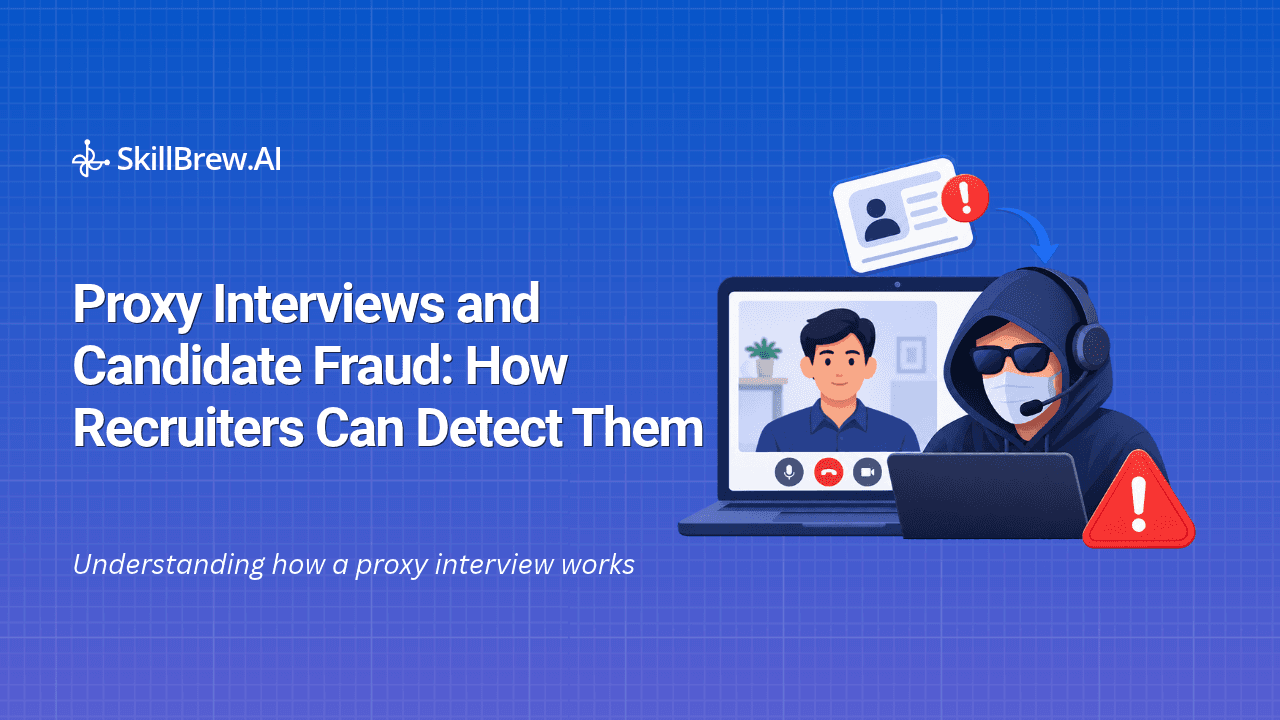
Understanding how a proxy interview works is an important step towards protecting hiring decisions.

Remote hiring has made it easier for organizations to interview candidates across locations, reduce scheduling delays, and evaluate larger talent pools. However, it has also created new challenges around candidate identity and interview integrity. One growing concern is the use of another person to attend an interview or complete an assessment on an applicant’s behalf.
A proxy interview occurs when someone other than the actual applicant participates in an interview while presenting themselves as that candidate. The person may be a friend, a paid professional, or someone hired specifically to answer technical and role-related questions.
This is different from a candidate receiving unauthorized help while remaining present. Both situations can compromise an evaluation, but they require different detection and prevention approaches.
The concern is reflected in industry research. In a Gartner survey of 3,000 job candidates, 6% admitted to participating in interview fraud, either by impersonating another candidate or having someone impersonate them. Gartner also predicts that by 2028, one in four candidate profiles worldwide will be fake. This is a forecast, not a measured current rate. Read the Gartner research on candidate trust and interview fraud.
For recruiters, understanding how a proxy interview works is an important step towards protecting hiring decisions. A consistent process combining identity verification, structured evaluation, and appropriate technology can help identify inconsistencies without unfairly accusing genuine candidates.
A proxy interview is a form of candidate impersonation in which another individual attends an interview or participates in an assessment on behalf of the person who applied for the role.
The proxy may have stronger technical knowledge, more relevant experience, or better interview skills than the actual applicant. Their involvement can make it appear that the applicant has skills, experience, or knowledge that they may not personally possess.
Proxy participation can occur during different stages of recruitment, including:
The central issue is that the employer evaluates one person's responses while believing they belong to another person.
These two situations are related, but they are not identical.
A candidate receiving help may still be the person speaking and responding. In a proxy interview, the person participating may not be the applicant at all.
This distinction matters because identity verification helps establish who is participating, while structured questions and assessment controls help evaluate whether that person can demonstrate the claimed skills independently.
Candidates may turn to impersonation when they believe they cannot meet the expectations of a role through their own abilities or experience.
Some possible reasons include:
A proxy interview can therefore create a gap between the abilities demonstrated during recruitment and the capabilities the eventual employee actually possesses.
For employers, the risk is not limited to selecting an unsuitable candidate. It can also affect project delivery, team productivity, client relationships, and confidence in the recruitment process.
Candidate impersonation makes it difficult to establish whether the person being evaluated is the same person who applied for the position.
HireRight's 2025 Global Benchmark Report found that more than three-quarters of surveyed employers had uncovered candidate discrepancies in the previous 12 months. One in six respondents also reported that their organization had experienced identity fraud during hiring.
These findings highlight why identity checks should not be treated as a one-time administrative step.
A proxy interview can create several hiring risks:
No single behavior can confirm a proxy interview. Recruiters should look for verifiable inconsistencies across the hiring process rather than relying on appearance, accent, or subjective impressions.
The following indicators can help determine when further checks may be appropriate.
Differences between identity information provided during the application and details confirmed during an interview may require investigation.
For example, the name or identity information presented during a verification step may not match the candidate record. Recruiters should follow approved verification procedures before drawing conclusions.
Recruiters should establish whether the same applicant is participating throughout the recruitment process.
Verification records from different stages can be compared to identify inconsistencies. If a candidate cannot be matched consistently with the original application details, recruiters should review the discrepancy and request clarification through the organization's approved process.
Changes in appearance, accent, or communication style alone are not evidence of impersonation. Candidates may have legitimate reasons for such differences.
A candidate may struggle to explain a technical solution, project decision, or assessment response they previously presented.
For example, someone who described a complex coding approach may be unable to explain why a particular method was selected or how the solution works.
This does not automatically establish impersonation. It is a reason to explore the candidate's understanding through relevant follow-up questions.
Recruiters can compare interview responses with the candidate's stated work history and project experience.
If someone claims to have independently delivered a project but cannot explain their responsibilities, technical decisions, or challenges, the recruiter should investigate the skills mismatch.
During remote assessments, unusual on-screen activity, external prompts, or indications of another person providing answers may warrant a closer review.
However, monitoring signals should be interpreted in context. A technical issue, accessibility requirement, or permitted use of resources should not automatically be treated as misconduct.
A reliable detection process should combine identity checks with practical evaluation methods. The objective is to establish who is participating and whether that person can demonstrate the skills required for the role.
Recruiters should compare the interview participant with the identity information collected during the application process.
Practical steps include:
For a proxy interview, consistent identity checks across stages can make it harder for someone else to participate unnoticed.
A structured interview makes it easier to compare candidate responses across evaluation stages.
Recruiters and technical interviewers should ask questions connected to the candidate's actual experience. Follow-up questions can explore the reasoning behind a solution, the tools used, and the challenges encountered.
For technical roles, candidates can be asked to explain code, discuss alternative approaches, or solve a related problem independently.
This helps determine whether the person being evaluated understands the work rather than simply repeating prepared answers.
A candidate's assessment performance should be considered alongside their interview responses.
For example, if an applicant performs well in a coding assessment but cannot explain the submitted solution during a follow-up discussion, the recruiter can investigate the difference.
Structured skills tests, practical exercises, and follow-up questions provide additional context when evaluating a suspected proxy interview.
SkillBrew.AI's AI Assessments can support structured skills evaluation through coding, multiple-choice, situational, and subjective question formats. Assessment results should still be interpreted by hiring teams as part of the wider evaluation process.
Candidates should understand the organization's expectations before an interview begins.
Communicate whether external assistance, additional participants, reference materials, or AI tools are permitted. Explain any identity verification or monitoring steps in advance.
Clear expectations help distinguish prohibited assistance from legitimate accommodations or approved resources.
Technology can provide additional signals during remote interviews and assessments.
For example, monitoring controls may help recruiters review:
These signals can help identify situations that deserve attention, but they are not definitive proof of a proxy interview or candidate fraud. Human review and appropriate verification remain essential.
SkillBrew.AI's BrewShield supports interview and assessment integrity through camera, screen, voice, and keystroke monitoring signals. Recruiters can use these controls as part of a broader evaluation process, rather than treating an individual alert as a final decision.
For a deeper look at evaluation controls, read our guide to evaluating AI interview proctoring software.
When a potential issue arises, recruiters should record the specific inconsistency and review the available evidence.
A fair investigation should:
This approach helps prevent false accusations and supports consistent hiring decisions.
Preventing a proxy interview should not mean treating every unusual behavior as suspicious. Candidates may have different communication styles, internet conditions, devices, or accessibility requirements.
Recruiters should avoid making assumptions based on appearance, accent, background, or confidence. Instead, they should rely on consistent identity checks, documented discrepancies, structured questions, and relevant assessment evidence.
A balanced process should also explain monitoring practices to candidates and apply the same rules across comparable roles and interview stages.
Technology can support this process by highlighting signals that deserve review. However, the final decision should consider the full context and include human judgement.
A proxy interview can undermine the reliability of remote hiring by allowing someone other than the applicant to demonstrate skills and answer questions. As virtual recruitment becomes more common, organizations need processes that establish candidate identity and evaluate actual capabilities.
Recruiters can reduce the risk through consistent identity verification, structured technical interviews, practical assessments, clear remote-interview rules, and appropriate integrity controls.
Technology can make potential inconsistencies easier to review, but it should support—not replace—human evaluation. A fair and well-documented process helps organizations protect interview integrity while giving genuine candidates an equal opportunity to demonstrate their skills.
A fair and well-documented hiring process helps organizations prevent proxy interview fraud, protect interview integrity, and give genuine candidates an equal opportunity to demonstrate their skills.
A proxy interview is when someone other than the actual applicant attends an interview or completes an assessment while pretending to be that candidate. It is a form of candidate impersonation that can lead to inaccurate hiring decisions.
Recruiters can use consistent identity verification, compare candidate details across interview stages, ask structured follow-up questions, and review assessment results. Monitoring signals may also help identify potential irregularities, but they should not be treated as proof on their own.
No. In a proxy interview, another person acts as the applicant. With off-camera assistance, the actual candidate remains present but receives unauthorized prompts, coaching, or answers from someone else.
A proxy may perform well if another person answers technical questions or completes an assessment on the applicant's behalf. Structured follow-up questions, consistent identity verification, and appropriate integrity checks can help establish whether the demonstrated skills belong to the applicant.
AI proctoring can provide monitoring signals related to camera, screen, voice, or keystroke activity, depending on the system and evaluation setup. These signals may help recruiters identify activity that requires review, but they cannot independently confirm impersonation. Identity verification and human investigation are still necessary.
Discover how SkillBrew helps hiring teams cut time-to-hire by 60% with skill-validated assessments and AI-ranked shortlists.
Book a free demoNo commitment required · 30 minutes