Campus Placement Drive
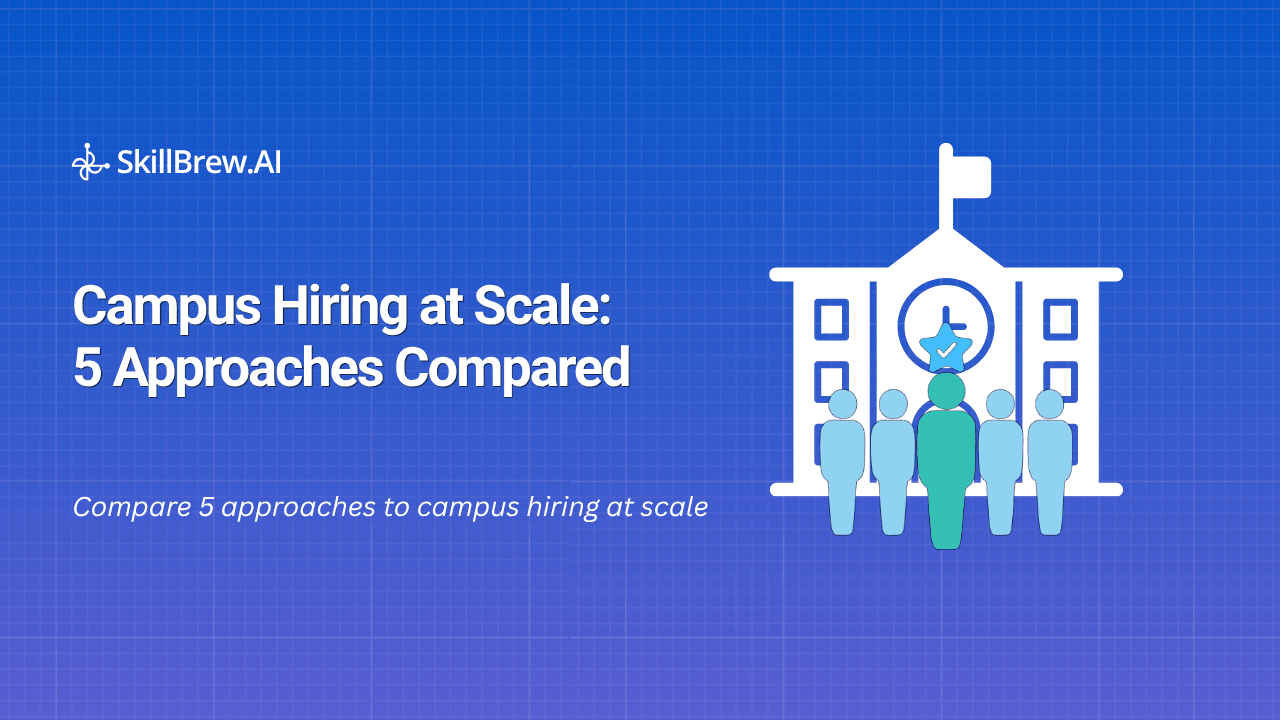
Campus Hiring at Scale: 5 Approaches Compared
Campus hiring at scale breaks the same way every year. The funnel opens, 600 applications arrive over 72 hours, and your team has four days to build a shortlist. Most of it gets done manually, most of the shortlist is inconsistent, and strong candidates can clear your process only to accept a competing offer while you're still scheduling interviews. The volume problem is only half of it. The other half is quality: specifically, the gap between the shortlist you produce under pressure and the sh
Campus hiring at scale breaks the same way every year. The funnel opens, 600 applications arrive over 72 hours, and your team has four days to build a shortlist. Most of it gets done manually, most of the shortlist is inconsistent, and strong candidates can clear your process only to accept a competing offer while you're still scheduling interviews.
The volume problem is only half of it. The other half is quality: specifically, the gap between the shortlist you produce under pressure and the shortlist you'd produce with twice the time. At 500+ applicants, that gap can become significant, and it compounds downstream: weaker cohorts, potentially higher first-year attrition, and offers that don't convert because strong candidates accepted elsewhere.
This post compares five approaches TA teams actually use to run campus hiring at scale, from manual-first to structured automation. Each has a real cost, a real ceiling, and a specific scenario where it works. At the end, there's a decision framework you can run before your next drive.
If you're heading into a placement drive for 1,000+ candidates, or scaling off campus recruitment across multiple colleges, this is the map you need before you start.
Table of Contents
- The Real Cost of Getting Campus Hiring at Scale Wrong: why the volume problem and the quality problem are actually the same problem
- Approach 1: Manual Screening With a Shared Tracker: where it still works, and exactly where it breaks
- Approach 2: ATS Filtering on Hard Cut-offs: fast, auditable, and blind to candidates who don't fit the standard profile
- Approach 3: Asynchronous Video Screening: solves recruiter bandwidth, not shortlist consistency
- Approach 4: Structured Skills Assessments at the Top of Funnel: the point where campus hiring at scale starts producing reliable shortlists
- Approach 5: AI-Assisted Screening With Automated Shortlisting: the strongest option once volume and timelines get extreme
- The Best Approach Is Usually a Combination: how the five approaches stack into one workflow
- How to Choose: A Decision Framework,: four questions to run before your next campus placement drive
- What Gets Missed in Most Campus Hiring Processes: the metric almost no TA team tracks
- FAQs: common questions on running campus hiring at scale
The Five Approaches at a Glance
| Approach | Best for | Scalability | Main limitation |
| Manual screening | Small, single-college drives | Low | Time-intensive, inconsistent across reviewers |
| ATS cut-offs | Eligibility filtering | High | Relies on proxies, not fit |
| Async video | Communication screening | Medium | Completion rates, reviewer consistency |
| Structured assessments | Skills evaluation | High | Needs good assessment design upfront |
| AI-assisted screening | High-volume, compressed timelines | Very high | Depends on rubric and model quality |
Each approach is broken down below, with where it works and where it stops holding up.
The Real Cost of Getting Campus Hiring at Scale Wrong
Most TA leaders treat campus hiring at scale as a pure throughput problem: more applications, more reviewers, faster turnaround. That framing misses the actual failure mode. The real cost isn't the hours spent screening, it's the inconsistency baked into a shortlist built under time pressure by five different recruiters applying five different standards.
That inconsistency may not show up immediately. Over time, it can contribute to differences in cohort quality, offer acceptance rates, and first-year outcomes that are difficult to explain. Getting campus hiring at scale right means fixing the shortlist logic before you fix the throughput.
Approach 1: Manual Screening With a Shared Tracker
What it is: Recruiters receive CVs, filter by GPA or degree cut-offs, and manage shortlisting through spreadsheets or shared folders. Candidate status is tracked in a master sheet, often updated by multiple people at once.
This is still the default at most companies attempting campus hiring at scale for the first time, or running a drive at a single college. At lower volumes, manual screening can still be manageable, particularly for single-college drives where the recruiter team is small and the hiring requirements are straightforward. For a small cohort hire, 10 to 20 joiners from one institution, it's often the fastest path available.
The ceiling is low. Once volume climbs into the hundreds, manual screening starts eating a large share of recruiter time, time that's nearly impossible to carve out during a compressed campus placement drive. Shortlist quality drifts too: different recruiters apply different thresholds. Review quality can also become less consistent as recruiters work through large candidate pools under tight deadlines.
Version control is another failure point. Shared trackers break down when multiple recruiters update the same file during a live drive. Duplicate entries, conflicting status updates, and accidental overwrites are common, and any one of them can mean a strong candidate gets missed entirely.
Where it works: First-year campus programs, single-college drives, or companies running fewer than two hiring cycles per year. Past that, the process cost outweighs the setup savings, and manual screening stops being a viable way to run campus hiring at scale.
Approach 2: ATS Filtering on Hard Cut-offs
What it is: Using your ATS to auto-reject below a GPA floor, filter by degree stream, or exclude certain graduation years. Candidates who don't meet defined criteria never enter the human review queue.
Cut-off filtering is faster than manual review and scales reasonably well on volume. If a large share of applicants don't meet minimum requirements, you immediately reduce the review load, without spending any recruiter time on it. The logic is simple, auditable, and applied consistently across every application, which matters more as your campus recruitment process grows across colleges.
But ATS cut-offs tell you who clears the floor. They don't tell you who's actually good. You still need humans to evaluate motivation, communication, problem-solving approach, and role fit. You've halved the volume, not the quality decision, and you've done it using a proxy (GPA, institution tier, degree stream) that may have no proven relationship to performance in your specific roles.
Cut-off filtering also misses strong candidates who don't fit the standard profile. Career-switchers, candidates from newer institutions, and people with non-linear GPAs all get filtered out before any human sees the application. Any serious attempt at campus hiring at scale eventually has to reach these candidates, especially in competitive technical and commercial roles where credential signals are often weak predictors of on-the-job output.
There's also an equity consideration. Any screening criterion can unintentionally exclude candidates from particular backgrounds, so TA teams should periodically evaluate whether their cut-offs are actually related to job requirements and outcomes.
Where it works: High-volume drives where minimum eligibility is genuinely a proxy for job performance, regulated professional roles, technical specializations with hard knowledge requirements, and where the role has narrow, verifiable requirements a credential can credibly signal. Used alone, though, it's not a complete answer to campus hiring at scale.
Approach 3: Asynchronous Video Screening
What it is: Candidates record responses to structured questions on their own schedule. Recruiters review recordings asynchronously, in batches, rather than running live phone screens.
This approach solves for recruiter bandwidth, not candidate volume. A 30-minute live phone screen per candidate adds up fast at scale, easily several weeks of combined recruiter time across a large drive. Async video cuts that review time down substantially per candidate, and it's schedulable rather than calendar-dependent, which matters when a placement drive compresses your entire campus recruitment process into a handful of days.
The drawback is completion rates. Campus candidates, especially those applying to multiple companies at once during placement season, drop off at any point of friction. Platforms with clunky UX, long question sets, or technical issues see meaningfully higher non-completion rates. You end up with a self-selected pool that's more persistent, not necessarily more capable, and you've effectively penalized candidates who had a poor internet connection on the day.
Evaluating async video also introduces inconsistency at scale. Without a structured scoring rubric applied uniformly, different reviewers weight confidence, communication style, and presentation very differently. The process is faster than live screens, but not necessarily more reliable: two recruiters reviewing the same set of videos will often produce noticeably different shortlists.
One pattern that works better: short, structured prompts with a defined rubric tied to specific competencies. Three questions, each scored on a 1-to-4 scale against explicit criteria, with reviewers calibrating on sample recordings before the drive opens. It adds setup time but meaningfully improves consistency.
Where it works: High-volume campus hiring where phone-screening capacity is the primary bottleneck, the role requires assessed communication skills, and completion rates can be protected with a short, well-designed prompt set and strong candidate communications. It's a solid middle step for teams building toward campus hiring at scale but not yet ready for full automation.
Approach 4: Structured Skills Assessments at the Top of Funnel
What it is: Candidates complete a role-relevant assessment, a coding challenge, verbal reasoning test, situational judgment test, domain knowledge check, or written case, before any human review takes place.
This is the point where campus hiring at scale starts producing consistent shortlists. Assessment scores give you an objective signal early, before volume overwhelms your team. For technical hiring, coding tests with automated evaluation cut human review time substantially while improving shortlist-to-offer conversion. For commercial and operations roles, situational judgment tests that mirror real job scenarios can provide a more job-relevant signal than GPA alone.
The design of the assessment matters more than the tool. Generic aptitude tests don't predict performance in specific roles. A 45-minute situational judgment test built for a sales role and a 60-minute coding challenge for a developer role are doing entirely different things, and both can provide a more job-relevant signal than a generic verbal-and-numerical reasoning battery. Recruiters who build assessments that mirror actual job tasks can create more job-relevant signals, improve candidate experience, and make the evaluation criteria easier to explain and defend.
Timing matters too. Companies that deploy the assessment before the application form see higher drop-off but a stronger pool, since only genuinely motivated candidates complete it. Companies that gate the assessment after CV review protect volume but delay the quality signal and spend recruiter time on applicants who will later fail the test anyway. The right call depends on your offer-to-applicant ratio and how tight your timeline is.
One underrated benefit of front-loaded assessment: it reshapes candidate experience. A well-designed front-loaded assessment can also improve candidate experience by making evaluation criteria clearer and giving candidates a defined opportunity to demonstrate their skills. It's one of the clearer wins available to anyone trying to improve their campus selection outcomes without adding headcount.
Where it works: Campus hiring operations handling several hundred applicants per cycle, particularly when the team is also tracking post-hire performance. The ROI on structured assessment compounds with volume, and with time, as you build a dataset that lets you validate and improve the assessment against actual job outcomes.
Approach 5: AI-Assisted Screening With Automated Shortlisting
What it is: AI evaluates candidates against a structured rubric, across CV signals, assessment scores, video responses, or a combination, and produces a ranked shortlist with reasoning that recruiters can review and override.
AI-assisted screening tends to be the strongest option for campus hiring at scale when several conditions line up at once:
- Applicant volume reaches several hundred per drive, especially with multiple colleges involved or a compressed turnaround window
- Turnaround time is short and there's no slack for sequential manual review
- Evaluation criteria can be made explicit and consistent across roles
- Recruiters need to be able to audit why a candidate scored the way they did
- Multiple recruiters would otherwise be screening the same pool with different standards
It removes the manual bottleneck without inheriting the inconsistency of distributed human review. A well-configured AI screening layer applies the same rubric to the 600th candidate as it does to the first, something a team of human reviewers working under drive conditions struggles to do consistently. Off campus recruitment running across geographies benefits the same way: one rubric, applied the same way everywhere.
That said, it isn't a complete solution on its own, and it isn't the only viable path at scale. Plenty of organizations run 1,000+ candidate programs successfully by combining ATS filtering, structured assessments, recruiter judgment, and outsourced screening capacity. AI-assisted screening is best understood as the strongest single lever once volume and timeline pressure become extreme, not a replacement for the rest of the process. For a deeper look at where automation genuinely helps versus where it doesn't, see our breakdown of AI in campus recruitment.
The question TA leaders should ask before committing to any AI screening tool is: what is the model actually being evaluated against, and what signals is it using? Screening tools that weight credentials (institution prestige, GPA, internship brand names) over demonstrated skills risk replicating the biases already present in your hiring history, producing shortlists that look like your last cohort rather than your best one. Better tools evaluate structured responses against job-relevant rubrics and surface the reasoning behind each score, so recruiters can audit outputs and catch errors.
What AI screening should never do:
- Make hiring decisions that a recruiter can't review or override
- Use protected characteristics or obvious proxies for them as scoring inputs
- Score candidates on signals that have no demonstrated relevance to the role
- Hide the reasoning behind a candidate's score from the recruiters using it
- Run without a defined process for recruiters to flag and correct errors
Recruiter oversight stays essential. AI screening narrows the field; it doesn't replace the judgment call on final shortlists. TA leaders who get the most out of automated screening stay close to the scoring criteria, review outputs on early runs, and adjust rubrics when the shortlist doesn't reflect what they know about the role.
Where it works: High-volume campus hiring across multiple institutions, compressed timelines, and any program where shortlist consistency directly affects hiring quality and equity. It's also a strong fit whenever a TA team is asked to scale output on roughly the same headcount, which describes most campus hiring programs most years.
The Best Approach Is Usually a Combination
Most companies running campus hiring at scale don't pick one approach and stop. They stack the five in sequence, using each one for what it's actually good at. The goal isn't to replace every screening method with the newest one; it's to put each method where it creates the most value.
ATS eligibility filtering → structured assessment → AI-assisted screening → recruiter review → interviews
ATS cut-offs remove the applicants who don't meet baseline eligibility, cheaply and consistently. A structured assessment then gives you a job-relevant quality signal on everyone who's left. AI-assisted screening applies a consistent rubric across CV, assessment, and any video signals to produce a ranked shortlist with visible reasoning. Recruiters review that shortlist, override where their judgment differs from the model, and move the final group into interviews.
The mistake most TA teams make is running this sequence backwards, doing human review first, then trying to reduce volume, instead of filtering intelligently before any recruiter time gets committed. Front-load the objective signals. Save human judgment for the decisions only humans can make: the final call between comparable candidates, and any edge case the rubric wasn't built to catch.
This combination approach is also what makes campus recruitment at scale defensible to a hiring manager or an auditor later. Each stage has a clear, explainable reason for the candidates it passes through and the ones it doesn't.
How to Choose: A Decision Framework
The right approach for campus hiring at scale depends on three variables: applicant volume, timeline compression, and what you're actually trying to predict at the shortlist stage. Most TA leaders optimize for speed and skip the third variable, which is why downstream metrics (offer conversion, cohort performance, first-year retention) don't improve even after they fix the process bottleneck.
Run through these four questions before your next campus placement drive:
1. How many applications will you receive, and in what window?
As a practical guideline: at low volumes over a longer window, manual screening is viable if your team is disciplined. As volume approaches several hundred applicants within a few days, you need structured filtering at the top of the funnel, or you'll be making shortlist decisions under conditions that tend to produce weaker outcomes.
2. What does your shortlist need to predict?
GPA cut-offs make the most sense when academic performance has a demonstrated relationship with success in the role. For many roles, however, GPA alone provides only a limited view of job readiness. If you don't know what predicts performance in your organization, start tracking it. Connect offer data to performance review scores 12 months post-joining and work backwards.
3. Where does your process currently break down?
If it's recruiter time, async screening or AI shortlisting helps. If it's shortlist quality, inconsistent scoring, strong candidates dropping through, move structured assessment earlier in the funnel. If it's both, you need to rebuild the top of your campus recruitment process from scratch.
4. What's your offer-to-applicant ratio?
If you're making 20 offers from 800 applicants, the cost of a weak shortlist is high: every wrong rejection is a strong hire you won't make. Scale your screening rigor to match that ratio. A 1-in-40 selection rate justifies more process investment than a 1-in-5.
| Approach | Best applicant volume | Primary weakness |
| Manual screening | Lower-volume drives | Inconsistent, doesn't scale |
| ATS cut-offs | Any, as a first filter | Filters on proxies, not fit |
| Async video | Moderate-volume drives | Completion and reviewer consistency |
| Structured assessment | Several hundred+ applicants | Requires upfront design |
| AI-assisted shortlisting | Several hundred+, multi-college | Requires clean rubric design |
This combination workflow, ATS eligibility, assessment, AI shortlisting, then recruiter review, is a practical model for high-volume campus hiring.
What Gets Missed in Most Campus Hiring Processes
Shortlist consistency is the metric almost no one tracks. TA leaders measure time-to-shortlist, offer acceptance rates, and time-to-fill, but that list is incomplete; see our full breakdown of campus hiring metrics that actually matter for what to track instead. Almost no team measures whether two recruiters reviewing the same 600-candidate pool would produce the same top 50. If they wouldn't, the shortlist is a function of who happened to be reviewing that day, not of who the strongest candidates actually were.
That gap matters more than most TA leaders realize. If your shortlist is inconsistent, every downstream metric gets noisy: offer quality varies by cohort rather than by role, first-year attrition patterns are hard to explain, and diversity numbers fluctuate without a clear process reason. You can't improve a process you can't measure, and a process that produces different outputs depending on who's running it isn't really a process.
The second thing that gets missed is the post-hire feedback loop. The companies that run the best campus hiring programs connect their screening decisions to actual job performance data. They know which assessment signals predicted strong performance at 12 months. They know which colleges produced high converters and which produced offer dropouts. They use that data to adjust rubrics before the next drive, not after three underwhelming cohorts.
The companies that get campus hiring at scale right build scoring into the process from the start. They define what a strong candidate looks like before the drive opens, in specific, measurable terms, not after the shortlist needs defending to a hiring manager. That definition becomes the rubric. The rubric becomes the shortlist. The shortlist becomes the cohort. The cohort becomes the data that improves next year's drive.
If your current program doesn't have that loop (screening criteria tied to performance outcomes, reviewed and updated each cycle), you're running the same campus hiring process every year and wondering why the results vary.
If your campus recruitment process still relies on spreadsheets, manual shortlisting, and inconsistent scoring across recruiters, SkillBrew.AI can help bring those stages into one structured workflow. With HireFlow for drive-level pipelines, role-specific assessments generated straight from your job description, and AI-assisted shortlisting with auditable scorecards, teams can reduce manual screening while keeping recruiters in control. Book a demo to see how it handles a live campus placement drive.
FAQs
Q1. What's the biggest risk in running campus hiring at scale without structured screening?
Inconsistent shortlists. Without a shared rubric, different recruiters apply different standards under time pressure, and the resulting cohort quality varies for reasons that have nothing to do with candidate ability.
Q2. How many applicants justify moving from manual screening to automated shortlisting?
There's no universal number, but many TA teams start feeling the strain once volume climbs into the several-hundreds within a short turnaround window. Below that, manual review with a disciplined tracker often still holds up.
Q3. Does AI screening replace recruiter judgment in the campus recruitment process?
No. It narrows the field using a consistent rubric so recruiters spend their time on the shortlist that actually matters, not on the first pass through hundreds of CVs. Final calls stay human.
Q4. How do you reduce drop-off during a large campus placement drive?
Shorten every step, communicate status automatically at each stage, and move the highest-friction step (typically the first screen) as early in the funnel as possible so candidates aren't waiting on a recruiter's calendar.
Q5. Is GPA a reliable filter for campus selection?
GPA can be useful when academic performance has a demonstrated relationship with success in the role. For many roles, however, GPA alone provides a limited view of job readiness and can exclude candidates who demonstrate relevant skills through other signals.
See AI-powered hiring in action
Discover how SkillBrew helps hiring teams cut time-to-hire by 60% with skill-validated assessments and AI-ranked shortlists.
Book a free demoNo commitment required · 30 minutes
Continue reading
View All Posts