Campus Placement Drive
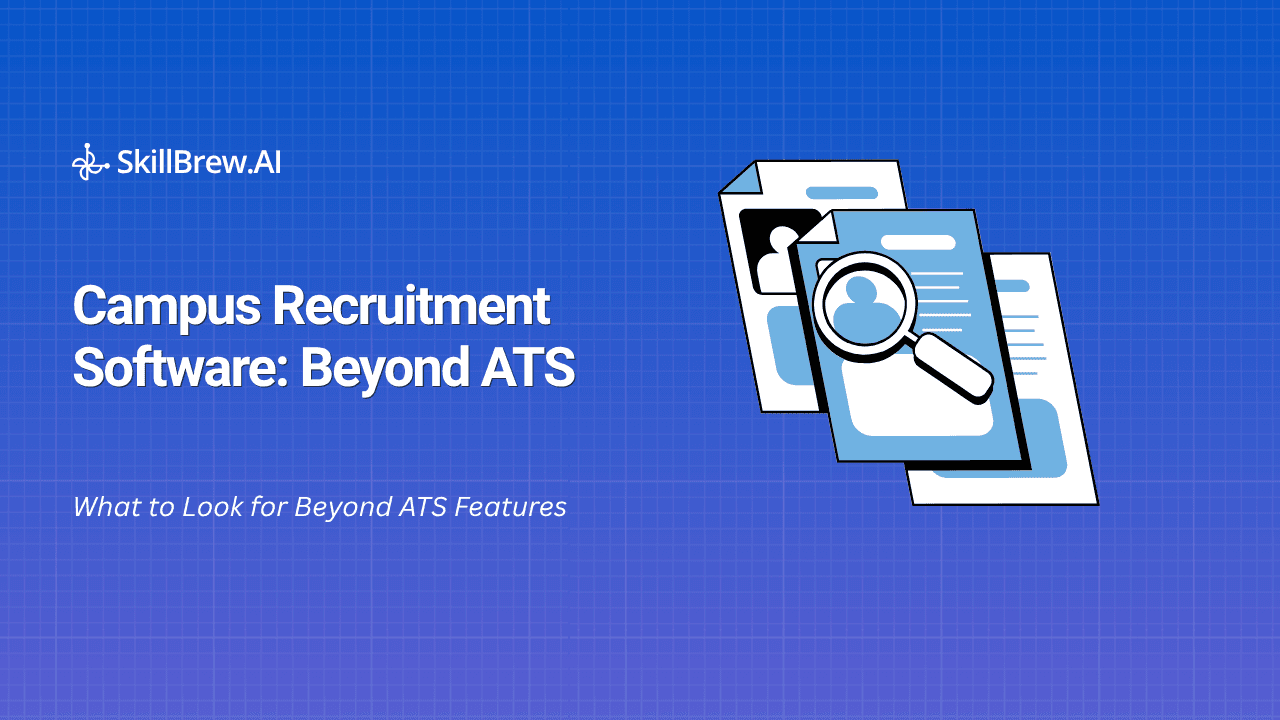
Campus Recruitment Software: What to Look for Beyond ATS Features
Most campus recruitment software on the market is an ATS with a "campus" label slapped on the pricing page. If you are running 200 to 2,000 hires from 20+ colleges in a single season, that is not going to be enough. This post covers the six features that actually separate purpose-built campus recruitment software from generic applicant tracking systems, the questions to ask any vendor before you sign, and where SkillBrew.AI's campus recruitment software fits into that picture. Table of Conten
Most campus recruitment software on the market is an ATS with a "campus" label slapped on the pricing page. If you are running 200 to 2,000 hires from 20+ colleges in a single season, that is not going to be enough.
This post covers the six features that actually separate purpose-built campus recruitment software from generic applicant tracking systems, the questions to ask any vendor before you sign, and where SkillBrew.AI's campus recruitment software fits into that picture.
Table of Contents
- The ATS gap - why generic tools break down at campus scale
- Drive-level pipeline management - managing by event, not by job
- Integrated assessment at scale - screening hundreds of candidates in hours
- College coordinator access - giving colleges visibility without seat costs
- Bulk offer generation - issuing hundreds of offers in one batch
- Real-time drive analytics - decisions during the drive, not after
- Offer acceptance and dropout tracking - catching attrition risk early
- The vendor question - one test that exposes repurposed tools
- How SkillBrew.AI fits in - what purpose-built campus recruitment software looks like in practice
- FAQ - buyer questions on campus recruitment software
The ATS Gap Is Bigger Than Vendors Admit
A standard ATS is built for one-at-a-time hiring: post a job, collect applications, move candidates through stages. Campus recruitment does not work like that. You are managing cohort-based hiring, coordinating with multiple college points of contact at once, running large-scale assessments, and generating offers in batches, often on the same day.
When TA teams try to run campus drives inside a generic ATS instead of dedicated campus recruitment software, they spend 30 to 40% of recruiter time on manual coordination that the tool should be handling. That is not a process problem. That is a tooling problem.
The six features below are the ones most ATS platforms do not have, or have badly.
Drive-Level Pipeline Management, Not Just Job-Level
Off campus recruitment and on-campus drives operate at the event level, not the individual job level. You are not filling one role at a time. You are processing 300 applications from a single college visit, across three different roles, on a shared timeline.
Purpose-built campus recruitment software manages pipelines by drive, not by job posting. This means bulk-advancing candidates between stages, applying drive-specific workflows, and seeing aggregate pass and fail rates at the college level, not just individual candidate status.
If the campus recruitment software you are evaluating can only show one job pipeline at a time, it was not designed for campus. You will spend the entire season exporting CSVs and reconciling them by hand.
Integrated Assessment That Runs at Scale
The average campus drive needs to screen 300 to 600 candidates in a 3 to 4 hour window. That requires an assessment layer built into the campus recruitment software itself, not a third-party link you email out and manually track.
When assessment lives outside the ATS or campus recruitment software, results end up in a separate system, scores need manual import, pass-through logic is inconsistent, and candidates end up completing the wrong test version. At 400 applicants, this breaks down fast.
What to look for: the ability to auto-assign assessments at registration, set cut-off scores that auto-advance or auto-reject candidates, and see assessment completion rates in real time during the drive. If a vendor's answer to "how does assessment integrate?" is "we have an integration with a third-party tool," that is a different architecture than native assessment inside the campus recruitment software, and it behaves very differently under load.
College Coordinator Access Without Recruiter Seat Costs
Campus selection involves college-side coordinators who need to submit candidate lists, confirm schedules, and track offer status. Most ATS platforms treat every user as a full recruiter seat, which means you are either paying for 40 coordinator logins or keeping coordinators out of the system entirely and handling all college communication by email.
Both options cost you time. Email threads across 20 colleges for a single drive create 15 to 20 hours of coordination overhead per recruiter per season.
The right setup: tiered access where college coordinators get a limited-access portal. They can upload candidate lists, view shortlists, and get offer confirmations without seeing your full pipeline or costing you a full seat. This is standard in purpose-built campus recruitment software and almost never available in generic ATS platforms.
Bulk Offer Generation With Conditional Logic
Generating 200 offer letters after a campus drive should not take two days. If a system can only generate offers one at a time, with manual field entry, that is exactly what happens.
Campus recruitment software should let you generate offer letters in bulk, mapped to a template, with role-specific and compensation-specific conditional logic applied automatically. The platform reads the candidate's assessed role, maps it to the right offer template, pulls compensation data from a preset range, and generates a draft for review, all in one batch action.
The hr hiring process for bulk campus intake breaks at this stage more than any other. It is worth asking every campus recruitment software vendor exactly how many clicks and how much manual input it takes to generate 100 offers. If they do not have a specific answer, the answer is "too many."
Real-Time Drive Analytics, Not Post-Drive Reports
Most platforms give you recruitment analytics as a historical report, something you pull after the drive is over. That is useful for retrospectives. It is useless for making decisions on the day of a drive.
When you are running an eight-hour campus event and 60% of candidates have not completed their assessment by hour four, you need to know that during the drive, not three days later in a report.
Real-time dashboards during live drives, showing assessment completion, stage-by-stage conversion, and no-show rates by slot, let TA leads make operational calls in the moment: extend a deadline, add a second interview slot, or flag a specific college cohort for follow-up. This capability is rare in generic campus recruitment software. Most platforms log events and surface them later.
Offer Acceptance Tracking With Dropout Flags
Campus offer dropout is a material problem for bulk hiring programs. Acceptance rates of 60 to 75% are common for engineering roles, which means a drive that generates 300 offers might yield 180 to 225 actual joiners. If a system only tracks "offer sent" and "offer accepted," there is no visibility into dropout risk until candidates do not show up on day one.
What you need: a post-offer workflow that tracks candidate engagement, whether they have logged into the pre-joining portal, whether they have submitted required documents, and whether they have responded to check-in communications, then flags at-risk candidates automatically. This gives your team four to six weeks to re-engage or backfill before attrition becomes a joiner gap.
The Vendor Question That Separates Purpose-Built From Repurposed
Ask any campus recruitment software vendor this: "Walk me through how your platform handles a drive where 500 candidates from one college apply across three roles, with a two-stage assessment, and offers need to go out within 48 hours."
The answer tells you everything. Purpose-built campus recruitment software has a clear, specific workflow for this. A repurposed ATS has a workaround.
How SkillBrew.AI's Campus Recruitment Software Delivers This
SkillBrew.AI was built around exactly this gap. HireFlow, the orchestration layer inside SkillBrew.AI's campus recruitment software, is always free and manages Kanban-style pipelines at the drive level, with bulk stage advancement and AI resume shortlisting built in rather than bolted on.
On the assessment side, SkillBrew.AI's technical assessments module turns a job description into a role-specific test in about two minutes, with BrewShield running underneath every assessment to catch integrity issues in real time, so a 500-candidate drive does not open the door to mass cheating. For roles that need a live conversation instead of a written test, AI interviews run 24/7 with an adaptive, resume-aware avatar, which matters when 300 candidates need to be interviewed inside a single day.
For high-volume, first-round screening at scale, BrewVoice runs outbound voice screening in 10+ languages and can place 500+ calls a day, useful for campus drives that span colleges with different regional language needs. Every stage, from registration to offer, runs on SkillBrew.AI's pay-as-you-go pricing at ₹10 per credit, with no monthly minimum, no onboarding project, and no annual contract, which matters for TA teams whose campus hiring volume is seasonal rather than constant.
Across these modules, SkillBrew.AI's campus recruitment software is built to cut screening time by 70%, reduce candidate drop-off by 60%, and save recruiters 28+ hours per hire, the same metrics that matter most during a compressed campus season.
Frequently Asked Questions
Q1. How is campus recruitment software different from a regular ATS? A regular ATS is built for one job at a time. Campus recruitment software manages pipelines at the drive level, handles hundreds of applicants from a single college in one workflow, and generates offers in bulk rather than one by one.
Q2. Can campus recruitment software handle multiple colleges in a single hiring season? Yes, purpose-built platforms let you run parallel drives across colleges, apply drive-specific workflows, and compare pass rates by college cohort, all inside one system instead of separate spreadsheets per college.
Q3. Does campus recruitment software prevent cheating during assessments? It should. Look for a built-in integrity layer, like SkillBrew.AI's BrewShield, that monitors for camera, screen, and behavioral anomalies during the test rather than relying on an honor system.
Q4. How long does it take to generate offer letters after a campus drive? With bulk offer generation and conditional logic, campus recruitment software can produce 100+ offer letters in a single batch action. Without it, the same task takes a recruiting team one to two days of manual entry.
Q5. What causes candidates to drop off after accepting a campus offer? Common causes include competing offers, delayed onboarding communication, and lack of visibility into pre-joining steps. Campus recruitment software with dropout tracking flags disengaged candidates weeks before their joining date, giving TA teams time to re-engage or backfill.
Q6. Is campus recruitment software worth it for smaller hiring volumes? Below roughly 100 hires per season, a generic ATS may be sufficient. Past that volume, especially across multiple colleges, the manual coordination overhead of a non-purpose-built tool usually costs more in recruiter hours than dedicated campus recruitment software does in licensing.
Ready to Run Your Next Campus Drive Without the Manual Overhead?
See how SkillBrew.AI's campus recruitment software handles a 500-candidate drive.
See AI-powered hiring in action
Discover how SkillBrew helps hiring teams cut time-to-hire by 60% with skill-validated assessments and AI-ranked shortlists.
Book a free demoNo commitment required · 30 minutes
Continue reading
View All Posts