AI Assessment
Cognitive vs. Technical vs. Behavioral Assessments: Which Should Recruiters Use?
Resume. Interview. Assessment. That's the evidence chain recruiters build with every hire, and the assessment step is where most of it falls apart. A resume shows what a candidate claims. An interview reveals how they communicate and whether they seem motivated. Neither proves they can actually do the job. That gap between claimed experience and demonstrated ability is exactly what employment assessments exist to close. Cognitive assessments ask: can this person reason through unfamiliar probl

Resume. Interview. Assessment. That's the evidence chain recruiters build with every hire, and the assessment step is where most of it falls apart.
A resume shows what a candidate claims. An interview reveals how they communicate and whether they seem motivated. Neither proves they can actually do the job. That gap between claimed experience and demonstrated ability is exactly what employment assessments exist to close.
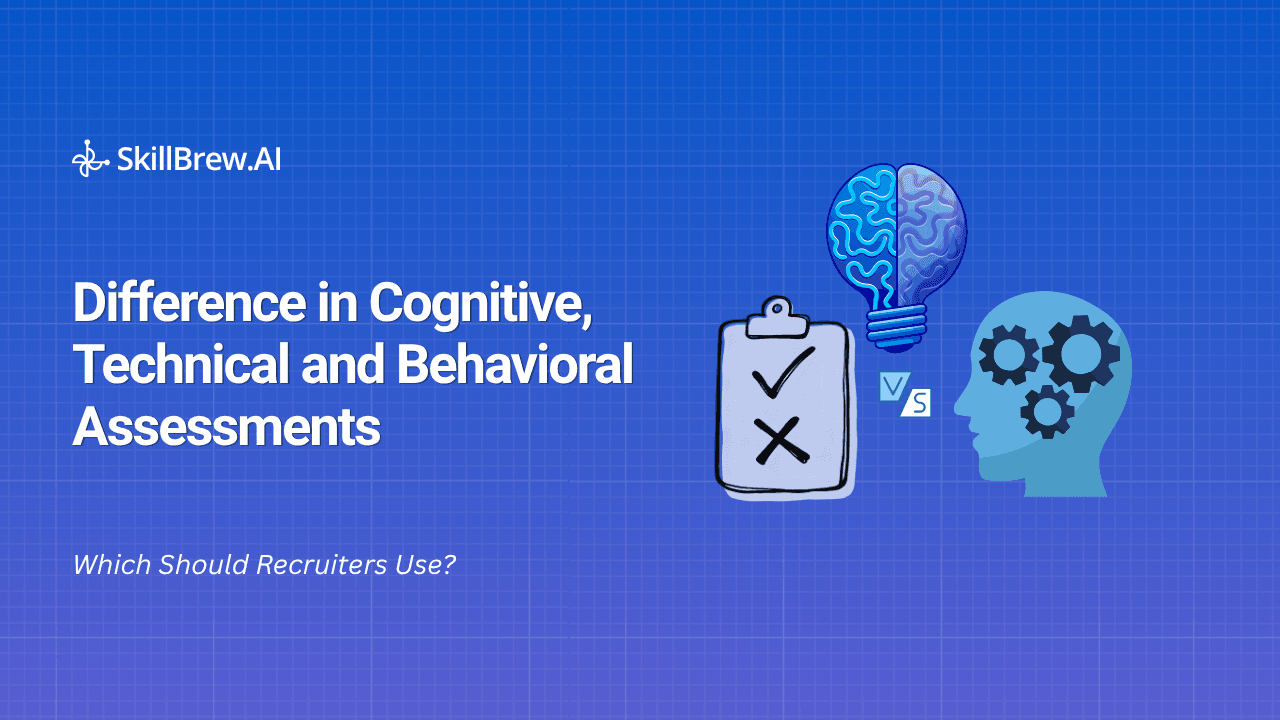
Cognitive assessments ask: can this person reason through unfamiliar problems? Technical assessments ask: can they perform the job? Behavioral assessments ask: how are they likely to behave in situations relevant to the role? Three different questions, three different tools, and most hiring processes need more than one of them.
The challenge isn't finding an assessment. It's picking the right one for the decision in front of you. This guide walks through the major types of employment assessments, how cognitive, technical, and behavioral methods differ, where work-sample tests fit into the picture, and how to combine them without turning your hiring process into an obstacle course.
Key Takeaways
- The different types of employment assessments each measure a different dimension of candidate capability, and none of them substitutes for the others.
- Cognitive assessments evaluate reasoning and problem-solving; technical assessments evaluate job-specific skill; behavioral and situational assessments evaluate workplace judgment and interpersonal tendencies.
- Work-sample assessments, where candidates perform a task resembling the actual job, sit alongside these three as a distinct and often underused category.
- No single assessment type covers every role. The right combination starts with what the job actually requires, not with what's convenient to administer.
- Structured, job-relevant assessments can improve consistency in hiring decisions, but they aren't automatically bias-free; validation and review still matter.
Table of Contents
- What Are Employment Assessments?: Where these tools sit in the hiring process
- The Main Categories at a Glance: a quick-reference table before the deep dive
- Cognitive Assessments: reasoning, problem-solving, and when they apply
- Technical Assessments: job-specific knowledge versus applied skill
- Behavioral Assessments: workplace tendencies, judgment, and where terminology gets muddled
- Where Work-Sample Assessments Fit: the category most guides skip
- Cognitive vs. Technical vs. Behavioral: a direct side-by-side comparison
- How to Choose the Right Assessment for a Role: a four-step framework
- Types of Employment Assessments by Job Role: practical combinations for common roles
- Should Recruiters Combine Assessment Types?: When more evidence helps, and when it doesn't
- Common Assessment Mistakes: what undermines even the right test
- How AI Supports Employment Assessments: where AI helps and where humans still decide
- Best Practices Checklist: what to confirm before you launch
- FAQ: direct answers to common recruiter questions
- Conclusion
What Are Employment Assessments?
Employment assessments are structured evaluations used during hiring to measure a specific candidate capability, rather than relying on self-reported experience or interview impressions alone.
Depending on the format, they can measure:
- Technical knowledge and job-specific skills
- Logical, numerical, or verbal reasoning
- Problem-solving ability
- Communication and situational judgment
- Behavioral tendencies
- Attention to detail
- Role-specific decision-making
Different types of employment assessments are built to answer different hiring questions. A cognitive test asks whether someone can reason through something new. A technical test asks whether they can execute the work itself. A behavioral or situational test asks how they'd likely handle the messier, people-facing parts of the job.
These aren't competing options. A recruiter might run a cognitive screen early in the funnel, a technical assessment for shortlisted candidates, and a structured behavioral interview before the final decision. Which methods you use, and in what order, depends entirely on the role.
The Main Categories at a Glance
Before going deeper, here's the fast answer to "which of the types of employment assessments do I need":
| If you need to know... | Use... |
| Can this person reason through unfamiliar problems? | Cognitive assessment |
| Can this person perform a job-specific task? | Technical assessment |
| How might this person respond to workplace situations? | Behavioral assessment or situational judgment test |
| Can this person demonstrate the skill in practice? | Work-sample assessment |
| Can this person communicate clearly and appropriately? | Communication assessment |
Keep this table in mind as a filter. Everything below explains why each row exists and when to reach for it.
Cognitive Assessments
Cognitive assessments measure the mental abilities behind reasoning, learning, and processing information. Among the types of employment assessments recruiters use, they're one of the more established, because so many roles require people to absorb information and make decisions under some degree of ambiguity.
What they measure:
- Logical, numerical, and verbal reasoning
- Abstract reasoning and pattern recognition
- Critical thinking
- Information processing speed and accuracy
A typical question might show a sequence and ask the candidate to identify the next value, or present a logical scenario and ask which conclusion follows from the given facts.
When to use them:
Cognitive assessments are useful whenever a role genuinely requires someone to learn quickly, analyze problems, work with numerical information, or adapt to unfamiliar situations. That's not limited to graduate hiring or early-career roles; a senior operations lead making judgment calls under time pressure benefits from the same underlying reasoning ability as a junior analyst. The relevant question is always whether reasoning ability is job-related, not how many years of experience the candidate has.
What cognitive assessments don't do is confirm a specific tool skill. A candidate can score well on numerical reasoning and still not know how to build a pivot table in Excel or write a SQL query. That distinction is exactly why cognitive assessments are usually paired with something else rather than used alone.
Technical Assessments
Technical assessments evaluate whether a candidate has the job-specific knowledge and practical skill a role actually requires. Among the types of employment assessments available to recruiters, they're most directly connected to day-to-day performance, which makes them the backbone of hiring for engineering, data, finance, and other specialized functions.
What they measure:
- Programming, coding, and debugging
- SQL and data analysis
- Domain-specific knowledge (engineering, accounting, cybersecurity, and similar fields)
- Applied technical problem-solving
Knowledge versus applied skill:
The strongest technical assessments test application, not recall. Compare:
- Knowledge question: "What is a database index?"
- Applied question: "A database query has become significantly slower after the dataset grew. What are the possible causes, and how would you investigate?"
The second question shows how a candidate actually thinks through a real problem, which is far more predictive than a definition they could look up. This is the same logic that underlies work-sample testing, covered a bit further down: the closer an assessment gets to the real task, the more useful the signal.
Structuring a coding assessment:
For engineering roles, a well-built assessment often layers several components: programming fundamentals, a coding challenge, a debugging task, and a technical reasoning question. That combination gives a fuller picture than a single theoretical test.
Behavioral Assessments
Behavioral assessments look at how candidates are likely to interact with others, handle workplace situations, and approach different kinds of work. Among the types of employment assessments in common use, this is one of the more misunderstood, mostly because several related methods get lumped under the same label.
What they can measure:
- Communication style and team orientation
- Adaptability and dependability
- Conflict management and emotional regulation
- Customer orientation and decision-making
A behavioral assessment shouldn't be treated as a personality verdict. The right framing is whether a particular tendency is relevant to the role, not whether the candidate seems like a "good" or "bad" fit as a person.
Clearing up the terminology:
"Behavioral" gets applied loosely to several distinct methods. Here's the distinction that matters:
| Method | What It Measures |
| Behavioral or personality assessment | Relatively stable traits and behavioral tendencies |
| Situational judgment test (SJT) | How a candidate responds to a hypothetical workplace scenario |
| Behavioral interview | Evidence drawn from how a candidate actually handled a past situation |
| Work-sample assessment | Demonstrated ability to perform a realistic task |
The difference between an SJT and a behavioral interview is a good example of why this matters:
- Behavioral assessment / SJT prompt: "How would you respond if a teammate repeatedly missed deadlines?"
- Behavioral interview prompt: "Tell me about a time you worked with a teammate who repeatedly missed deadlines."
Both produce useful signal, but one is hypothetical and the other is evidence-based. Knowing which one you're actually running changes how much weight to put on the result.
Where Work-Sample Assessments Fit
Work-sample assessments are the category most guides on types of employment assessments mention once and then forget. That's a gap worth closing, because they often produce the clearest signal of all four categories.
A work-sample assessment asks a candidate to perform a task that closely resembles what they'd actually do on the job, rather than answering questions about the job. The logic is simple: the closer the test is to the real work, the less inference is required to predict performance.
Examples by role:
- Developer → build or debug a small piece of working code
- Recruiter → screen resumes against a job description and shortlist candidates with reasoning
- Copywriter → write a short piece to a brief
- Data analyst → interpret a dataset and summarize findings
- Customer support → respond to a realistic customer scenario
- Salesperson → run a mock sales call
Work-sample tests take more effort to build and score than a multiple-choice cognitive test, which is likely why they get less coverage. But for roles where the day-to-day work is easy to simulate, they're often worth the extra setup.
Cognitive vs. Technical vs. Behavioral Assessments
Here's a direct comparison of these three types of employment assessments:
| Assessment Type | Primary Purpose | Example | Best Used For |
| Cognitive | Measures reasoning and problem-solving | Logical reasoning test | Analytical roles, roles requiring fast learning |
| Technical | Measures job-specific knowledge and skills | Coding or SQL task | Technical and specialized roles |
| Behavioral | Measures workplace behaviors and judgment | Customer conflict scenario | People-facing and management roles |
Cognitive asks how a candidate reasons. Technical asks whether they can perform the skill. Behavioral asks how they're likely to act in a given situation. None of the three outranks the others in the abstract. Their value is entirely a function of the role.
How to Choose the Right Assessment for a Role
Choosing among the types of employment assessments should start with the job, not with whatever assessment platform is easiest to spin up.
1. What does the person actually do?
Look at the responsibilities, not the title. A "Data Analyst" at one company might spend most of their time writing SQL; at another, the role is mostly stakeholder reporting. Build the assessment around the real day-to-day, not the label on the job posting.
2. Which skills are essential?
Sort requirements into critical, important, and secondary. Critical skills should get the most assessment weight; secondary skills often don't need formal testing at all.
3. Which format actually demonstrates that skill?
| Skill | Recommended Format |
| Logical reasoning | Cognitive |
| Numerical ability | Cognitive |
| Programming | Technical |
| SQL | Technical |
| Writing | Communication or work-sample |
| Customer handling | Situational or behavioral |
| Leadership judgment | Behavioral or situational |
| Data interpretation | Cognitive + technical |
4. How much evidence do you actually need?
A junior developer might need nothing more than one solid coding assessment. A senior sales hire might justify a situational exercise, a communication check, and a structured interview. The goal is never to run as many assessment stages as possible; it's to gather just enough relevant evidence to make a confident call.
Assessment Types by Job Role
Different roles call for different types of employment assessments, as shown below.
| Role | Recommended Combination | Why |
| Software Engineer | Technical assessment, coding assessment, structured technical interview | Needs both theoretical knowledge and demonstrated coding ability |
| Data Analyst | Cognitive/numerical assessment, SQL assessment, data interpretation task, communication exercise | Role blends analysis, tooling, and explaining findings clearly |
| Sales Representative | Situational assessment, communication assessment, behavioral assessment, role-play | Technical testing adds little unless the role needs specialized product knowledge |
| Customer Support Specialist | Communication assessment, situational judgment, product knowledge check | Realistic scenarios show how candidates actually handle customers |
| Marketing Manager | Case study, analytical assessment, communication exercise | Tests judgment on real campaign data, not just theory |
| Recruiter | Work-sample assessment (resume screening and shortlisting), situational assessment, communication assessment | The core task, prioritizing candidates and explaining the reasoning, is a work sample, not a personality trait |
| Campus Hiring | Staged: cognitive/aptitude, then technical, then communication/behavioral, then interview | Splitting stages lets high-volume drives manage thousands of applicants without one overloaded test |
Note the recruiter row specifically: giving candidates a job description and a stack of resumes to shortlist is a work-sample exercise, not a generic behavioral one. Naming it correctly changes how you score it.
Should Recruiters Combine Assessment Types?
Usually, combining types of employment assessments is worthwhile, but not without limit.
For a software engineering hire, a cognitive assessment measures general reasoning, a technical assessment measures domain knowledge, a coding task measures applied programming ability, and an interview covers communication. Each stage answers something the others don't.
The failure mode is stacking assessments that measure the same thing twice. Every additional stage adds candidate effort and recruiter workload, and both drive drop-off. Before adding a stage, ask a simple question: does this actually tell us something we don't already know? If two assessments are measuring the same underlying capability, cut one.
Common Assessment Mistakes
Even a well-chosen assessment type can fail in execution, and this applies across all the types of employment assessments covered here.
- Using one test for every role.
A developer's technical assessment shouldn't get reused for a sales candidate just because it's already built. - Testing skills the job doesn't require.
If you can't explain why a skill is being tested, it probably shouldn't be. - Over-relying on cognitive scores.
Reasoning ability is useful evidence, but it says nothing about a candidate's specific technical competence. - Treating behavioral results as personality labels.
Score against job-relevant behaviors, not a vague sense of "fit." - Making the assessment too long.
Longer doesn't mean more accurate; it mostly increases drop-off. - Skipping candidate communication.
Candidates should know what's being measured, roughly how long it takes, and whether AI or proctoring is involved. - Never validating results.
If a test consistently fails to distinguish strong performers from weak ones after the fact, it's not doing its job, regardless of how well-designed it looked on paper.
How AI Supports Employment Assessments
AI is changing how the different types of employment assessments get built, not how hiring decisions get made, and that distinction matters more than most coverage of this topic acknowledges.
Where AI genuinely helps:
- Job description analysis: identifying the skills, technologies, and competencies embedded in a JD
- Question generation: producing role-specific technical, situational, or cognitive questions at the right difficulty level
- Assessment assembly: organizing generated questions into a balanced, structured test
- Automated scoring: grading objective questions instantly, and supporting evaluation of open-ended responses against predefined criteria
- Competency-level reporting: breaking a single score into a readable breakdown, for example:
| Competency | Score |
| Problem-solving | 86% |
| Technical knowledge | 78% |
| Communication | 91% |
| Analytical reasoning | 82% |
Where AI should not be the final word:
Generating and scoring an assessment is different from deciding who gets hired. AI can help produce, organize, and summarize assessment data, but recruiters still need to define what "good" looks like for the role, confirm the assessment is actually valid for that role, and make the final call. Treating an AI-generated score as an automatic hiring decision skips the human judgment step that makes the assessment defensible in the first place.
How SkillBrew.AI Fits Into the Workflow
The core sequence here, job description → skills → assessment → candidate → results, is exactly what SkillBrew.AI's Assessment Builder is built around.
Instead of starting from a blank question bank, recruiters can generate a structured assessment directly from the job description, review and edit the generated questions, and send it to candidates. For technical roles, the platform supports coding questions and AI-generated test cases so recruiters aren't writing every prompt by hand.
Assessment integrity is handled through BrewShield, which monitors signals like camera activity, screen behavior, and tab-switching during proctored assessments, for teams that need that layer.
As with any AI-assisted process, the output is a starting point. Recruiters should still review generated questions for role relevance and appropriate difficulty before sending an assessment live.
Best Practices Checklist
Run this checklist before launching any of the types of employment assessments discussed above.
Job alignment
- Does the assessment measure something genuinely relevant to the role?
- Are critical skills weighted more heavily than secondary ones?
Assessment design
- Are candidates demonstrating skills wherever that's practical?
- Is the difficulty appropriate for the seniority level?
Scoring
- Are scoring criteria defined before candidates are evaluated, not after?
- Can recruiters clearly explain what a given score represents?
Candidate experience
- Is the expected completion time realistic?
- Are candidates told whether AI or proctoring is involved?
Validation
- Are results periodically checked against actual hiring outcomes?
- Are weak-performing questions revised or retired?
Frequently Asked Questions
Q1. What are the main types of employment assessments?
The major categories are cognitive, technical, behavioral, situational judgment, work-sample, and communication assessments. Which one fits depends on the role and the specific capability being measured.
Q2. What is the difference between cognitive and technical assessments?
Cognitive assessments measure broad reasoning, such as logical, numerical, or verbal ability. Technical assessments measure job-specific knowledge or skill, such as programming, SQL, or accounting.
Q3. What is the difference between technical and behavioral assessments?
A technical assessment checks whether a candidate can perform specific job-related tasks. A behavioral assessment looks at workplace tendencies, judgment, communication, and how someone is likely to handle interpersonal situations.
Q4. Are cognitive assessments useful for hiring?
Yes, when reasoning, learning speed, or problem-solving genuinely matter for the role. They shouldn't replace a direct measure of job-specific skill, though; the two work best together.
Q5. Which assessment is best for software engineers?
A technical or coding assessment carries the most weight, since it directly measures programming and problem-solving ability. Many teams pair it with a structured technical interview.
Q6. Which assessment is best for sales roles?
Situational, communication, and behavioral assessments tend to matter most, since sales work depends heavily on objection handling, prioritization, and reading customer intent.
Q7. Should every candidate take the same assessment?
Candidates for the same role should be evaluated against consistent criteria. If different versions exist, they need to measure comparable competencies under a documented evaluation framework.
Q8. Can AI create employment assessments?
Yes. AI can help with job-description analysis, question generation, assessment assembly, scoring support, and reporting. Human review still matters to confirm the assessment reflects the actual job.
Q9. How many assessment types should recruiters use?
There's no fixed number. Use enough methods to gather meaningful evidence on the capabilities that matter most, without adding candidate effort that isn't buying you new information.
Q10. Can employment assessments reduce hiring bias?
Structured assessments can improve consistency by evaluating every candidate against the same predefined criteria. That said, an assessment isn't automatically bias-free just because it's structured. The test itself still has to be job-related, accessible, and reviewed for adverse impact, which is the standard the EEOC's Uniform Guidelines on Employee Selection Procedures and SIOP's Principles for the Validation and Use of Personnel Selection Procedures are both built around.
Q11. What is the most effective type of employment assessment?
There isn't a single best type. Effectiveness depends entirely on the job and the specific competency being measured, which is why most well-built hiring processes combine two or three methods rather than relying on one.
Conclusion
The strongest hiring process doesn't run every one of the types of employment assessments available. It runs the right combination for the questions that actually need answering.
Cognitive assessments surface reasoning ability. Technical assessments confirm job-specific skill. Behavioral, situational, and work-sample methods show how a candidate is likely to handle the real, messier parts of the role. A software engineer probably needs coding and technical evaluation. A sales rep is better served by situational and communication exercises. A data analyst often needs a mix of numerical reasoning, SQL, and interpretation.
None of this is about building the longest possible process. It's about collecting evidence that's actually relevant, scored consistently, and validated over time, whether or not AI is involved in building it.
If you're looking to build and manage these assessments in one workflow, explore SkillBrew.AI's Assessment Builder.
See AI-powered hiring in action
Discover how SkillBrew helps hiring teams cut time-to-hire by 60% with skill-validated assessments and AI-ranked shortlists.
Book a free demoNo commitment required · 30 minutes
Continue reading
View All Posts