AI Assessment
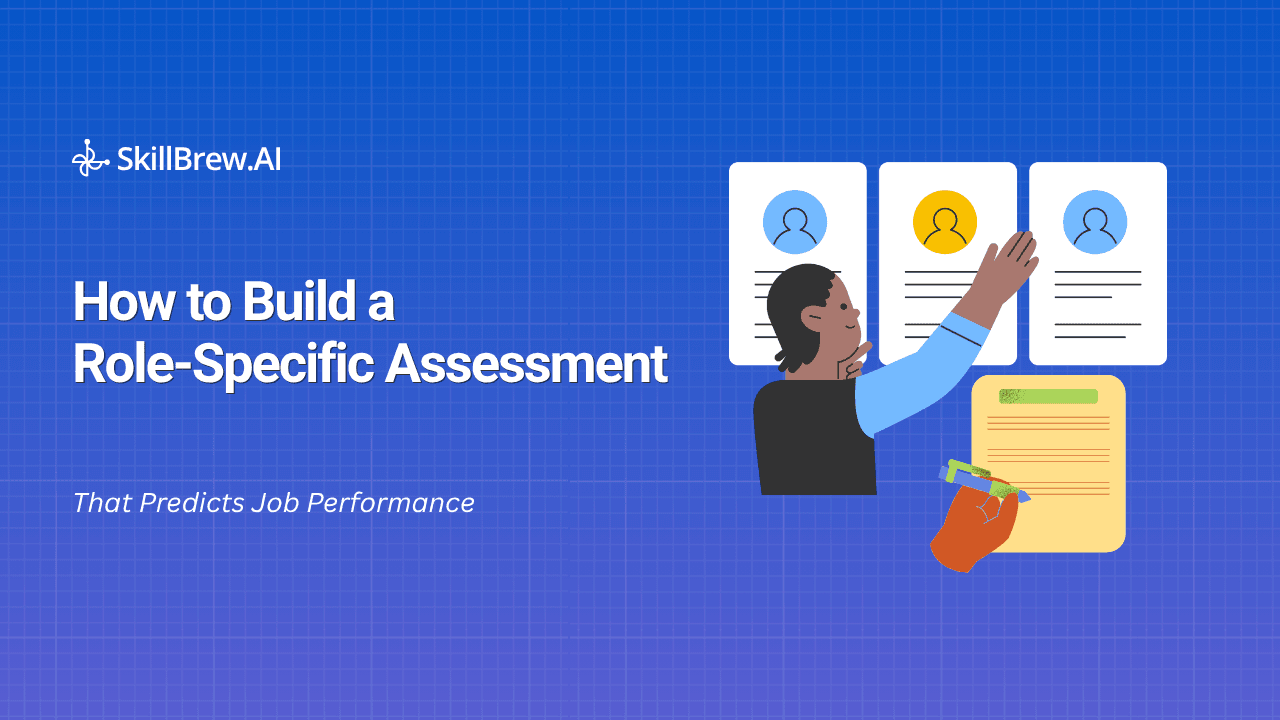
How to Build a Role-Specific Assessment That Predicts Job Performance
A great resume can tell you where someone has worked. A good interview can tell you how they communicate. But neither necessarily tells you whether a candidate can actually perform the job. That's where a role-specific assessment comes in. Instead of giving every candidate the same generic test, a role-specific assessment evaluates the skills, knowledge, and behaviors that matter for a particular position. A software engineer might be asked to debug code. A sales representative might handle a

A great resume can tell you where someone has worked. A good interview can tell you how they communicate. But neither necessarily tells you whether a candidate can actually perform the job.
That's where a role-specific assessment comes in.
Instead of giving every candidate the same generic test, a role-specific assessment evaluates the skills, knowledge, and behaviors that matter for a particular position. A software engineer might be asked to debug code. A sales representative might handle a customer objection. A data analyst might interpret a dataset. The assessment changes because the job changes.
The goal isn't to make assessments harder. It's to make them more relevant.
When an assessment reflects the work a candidate would actually perform, recruiters get a more useful signal before investing time in interviews. Research on employee selection supports this approach. For example, the U.S. Office of Personnel Management reports meaningful estimated relationships between work-sample tests, structured interviews, and job performance.
This guide explains how to build one, choose the right assessment format, create better questions, define scoring criteria, validate your approach, and use AI to make the process faster.
Key Takeaways
- It evaluates skills directly related to a particular job, rather than testing broad, generic capability.
- Generic assessments aren't inherently bad, but they can produce a weak signal when they aren't aligned with the role.
- The strongest assessments focus on job-relevant skills and applied ability rather than broad knowledge alone.
- A skills-to-question blueprint helps recruiters ensure every important competency is evaluated appropriately.
- Consistent scoring rubrics make candidate comparisons more reliable.
- Assessment results should be reviewed against later hiring outcomes to determine whether the assessment is measuring what matters.
- AI can reduce the time required to create these assessments from job descriptions while helping recruiters standardize evaluation.
Table of Contents
- What Is a Role-Specific Assessment?: Understand what it is and how it differs from generic tests.
- Role-Specific vs. Generic Assessments: Compare both approaches and when to use them.
- Why Generic Hiring Assessments Often Fail: Learn why they often miss job relevance.
- What Makes a Role-Specific Assessment Predictive?: Explore key factors like relevance, skills, and validation.
- How to Build a Role-Specific Assessment Step by Step: Simple process from JD to final test.
- How to Choose the Right Assessment Type: Match the test type to the role.
- Role-Specific Assessment Examples: See examples across key job roles.
- Common Hiring Assessment Mistakes: Identify errors that reduce assessment quality.
- How AI Makes Role-Specific Assessments Easier: See how AI speeds up creation and evaluation.
- Best Practices Checklist: Quick checklist before launching an assessment.
- Frequently Asked Questions: Common answers about role-specific assessments.
- Conclusion: How structured assessments improve hiring decisions.
What Is a Role-Specific Assessment?
A role-specific assessment is a pre-employment test designed to evaluate the skills, knowledge, and behaviors required for a particular job.
Instead of using one assessment across multiple positions, recruiters tailor the questions, tasks, difficulty, and scoring criteria to the responsibilities of the role.
For example, a generic technical test might ask every candidate about programming concepts. A role-specific assessment for a backend engineer could instead ask candidates to debug an API, write a SQL query, or identify a performance issue in a service.
The difference is simple:
Generic assessment: "Does this candidate know this concept?"
Role-specific assessment: "Can this candidate apply the skills this job actually requires?"
That distinction matters because hiring decisions are ultimately about job performance, not test performance in isolation.
A well-designed assessment should therefore start with the job rather than with a question bank.
Generic Assessment vs. Role-Specific Assessment
| Generic Assessment | Role-Specific Assessment |
| Tests broad skills | Tests job-specific skills |
| Often reused across roles | Adapted to each role |
| May focus on general knowledge | Focuses on applied ability |
| Less connected to daily work | Reflects actual job responsibilities |
| Uses broad evaluation criteria | Maps skills to role requirements |
| Useful for common capabilities | Useful for role-specific decisions |
Generic assessments still have legitimate uses. Aptitude, logical reasoning, and cognitive assessments can be useful when the same underlying capability matters across many roles.
The problem isn't that an assessment is generic. The problem is using a generic assessment to answer a question it wasn't designed to answer.
Why Generic Hiring Assessments Often Fail
A generic assessment can look efficient on paper. Build it once, send it to every candidate, and compare the scores.
But efficiency isn't the same as relevance.
They test knowledge instead of job performance
Knowing a definition doesn't necessarily mean someone can apply it.
A candidate may correctly answer a question about SQL joins but struggle when asked to troubleshoot a query against messy production data. This is one of the more common bottlenecks in technical screening: knowledge questions move quickly, but they don't tell a recruiter much about how a candidate handles the messy version of the problem.
Whenever possible, assessments should include practical tasks that resemble the problems candidates will encounter on the job.
They don't reflect different role requirements
Consider two marketing roles.
A content writer needs strong writing, editing, research, and audience understanding.
A performance marketer may need analytical thinking, campaign optimization, attribution, and data interpretation.
Giving both candidates the same marketing quiz doesn't necessarily tell you whether either person can succeed in their specific role.
They can over-test low-priority skills
A candidate may spend 40% of an assessment answering questions about a skill that represents only 10% of the actual job.
This creates a distorted picture of candidate capability.
A well-built assessment starts by identifying which skills are critical, important, or secondary, and then distributes assessment weight accordingly.
They make weak results difficult to interpret
Suppose a candidate scores 62%.
What does that mean?
Without knowing which skills were tested and how heavily each skill was weighted, the number doesn't tell a recruiter much.
A strong candidate assessment should explain why the candidate received that score.
What Makes a Role-Specific Assessment Predictive?
The word "predictive" should be used carefully.
An assessment doesn't become predictive simply because it is labeled role-specific or because it uses AI. Its usefulness as a predictor depends on how closely it measures the capabilities required for the job and whether its results are validated against meaningful outcomes.
Research on employee selection supports the value of job-relevant assessment methods. For example, the U.S. Office of Personnel Management reports estimated validity coefficients of .54 for work-sample tests and .51 for structured interviews, indicating meaningful relationships between these assessment methods and job performance.
Several characteristics make an assessment more useful for this purpose.
1. Job relevance
Every major assessment component should connect to a real job responsibility or competency.
If a skill isn't required for the role, ask whether it belongs in the assessment at all.
2. Applied skills
Whenever possible, ask candidates to demonstrate rather than simply describe their knowledge.
Examples include:
- Debugging a piece of code
- Analyzing a spreadsheet
- Responding to a customer complaint
- Prioritizing a project backlog
- Writing a sales email
- Reviewing a candidate resume
- Interpreting campaign performance data
3. Appropriate difficulty
An assessment should reflect the expected level of the role.
A graduate candidate shouldn't necessarily receive the same assessment as a senior engineer.
Difficulty should reflect:
- Seniority
- Technical complexity
- Decision-making responsibility
- Expected independence
- Scope of the position
4. Consistent scoring
Candidates should be evaluated against the same predefined criteria.
For objective questions, that may mean correct and incorrect answers.
For open-ended tasks, it may mean a weighted rubric covering areas such as accuracy, reasoning, communication, and problem-solving.
Structured evaluation reduces unnecessary variation in how candidates are judged and gives hiring teams a more consistent basis for comparing applicants.
5. Validation against outcomes
This is the part many hiring teams overlook.
After using an assessment for several hiring cycles, compare assessment results with later outcomes.
For example, recruiters could examine whether candidates who scored highly on a particular competency also performed well during:
- Interviews
- Technical rounds
- Onboarding
- Training
- Probation
- Early performance reviews
- Role-specific performance metrics
This doesn't mean assessment scores should automatically determine who gets hired.
It means hiring teams should continuously ask:
"Is this assessment measuring something that actually matters after the candidate joins?"
If the answer is no, the assessment needs to change.
How to Build a Role-Specific Assessment Step by Step
Building an effective assessment doesn't have to start with hundreds of questions.
Start with the role.
Step 1: Conduct a job analysis
Read the job description as an assessment blueprint, then go a step further: a job analysis identifies the responsibilities, tasks, competencies, and outcomes that actually define success in the role, not just the language used to advertise it.
Identify:
- Responsibilities
- Required skills
- Preferred skills
- Tools and technologies
- Expected outcomes
- Seniority level
- Communication requirements
- Problem-solving responsibilities
For example, a data analyst JD might mention SQL, Excel, dashboarding, data interpretation, stakeholder communication, and business reporting.
Those become potential assessment areas, and together they form the foundation the rest of the assessment is built on.
Step 2: Identify the skills that matter
Separate skills into three categories:
Critical: The candidate cannot perform the role effectively without this skill.
Important: The skill contributes significantly to success but isn't the primary requirement.
Nice to have: Useful, but not essential for the position.
This prevents the assessment from giving equal weight to skills that don't have equal importance.
Step 3: Prioritize the skills
Not every skill deserves the same number of questions.
For example:
| Skill | Importance | Suggested Weight |
| SQL | Critical | 30% |
| Data interpretation | Critical | 30% |
| Excel | Important | 20% |
| Communication | Important | 20% |
The exact percentages will vary by role.
The important part is that the weighting reflects the job.
Step 4: Create a skills-to-question blueprint
Before writing questions, decide how each skill will be tested.
For example:
| Skill | Assessment Method | Example |
| SQL | Practical task | Fix an incorrect query |
| Data interpretation | Case question | Analyze a sales dataset |
| Excel | Practical task | Build a basic analysis |
| Communication | Written response | Explain findings to a stakeholder |
This step prevents the assessment from accidentally becoming too focused on one skill.
Step 5: Choose the assessment format
The format should follow the skill being measured.
If you're testing coding, use coding tasks.
If you're testing communication, use written or voice-based scenarios.
If you're testing problem-solving, use case-based or situational questions.
If you're testing technical knowledge, combine objective questions with practical application where possible.
Step 6: Create realistic questions
Avoid questions that test information candidates can memorize without demonstrating the underlying skill.
Instead of:
"What is the definition of API latency?"
Consider:
"An API endpoint has suddenly increased from 200ms to 2 seconds under normal traffic. What would you investigate first, and why?"
The second question gives the candidate an opportunity to demonstrate reasoning.
Step 7: Define the scoring rubric
Create the scoring criteria before candidates begin.
For a written response, for example:
| Criterion | Weight |
| Technical accuracy | 40% |
| Problem-solving | 30% |
| Reasoning | 20% |
| Communication | 10% |
This gives recruiters a consistent framework for comparing candidates.
Step 8: Set a practical assessment duration
There is no universal ideal assessment length.
A focused screening assessment can often fit within 15–40 minutes, depending on the role, assessment format, and number of skills being evaluated. This is a practical recommendation rather than a figure established by research, so treat it as a starting point to adjust based on the role.
The key is to avoid adding questions simply to make the assessment feel comprehensive.
Every question should earn its place.
Step 9: Validate and improve
Once candidates begin completing the assessment, monitor:
- Completion rate
- Average score
- Question-level performance
- Candidate feedback
- Interview conversion
- Hiring outcomes
- Early job performance
If one question is consistently misunderstood, it may be poorly written.
If candidates with high assessment scores consistently perform poorly later, the assessment may be measuring the wrong capabilities.
How to Choose the Right Assessment Type
Different roles require different forms of evaluation.
| Assessment Type | Best For | Example |
| Technical | Technical roles | Debugging a production issue |
| Coding | Software engineering | Build or fix a coding task |
| Aptitude | Entry-level and campus roles | Logical reasoning |
| Cognitive | Problem-solving roles | Pattern recognition |
| Behavioral | People-focused roles | Conflict-resolution scenario |
| Communication | Sales and support | Customer response |
| Situational | Managers and customer-facing roles | Prioritization scenario |
| Case study | Marketing, consulting, strategy | Analyze a business problem |
Aptitude and cognitive assessments overlap conceptually, so it helps to draw the line clearly: aptitude tests generally measure broad reasoning and quantitative ability, while cognitive assessments focus on problem-solving and pattern-based reasoning. If a role doesn't require the distinction, it's fine to combine them into a single reasoning section.
You can also combine multiple formats.
For example, a software engineer might complete a coding task plus technical questions.
A sales representative might complete a communication exercise plus a behavioral scenario.
The assessment should reflect the actual combination of skills required by the job.
Role-Specific Assessment Examples
The easiest way to understand the concept is to see how the assessment changes with the role.
Software Engineer
Skills to evaluate:
- Programming
- Debugging
- Data structures
- Problem-solving
- Technical reasoning
Assessment format:
A coding task, debugging scenario, and technical questions related to the candidate's expected stack.
The assessment should test whether the candidate can work through problems, not simply remember syntax.
Sales Representative
Skills to evaluate:
- Communication
- Objection handling
- Product understanding
- Prioritization
- Customer empathy
Assessment format:
Give the candidate a simulated customer objection and ask them to respond. Add a scenario requiring them to prioritize several leads.
Customer Support Specialist
Skills to evaluate:
- Communication
- Empathy
- Problem-solving
- Product understanding
- Conflict management
Assessment format:
Provide several simulated customer tickets and ask the candidate to respond to them based on urgency and customer context.
Marketing Manager
Skills to evaluate:
- Strategic thinking
- Campaign planning
- Analytics
- Copywriting
- Audience understanding
Assessment format:
Give the candidate a campaign scenario and ask them to identify the target audience, propose a campaign approach, and explain how they would measure success.
Data Analyst
Skills to evaluate:
- SQL
- Data interpretation
- Excel
- Analytical reasoning
- Communication
Assessment format:
Provide a dataset and ask the candidate to identify trends, write a query, and explain their findings to a non-technical stakeholder.
Recruiter
Skills to evaluate:
- Candidate screening
- Sourcing judgment
- Communication
- Stakeholder management
- Prioritization
Assessment format:
Give the candidate a job description and several resumes. Ask them to shortlist candidates, explain their decisions, identify potential concerns, and write an outreach message.
Campus Hiring
Skills to evaluate:
- Logical reasoning
- Aptitude
- Basic technical knowledge
- Communication
- Problem-solving
Assessment format:
A shorter standardized assessment can evaluate large candidate pools consistently, followed by role-specific technical or interview stages for shortlisted candidates. High-volume campus placement drives face a related challenge: managing drop-off between registration and final selection, which is where automated screening and communication workflows tend to matter as much as the assessment itself.
Common Hiring Assessment Mistakes
Even a well-targeted assessment can fail if it's poorly designed.
Testing everything
More questions don't automatically create better signal.
Focus on the capabilities that matter most.
Using theoretical questions exclusively
Knowing the theory doesn't always demonstrate the ability to apply it.
Include practical or situational questions where appropriate.
Giving every skill equal weight
A candidate shouldn't be penalized heavily for a secondary skill if they excel at the capabilities that define success in the role.
Changing the scoring criteria between candidates
Define the rubric before the assessment starts.
Changing the evaluation standard after seeing candidate responses introduces unnecessary inconsistency.
Making the assessment unnecessarily long
Longer assessments can increase candidate effort without proportionally improving the quality of the signal.
If a question doesn't help evaluate an important competency, remove it.
Ignoring candidate experience
A confusing interface, unclear instructions, or technical problems can make even a well-designed assessment ineffective.
Candidates should understand:
- What they're being evaluated on
- How long the assessment should take
- Whether AI is involved
- What technology they need
- What happens after completion
Never validating the assessment
An assessment shouldn't remain unchanged forever.
Review its results and compare them with actual hiring outcomes.
How AI Makes Role-Specific Assessments Easier
Creating a customized assessment manually can take considerable recruiter or hiring-manager time.
Someone needs to analyze the JD, identify skills, write questions, decide difficulty, build scoring criteria, assemble the test, and review the results.
AI can automate much of this workflow.
A useful AI-powered assessment process can look like this:
Job Description → Skill Extraction → Skill Weighting → Question Generation → Assessment Assembly → Evaluation → Candidate Report
1. Job description analysis
The system starts with the role requirements instead of a generic question bank.
2. Skill identification
AI can identify technical, behavioral, cognitive, and other competencies mentioned in the role.
3. Question generation
Questions can then be created around those competencies.
The important distinction is not simply generating more questions. It's generating questions that are relevant to the role.
4. Assessment assembly
Questions can be distributed across different categories and difficulty levels to create a balanced assessment.
5. Automated evaluation
Objective questions can be scored automatically, while other responses can be evaluated against predefined criteria depending on the assessment format.
6. Structured candidate reporting
Instead of leaving recruiters with a single percentage, structured reporting can show performance across different competencies.
This makes it easier to identify strengths, weaknesses, and candidates who warrant further evaluation.
How SkillBrew.AI Fits Into the Workflow
SkillBrew.AI's Assessment Builder helps recruiters turn job requirements into structured assessments without starting from a blank question bank. Recruiters can generate an assessment from a job description, review the suggested skills and questions, and adjust the assessment before sending it to candidates.
For technical hiring, the platform also supports coding questions and generated test cases. Recruiters can additionally use assessment integrity features when proctoring is appropriate for the hiring process, monitoring signals such as camera activity, screen behavior, and tab switching during the assessment.
The important point is that AI should support assessment design, not replace thoughtful hiring criteria.
A poorly defined job description can still produce a poorly targeted assessment. Recruiters should review generated assessments to ensure the skills, difficulty, questions, and scoring criteria match the actual role.
For roles where a written or coding assessment alone isn't enough signal, pairing it with an AI interview adds a conversational, adaptive round that can probe a shortlisted candidate's reasoning in more depth.
Best Practices Checklist for Role-Specific Assessments
Before sending an assessment to candidates, ask:
Job alignment
- Does every major section relate to the job?
- Are the most important skills weighted appropriately?
- Does the assessment reflect the actual responsibilities?
Question quality
- Are candidates demonstrating skills rather than only recalling information?
- Are the scenarios realistic?
- Does each question have a clear purpose?
Scoring
- Is the scoring rubric defined before candidates take the test?
- Are critical skills weighted more heavily than secondary ones?
- Can recruiters understand why a candidate received their score?
Candidate experience
- Are instructions clear?
- Is the expected completion time reasonable?
- Is the assessment accessible on the devices candidates are likely to use?
- Are candidates informed when AI or proctoring is being used?
Validation
- Are assessment scores compared with interview and hiring outcomes?
- Are poorly performing questions removed or rewritten?
- Is the assessment reviewed as the role changes?
Frequently Asked Questions
Q1. What is a role-specific assessment?
It is a candidate evaluation designed around the skills, knowledge, behaviors, and responsibilities required for a particular job. Instead of using the same test for every position, recruiters customize the questions, tasks, difficulty, and scoring criteria to the role.
Q2. How is a role-specific assessment different from a generic hiring assessment?
A generic assessment typically measures broad capabilities using the same test across multiple roles. This one instead focuses on competencies directly connected to a particular position, making it easier to evaluate whether candidates can perform relevant job tasks.
Q3. What should a role-specific assessment measure?
It should measure the capabilities that are important for success in the role. Depending on the position, these may include technical skills, coding, problem-solving, communication, behavioral competencies, analytical ability, or situational judgment.
Q4. How long should a role-specific assessment be?
There is no universal duration. For many focused screening assessments, 15–40 minutes can be a practical range, but the appropriate length depends on the role, assessment format, and number of competencies being evaluated. The assessment should be long enough to gather useful evidence without adding unnecessary questions.
Q5. Can AI create a role-specific assessment?
Yes. AI assessment platforms can analyze a job description, identify relevant skills, generate questions, assemble an assessment, and automate parts of evaluation and reporting. Recruiters should still review the output to ensure it accurately reflects the role.
Q6. How do you know whether an assessment predicts job performance?
Compare assessment results with later outcomes. Hiring teams can examine relationships between assessment scores and interview performance, onboarding results, training performance, early job performance, or other relevant measures. This helps determine whether the assessment is measuring capabilities that matter after hiring.
Q7. Should every candidate receive the same assessment?
Candidates applying for the same role should generally be evaluated against consistent criteria so their results can be compared fairly. If the assessment adapts questions or difficulty, the adaptation should still follow a consistent and documented evaluation framework.
Q8. Are role-specific assessments only useful for technical hiring?
No. They can be used for almost any role. Sales, customer support, marketing, recruiting, operations, finance, management, and campus hiring can all use assessments designed around the competencies required for the position.
Q9. Can a role-specific assessment reduce hiring bias?
Standardized assessments can reduce some forms of inconsistency by giving candidates the same evaluation criteria. However, they aren't automatically bias-free. The questions, scoring criteria, language, and assessment design should still be reviewed for fairness and job relevance, particularly wherever adverse impact is a concern.
Conclusion
A strong role-specific assessment doesn't try to measure everything a candidate knows.
It measures what matters for the job.
The role should determine the assessment, not the other way around. Getting there takes discipline more than tooling: knowing which skills are actually critical, building questions that ask candidates to demonstrate them, and revisiting the assessment once real hiring outcomes come in.
AI can make that process significantly faster by helping recruiters move from a job description to a structured assessment without manually building every question from scratch. But automation works best when it is built around sound assessment principles: job relevance, applied skills, consistent scoring, appropriate difficulty, and continuous validation.
For recruiters hiring at scale, that combination can turn assessment from a generic screening step into a more useful source of evidence for hiring decisions.
Ready to build assessments around the skills that actually matter? Create role-specific assessments faster with SkillBrew.AI's Assessment Builder.
See AI-powered hiring in action
Discover how SkillBrew helps hiring teams cut time-to-hire by 60% with skill-validated assessments and AI-ranked shortlists.
Book a free demoNo commitment required · 30 minutes
Continue reading
View All Posts