AI Assessment
How to Create a Pre Hiring Assessment for Any Job Role
Most hiring teams don't lose good candidates in the interview. They lose them earlier, in a screening process that rewards polished resumes over actual skill. A well-built pre hiring assessment fixes that. It gives you signal before you spend an hour on a call, and it does it for every candidate, not just the ones whose resume caught a recruiter's eye at 11 PM. This guide covers what a pre hiring assessment actually is, the types worth using, how it compares to resume-based screening, how to pi

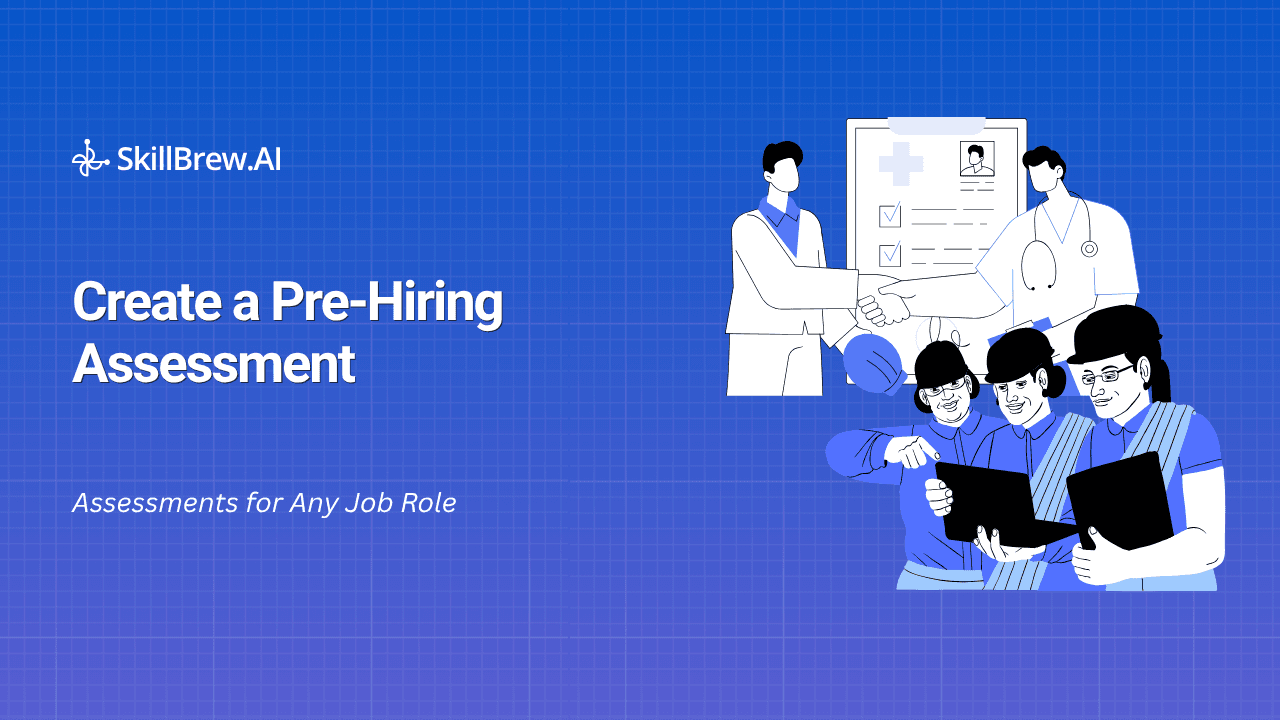
Most hiring teams don't lose good candidates in the interview. They lose them earlier, in a screening process that rewards polished resumes over actual skill. A well-built pre hiring assessment fixes that. It gives you signal before you spend an hour on a call, and it does it for every candidate, not just the ones whose resume caught a recruiter's eye at 11 PM.
This guide covers what a pre hiring assessment actually is, the types worth using, how it compares to resume-based screening, how to pick the right hiring assessment for a given role, and a step-by-step process for building one that holds up at scale, whether you're hiring five software engineers or five hundred campus graduates.
Table of Contents
- What Is a Pre Hiring Assessment?: the definition, and why it exists.
- Why Hiring Assessments Matter: the business case in four points.
- Pre Hiring Assessment vs. Traditional Resume Screening: claims versus proof.
- What the Data Says About Structured Assessments: the research behind the practice.
- Types of Employment Assessments: technical, aptitude, behavioral, cognitive, communication, coding, and role-specific.
- How to Choose the Right Hiring Assessment: matching format to role and volume.
- Step-by-Step Guide to Creating a Pre Hiring Assessment: the eight-step build process.
- Common Hiring Assessment Mistakes: where most tests quietly fail.
- How AI Improves Candidate Skill Assessment: from JD to scored report in minutes.
- Best Practices for Fair, Accurate, Scalable Assessments: plus role-specific examples.
- Frequently Asked Questions
- Key Takeaways
- Conclusion
What Is a Pre Hiring Assessment?
A pre hiring assessment is a structured test or exercise given to job candidates before they're hired, designed to measure whether they can actually do the job. It's not a personality quiz and it's not a formality between the resume screen and the offer letter. Done right, it's the single most objective data point in your entire hiring process.
Where a resume tells you where someone worked, a pre hiring assessment tells you what they can do. That distinction matters more than most TA teams give it credit for. A candidate can list "Python" on a resume for years without ever having shipped production code. A hiring assessment test that asks them to actually write and debug Python settles the question in twenty minutes instead of two rounds of interviews.
Companies use them for one core reason: interviews and resumes alone are weak predictors of job performance. Structured, job-relevant testing consistently outperforms unstructured screening at predicting who actually succeeds once hired, from startups doing a handful of hires a quarter to enterprises running thousands of candidates a month.
Why Hiring Assessments Matter
Every recruiter has a story about the candidate who interviewed brilliantly and then couldn't do the job. A hiring assessment catches that gap before it becomes a bad hire.
- They reduce cost of a mis-hire.
A bad hire costs more than a salary: onboarding time, team morale, and recruiter hours spent replacing them six months later. A well-built employment assessment filters out candidates who can't clear a basic skill bar before they reach a hiring manager's calendar. - They standardize evaluation.
Two interviewers rarely score the same candidate identically. A structured hiring assessment scores everyone against the same rubric, making your hiring data comparable across roles, recruiters, and cycles. - They speed up the funnel.
When 300 people apply for one opening, no recruiter has time to interview all of them. A hiring assessment test does the first pass, so recruiter time goes toward candidates who've already demonstrated skill, not just a good cover letter. - They improve candidate experience, when done well.
A good candidate skill assessment often improves how candidates feel about your process, giving them a chance to show what they can do instead of being filtered out on pedigree alone.
Pre Hiring Assessment vs. Traditional Resume Screening
Resumes and structured assessments answer two different questions, and TA teams that treat them as interchangeable end up with weaker shortlists than they should.
A resume is a claim. It tells you what a candidate says they did, phrased in the most flattering way possible, with no independent verification of whether they actually did it well. A pre hiring assessment is proof. It puts the candidate in front of a real task and scores what they produce, not what they say they can produce.
That distinction cascades into everything downstream. A resume-first process is subjective by design; two recruiters reading the same resume will rank it differently depending on mood, bias, and how closely the candidate's past titles resemble their own mental template of "good." A hiring assessment applies the same rubric to everyone, which is what makes the resulting shortlist defensible and repeatable.
The workload difference is just as real. Recruiters scanning resumes are pattern-matching against keywords and pedigree, a task that scales linearly with the number of recruiters you hire. A pre hiring assessment scales candidates against a fixed rubric instead, so adding volume doesn't require adding headcount, and prediction accuracy improves because the recruiter is now evaluating a demonstrated skill rather than a self-reported one.
| Resume Screening | Pre-Employment Assessment |
| Based on claims | Based on demonstrated skills |
| Subjective, varies by recruiter | Structured, same rubric for everyone |
| Easy to exaggerate or embellish | Harder to fake under a live task |
| Recruiter time scales with volume | Scoring scales without added headcount |
| Weak predictor of on-the-job performance | Stronger predictor of on-the-job performance |
Neither replaces the other entirely. Resumes still matter for context, career trajectory, and basic eligibility. But as the first filter in a high-volume funnel, structured testing simply produces better signal per minute of recruiter time than a resume ever will.
What the Data Says About Structured Assessments
The case for structured hiring assessments isn't just operational, it's backed by decades of personnel-selection research. A few data points worth knowing:
Structured, job-relevant testing is among the strongest available predictors of job performance. Landmark meta-analyses in industrial-organizational psychology, and the research that has revisited them since, consistently rank structured selection methods, cognitive and skills-based testing among them, well above unstructured interviews and resume-based screening alone.
Recruiters spend a disproportionate share of their week on manual resume review before a candidate ever reaches an assessment or interview stage, time that a structured, auto-scored hiring assessment test can compress from days to minutes for the same applicant volume.
Organizations using standardized, structured hiring methods make more consistent decisions across recruiters and hiring cycles than those relying primarily on unstructured judgment, which is the core reason a pre hiring assessment reduces variance in who gets hired for the same role.
None of this means assessments alone should make the hiring decision. It means they should carry real weight in it, which is exactly the role a well-designed candidate skill assessment is meant to play.
Types of Employment Assessments
Not every role needs the same kind of test. Here's the breakdown of what's actually available, and where each type earns its place in a pre hiring assessment strategy.
- Technical assessments - These test hands-on, job-specific skills: SQL queries, spreadsheet modeling, a marketing brief, a debugging exercise. This is the backbone of any employment assessment for roles where a specific hard skill decides success or failure.
- Coding assessments - A subset of technical testing built for engineering roles. Candidates write, debug, or review real code, often in a live sandboxed environment, which is where a hiring assessment test does the most work eliminating false positives from resumes padded with tech buzzwords. Well-built coding assessments also generate the underlying questions automatically from the role's tech stack rather than reusing a static bank.
- Aptitude assessments - These measure general problem-solving, numerical reasoning, and logical thinking, useful for roles where the job changes constantly and raw learning agility matters more than a fixed skill set. Common in campus hiring and entry-level pre hiring assessment programs.
- Cognitive assessments - Related to aptitude testing but focused on how someone processes information under time pressure. Useful as an early filter in high-volume hiring assessment funnels.
- Behavioral assessments - These evaluate how a candidate is likely to act in real work situations: conflict handling, prioritization under pressure, decisions with incomplete information. A behavioral hiring assessment doesn't replace the interview, but it gives interviewers something concrete to probe instead of guessing.
- Communication assessments - Especially relevant for customer-facing, sales, and support roles, these evaluate clarity, tone, and the ability to structure a response, not just grammar. A voice-based communication component in a pre hiring assessment catches gaps a written test never will.
- Role-specific assessments - The most effective employment assessment isn't a generic template. It's built around the actual JD: the tools the person will use, the problems they'll solve, and the seniority they're hired at.
How to Choose the Right Hiring Assessment
The mistake most TA teams make is picking one assessment format and applying it everywhere. The right pre hiring assessment depends entirely on the role.
Start with what actually predicts success, not what's easiest to administer. Ask: if this candidate fails at the job in six months, what will that failure look like? Build the hiring assessment test to catch it.
Match depth to seniority. A junior role can be screened with a shorter aptitude or technical test. A senior hire justifies a deeper, multi-stage assessment, sometimes paired with a live technical round.
Match format to volume. High-volume roles, campus hiring, BPO, retail, frontline, need a hiring assessment test that can run at scale without recruiter babysitting: auto-scored, quick to complete, mobile-friendly. Low-volume, high-stakes roles can support a longer, more detailed candidate skill assessment.
Combine types when the role demands it. A sales role might need a communication plus behavioral assessment. A software engineering role usually needs a coding assessment plus a system-design discussion. There's no rule that says a pre hiring assessment has to be single-format.
Step-by-Step Guide to Creating a Pre hiring Assessment
Here's the actual process, whether you're building your first hiring assessment or fixing one that isn't producing good signal. At a high level, it looks like this:
Job Description
      ↓
Identify Skills to Assess
      ↓
Generate Assessment Questions
      ↓
Invite Candidates
      ↓
AI Scores Responses
      ↓
Review Reports
      ↓
Interview Top Candidates
      ↓
Make Hiring Decision
Each step below expands on what that actually involves.
Step 1: Start from the job description, not a template.
Pull the specific skills, tools, and responsibilities directly from the JD. A generic pre hiring assessment tests generic skills. A JD-anchored one tests the skills that matter for this exact role.
Step 2: Define what "pass" means.
Before writing a single question, decide what score indicates a candidate is worth moving forward. Skip this and scoring on your hiring assessment becomes subjective after the fact.
Step 3: Choose your assessment types.
Based on the role, decide which combination of technical, aptitude, behavioral, cognitive, communication, and coding elements actually predicts performance. Resist the urge to add every category "just in case." Longer isn't better; relevant is better.
Step 4: Write role-specific questions.
Generic question banks produce generic signal. Build questions around real scenarios the person will face: an actual customer objection for a sales hiring assessment, an actual bug pattern for a coding assessment.
Step 5: Set a realistic time limit.
Most candidates disengage past 30 to 40 minutes. A 90-minute test will see completion rates collapse, especially for passive candidates who haven't fully committed to your process yet.
Step 6: Pilot the hiring assessment test first.
Run it against a handful of candidates, or current employees in that role, before rolling it out to the full funnel.
Step 7: Build in integrity checks.
Any employment assessment delivered remotely needs proctoring: timed sections, randomized question banks, or behavioral monitoring, or results become unreliable the moment candidates start sharing answers.
Step 8: Review and refine using outcome data.
Once hires are made, compare assessment scores against actual on-the-job performance. If a high scorer underperforms consistently, it isn't measuring the right thing yet.
Common Hiring Assessment Mistakes
Most hiring assessments fail quietly. They don't get flagged as broken; they just stop producing useful signal.
- Using the same test for every role.
A generic aptitude test tells you almost nothing about whether someone can do a specific job. It's the single most common failure point in most companies' employment assessment strategy. - Making it too long.
Every extra ten minutes past the 30-minute mark loses candidates, particularly strong ones with other offers in play on a competing hiring assessment test. - Testing knowledge instead of applied skill.
A candidate who can define a concept isn't the same as one who can apply it under real conditions. Multiple-choice trivia is a weak substitute for a scenario-based candidate skill assessment. - No defined scoring rubric.
Subjective scoring reintroduces the same bias structured testing is supposed to remove. Every question needs a defined right answer or a weighted rubric before going live. - Ignoring candidate experience.
A confusing, buggy, or overly long employment assessment reflects on your employer brand. Candidates talk, and a bad experience costs you referrals, not just the person who dropped off. - Never revisiting the test.
Roles evolve and tools change. A hiring assessment built two years ago for a role that's since shifted scope is testing the wrong thing.
How AI Improves Candidate Skill Assessment
Building a strong pre hiring assessment manually takes real time: research the role, write questions, build a rubric, pilot it, iterate. Most TA teams don't have that time for every open req, so they skip assessments for some roles or reuse generic ones that don't fit.
This is where AI has genuinely changed the process, not just sped it up. Paste a job description into an AI-powered platform, and its assessment builder handles the JD-to-assessment step directly: automatic question generation across technical, aptitude, behavioral, and coding categories, role-specific customization based on the actual seniority and tools in the JD, and a complete hiring assessment test ready to send in minutes instead of a generic bank pulled off the shelf. SkillBrew.AI's Assessment Builder breaks down how that generation step actually works.
The bigger shift is on the evaluation side. AI scoring doesn't just produce a pass/fail number; it gives recruiters a structured candidate skill assessment report showing where a candidate is strong and where they're weak, so a hiring manager sees the reasoning behind the score, not just the score itself. Built-in proctoring runs alongside the assessment itself, flagging integrity issues in real time rather than leaving recruiters to catch cheating after the fact. For high-volume hiring, that combination, automatic generation, structured scoring, and integrity monitoring, is what actually lets recruiters scale without adding headcount.
Platforms built this way also close the loop with the rest of the funnel. A candidate who clears a technical hiring assessment can move directly into an AI interview without a recruiter manually transferring data between tools, which is where a lot of the 28+ hours per hire currently gets lost to coordination rather than evaluation. The same automation logic applies further down the funnel too, including in high-volume settings like campus hiring drives, where the assessment and interview stages need to run without manual handoffs between them.
Best Practices for Fair, Accurate, Scalable Assessments
Keep it job-relevant, always.
Every question in a pre hiring assessment should map back to something the person will actually do in the role. If you can't draw that line, cut the question.
Standardize the rubric before candidates see the test.
Fairness comes from consistency, and scoring everyone the same way on the same hiring assessment is the fastest route to removing bias from early-stage screening.
Respect candidate time.
Completion rates drop sharply once a hiring assessment test crosses the 30 to 40 minute mark. Shorter, sharper assessments outperform long ones on both completion rate and candidate sentiment.
Build for mobile.
A large share of candidates, especially in campus and blue-collar hiring, will attempt an employment assessment from a phone. If it's not mobile-friendly, you're losing candidates before they start.
Add integrity safeguards without over-policing.
Proctoring should catch real cheating, not create an adversarial experience for honest candidates. Signal-based detection across camera, screen, and behavior beats lockdown software that treats every candidate as a suspect.
Use role-specific examples.
- Software engineering: a coding assessment with a real debugging task plus a short system-design question.
- Sales: a communication assessment built around an actual objection-handling scenario, paired with a behavioral prompt on pipeline prioritization.
- Customer support: a scenario-based candidate skill assessment testing tone, empathy, and problem resolution under a simulated ticket queue.
- Marketing: a short applied exercise, writing a campaign brief or critiquing existing copy, over a generic multiple-choice quiz.
- Campus hiring: a shorter aptitude and cognitive hiring assessment test, standardized across every college in the drive so scores are comparable at scale.
Revisit the assessment quarterly. Treat your pre hiring assessment like a live product, not a document you write once and forget.
Frequently Asked Questions
Q1. What is a pre hiring assessment used for? It evaluates a candidate's job-relevant skills, knowledge, or behavioral fit before a hiring decision, giving recruiters an objective data point earlier in the funnel instead of relying solely on resumes and interviews.
Q2. How long should a hiring assessment test take? Most effective assessments run 15 to 40 minutes. Completion rates drop sharply past that mark, especially for passive candidates who haven't fully committed to your process yet.
Q3. What's the difference between a technical assessment and a cognitive assessment? A technical assessment measures job-specific hard skills, like coding or spreadsheet modeling. A cognitive assessment measures general reasoning ability, independent of any specific tool or domain.
Q4. Can a pre hiring assessment reduce hiring bias? Yes, when it's built on a standardized rubric applied identically to every candidate. It reduces the inconsistency unstructured interviews introduce, though it isn't automatically bias-free; the questions and scoring still need auditing for fairness.
Q5. How does AI help create a hiring assessment? AI can generate one directly from a job description, producing technical, behavioral, and cognitive questions matched to the role in minutes instead of hours, and standardize scoring into structured candidate skill assessment reports for recruiters.
Q6. Should every job role have the same assessment? No. The most effective hiring assessment is tailored to the role, its seniority level, and what actually predicts success in that job. A one-size-fits-all employment assessment produces weak, generic signal.
Q7. Does a longer assessment give better results? Not usually. Beyond 30 to 40 minutes, candidate drop-off rises faster than signal quality gained. A focused, well-designed hiring assessment test beats a long, unfocused one almost every time.
Q8. Can pre hiring assessments be used for campus hiring?
Yes. Standardized aptitude and cognitive hiring assessments are especially valuable there, where you need comparable scores across hundreds or thousands of candidates from different colleges.
Key Takeaways
- A pre hiring assessment measures real skills before interviews, not just resume claims.
- Match the assessment type, technical, aptitude, behavioral, cognitive, communication, or coding, to the actual role.
- Keep assessments focused and under 40 minutes to protect completion rates.
- Use standardized scoring rubrics to improve consistency and reduce bias.
- AI can automate assessment creation, scoring, and reporting for high-volume hiring.
Conclusion
The best hiring decisions come from evidence, not assumptions. A well-designed pre hiring assessment helps recruiters evaluate every candidate consistently, reduce hiring bias, and identify job-ready talent before interviews begin. As hiring volumes continue to grow, AI-powered assessments make it practical to build role-specific evaluations in minutes rather than days.
Start from the job description, pick the assessment types that match what the role demands, keep it short enough that candidates finish it, and revisit it as the role evolves. That combination, relevance, structure, and speed, is what separates a hiring assessment that actually predicts performance from one that's just another step candidates click through.
Ready to build a hiring assessment tailored to your next open role? Try SkillBrew.AI's Assessment Builder.
See AI-powered hiring in action
Discover how SkillBrew helps hiring teams cut time-to-hire by 60% with skill-validated assessments and AI-ranked shortlists.
Book a free demoNo commitment required · 30 minutes
Continue reading
View All Posts