Campus Placement Drive
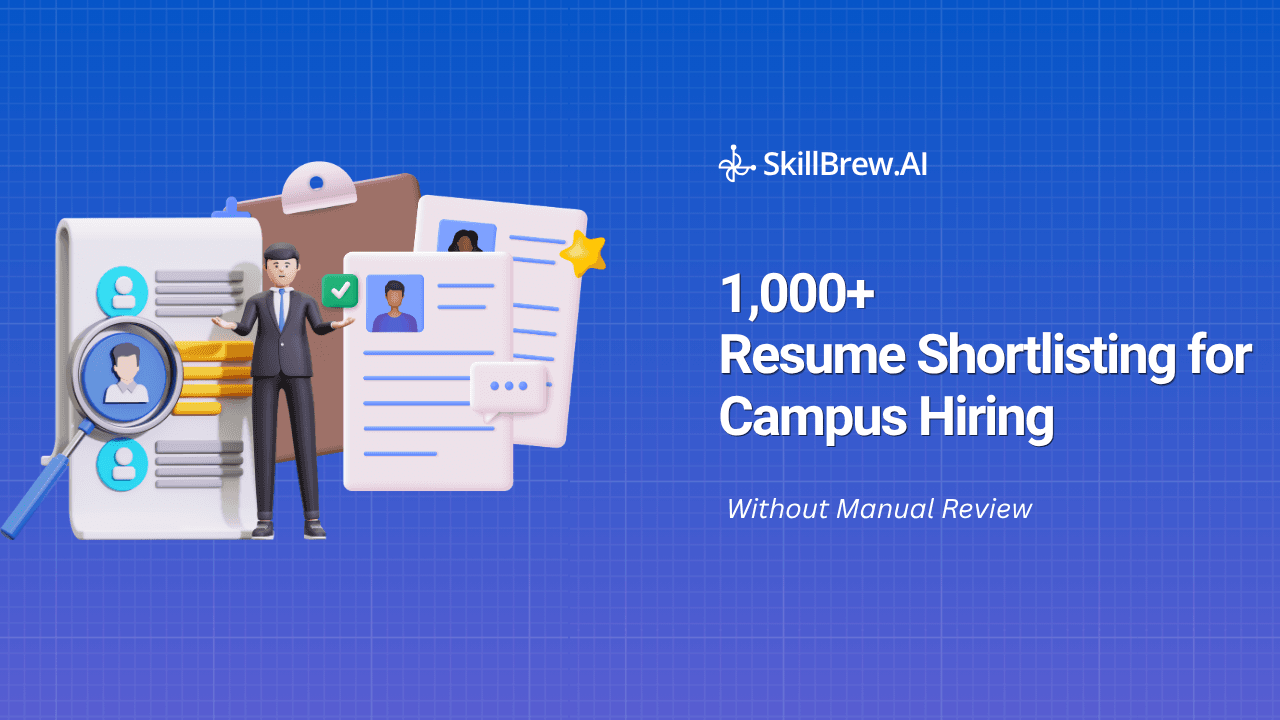
How to do 1,000+ Resume Shortlisting for Campus Hiring Without Manual Review
A campus hiring drive can generate hundreds, even thousands, of applications in a matter of days. The challenge was never collecting resumes. It's turning that pile into a shortlist worth interviewing. For many Talent Acquisition (TA) teams, resume shortlisting campus hiring becomes the single biggest bottleneck in the funnel. Recruiters spend days reviewing resumes, hiring managers wait on shortlists, and candidate experience quietly falls apart because decisions take too long. The reality is
A campus hiring drive can generate hundreds, even thousands, of applications in a matter of days. The challenge was never collecting resumes. It's turning that pile into a shortlist worth interviewing.
For many Talent Acquisition (TA) teams, resume shortlisting campus hiring becomes the single biggest bottleneck in the funnel. Recruiters spend days reviewing resumes, hiring managers wait on shortlists, and candidate experience quietly falls apart because decisions take too long.
The reality is simple: reviewing every resume manually does not scale.
Organizations that hire successfully at volume don't ask recruiters to work faster. They build a structured resume shortlisting campus hiring process that filters, scores, and ranks candidates before a human ever opens the pile.
This article breaks down how high-volume campus hiring teams move from 1,000 applications to a qualified shortlist in under 48 hours, without sacrificing consistency or hiring quality.
Table of Contents
- Why Manual Resume Screening Breaks at Scale
- What Makes a Strong Campus Hiring Shortlist?
- The Three-Layer Campus Resume Screening Framework
- Using Assessments to Improve Shortlist Quality
- The Business Impact of Structured Resume Screening
- Common Campus Hiring Shortlisting Mistakes
- A Campus Hiring Shortlisting Checklist
- Frequently Asked Questions
- Building Better Shortlists with SkillBrew.AI
Why Manual Resume Screening Breaks at Scale
Resume screening looks manageable when application volumes are low. Once that number hits 500, 1,000, or 2,000 applicants, the process starts to break down, and any resume shortlisting campus hiring done by hand hits a wall fast.
Volume Creates Delays
A recruiter spending three minutes per application would need roughly 50 hours to screen 1,000 resumes. In reality, discussions, calibration meetings, second reviews, and coordination push that number a lot higher.
Consistency Starts to Drop
The first hundred resumes rarely get the same attention as the last hundred. Recruiters get tired. Priorities shift. Different reviewers interpret hiring criteria differently. As a result:
- Strong candidates get overlooked.
- Evaluation standards drift.
- Shortlist quality becomes inconsistent.
- Hiring managers lose confidence in the process.
The issue was never recruiter effort. It's that manual review was never built for campus hiring at scale.
What Makes a Strong Campus Hiring Shortlist?
Before improving the screening process, organizations need to define what they're actually looking for. Many teams focus heavily on resume review without ever agreeing on the criteria that determine candidate quality, and that gap is where resume shortlisting campus hiring usually falls apart first.
A strong campus shortlist is typically built around three categories of signals.
Academic Eligibility
These are the baseline requirements checked at the start of any resume shortlisting campus hiring process:
- CGPA thresholds
- Degree requirements
- Graduation year
- Branch eligibility
These are pass-or-fail filters and should be evaluated automatically, every time.
Relevant Academic Experience
Campus candidates often have limited work experience. Instead, recruiters should focus on:
- Academic projects
- Internship experience
- Coursework relevance
- Participation in competitions
- Research activities
These indicators help identify candidates whose backgrounds actually align with the role.
Role-Specific Skills
Every role requires different capabilities.
For technical positions: programming languages, development tools, framework experience, technical project work.
For business or operations roles: certifications, analytical projects, leadership experience, quantifiable achievements.
The goal is to evaluate candidates against role requirements rather than leaning on academic scores alone, a distinction that separates effective resume shortlisting campus hiring from a purely academic filter.
The Three-Layer Campus Resume Screening Framework
The most effective campus hiring teams don't screen every application manually. Instead, they run a layered approach that narrows the funnel progressively, the core mechanic behind any scalable resume shortlisting campus hiring.
Layer 1: Eligibility Filtering
This is the fastest and easiest stage to automate in any resume shortlisting campus hiring workflow. Candidates who don't meet basic hiring criteria get removed immediately. Common filters:
- Minimum CGPA
- Eligible graduation year
- Required degree or specialization
- Mandatory certifications
For many campus drives, this stage alone reduces the applicant pool by 30-40%.
Layer 2: Skills and Relevance Scoring
Once eligibility requirements are met, candidates should be ranked, not just approved or rejected. This stage evaluates:
- Project relevance
- Technical capabilities
- Academic achievements
- Internship experience
- Resume-job description alignment
The objective is to identify the strongest candidates within the eligible pool.
Layer 3: Recruiter Review
Human review should happen after filtering and scoring, not before. At this stage, recruiters review a manageable shortlist instead of hundreds of raw applications, which lets them focus on:
- High-potential candidates
- Borderline cases
- Unique experiences
- Cultural and contextual considerations
Recruiters add the most value when they're evaluating a shortlist, not manually sorting a pile of resumes.
Using Assessments to Improve Shortlist Quality
One of the biggest limitations of resume-based screening is that resumes only show claimed skills, they don't demonstrate actual capability. This is why many organizations bring assessments in early, right alongside resume shortlisting campus hiring.
Why Assessments Beat Resume Keywords
A resume can indicate that a candidate knows Python. An assessment can show whether they can actually solve problems using it. The same principle holds across every hiring function. Assessments give teams measurable data to rank candidates objectively, instead of guessing from bullet points.
Benefits of Early Assessment Screening
Organizations that assess candidates during the application stage as part of resume shortlisting campus hiring typically see:
- Better shortlist quality
- Reduced recruiter workload
- Faster hiring decisions
- Stronger hiring manager confidence
Instead of reviewing resumes alone, recruiters get access to performance-based signals from day one.
The Business Impact of Structured Resume Screening
A structured resume shortlisting campus hiring process affects a lot more than recruiter productivity.
Faster Time-to-Shortlist - Many campus hiring teams cut shortlisting timelines from five to seven days down to less than 48 hours.
Better Candidate Experience - Candidates get faster responses and fewer delays throughout the process.
Improved Recruiter Efficiency - Recruiters spend more time engaging qualified candidates and less time reviewing applications that were never a strong fit.
Higher Hiring Quality - Structured evaluation reduces inconsistency and improves the overall quality of the shortlist.
The result is a hiring process that moves faster without sacrificing decision quality, the entire point of doing resume shortlisting campus hiring properly in the first place.
Common Campus Hiring Shortlisting Mistakes
Even organizations with defined hiring criteria run into the same handful of resume shortlisting campus hiring problems.
Treating Screening Criteria as Guidelines - Requirements should be built into the process, not interpreted differently by every reviewer.
Reviewing Resumes Before Ranking Candidates - Starting with raw resumes creates unnecessary workload. Ranking should happen before detailed review begins.
Delaying Assessments Until Later Stages - The earlier organizations gather performance-based signals, the stronger the shortlist becomes.
Measuring Time-to-Hire but Not Time-to-Shortlist - Shortlisting delays often create downstream hiring delays. Tracking shortlist speed separately helps catch bottlenecks earlier.
A Campus Hiring Shortlisting Checklist
Before launching your next resume shortlisting campus hiring drive, review the following.
Eligibility Requirements
- Defined minimum CGPA
- Eligible graduation years
- Required degree criteria
- Mandatory qualification filters
Candidate Evaluation Framework
- Project relevance criteria
- Technical skill requirements
- Assessment strategy
- Ranking methodology
Process Efficiency
- Automated filtering enabled
- Assessment workflow configured
- Recruiter review process calibrated
- Time-to-shortlist metrics defined
The more of these items are structured before applications arrive, the smoother resume shortlisting campus hiring becomes once the drive actually opens.
Frequently Asked Questions
How long should resume shortlisting take for campus hiring?
Organizations running structured resume shortlisting campus hiring workflows with automated filtering often complete shortlisting within 24-48 hours, even for large applicant volumes.
What is the best way to screen 1,000 campus applications?
A combination of eligibility filtering, skills assessments, and ranked candidate review is typically the most scalable approach to resume shortlisting campus hiring.
Should recruiters review every campus resume?
No. Recruiters should review shortlisted candidates after filtering and ranking have already reduced the applicant pool.
Why are assessments important during shortlisting?
Assessments provide objective performance data that helps identify qualified candidates more accurately than resume review alone.
What metrics should TA teams track?
Key metrics include time-to-shortlist, assessment completion rate, shortlist-to-interview conversion, offer acceptance rate, and quality-of-hire indicators.
Building Better Shortlists with SkillBrew.AI
The purpose of resume shortlisting campus hiring was never to review every application. It's to identify the right candidates quickly, consistently, and fairly.
SkillBrew.AI helps campus hiring teams streamline resume shortlisting campus hiring through:
- HireFlow for automated resume screening and candidate ranking
- Technical Assessments for skills-based evaluation at scale
- Integrated hiring workflows that reduce recruiter effort and accelerate decision-making
When recruiters spend less time sorting applications, they get more time for interviews, candidate engagement, and hiring decisions, the parts of recruitment where human judgment actually matters most.
Book a demo → and see how fast your next campus drive could move from applications to shortlist.
See AI-powered hiring in action
Discover how SkillBrew helps hiring teams cut time-to-hire by 60% with skill-validated assessments and AI-ranked shortlists.
Book a free demoNo commitment required · 30 minutes
Continue reading
View All Posts