BrewVoice
Pre-Hire Voice and Accent Test for Smarter Candidate Screening
Resumes can show a candidate’s experience, qualifications, and career history, but they do not always show how effectively someone communicates in a real conversation. This matters especially for customer support, sales, BPO, recruitment, telecalling, and other voice-based roles. A pre-hire voice and accent test gives recruiters a structured way to evaluate spoken communication before investing time in later interview stages. Depending on the role, the assessment can examine pronunciation, clar

Resumes can show a candidate’s experience, qualifications, and career history, but they do not always show how effectively someone communicates in a real conversation. This matters especially for customer support, sales, BPO, recruitment, telecalling, and other voice-based roles.
A pre-hire voice and accent test gives recruiters a structured way to evaluate spoken communication before investing time in later interview stages. Depending on the role, the assessment can examine pronunciation, clarity, fluency, listening comprehension, vocabulary, pace, and other communication skills.
The goal is not to determine whether one accent is better than another. Instead, the focus should be on whether a candidate can communicate clearly and effectively for the requirements of the role.
Table Of Contents
- What Is a Pre-Hire Voice and Accent Test?: Learn what this assessment means and where it fits in hiring.
- Why Is a Pre-Hire Voice and Accent Test Important?: Understand how voice assessments can support early-stage screening.
- What Does a Voice and Accent Assessment Evaluate?: Explore the communication skills recruiters can assess.
- Is Accent the Same as Pronunciation?: Understand the difference between accent, pronunciation, and clarity.
- When Should a Company Use a Voice and Accent Test?: See where an assessment can fit into different hiring workflows.
- Which Roles Benefit From a Voice and Accent Test?: Explore roles where spoken communication is especially important.
- How to Choose Voice Assessment Criteria: Connect job requirements with the right evaluation areas.
- What Happens During a Pre-Hire Voice and Accent Test?: Understand the candidate experience from invitation to results.
- What Questions Are Asked in a Voice and Accent Test?: Explore examples of role-relevant questions.
- How Are Candidates Evaluated?: Learn how recruiters can interpret assessment results.
- Voice and Accent Test vs. Interview: Understand how the two approaches differ.
- Manual vs. AI-Based Voice Screening: Compare traditional and AI-supported screening.
- How AI Can Improve Voice Screening: Explore where AI can support the assessment process.
- Best Practices and Common Mistakes: Learn how to build a useful and fair assessment.
- FAQs: Get answers to common recruiter questions.
Key Takeaways
- A pre-hire voice and accent test evaluates spoken communication before later hiring stages.
- It can assess pronunciation, clarity, fluency, listening comprehension, pace, vocabulary, and role-specific communication skills.
- Accent should not be treated as an indicator of candidate quality. The focus should be on intelligibility and communication effectiveness.
- Voice assessments can help recruiters screen candidates more consistently, particularly in high-volume hiring.
- AI can automate parts of voice screening and organize candidate results into structured insights.
- Assessment results should support recruiter decisions rather than independently determine hiring outcomes.
What Is a Pre-Hire Voice and Accent Test?
A pre-hire voice and accent test is a structured assessment used to evaluate a candidate’s spoken communication during the early stages of recruitment.
Instead of relying only on a resume or a short recruiter call, candidates complete voice-based tasks designed around the communication requirements of the position.
Depending on the role, a candidate may be asked to:
- Answer questions about their experience
- Read a short passage aloud
- Respond to a customer scenario
- Explain a product or process
- Listen to a question and respond appropriately
- Participate in a short voice conversation
The assessment can then provide information about specific communication skills that recruiters may want to evaluate before moving candidates to interviews.
A typical workflow might look like:
Application → Resume Screening → Voice Assessment → Interview → Final Selection
For some high-volume roles, companies may instead use:
Application → Voice Assessment → Recruiter Screening → Interview
The right placement depends on the role, candidate volume, and hiring process.
Why Is a Pre-Hire Voice and Accent Test Important?
A pre-hire voice and accent test can be useful when spoken communication is an important part of the job and recruiters need to evaluate many candidates within a limited amount of time.
Screen Candidates Earlier
A voice assessment can provide additional information before recruiters schedule interviews. This can help teams identify candidates who meet the communication requirements of the role before moving them further through the process.
Support High-Volume Hiring
When hundreds or thousands of candidates apply for similar roles, conducting an initial phone conversation with every applicant can become difficult to manage.
A structured voice assessment can help teams collect comparable communication information from a larger candidate pool.
Create More Consistent Evaluation
Manual screening calls can vary depending on who conducts them, what questions they ask, and how they record their observations.
A standardized assessment gives candidates a more consistent set of questions and evaluation criteria.
Reduce Unnecessary Interviews
Recruiters can use assessment results as one input when deciding which candidates should move to the next stage. This can reduce the number of interviews spent on candidates who do not meet clearly defined communication requirements.
Provide Structured Candidate Data
Instead of relying only on notes such as “good communication,” recruiters can review individual skills and role-specific criteria.
The goal is not to replace recruiter judgment, but to give recruiters more structured evidence to consider.
What Does a Voice and Accent Assessment Evaluate?
A voice and accent assessment can evaluate several aspects of spoken communication.
| Skill | What recruiters may look for |
|---|---|
| Pronunciation | How clearly individual sounds and words are articulated |
| Speech clarity | How easily the candidate's message can be understood |
| Fluency | Ability to communicate smoothly without excessive hesitation |
| Grammar | Appropriate sentence formation and grammatical usage |
| Vocabulary | Ability to use words appropriate to the conversation and role |
| Pace | Whether the speaking speed supports clear communication |
| Listening comprehension | Ability to understand questions, instructions, and context |
| Role-specific communication | Skills directly related to the communication demands of the job |
The exact criteria should depend on the position.
For example, a customer support role may place greater importance on listening and clarity, while a sales role may require stronger conversational ability and product explanation skills.
Is Accent the Same as Pronunciation?
No. Accent, pronunciation, and clarity describe different aspects of spoken communication.
- Accent refers to characteristics of speech associated with a person's linguistic or regional background.
- Pronunciation refers to how individual sounds and words are articulated.
- Clarity refers to how easily another person can understand the message.
A candidate can have a regional or international accent and still communicate extremely clearly.
Therefore, a pre-hire voice and accent test should not treat a particular accent as inherently better or worse. The relevant question is whether the candidate's speech is intelligible and effective for the communication demands of the role.
This distinction is especially important when designing fair voice assessments. Recruiters can also explore how accent tests can be used in recruitment at scale while keeping role requirements at the center of the evaluation.
When Should a Company Use a Voice and Accent Test?
Companies can place the assessment at different points in the hiring process depending on candidate volume, role requirements, and the information recruiters need before the next stage.
Common use cases include:
Before the First Interview
A company can use the assessment as an initial screening step before scheduling recruiter interviews.
After Resume Screening
Recruiters can invite shortlisted applicants to complete the assessment before deciding which candidates should receive an interview.
During High-Volume Recruitment
For BPO, customer support, telecalling, and other large-scale hiring campaigns, a standardized voice assessment can help teams process a larger candidate pool.
For Remote Hiring
Voice assessments can provide a structured way to evaluate communication when recruiters and candidates are not meeting in person.
For Multilingual Roles
When candidates are expected to communicate with customers or colleagues in specific languages, the assessment can include role-relevant language and communication tasks.
Which Roles Benefit From a Voice and Accent Test?
A pre-hire voice and accent test is most relevant when spoken communication is a meaningful part of daily work.
| Role | Relevant assessment criteria |
|---|---|
| Customer Support | Clarity, listening, fluency |
| BPO / Call Center | Pronunciation, comprehension, communication |
| Sales | Fluency, clarity, conversational ability |
| Telecalling | Clarity, pace, conversational ability |
| Recruitment | Listening, clarity, communication |
| Customer Success | Communication, empathy, clarity |
| Voice Process Roles | Pronunciation, pace, comprehension |
The assessment should always reflect the actual communication tasks candidates will perform after joining.
How to Choose Voice Assessment Criteria
The best criteria start with the job, not with a generic scoring template.
Before creating a pre-hire voice and accent test, identify the communication tasks the candidate will perform and then select the skills needed for those tasks.
| Job requirement | Relevant criteria |
|---|---|
| Handling customer calls | Clarity, listening, fluency |
| Explaining products | Clarity, vocabulary, fluency |
| International calling | Intelligibility, comprehension, pace |
| Sales conversations | Fluency, clarity, conversational ability |
| Recruitment calls | Listening, clarity, communication |
| Handling complaints | Listening, clarity, empathy, conversational ability |
This approach makes the assessment more relevant and reduces the risk of evaluating candidates on skills that are not actually important to the position.
What Happens During a Pre-Hire Voice and Accent Test?
A typical assessment can include five stages.
1. Test Invitation
The candidate receives instructions about the assessment, including how to access it and what to expect.
2. Setup
The candidate checks their microphone and other required permissions before beginning.
3. Voice Questions or Tasks
Candidates respond to questions, read content, complete role-based scenarios, or participate in a short conversation.
4. Evaluation
The responses are evaluated against predefined communication criteria.
5. Results
Recruiters receive structured results that can help them compare candidates against the requirements of the role.
For a deeper look at how voice assessments can fit into hiring workflows, see Voice and Accent Assessment for Hiring.
The exact workflow can vary depending on the assessment platform and hiring process.
What Questions Are Asked in a Voice and Accent Test?
Questions should reflect the communication situations candidates are likely to encounter on the job.
General Communication
- Tell us about yourself.
- Describe your previous work experience.
- Tell us about a challenge you recently solved.
Customer Support
- How would you handle an unhappy customer?
- What would you do if a customer did not understand your explanation?
- Explain how you would help a customer resolve a common issue.
Sales
- Explain a product or service to a first-time customer.
- How would you respond if a customer said the product was too expensive?
Recruitment
- How would you explain a job opportunity to a candidate?
- What information would you confirm during an initial screening call?
A test can also include reading and listening tasks when those skills are relevant to the position.
How Are Candidates Evaluated?
A pre-hire voice and accent test should use criteria that are defined before candidates are assessed.
For example, an assessment platform might provide results like this:
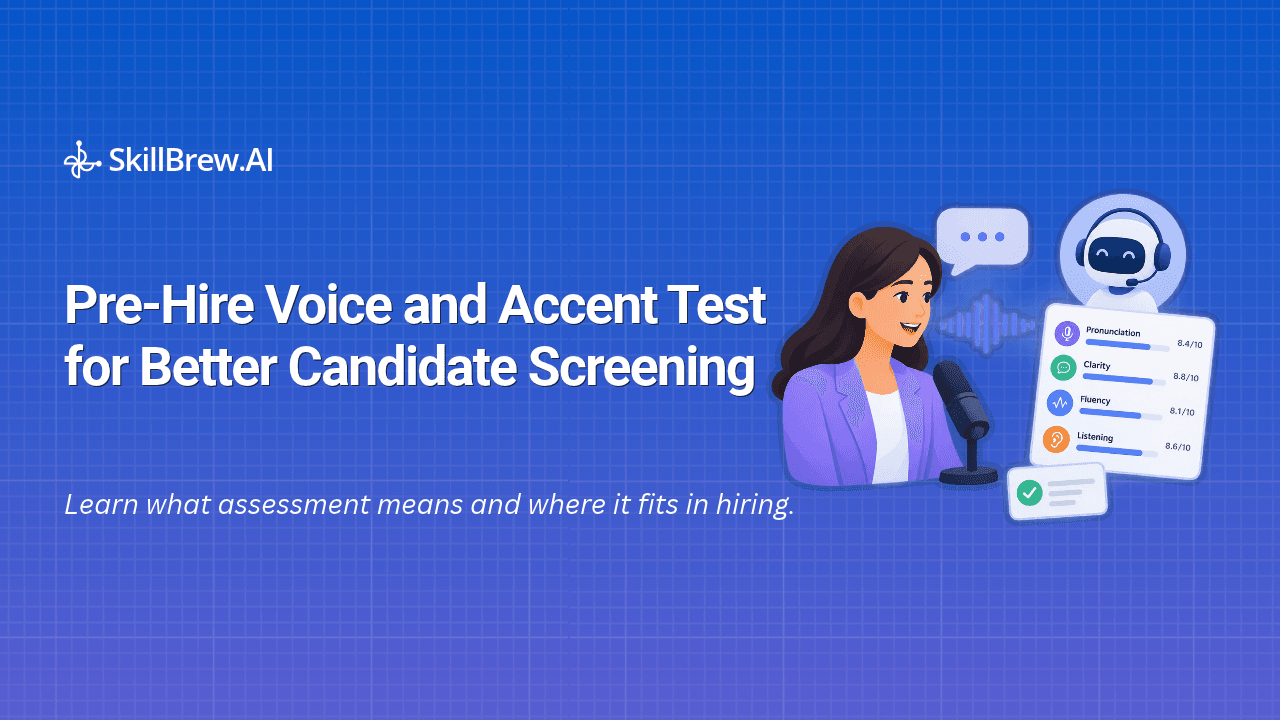
Example of Role-Specific Assessment Results
| Skill | Example Score |
|---|---|
| Pronunciation | 8.4/10 |
| Speech Clarity | 8.8/10 |
| Fluency | 8.1/10 |
| Listening | 8.6/10 |
These scores are illustrative. Assessment platforms may represent results differently depending on their scoring methodology.
Recruiters should look beyond an overall score and consider:
- Individual skill-level results
- Role-specific criteria
- Candidate responses to relevant scenarios
- Communication effectiveness
- Areas that may require further verification
There is no universal “good accent score.” A score that works for one role may not be appropriate for another.
For example, a customer support position may require strong listening and clarity, while a role involving product demonstrations may place greater importance on explanation skills and vocabulary.
Voice and Accent Test vs. Interview: What's the Difference?
A voice assessment and an interview can both evaluate communication, but they serve different purposes.
| Voice and Accent Test | Interview |
|---|---|
| Usually focused on predefined communication criteria | Covers broader candidate evaluation |
| Can be standardized across candidates | Conversation may vary between candidates |
| Often used earlier in the hiring process | Usually occurs at a later stage |
| Can support high-volume screening | Requires more recruiter or interviewer time |
| Produces structured assessment data | Produces broader qualitative observations |
A voice assessment should not necessarily replace an interview. Instead, it can provide additional information before recruiters invest more time in later-stage conversations.
Manual vs. AI-Based Voice Screening
Voice screening can be performed manually or with AI-supported workflows.
| Manual Voice Screening | AI-Based Voice Screening |
|---|---|
| Recruiter conducts the conversation | AI conducts structured conversations |
| Depends on recruiter availability | Can support screening outside recruiter working hours |
| Questions may vary between calls | Questions can follow predefined criteria |
| Notes may be recorded manually | Results can be organized into structured insights |
| Difficult to scale across large candidate pools | Better suited to high-volume screening workflows |
For recruiters who want to understand how this technology fits into recruitment, see What Is an AI Voice Recruiter?.
AI does not automatically make an evaluation more accurate. The quality of the assessment still depends on the questions, criteria, conversation design, technology, and how recruiters interpret the results.
How AI Can Improve Voice Screening
AI can make a pre-hire voice and accent test more scalable by automating parts of the candidate conversation and organizing the resulting information.
Automated Candidate Conversations
AI voice systems can conduct predefined or role-specific screening conversations without requiring a recruiter to make every initial call.
Role-Specific Questions
Questions can be designed around the requirements of a specific position rather than using one generic script for every candidate.
Consistent Screening
A structured AI workflow can present candidates with consistent questions and evaluation criteria.
Speech and Communication Analysis
AI can help analyze defined aspects of spoken responses, such as pronunciation, clarity, fluency, or other communication signals selected for the assessment.
Structured Candidate Insights
Instead of relying entirely on manual notes, recruiters can receive organized information that makes candidate review easier.
Large-Scale Screening
Automating initial conversations can help recruitment teams handle larger candidate pools without increasing manual calling effort at the same rate.
For recruiters evaluating available solutions, AI Voice Screening Tools can provide additional context on how these tools are used.
The important point is that AI should support the screening process, not independently determine whether a person is suitable for employment.
Best Practices for Using a Voice and Accent Test
A pre-hire voice and accent test works best when it is designed around the actual requirements of the position.
Use these practices when creating one:
- Define the role's communication requirements before creating the assessment.
- Choose evaluation criteria in advance so candidates are assessed consistently.
- Use role-relevant questions instead of generic questions wherever possible.
- Keep the assessment reasonably short and focused on relevant skills.
- Give candidates clear instructions before they begin.
- Use consistent evaluation criteria across candidates for the same role.
- Do not treat a particular accent as inherently better than another.
- Review individual skill results, not just an overall score.
- Combine voice assessment results with other hiring evidence such as experience, technical ability, and interview performance.
- Keep human judgment in the final decision-making process.
Common Mistakes to Avoid
Poorly designed voice assessments can introduce unnecessary bias or produce information that is not useful to recruiters.
Testing Accent Instead of Communication
A candidate's accent should not be treated as a proxy for their ability to communicate effectively.
Using Generic Questions
Questions that have little connection to the role may not provide useful evidence about job-related communication skills.
Making the Assessment Too Long
Candidates may disengage if the assessment takes too much time or contains repetitive tasks.
Using Unclear Criteria
If recruiters cannot explain what the assessment is measuring, the resulting scores become harder to interpret.
Relying Only on an Overall Score
A single score can hide important differences between candidates. Skill-level results and actual responses provide more context.
Removing Human Review
Automated results should support recruiter evaluation rather than completely replacing it.
How SkillBrew.AI Can Help With Voice Screening
For recruiters who want to apply these principles at scale, BrewVoice can automate first-round candidate conversations and provide structured screening insights.
BrewVoice uses Rhea, SkillBrew.AI's AI voice recruiter, to conduct candidate conversations based on the requirements of the hiring workflow.
Recruiters can use BrewVoice for:
- AI-powered candidate voice screening
- Automated first-round conversations
- Role-specific screening questions
- Communication evaluation
- Multiple language and accent options
- Structured candidate insights
- Scalable candidate screening
You can also learn more about Rhea and BrewVoice and multilingual AI voice recruitment for hiring across different languages.
For a broader look at automated voice conversations in recruitment, explore AI Voice Calling for Hiring.
The goal is to make early candidate evaluation more structured and scalable while keeping recruiters involved in the broader hiring decision.
Frequently Asked Questions
What is a pre-hire voice and accent test?
A pre-hire voice and accent test is an early-stage recruitment assessment that evaluates a candidate's spoken communication. It can assess skills such as clarity, pronunciation, fluency, comprehension, and role-specific communication.
What does a voice and accent test evaluate?
Depending on the role, it can evaluate pronunciation, speech clarity, fluency, vocabulary, grammar, pace, listening comprehension, and other job-relevant communication skills.
Why do companies use voice and accent tests before interviews?
Companies can use them to evaluate spoken communication earlier in the hiring process, particularly when recruiting for roles where voice communication is important or candidate volume is high.
What questions are asked in a voice and accent test?
Questions vary by role. Candidates may be asked to introduce themselves, describe their experience, respond to customer scenarios, explain a product, handle an objection, or complete reading and listening tasks.
Which jobs require a voice and accent test?
Customer support, BPO, call center, sales, telecalling, recruitment, customer success, and other voice-based roles can benefit from this type of assessment when spoken communication is an important job requirement.
How is a voice and accent test scored?
There is no single universal scoring system. Platforms may use numerical scores, skill levels, or other assessment formats. Recruiters should interpret results according to the requirements of the specific role.
Can AI conduct a voice and accent test?
Yes. AI voice systems can conduct structured candidate conversations and help analyze defined communication signals. However, the assessment criteria and recruiter interpretation remain important to the quality and fairness of the process.
Is a voice and accent test the same as a communication assessment?
They can overlap, but they are not necessarily identical. A voice and accent assessment generally focuses on spoken communication, while a broader communication assessment may include written communication, comprehension, or other skills.
Conclusion
A pre-hire voice and accent test can give recruiters structured evidence about spoken communication before candidates reach later hiring stages.
The most useful assessments are built around the actual communication requirements of the role. They use clear criteria, relevant questions, consistent evaluation, and results that recruiters can interpret alongside other candidate information.
AI can make voice screening more scalable and structured, especially for high-volume recruitment. However, the goal should not be to reduce a candidate to a score or judge them based on their accent. The focus should remain on whether their communication is clear, understandable, and effective for the job.
If you are looking to make first-round voice screening more efficient, explore BrewVoice by SkillBrew.AI or Schedule a Demo.
See AI-powered hiring in action
Discover how SkillBrew helps hiring teams cut time-to-hire by 60% with skill-validated assessments and AI-ranked shortlists.
Book a free demoNo commitment required · 30 minutes
Continue reading
View All Posts