AI Assessment
What Does Assessment Round Mean in Hiring?
If you are applying for a job and have been told that the next step is an assessment round, you may be wondering what it actually involves. So, what does assessment round mean in the hiring process? An assessment round is a structured stage of recruitment where employers evaluate a candidate's skills, knowledge, reasoning, communication, or other job-relevant competencies. Depending on the role, it may include technical questions, coding tasks, aptitude tests, situational questions, communicat

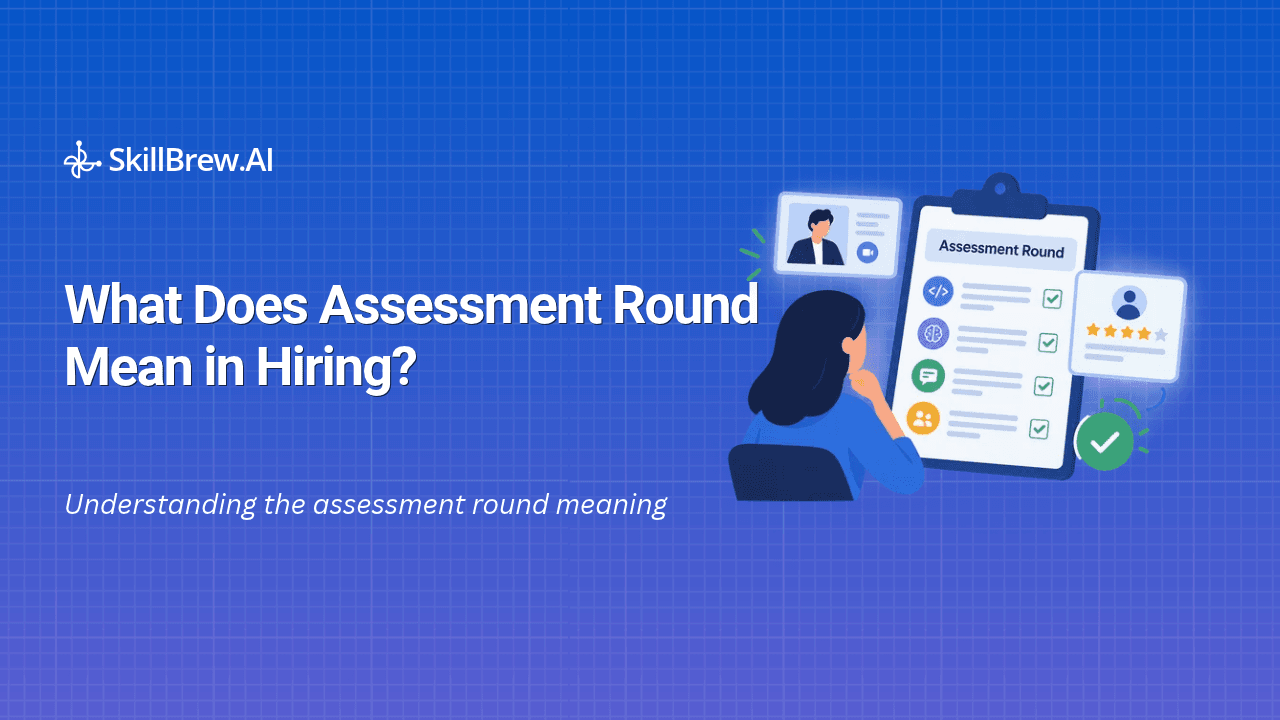
If you are applying for a job and have been told that the next step is an assessment round, you may be wondering what it actually involves.
So, what does assessment round mean in the hiring process?
An assessment round is a structured stage of recruitment where employers evaluate a candidate's skills, knowledge, reasoning, communication, or other job-relevant competencies. Depending on the role, it may include technical questions, coding tasks, aptitude tests, situational questions, communication exercises, or practical assignments.
There is no single format for this stage. A software developer may complete coding challenges, while a customer support candidate may be evaluated on communication and situational judgment. A graduate applicant may take an aptitude test, while a content writer may complete a writing exercise.
Understanding the assessment round meaning can help candidates prepare for the process and help recruiters choose an evaluation method that matches the role.
Key Takeaways
- An assessment round is a structured stage used to evaluate candidates during hiring.
- The format depends on the role, skills required, and hiring process.
- Assessments can evaluate technical, cognitive, communication, behavioral, or role-specific skills.
- Clear evaluation criteria make candidate results easier to compare.
- Assessment results should be considered alongside interviews, experience, and other candidate evidence.
- AI can help recruiters create role-specific assessments, automate parts of evaluation, and organize candidate results.
What Does Assessment Round Mean?
When candidates search for what does assessment round mean, they are usually looking for a simple explanation of what happens after an application or screening stage.
An assessment round is a structured evaluation where candidates are asked to demonstrate specific skills, knowledge, or competencies relevant to a job.
It may involve:
- Answering multiple-choice questions
- Solving technical problems
- Completing coding challenges
- Analyzing data
- Writing responses
- Answering situational questions
- Completing practical tasks
- Demonstrating communication skills
The important point is that an assessment is not necessarily a single "test." It is a broader assessment stage in recruitment that can use different methods depending on what the employer needs to evaluate.
For example, a company hiring software engineers may use coding and debugging tasks, while a sales team may use communication and situational assessments.
So, when someone asks what does assessment round mean in a job, the answer depends partly on the role and the competencies being evaluated.
The common factor is that candidates are asked to demonstrate specific capabilities through a structured evaluation rather than simply describing their experience.
When Does an Assessment Round Happen?
An assessment round can happen at different points in the hiring process.
A company may use an assessment immediately after receiving an application:
Application → Assessment → Interview → Final Selection
Another hiring process may look like:
Application → Resume Screening → Assessment → Interview → Final Selection
For some positions, the sequence may be:
Application → Recruiter Call → Assessment → Technical Interview → Final Interview
The timing depends on what the employer wants to learn at each stage.
For high-volume hiring, companies may use an assessment early in the process to identify candidates who meet defined skill requirements before investing significant time in interviews.
For specialized roles, an assessment may happen after an initial conversation so the hiring team can validate specific skills before moving the candidate forward.
Therefore, an assessment round in hiring is not tied to one specific position in the recruitment funnel. Its purpose and timing depend on the company's hiring workflow.
Why Is an Assessment Round Important?
The purpose of a hiring assessment is to provide structured evidence about a candidate's capabilities.
A resume can show education, previous roles, and experience. An interview can help recruiters understand communication, decision-making, and past experiences. An assessment can add another type of evidence by asking candidates to demonstrate specific skills.
Evaluate Job-Related Skills
A good assessment focuses on competencies that matter for the position.
For example, a developer assessment might evaluate programming and problem-solving, while a financial analyst assessment could focus on numerical reasoning and financial analysis.
Create Consistent Evaluation
Without a defined framework, different candidates may be evaluated using different questions or standards.
A structured assessment gives candidates a more consistent process and provides recruiters with common criteria for reviewing results.
Screen Candidates at Scale
When hundreds or thousands of candidates apply for a role, interviewing every applicant may not be practical.
A recruitment assessment can help identify candidates who demonstrate the required skills before they move to later stages.
Generate Structured Candidate Data
Assessment results can provide scores, skill-level performance, answers, rankings, or reports.
This can help recruiters understand differences between candidates who may appear similar based on their resumes.
Support Better Hiring Decisions
An assessment should not make the hiring decision on its own.
Instead, it can provide another source of evidence that recruiters can consider alongside interviews, resumes, work samples, and other relevant information.
What Happens in an Assessment Round?
If you are trying to understand what an assessment round means because you have one coming up, knowing what happens during the process can make it easier to prepare.
Although formats vary, many assessments follow a similar process.
1. Assessment Invitation
Candidates receive an invitation containing the assessment link, deadline, instructions, and any technical requirements.
2. Instructions and Setup
Before starting, candidates may need to review the time limit, assessment format, permitted resources, and other requirements.
Online assessments may also include technical checks for the browser, camera, microphone, or internet connection.
3. Questions or Tasks
Candidates complete the questions or activities included in the assessment.
These may include technical questions, coding challenges, aptitude questions, written responses, communication exercises, or practical assignments.
4. Evaluation
Responses are evaluated against predefined criteria.
Some questions can be evaluated automatically, while others may require manual review by recruiters or hiring managers.
5. Results
The assessment produces results that can help the hiring team understand how the candidate performed against the selected competencies.
This is why an assessment process should be designed around clear evaluation objectives rather than simply adding a test to the hiring workflow.
What Are the Different Types of Assessment Rounds?
The type of assessment should match the skills required for the position.
Technical Assessment
Technical assessments evaluate knowledge and skills specific to a technical role.
They may cover programming, databases, engineering concepts, system design, or other technical competencies.
Coding Assessment
Coding assessments are commonly used for software development roles.
Candidates may need to solve programming problems, debug code, write functions, or work through algorithmic challenges.
Aptitude Assessment
Aptitude assessments can evaluate areas such as:
- Numerical reasoning
- Logical reasoning
- Verbal reasoning
- Data interpretation
- Problem-solving
They are commonly used in graduate and entry-level hiring and can also be useful in high-volume recruitment when employers need to evaluate candidates consistently at scale.
Cognitive Assessment
Cognitive assessments may evaluate reasoning, attention, pattern recognition, and problem-solving abilities.
The specific competencies should still be relevant to the requirements of the position.
Communication Assessment
Communication assessments can evaluate written or spoken communication, language proficiency, comprehension, and clarity.
They can be particularly useful for customer-facing, sales, support, and communication-heavy roles.
Behavioral or Situational Assessment
Candidates may be presented with workplace scenarios and asked how they would respond.
These questions can help employers explore how candidates approach situations relevant to the position.
Role-Specific Assessment
A role-specific assessment is designed around the actual competencies required for a particular position.
| Role | Possible Assessment |
| Software Developer | Coding and debugging |
| Data Analyst | Data interpretation and SQL |
| Customer Support | Communication and situational judgment |
| Sales Executive | Sales scenarios and communication |
| Content Writer | Writing and editing |
| Financial Analyst | Financial analysis and numerical reasoning |
| Recruiter / HR | Situational judgment and communication |
The goal is not to make every assessment completely different. Instead, the evaluation should reflect the skills that matter for the role.
How Are Candidates Evaluated?
Another important part of understanding what an assessment round means is knowing what happens after candidates submit their answers.
Assessment results can be evaluated in several ways.
Overall Score
A candidate may receive an overall percentage based on their performance.
For example, a candidate might receive 82/100.
An overall score provides a useful summary, but it may not explain where the candidate performed well or where they have weaknesses.
Skill-Based Scores
A more detailed assessment can provide separate scores for different competencies.
| Competency | Candidate Score |
| Technical Knowledge | 86% |
| Problem Solving | 82% |
| Communication | 78% |
| Role-Specific Skills | 90% |
This gives recruiters more context than a single number.
Weighted Scores
Some competencies may be more important than others.
For example, a software engineering position may place greater weight on coding and technical problem-solving than on general aptitude.
Pass or Fail Criteria
Companies may also establish minimum thresholds for certain competencies or assessments.
However, there is no universal score that automatically means a candidate is suitable for every role.
A candidate with an overall score of 82% may still have a significant weakness in one critical competency. For this reason, recruiters should review skill-level results rather than relying only on the overall score.
Assessment Round vs Interview: What's the Difference?
Candidates often wonder whether an assessment is simply another type of interview.
They are related, but they usually serve different purposes.
| Assessment Round | Interview |
| Usually evaluates specific skills or competencies | Usually explores experience, reasoning, communication, and fit |
| Often includes questions or practical tasks | Usually involves a conversation |
| Can be completed online | Usually involves an interviewer |
| Can produce structured scores | May produce qualitative or structured feedback |
| Focuses on demonstrated performance | Can explore past experiences and decision-making |
The two stages can complement each other.
For example, an assessment may demonstrate that a candidate can solve technical problems, while an interview can help the hiring team understand how the candidate approaches problems, explains decisions, and collaborates with others.
This is why the meaning of an assessment round should not be reduced to "a test before the interview." It is one component of a broader candidate evaluation process.
How to Conduct an Effective Assessment Round
For recruiters, understanding what an assessment round means is only the starting point. The more important question is whether the assessment produces useful evidence for the hiring decision.
A practical framework is:
Role → Competencies → Questions → Evaluation → Results → Hiring Decision
1. Define the Role Requirements
Start with the job description.
Identify the technical skills, knowledge areas, behavioral competencies, and other capabilities that are genuinely important for successful performance.
2. Map Requirements to Competencies
Turn those requirements into measurable competencies.
For example:
Software Developer → Programming → Problem Solving → Debugging → Technical Knowledge
This gives the assessment a clear purpose.
3. Create Relevant Questions
Each question or task should connect to one or more competencies.
Avoid adding questions simply because they are easy to generate or commonly used in generic tests.
4. Establish Evaluation Criteria
Decide how responses will be evaluated before candidates begin.
This could include scoring rubrics, competency weights, passing thresholds, or predefined evaluation criteria.
5. Keep the Process Consistent
Candidates applying for the same role should generally be evaluated against the same core framework.
This makes results easier to compare.
6. Review the Results
Look beyond the overall score.
Review skill-level performance, individual responses, and any other available evidence that can help explain the result.
7. Use Results in the Hiring Decision
Assessment results should contribute to the decision rather than automatically determine it.
Recruiters can combine assessment results with interviews, experience, work samples, and other relevant evidence.
Common Assessment Round Mistakes to Avoid
A strong assessment round in recruitment should be useful to both the hiring team and the candidate. Several common mistakes can reduce its value.
Using One Generic Assessment for Every Role
A generic test may not measure the skills required for a specific job.
Testing Irrelevant Knowledge
Not every difficult question is a useful hiring question.
If a skill is not relevant to the role, it may not belong in the assessment.
Making the Assessment Too Long
Length does not automatically equal quality.
Long assessments can create candidate fatigue and negatively affect the candidate experience.
Using Unclear Scoring Criteria
Recruiters should know what each question is intended to measure and how the response will be evaluated.
Relying Only on the Overall Score
An overall score can hide important differences between candidates.
Skill-level results often provide more useful context.
Changing Criteria During the Process
Candidates should generally be evaluated using the same core criteria throughout the assessment stage.
Removing Human Review
Automation can make evaluation faster, but recruiters and hiring managers should still interpret results in context.
How AI Can Improve Assessment Rounds
AI is changing how companies create and manage assessments.
Traditionally, recruiters or hiring teams may spend significant time creating questions, organizing assessments, reviewing responses, and preparing candidate reports.
AI can support several parts of this process.
Generate Role-Specific Assessments
AI assessment platforms can use job requirements to help generate questions aligned with a particular role.
Automate Parts of Evaluation
Objective questions and certain structured responses can be evaluated automatically, reducing repetitive manual work.
Organize Candidate Results
AI-powered assessment platforms can organize candidate performance into structured scores and reports.
Provide Skill-Level Insights
Instead of showing only whether a candidate passed or failed, a platform can present performance across multiple competencies.
Support Consistent Evaluation
When the same assessment framework and scoring criteria are applied across candidates, recruiters can compare results more systematically.
SkillBrew.AI's AI Assessment Builder helps recruiters create role-specific assessments from job requirements, evaluate candidate performance, and organize results within the hiring workflow.
The important distinction is that AI should support the evaluation process rather than replace hiring judgment. AI-generated questions still need to be relevant to the role, evaluation criteria need to be appropriate, and recruiters should review results before making important hiring decisions.
How Candidates Can Prepare for an Assessment Round
If you are searching for what does assessment round mean because you have one coming up, preparation should begin with the job itself.
Review the Job Description
Look for the skills and responsibilities the employer emphasizes.
These often provide clues about what the assessment may focus on.
Understand the Assessment Format
Find out whether you will complete coding questions, aptitude questions, written responses, communication tasks, or another type of evaluation.
Practice the Type of Questions You May Face
Your preparation should match the role.
- Technical roles: Practice coding and technical questions.
- Graduate roles: Practice aptitude, reasoning, and problem-solving.
- Customer-facing roles: Practice communication and situational questions.
- Writing roles: Practice writing, editing, and comprehension.
- Analytical roles: Practice data interpretation and numerical reasoning.
Read Instructions Carefully
Understand the time limit, question format, permitted resources, and submission requirements before beginning.
Manage Your Time
If the assessment is timed, avoid spending too long on one question.
If you are allowed to return to previous questions, plan your time accordingly.
Check Your Technical Setup
For online assessments, check your browser, internet connection, camera, microphone, or other required equipment beforehand.
Focus on Demonstrating Your Skills
The goal of an assessment is to demonstrate your capabilities. Preparation should help you perform confidently rather than simply memorize answers.
Assessment Checklist for Recruiters
Before launching an assessment, recruiters can use this checklist:
| Question | Check |
| Does the assessment measure job-relevant skills? | $\checkmark$ |
| Are the questions appropriate for the role level? | $\checkmark$ |
| Are evaluation criteria defined in advance? | $\checkmark$ |
| Are candidates evaluated consistently? | $\checkmark$ |
| Is the assessment reasonably time-efficient? | $\checkmark$ |
| Are results easy for recruiters to interpret? | $\checkmark$ |
| Is human review included where necessary? | $\checkmark$ |
| Does the assessment provide useful evidence for the next hiring stage? | $\checkmark$ |
This helps turn an assessment from simply another hiring step into a structured part of the candidate evaluation process.
FAQs
Q1. What does assessment round mean in a job?
An assessment round in a job is a stage where candidates complete a test, task, or structured evaluation to demonstrate skills relevant to the position.
Q2. What is an assessment stage in hiring?
An assessment stage is a structured candidate evaluation used to measure skills, knowledge, reasoning, communication, or other competencies relevant to a job.
Q3. What happens during an assessment?
Candidates typically receive instructions, complete questions or tasks within a defined format or time period, and have their responses evaluated against predefined criteria.
Q4. Is an assessment the same as an interview?
No. An assessment usually focuses on demonstrating specific skills or competencies, while an interview often explores experience, communication, reasoning, and role fit. Companies may use both.
Q5. What questions are asked during an assessment?
The questions depend on the position. They may include technical, coding, aptitude, cognitive, communication, behavioral, situational, or role-specific questions.
Q6. How is an assessment scored?
Assessments can use overall scores, skill-level scores, weighted competencies, passing thresholds, or a combination of these methods.
Q7. What is a good score in an assessment?
There is no universal passing score. The required score depends on the company, role, assessment difficulty, and evaluation criteria. Some employers use a fixed threshold, while others compare candidates based on their relative performance.
Q8. How long does an assessment take?
There is no fixed duration. Some online assessments may take less than 30 minutes, while technical or practical assessments can take considerably longer. The time usually depends on the number and complexity of tasks.
Q9. Is an assessment difficult?
The difficulty depends on the role and assessment design. A technical position may require advanced technical tasks, while an entry-level role may focus on foundational skills.
Q10. Can AI be used for assessments?
AI can support assessment creation, question generation, automated evaluation, candidate reporting, and result organization. Human review can still play an important role in interpreting results and making the final hiring decision.
Conclusion
So, what does assessment round mean in modern hiring?
It is a structured stage of recruitment where candidates are evaluated against skills or competencies relevant to a particular role.
For candidates, an assessment provides an opportunity to demonstrate capabilities beyond what appears on a resume. For recruiters, it provides structured evidence that can make candidate evaluation more consistent and scalable.
The strongest assessments are not necessarily the longest or most difficult. They are the ones that measure the right skills, use clear criteria, provide useful results, and fit naturally into the broader hiring process.
AI can make this process more efficient by helping recruiters create role-specific assessments, automate parts of evaluation, and organize candidate results. But technology should support hiring decisions rather than make them without context.
For recruiters, the challenge is not simply adding an assessment to the hiring process, but creating one that is relevant, structured, and easy to evaluate.
Ultimately, the purpose of an assessment is simple: to give hiring teams better evidence about whether a candidate has the skills required for the job.
If your team wants to create role-specific assessments and evaluate candidates through a structured hiring workflow, SkillBrew.AI can help streamline assessment creation, evaluation, and reporting.
See AI-powered hiring in action
Discover how SkillBrew helps hiring teams cut time-to-hire by 60% with skill-validated assessments and AI-ranked shortlists.
Book a free demoNo commitment required · 30 minutes
Continue reading
View All Posts