Technical Screening
Why Technical Screening Is Slowing Down Your Hiring (And How to Fix It)
Technical screening taking too long? Learn the signs of a slow technical screening process, common bottlenecks, and how AI speeds hiring without sacrificing quality.
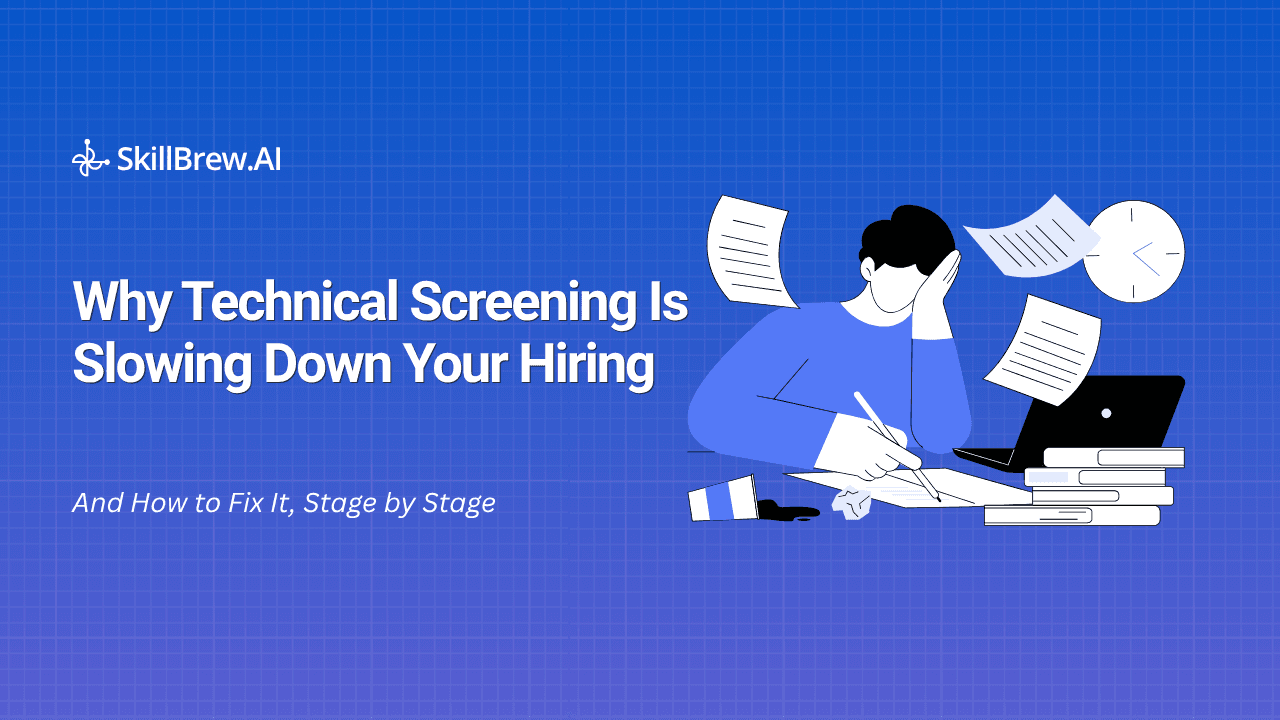
A screening process slowing hiring is where most hiring timelines quietly fall apart. According to SHRM's 2026 benchmarking data, average time-to-fill for nonexecutive roles now sits around 44 to 45 days, with screening and interviewing alone consuming roughly 8 to 9 of those days. Technical hiring is even slower, with candidates spending more than 23 hours across interview rounds before receiving an offer, nearly double the time non-technical candidates spend. Unsurprisingly, 57% of job seekers report losing interest when the hiring process drags on.
A screening process slowing hiring does not make hiring safer. It makes it slower, and slower hiring loses candidates. This piece breaks down why a screening process slowing hiring happens, the mistakes that cause it, and the specific fixes, including where AI-powered screening removes the bottleneck without cutting corners on evaluation quality.
Table of Contents
- Signs the Process Is Too Slow: bottleneck patterns to watch for.
- How Long Should Screening Take?: benchmark timelines.
- Common Screening Mistakes: recurring delay causes.
- What Makes a Good Process?: fast, consistent, evidence-based.
- How to Fix a Slow Technical Screening Process: concrete fixes.
- How AI Improves Technical Screening Accuracy: where AI adds signal.
- The Workflow, Rebuilt: resume to shortlist, step by step.
- Metrics to Measure Screening Efficiency: four numbers to track.
- Technical Screening Checklist: seven-point pre-cycle check.
- Frequently Asked Questions: quick answers.
Signs a Technical Screening Process Is Too Slow
A few patterns show up consistently in teams dealing with a screening process slowing hiring rather than filtering it:
Coding assignments sit ungraded for three or more days because a senior engineer has to manually review each submission
Candidates drop off between the assessment invite and the completed submission, often above 40%
Interview panels get rebuilt every week because interviewer availability, not candidate quality, decides the schedule
Recruiters cannot explain why one candidate scored higher than another beyond "the interviewer liked that candidate more"
Strong candidates accept a competing offer while still waiting on an internal screening decision
If two or more of these are familiar, this is a screening process slowing hiring rather than adding signal.
How Long Should Technical Screening Take?
There is no universal number, but industry benchmarks give a useful target for spotting a screening process slowing hiring. Screening and interviewing stages combined average 8 to 9 days industry-wide. For a role with a single coding assessment and one structured technical interview, a well-run process should move a candidate from application to decision in 5 to 7 days, not the 2 to 3 weeks many teams currently take.
The assessment itself rarely causes delays. Most bottlenecks come from manual grading, interview scheduling, and waiting for hiring feedback: assessments sitting in a shared inbox, interview slots waiting on a specific engineer's calendar, and scorecards waiting on a hiring manager to compare notes across five different interviewers.
Common Technical Screening Mistakes
Most delays trace back to a small set of recurring mistakes that turn into a screening process slowing hiring.
- Assigning take-home projects that take four or more hours to complete.
Long assignments discourage strong candidates who are also interviewing elsewhere and have less time to spend. A four-hour take-home before a first conversation routinely produces lower completion rates than a focused 30-minute assessment. - Relying on a single senior engineer to manually grade every submission.
This creates a queue that grows faster than one person can clear it, especially during high-volume hiring drives. - Running four to six interview rounds for a single technical role.
This is a common cause of a screening process slowing hiring on its own. Each additional round adds scheduling delay without proportionally improving decision quality. - Skipping proctoring on remote technical assessments.
Without an integrity layer, scored results cannot be trusted, which pushes teams to add a redundant live coding round just to verify what the assessment was supposed to confirm. - Generating generic assessments instead of role-specific ones.
A backend engineer and a frontend developer should not be tested on the same question bank. A generic assessment produces false positives and false negatives in roughly equal measure. - No standardized scorecard across interviewers.
When each interviewer evaluates technical ability differently, comparing candidates becomes guesswork, and hiring managers default to re-interviewing to resolve the ambiguity.
What Makes a Good Technical Screening Process?
A strong process avoids becoming a screening process slowing hiring by staying fast, consistent, and evidence-based.
A fast technical screening process moves candidates from application to an initial decision within days, not weeks, without requiring recruiters or engineers to be available at every step. Consistent means every candidate for a given role is evaluated against the same criteria, using the same assessment and the same scoring rubric. Evidence-based means the outcome is a scored transcript or a graded submission, something a hiring manager can review in two minutes rather than a verbal summary of "how the interview felt."
A process that hits all three tends to convert faster and produce fewer regretted hires, because the decision is based on demonstrated skill rather than interviewer preference.
How to Fix a Slow Technical Screening Process
- Replace long take-home assignments with short, scored assessments.
This is one of the fastest ways to fix a screening process slowing hiring. A 30-minute, role-specific coding assessment combined with an AI-scored technical interview usually provides enough signal to decide whether a candidate should move forward, without the four-hour commitment that causes drop-off. - Move to asynchronous interviews for the first technical round.
Candidates complete a structured, adaptive interview on their own schedule instead of waiting for a mutual calendar slot with an available engineer. This alone removes the single biggest source of scheduling delay. - Automate coding assessment generation from the job description.
Instead of a generalist writing generic questions, a JD-to-test tool generates role-specific technical, behavioral, and cognitive questions in minutes, so the assessment reflects the actual role rather than a stock template. - Score coding challenges instantly instead of queuing submissions for manual review.
Automated grading removes the multi-day backlog that builds up when one engineer is responsible for every submission. - Add proctoring to every remote technical assessment.
Skipping this step is a frequent source of a screening process slowing hiring later on. An integrity layer that flags camera, screen, voice, keystroke, and tab-switching anomalies during the test means a scored result can be trusted the first time, removing the need for a duplicate verification round later in the process. - Auto-generate interview summaries instead of relying on interviewer notes.
A structured summary of what a candidate covered, along with clear strengths and gaps, gives a hiring manager a two-minute read instead of a 40-minute recording to sit through.
For teams dealing with a screening process slowing hiring, platforms such as SkillBrew.AI generate role-specific assessments from a job description, combine AI Interviews with automated scoring, and use BrewShield to monitor remote assessment integrity. Together, these features reduce manual coordination while keeping technical screening consistent. For teams evaluating this approach, SkillBrew.AI's Technical Assessments module turns a job description into a role-specific test in about two minutes, covering technical, behavioral, and cognitive questions.
How AI Improves Technical Screening Accuracy
AI addresses a screening process slowing hiring not by being faster than a human, but by being consistent, which is what most screening processes are missing.
Specifically, AI-powered screening can:
Assessment
Generate role-specific technical questions directly from a job description, instead of pulling from a generic question bank
Score coding challenges instantly against a defined rubric, removing subjective grading
Compare candidate answers against role expectations set at the JD level, producing a role-fit score rather than a pass or fail
Interview
Evaluate voice and video interview responses for technical depth, not just keyword matching
Rank candidates across a full applicant pool on a consistent scale, so the top 10% surfaces automatically
Generate a structured interview summary for every completed round, so a hiring manager reviews a scorecard, not a raw transcript
Together, these functions turn the process from an interviewer-dependent judgment call into a repeatable, auditable one. Based on internal benchmarking across customer hiring workflows, SkillBrew.AI reports 85% screening accuracy and a 70% reduction in screening time for teams that move onto this kind of automated, AI-scored workflow.
The Technical Screening Workflow, Rebuilt
A modern version of this workflow exists specifically to prevent a screening process slowing hiring at any single stage:
Resume
   |
AI Resume Screening
   |
JD-Based Assessment
   |
AI Interview
   |
Proctoring Review
   |
Ranked Shortlist
   |
Hiring Manager
- Resume parsed against the JD.
AI shortlisting flags candidates whose stated skills match the role, without a recruiter manually reading every application. - Role-specific assessment sent automatically.
A short, JD-generated technical assessment goes out the moment a candidate clears the resume stage, with BrewShield proctoring running in the background. - AI interview conducted asynchronously.
An adaptive, resume-aware interview probes technical depth with follow-up questions, available to the candidate at any hour rather than tied to a recruiter's calendar. - Shortlist generated automatically.
Scored results from the assessment and the interview roll into a ranked shortlist inside HireFlow, SkillBrew.AI's free orchestration layer, with candidates tracked on a Kanban board from outreach through offer.
Each stage removes one of the waiting points behind a screening process slowing hiring. Resume review no longer waits on a recruiter's inbox. Assessment grading no longer waits on a senior engineer. Interview scheduling no longer waits on a shared calendar. What is left is a screening process measured in days, not weeks.
Metrics to Measure Technical Screening Efficiency
Teams that want to catch a screening process slowing hiring early, rather than after candidates are already lost, track a small set of metrics consistently.
| Metric | What It Measures | Healthy Benchmark |
| Time to screen | Days from application to screening decision | 5-7 days |
| Assessment completion rate | Percentage of invited candidates who finish the assessment | 70%+ |
| Candidate drop-off rate | Percentage lost between invite and final decision | Under 30% |
| Interview-to-offer ratio | Interviews required per offer extended | Improves as scoring gets more consistent |
Tracking these consistently makes it possible to see exactly where the process is leaking candidates, rather than guessing based on anecdotal complaints from hiring managers.
Technical Screening Checklist
Before running the next cycle, confirm the following to rule out a screening process slowing hiring:
☐ Assessment length is 30 to 45 minutes, not a multi-hour take-home
☐ Questions are generated or reviewed against the specific job description, not a generic bank
☐ Proctoring is active on every remote assessment
☐ Scoring is automated and rubric-based, not left to individual grader judgment
☐ Interview format allows asynchronous completion, not just live scheduling
☐ Every candidate gets a structured summary, not just a pass or fail flag
☐ Time-to-screen, completion rate, and drop-off rate are tracked per hiring cycle
A process that checks all seven is unlikely to be a screening process slowing hiring and losing strong candidates.
Frequently Asked Questions
Q1. What is technical screening?
Technical screening is the stage of hiring where a candidate's job-relevant technical skills are evaluated, typically through a coding assessment, a technical interview, or both, before the candidate advances to later interview rounds.
Q2. What causes a screening process slowing hiring?
Delay usually comes from queueing, not the evaluation itself. Long take-home assignments, manual grading by a single engineer, too many interview rounds, and scheduling around interviewer availability are the most common causes.
Q3. How long should technical screening take?
A well-run process should move a candidate from application to decision in 5 to 7 days. Industry benchmarks put combined screening and interviewing time at 8 to 9 days on average.
Q4. Does automation actually fix a screening process slowing hiring?
Yes, when it targets the right stages: assessment grading, interview scheduling, and shortlist generation. The following question covers where AI still needs a human in the loop.
Q5. Can AI replace technical interviews entirely?
AI can conduct and score the full first-round technical interview asynchronously. Most teams still involve a human for later, deeper technical rounds, but AI handles the volume-heavy first pass that used to consume the most recruiter time.
Q6. Does proctoring actually improve technical screening accuracy?
Yes. Without an integrity layer, a scored assessment result cannot be fully trusted, which pushes teams toward redundant verification steps. Proctoring that flags camera, screen, voice, and keystroke anomalies removes that redundancy.
Q7. What is the difference between a technical screening and a full technical interview?
Technical screening is typically an earlier, shorter evaluation designed to filter a large pool down to a qualified shortlist. A full technical interview is usually a deeper, later-stage conversation reserved for candidates who already cleared screening.
Q8. How does SkillBrew.AI speed up technical screening?
SkillBrew.AI generates role-specific assessments from a job description in about two minutes, scores coding challenges and interview responses automatically, runs BrewShield proctoring on every remote round, and produces a ranked shortlist inside HireFlow without manual coordination between recruiters and hiring managers.
Conclusion
The goal of technical screening is not to create a screening process slowing hiring further. It is to identify qualified candidates as quickly and accurately as possible. Teams that replace long take-home assignments and manual grading with structured, role-specific assessments and AI-powered evaluation spend less time reviewing submissions, reduce interviewer workload, and move strong candidates through the funnel before a competitor closes out the offer.
See faster technical screening in action
Ready to fix a screening process slowing hiring and see what a 5-day cycle looks like end to end? Book a demo and see SkillBrew.AI's Technical Assessments, AI Interviews, and BrewShield running on a live job description.
See AI-powered hiring in action
Discover how SkillBrew helps hiring teams cut time-to-hire by 60% with skill-validated assessments and AI-ranked shortlists.
Book a free demoNo commitment required · 30 minutes
Continue reading
View All Posts