Assessment
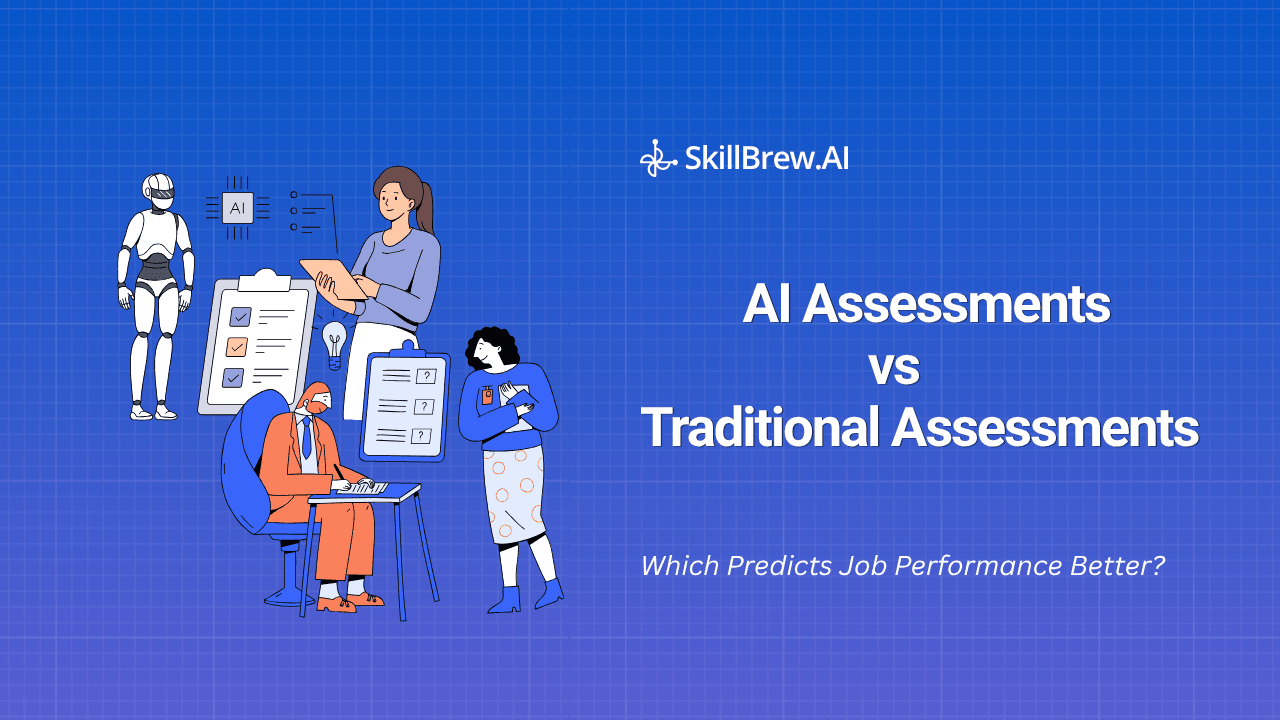
AI Assessments vs Traditional Assessments: Which Predicts Job Performance Better?
Every hiring team eventually asks the same question: does a 90-minute proctored exam actually tell you who will perform well on the job, or is it just a filter that's easy to game and expensive to run? That question has gotten sharper with AI in the mix. AI assessments vs traditional assessments isn't just a tooling debate anymore. It's a debate about what predictive validity actually means when you're hiring at volume, against a deadline, with candidates who can find the answer key on Telegram

Every hiring team eventually asks the same question: does a 90-minute proctored exam actually tell you who will perform well on the job, or is it just a filter that's easy to game and expensive to run?
That question has gotten sharper with AI in the mix. AI assessments vs traditional assessments isn't just a tooling debate anymore. It's a debate about what predictive validity actually means when you're hiring at volume, against a deadline, with candidates who can find the answer key on Telegram before your interview loop even starts.
This guide breaks down what each approach actually measures, compares AI assessments and traditional assessments across the dimensions that matter to a hiring team, explains which one predicts job performance better and why, and shows where traditional assessments still hold their ground.
Table of Contents
- What Are Traditional Assessments?
- What Are AI Assessments?
- AI Assessments vs Traditional Assessments: The Full Comparison
- Which One Actually Predicts Job Performance Better?
- When Traditional Assessments Still Work Well
- Benefits of AI Assessments
- Best Practices for Using AI Assessments
- Where SkillBrew.AI Fits In
- FAQs on AI Assessments vs Traditional Assessments
- Key Takeaways
What Are Traditional Assessments?
Traditional assessments are static, pre-built tests administered the same way to every candidate, usually through a proctored portal, a timed exam window, and manual or semi-automated scoring.
Common formats include:
- Paper-based or PDF exams for aptitude, domain knowledge, or reasoning
- Fixed online test banks with the same question set for every candidate in a role
- Standardized psychometric tools (personality inventories, cognitive ability tests)
- Take-home coding assignments graded manually by an engineer
- In-person panel exercises, like whiteboard coding or case studies
The defining trait of a traditional assessment is that it doesn't adapt. The questions, the difficulty, and the scoring rubric are fixed before the first candidate ever logs in. A recruiter or hiring manager typically builds the test once, reuses it across an entire hiring cycle, and reviews results manually or through basic auto-grading.
This model worked well when hiring volumes were low and question banks could be refreshed often enough to stay ahead of leaked answers. It struggles when volume climbs past a few hundred candidates a month, which is the starting point for most of the AI assessments vs traditional assessments debate that follows.
What Are AI Assessments?
AI assessments are hiring assessments that use machine learning to help generate, administer, or score tests, based on the specific role, job description, or candidate responses. Not every platform in this category works the same way. Some automate scoring on top of a fixed question bank. Others generate questions dynamically and adapt in real time. The label "AI assessment software" covers a range of sophistication, and it's worth knowing where a given tool sits on that spectrum before you trust its output.
What modern AI assessment platforms can offer:
- Dynamic question generation pulled directly from a job description, rather than pulled from a static bank
- Adaptive difficulty, where the next question can adjust based on how the candidate answered the last one
- Multi-dimensional scoring that looks at technical accuracy, reasoning process, communication, and behavioral signals together
- Built-in integrity layers that flag tab-switching, voice mismatches, screen sharing, or suspicious response patterns as they happen
- Automated, structured scorecards delivered to recruiters within minutes of test completion, rather than days
At their most capable, AI assessments behave less like a fixed exam and more like a skilled interviewer who asks a baseline question, listens to the answer, and decides what to probe next. That adaptability, where it's genuinely present, is the core mechanical difference in AI assessments vs traditional assessments, and it's one of the bigger factors behind why AI hiring assessments can produce stronger predictive signal than a static test. The keyword is "can." A platform that only automates grading on the same old question bank isn't offering much of an upgrade.
AI Assessments vs Traditional Assessments: The Full Comparison
Here's how the two approaches stack up across the dimensions that actually matter when you're evaluating hiring assessment tools for your team.
| Dimension | Traditional Assessments | AI Assessments |
| Accuracy | Fixed; prone to leaked answers | Dynamic, adaptive questions |
| Cost | Low test cost; high manual overhead | Pay-as-you-go pricing; no proctors |
| Speed | Days to score | Results in minutes |
| Scalability | Struggles past hundreds of candidates | Handles thousands concurrently |
| Candidate Experience | Rigid and impersonal | Adaptive pacing and fast feedback |
| Bias Mitigation | Vulnerable to subjective grading | Standardized criteria |
| Security & Integrity | Hard to monitor at scale | Real-time proctoring |
| Reporting | Manual spreadsheets | Automated scorecards |
| Recruiter Effort | High (building and grading) | Low (automated workflow) |
The pattern is consistent across nearly every row of this AI assessments vs traditional assessments comparison. Traditional assessments front-load effort into design and back-load it into grading. AI assessments front-load effort into building the JD-to-test workflow once and then scale that workflow indefinitely at close to zero marginal recruiter effort.
Which One Actually Predicts Job Performance Better?
This is the core question behind AI assessments vs traditional assessments, and it deserves more than a one-line verdict, because "predicts job performance" means different things depending on the role, the evaluation design, and how the test is actually built.
For roles with a well-defined, stable skill set (fixed-syntax coding tests, standardized aptitude for a mature function), traditional assessments have decades of psychometric validation behind them. A well-built cognitive ability test still correlates reasonably well with performance across many roles. That research isn't invalidated by AI. The question isn't whether traditional methods ever worked. It's whether the conditions that made them work still hold at today's hiring volume and today's level of answer-key exposure.
Skills-based hiring vs credential-based hiring. Traditional assessments, especially older psychometric batteries, often lean on proxies: degrees, years of experience, generic aptitude scores. Skills-based hiring flips that, evaluating candidates on the specific competencies the role actually requires. This is one of the sharpest divides in AI assessments vs traditional assessments: AI assessments are well suited to skills-based hiring because a JD-to-test workflow can generate questions tied directly to the skills listed in the job description, rather than a generic aptitude score that only loosely correlates with the work itself. This is one of the clearer mechanisms by which candidate assessment shifts from "who looks qualified on paper" to "who can actually do the job."
Structured evaluations reduce guesswork. Unstructured interviews and loosely graded take-home tests are notoriously inconsistent, two reviewers can score the same answer differently based on mood, familiarity with the candidate's background, or simple fatigue late in the day. Structured evaluations, where every candidate is measured against the same defined rubric, are one of the most consistently replicated findings in hiring research: they outperform gut-feel evaluation. On this dimension, AI assessments vs traditional assessments isn't really a contest, both well-run traditional assessments and AI assessments can be structured. The difference is that AI assessment software enforces structure automatically, so a hiring team doesn't have to depend on every reviewer following the rubric correctly every time.
Reduced interviewer and reviewer bias. Manual grading introduces reviewer bias, even from well-intentioned graders. A tired reviewer, a familiar-sounding name, or a slightly unconventional answer format can quietly shift a score. Standardized scoring criteria, applied identically to every candidate, narrow that gap. This doesn't eliminate bias (the questions themselves, or the data used to build a scoring model, can still carry bias), but it removes a specific and well-documented source of inconsistency: the reviewer's own variability from one candidate to the next.
Consistent scoring at scale. A traditional assessment graded by five different reviewers across a hiring cycle can produce five different scoring standards, even with a shared rubric. Consistency tends to erode as volume increases and more people get pulled into grading. This is where AI assessments vs traditional assessments diverges most at scale: AI assessments apply the same scoring logic to every candidate regardless of volume, which matters most exactly when traditional grading is most likely to drift: high-volume hiring cycles with tight deadlines.
Real-world simulations over abstract puzzles. Some of the least predictive traditional assessments are the most abstract ones, brainteasers and generic logic puzzles that have little connection to daily work. Whether the format is AI-generated or traditionally built, assessments that simulate real job scenarios (a debugging task pulled from the actual tech stack, a customer scenario relevant to the role) tend to correlate more closely with performance than abstract puzzles do. AI assessment generation makes it easier to build these role-specific simulations at scale, since the test can be regenerated from a new job description instead of hand-built each time.
Adaptive questioning surfaces reasoning, not just recall. Where an AI assessment does ask a genuine follow-up based on how a candidate answered the first question, it's testing whether they understand the underlying concept or memorized a pattern. That distinction maps more closely to on-the-job problem-solving than a single static answer does. This is one of the clearest mechanical advantages of adaptive platforms over static ones, but it only applies when the adaptivity is real, not simulated by randomizing question order or difficulty labels without actually responding to the candidate's input.
Standardized evaluation across a hiring cycle. A candidate assessed in week one of a hiring cycle should face the same bar as a candidate assessed in week six. Question banks that rotate informally, reviewers who calibrate differently over time, and shifting rubrics all work against that. Standardized evaluation, where the criteria and question difficulty stay consistent (or adapt in a controlled, documented way) across the full cycle, protects the integrity of the comparison between candidates. This matters as much for compliance and defensibility as it does for accuracy.
So, which wins? Pulling this together: AI assessments tend to predict performance better when they combine skills-based question design, structured and standardized scoring, reduced reviewer bias, and, where relevant, genuine adaptivity or real-world simulation. A poorly configured AI assessment, one running on a static question bank with a thin automation layer on top, doesn't automatically outperform a well-validated traditional test. The advantage comes from design quality and consistency at scale, not from the word "AI" on the box.
When Traditional Assessments Still Work Well
It would be dishonest to frame the AI assessments vs traditional assessments debate as AI winning across the board. Traditional assessments, and traditional interview formats more broadly, still make sense in specific situations:
- Highly regulated roles where a specific certified test is legally or contractually required (certain finance, aviation, or government roles)
- Executive and senior leadership hiring, where the decision rests on judgment, stakeholder alignment, and track record more than a testable skill, and where the relationship built through an in-person or panel process is itself part of the evaluation
- Leadership interviews more generally, where board members or senior stakeholders often expect direct, unstructured conversation as part of due diligence, not a standardized test
- Creative portfolio reviews, where the work product (a design portfolio, a writing sample, a reel) is inherently subjective and benefits from expert human judgment rather than standardized scoring
- Very low volume hiring, where a small company hiring a handful of candidates a year gets little return from standing up an automated pipeline, and manual review is simply faster to set up
- Established psychometric tools with long validation histories, where switching formats would break years of internal benchmarking data
- In-person panel exercises for senior roles where the interaction itself, not just the output, is the signal hiring managers want to observe
If you're a small company hiring five people a year, or filling an executive seat where cultural and strategic fit outweighs a testable skill, a traditional process administered manually is a perfectly reasonable choice, often the better one. The case for AI assessments strengthens sharply as volume, speed pressure, and answer-leakage risk increase, which is exactly the profile of most high-volume technical and frontline hiring.
Benefits of AI Assessments
The AI assessments vs traditional assessments comparison tilts hardest in AI's favor for high-volume, high-velocity hiring, where the benefits compound quickly:
- Faster time-to-shortlist. Structured scorecards land within minutes, not days, cutting the gap between test completion and recruiter decision.
- Lower recruiter workload per hire. No manual grading queue, no chasing hiring managers for feedback on take-home assignments.
- Reduced candidate drop-off. Long delays between assessment and next steps are one of the biggest drop-off triggers in high-volume pipelines. Faster scoring keeps candidates engaged.
- Consistent, defensible scoring. Every candidate is measured against the same criteria, which matters both for fairness and for compliance documentation.
- Real-time integrity monitoring. Instead of discovering cheating after an offer has gone out, flags surface during the test itself.
- Scale without headcount. A recruiting team of three can run thousands of assessments a month without adding a single grader.
Best Practices for Using AI Assessments
AI assessments aren't a drop-in replacement you can deploy carelessly. Getting the AI assessments vs traditional assessments trade-off right depends on execution. A few practices separate teams that get strong predictive results from teams that just get faster bad results:
- Tie every question directly to the job description. Generic question banks defeat the purpose. The test should reflect the actual role, not a category the role loosely belongs to.
- Keep a human in the loop for final decisions. Use AI scoring to shortlist and prioritize, not to auto-reject without any recruiter review, especially for borderline scores.
- Pair technical scoring with integrity verification. A high score with no integrity check is a red flag waiting to happen. Proctoring and scoring should run together, not as separate afterthoughts.
- Recalibrate difficulty as roles evolve. A JD-to-test workflow should regenerate questions as the role's requirements shift, not lock in a static version forever.
- Audit for bias periodically. Standardized scoring reduces reviewer bias, but the underlying question generation should still be reviewed for role or language skew.
- Communicate the process to candidates. Adaptive tests can feel unfamiliar. A short explanation of how the assessment works improves completion rates and candidate sentiment.
Where SkillBrew.AI Fits In
The gap between "AI assessment" as a marketing label and AI assessment as a genuinely predictive workflow is exactly what SkillBrew.AI's assessment stack is built to close, and it's a useful lens for the AI assessments vs traditional assessments debate in practice, not just in theory. It helps to walk through what actually happens across a hiring cycle rather than list out features in isolation.
Stage 1: Assessment Generation. A recruiter pastes in the job description, and the SkillBrew.AI Assessment Builder generates a role-specific assessment from it, technical, behavioral, and cognitive components included, instead of pulling from a generic, one-size-fits-all bank. For technical roles, that assessment includes coding questions built against the actual stack and requirements in the JD, auto-graded against the role rather than a library of unrelated algorithm problems.
Stage 2: Screening and Interviews. Candidates move through whichever combination of rounds the role calls for. Some roles need a written technical assessment. Others benefit more from a live conversation, in which case candidates complete an AI Interview: a resume-aware, adaptive conversation that asks genuine follow-up questions rather than a fixed script. Earlier in the funnel, AI screening filters the incoming pool so that only reasonably qualified candidates reach a full assessment or interview in the first place, which keeps recruiter time focused on candidates worth a closer look.
Stage 3: Integrity and Reporting. BrewShield integrity verification runs automatically underneath every assessment and interview, detecting thirteen distinct signals including camera activity, screen behavior, voice mismatches, keystroke patterns, and tab-switching. That matters because a strong score is only useful if it reflects the candidate's own work. Once a candidate finishes, the recruiter doesn't get a raw transcript to interpret manually, they get an automated, structured scorecard they can act on immediately. Teams with non-standard needs can also configure fully custom assessments rather than working from a fixed template, and everything runs on top of HireFlow, the always-free orchestration layer that tracks candidates through the pipeline.
The result lines up with the broader argument in this piece: pre-employment assessments built this way cut screening time by roughly 70% for teams using SkillBrew.AI, speed up time-to-shortlist, and produce the kind of structured signal a static test was never built to deliver at scale.
FAQs
Q1. Are AI assessments more accurate than traditional assessments?
On the accuracy dimension of AI assessments vs traditional assessments, AI assessments tend to come out ahead for roles with evolving skill requirements or high candidate volume, because questions stay tied to the actual job description and adapt based on responses. For narrow, highly standardized roles with long-validated psychometric tools, traditional assessments can still hold their own.
Q2. Do AI assessments eliminate bias completely?
No assessment format eliminates bias completely. AI assessments reduce reviewer-level bias by applying identical scoring criteria to every candidate, but the underlying question generation still needs periodic auditing to catch any skew.
Q3. Can candidates cheat on AI assessments?
It's harder than with traditional tests. Integrity layers like BrewShield monitor camera activity, screen behavior, voice consistency, and tab-switching in real time, which catches most cheating attempts as they happen rather than after the fact.
Q4. How much faster are AI assessments compared to traditional ones?
Traditional assessments typically take days between test completion and scored results, given manual grading. AI assessments generate structured scorecards within minutes of test completion.
Q5. Are AI assessments more expensive than traditional assessments?
On cost, AI assessments vs traditional assessments often looks close at first glance, but per-test pricing hides the real gap. Traditional assessments carry hidden costs in proctor staffing and manual grading hours. Pay-as-you-go AI assessment pricing, without a monthly minimum, usually works out cheaper at any meaningful volume.
Q6. Do AI assessments work for non-technical roles?
Yes. An AI recruitment assessment can be built for behavioral, cognitive, and role-specific scenarios well beyond coding, including sales aptitude, communication skills, and situational judgment.
Q7. Should recruiters still review results manually?
Yes, especially for borderline scores. AI assessments are built to prioritize and shortlist faster, not to remove human judgment from the final decision.
Q8. How do I switch from traditional to AI assessments without disrupting an active hiring cycle?
Most teams run both in parallel for one hiring cycle, benchmarking AI-assessed candidates against traditionally assessed ones before fully switching over. This validates the new scoring model against outcomes the team already trusts.
Key Takeaways
- Traditional assessments are static and don't adapt, which limits their predictive value as answer keys leak and volume scales up.
- In the AI assessments vs traditional assessments comparison, AI assessments generate role-specific, adaptive questions and score across multiple dimensions, which more closely mirrors real job performance.
- The comparison isn't AI winning by default. Design quality, JD-alignment, and integrity verification determine whether an AI assessment actually predicts performance better.
- Traditional assessments still make sense for regulated, low-volume, executive, or long-validated use cases.
- SkillBrew.AI combines AI assessment generation, coding assessments, AI interviews, AI screening, BrewShield integrity verification, and automated scorecards into one workflow built for high-volume hiring.
Still deciding between AI assessments and traditional assessments for your next hiring cycle? Explore the SkillBrew.AI Assessment Builder and generate a role-specific assessment in minutes.
See AI-powered hiring in action
Discover how SkillBrew helps hiring teams cut time-to-hire by 60% with skill-validated assessments and AI-ranked shortlists.
Book a free demoNo commitment required · 30 minutes
Continue reading
View All Posts