BrewVoice
How Call Assistant and Screening Technologies Are Transforming Recruitment
Introduction How much time does your recruitment team spend calling candidates who are unavailable, unqualified, or no longer interested in a position? This is where call assistant and screening technologies can help recruitment teams automate routine outreach, standardize initial screening, and organize candidate information for faster review. By combining automated calling, conversational artificial intelligence (AI), and structured reporting, these solutions let recruiters spend less time o

Introduction
How much time does your recruitment team spend calling candidates who are unavailable, unqualified, or no longer interested in a position?
This is where call assistant and screening technologies can help recruitment teams automate routine outreach, standardize initial screening, and organize candidate information for faster review. By combining automated calling, conversational artificial intelligence (AI), and structured reporting, these solutions let recruiters spend less time on repetitive phone conversations and more time evaluating qualified applicants.
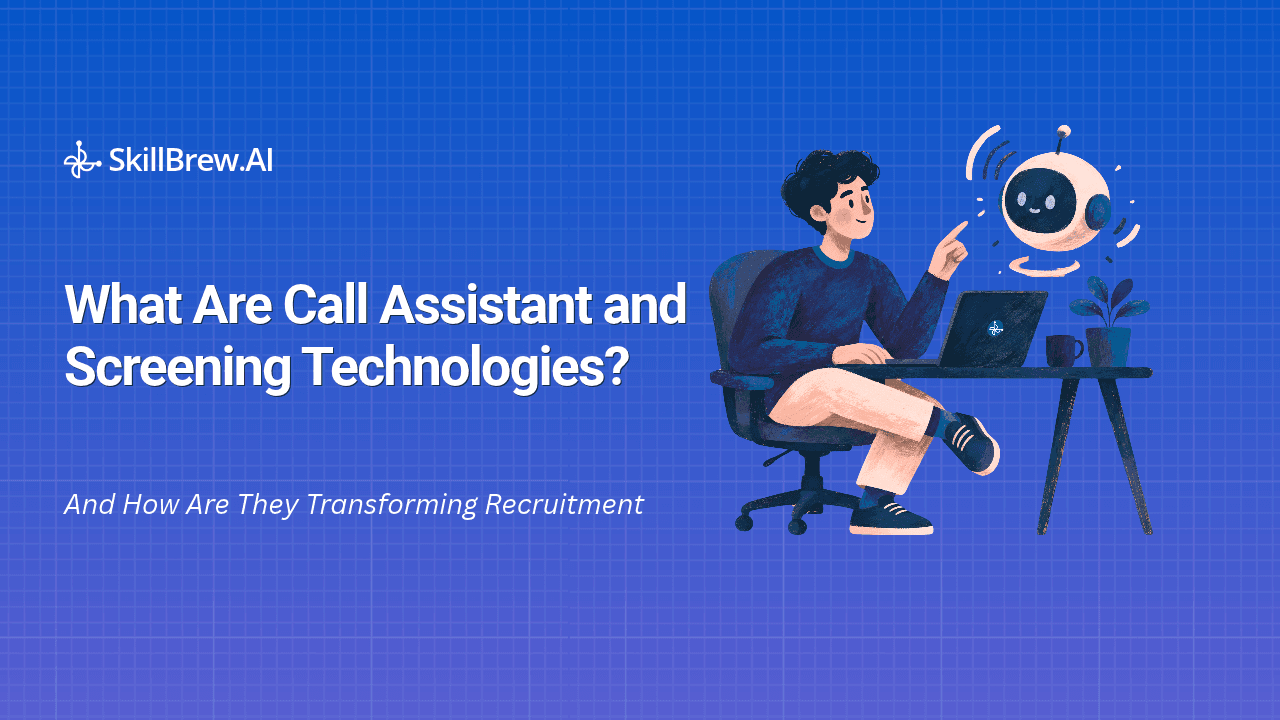
What Are Call Assistant and Screening Technologies?
Call assistant and screening technologies are digital solutions that help recruiters contact applicants, collect job-related information, and evaluate candidates during the initial stages of hiring. Teams should choose call assistant and screening technologies based on role needs and candidate volume.
Common capabilities include automated outreach, initial qualification, conversational screening, response analysis, and candidate prioritization. Basic calling systems may only automate dialing and reminders, while AI voice agents can conduct conversations and generate structured evaluations.
Why Is Traditional Candidate Screening Becoming Difficult?
1. Repetitive Calls Consume Recruiter Time
Recruiters frequently ask similar questions across hundreds of applications. Manually contacting every applicant leaves less time for interviews, hiring manager discussions, and candidate engagement. Automating repeatable calls can help reclaim that time.
2. Delayed Communication Causes Candidate Drop-Off
Candidates often apply to multiple organizations simultaneously. Delayed outreach can result in missed opportunities when applicants accept other offers or lose interest. Call assistant and screening technologies can reduce waiting time when calling and follow-up workflows are configured effectively. The value of call assistant and screening technologies depends on timely, relevant outreach.
3. Manual Evaluation Creates Inconsistency
Different recruiters may ask different questions or record information differently. Standardized questions and documented criteria help make candidate comparisons more consistent, although teams still need to check for bias.
4. Recruitment Data Becomes Difficult to Manage
When call notes are scattered across spreadsheets, emails, and recruiter records, hiring managers may struggle to understand candidate progress. Centralized reports and structured records can make screening outcomes easier to review.
How Call Assistant and Screening Technologies Work
Step 1: Upload Candidate Information
Recruiters provide candidate details and job requirements. Some platforms support bulk uploads through CSV or Excel files, while others offer recruitment system integrations.
Step 2: Configure Outreach and Screening Questions
The recruiter defines the questions, qualification criteria, and calling windows. Depending on the platform, calls can be scheduled or initiated in batches, with automated retries for unanswered calls.
Step 3: Conduct the Screening Conversation
An AI voice assistant introduces itself and asks role-related questions. For example, it may confirm experience, shift availability, and joining timelines for a customer support role.
Step 4: Generate Structured Results
The system organizes the conversation into available outputs, such as transcripts, summaries, response details, or evaluation scores.
Step 5: Review Candidates and Decide Next Steps
Recruiters examine the results, compare responses against job requirements, and decide who should progress to an assessment or interview. This workflow shows how call assistant and screening technologies can support initial qualification while leaving important hiring decisions with recruiters. Well-configured call assistant and screening technologies should keep the candidate journey clear.
7 Ways Call Assistant and Screening Technologies Are Transforming Recruitment
1. Automating High-Volume Candidate Outreach
Campus recruitment, staffing, and frontline hiring can generate hundreds or thousands of applications in a short period. Manually calling every applicant creates a substantial operational burden. Automated voice assistants can contact candidates according to configured calling rules, helping recruiters manage large screening queues. For example, a staffing agency can confirm candidate interest, shift preferences, and joining availability before arranging interviews.
2. Accelerating Initial Screening
Traditional screening depends on recruiter availability and the time required to arrange conversations. AI-enabled calling can help teams complete initial qualification sooner, especially when questions are repeatable and straightforward.
Call assistant and screening technologies can help recruiters prioritize applicants who meet essential requirements, reducing unnecessary delays between application and the next recruitment stage. Call assistant and screening technologies work best when screening criteria are role-specific. The actual improvement depends on candidate response rates, call completion, and the complexity of each role. Measure call assistant and screening technologies against a baseline rather than assuming gains.
3. Supporting Multilingual Candidate Communication
Recruitment teams often hire candidates from different linguistic backgrounds. Screening conducted in a single language can create unnecessary barriers for otherwise suitable applicants. Some AI voice assistants support multiple languages and accents, allowing candidates to communicate in a supported language.
Recruiters should verify language accuracy and ensure that accent differences do not unfairly influence candidate evaluations. This is an important consideration when evaluating call assistant and screening technologies for geographically distributed hiring. Organizations should evaluate call assistant and screening technologies across their actual candidate populations.
4. Improving Screening Consistency
Manual screening can vary according to recruiter experience, workload, and interviewing style. Standardized question sets and consistent evaluation criteria help teams collect comparable information across applicants.
For example, applicants for a software developer position can be asked about relevant experience, availability, and familiarity with required technologies. Recruiters should still review the criteria to ensure that evaluations remain relevant to the role.
5. Reducing Administrative Work
Recruiters spend time documenting calls, updating candidate records, preparing summaries, and communicating results to hiring managers. When supported by the platform, integrations can also transfer relevant information into recruitment dashboards or applicant tracking systems. Call assistant and screening technologies are most useful when they reduce manual work without creating additional data-cleanup tasks. Integrations can make call assistant and screening technologies more useful across the recruitment funnel.
6. Enabling Better Recruitment Decisions
Recruiters make better-informed decisions when they have structured, job-relevant information instead of relying on memory or incomplete notes. These systems can organize candidate responses around specific requirements, helping recruiters compare applicants and identify areas requiring further investigation. Call assistant and screening technologies should support, not replace, evidence-based recruiter judgment.
7. Scaling Recruitment Without Proportionally Increasing Manual Work
Organizations expanding across locations often need to screen more applicants without increasing recruiter headcount at the same rate. Call assistant and screening technologies can help teams reuse approved questions, qualification rules, and outreach workflows across multiple hiring campaigns. Before scaling, test whether call assistant and screening technologies maintain quality as volume rises.
This is particularly valuable for staffing agencies, recruitment process outsourcing firms, and enterprises repeatedly hiring for similar roles. The benefits depend on system reliability, candidate engagement, screening quality, and the amount of human review required.
Traditional Screening vs. AI-Assisted Screening
| Factor | Traditional screening | AI-assisted screening |
| Candidate outreach | Manual calls and follow-ups | Automated calling where supported |
| Question delivery | Varies by recruiter | Standardized question sets |
| Documentation | Manual notes | Transcripts and summaries where available |
| Screening capacity | Limited by recruiter availability | Potentially higher throughput |
| Evaluation | Recruiter-led | AI-generated insights with recruiter review |
| Quality control | Manual reviews and training | Human review plus system monitoring |
The right approach depends on the role and hiring context. Complex positions and sensitive discussions may require direct recruiter involvement throughout screening. Combining automation with human judgment and ongoing quality checks can help maintain recruitment quality.
How to Measure the Impact of Screening Technology
Track these five metrics:
- Screening turnaround time: Measure the time between application and completion of initial screening.
- Call connection and completion rates: Track how many candidates answer and how many complete the conversation.
- Qualified-candidate progression: Measure how many screened applicants progress to the next stage and meet the role's requirements.
- Recruiter hours saved: Compare the time spent on manual calling, documentation, and follow-ups before and after implementation.
- Candidate feedback: Collect feedback on call clarity, language options, transparency, and the overall experience.
How SkillBrew.AI Supports AI-Powered Candidate Screening
SkillBrew.AI offers recruitment tools designed to support candidate screening and subsequent evaluation stages.
Its BrewVoice AI voice screening solution uses Rhea, an AI voice agent, to conduct initial candidate screening calls. The current product page describes support for 10+ languages and accents, 24/7 outreach, retries for unanswered calls, and CSV/Excel and resume uploads for candidate lists. It also describes scored call reports covering intent and interest, technical and role fit, communication and confidence, and personality and fit, alongside a ranked shortlist.
These capabilities help recruitment teams organize initial phone screening and review candidate information without manually conducting every routine call. Recruiters can examine the results and decide which applicants should progress.
For the next stage, SkillBrew.AI's AI Interviews supports role-specific interviews and candidate reports. Its AI Assessments platform supports four listed question types: MCQ, coding, situational, and subjective. These formats can help teams assess job-related knowledge and skills before interviews.
Teams looking to coordinate multiple recruitment stages can also explore HireFlow, which provides recruitment workflow management and candidate-stage tracking. Together, these tools can support a process built around initial screening, skill evaluation, and interviews while retaining recruiter oversight at each stage.
Challenges to Consider Before Implementing Screening Technology
Candidate Privacy and Transparency
Candidates should know when they are interacting with an AI assistant and understand how their call information may be used. Transparency is essential when introducing call assistant and screening technologies. Establish appropriate consent, access, and data-retention practices.
Bias and Evaluation Accuracy
Speech recognition and automated evaluation may perform differently across languages and accents. Test transcription accuracy across supported languages and review whether candidate groups experience disproportionate negative outcomes.
Integration With Existing Systems
Disconnected tools can create duplicate records and additional administrative work. Confirm integration capabilities before implementation. For broader workflow coordination, evaluate whether a solution such as HireFlow fits your requirements.
Candidate Experience
Calls should be clear, relevant, and respectful of candidates' time. Configure appropriate calling windows and retry rules, and provide an alternative contact method when candidates cannot complete an automated call.
Human Oversight and Quality Control
Document evaluation criteria and review a sample of calls and reports regularly. Investigate unexpected outcomes, allow recruiters to challenge automated recommendations, and ensure final hiring decisions account for relevant evidence beyond a single score.
Frequently Asked Questions (FAQs)
1. What are call assistant and screening technologies in recruitment?
Call assistant and screening technologies are digital tools that help automate candidate outreach, conduct initial screening conversations, organize responses, and support recruiters in identifying applicants who meet job requirements.
2. How does an AI call assistant screen candidates?
An AI call assistant contacts candidates, asks predefined or adaptive questions, processes spoken responses, and may generate transcripts, summaries, or evaluation scores. Recruiters review the available information before deciding the next steps.
3. Can these technologies support multilingual recruitment?
Some platforms support multiple languages and regional speech patterns. Organizations should verify available languages and test transcription and evaluation accuracy before deployment.
4. Do automated screening tools replace recruiters?
No. These tools can automate repetitive outreach and information collection, but recruiters remain responsible for interpreting results, conducting interviews, evaluating suitability, and making hiring decisions.
5. How can organizations measure screening automation success?
Teams can track screening turnaround time, call connection and completion rates, qualified-candidate progression, recruiter hours saved, and candidate feedback. Comparing these metrics against a pre-implementation baseline helps establish whether the technology is delivering meaningful improvements.
6. Which organizations benefit most from automated screening?
Staffing agencies, large enterprises, recruitment process outsourcing firms, and organizations conducting campus or frontline hiring may benefit when they process high application volumes and repeat similar screening workflows.
Final Thoughts
Recruitment requires more than attracting applications. Teams must identify suitable candidates, communicate promptly, and move qualified applicants through the hiring process without unnecessary delays.
Call assistant and screening technologies can help address repetitive phone calls, inconsistent documentation, and growing application volumes. They make it possible to organize candidate information more efficiently while preserving the human judgment required for effective hiring.
The key is to automate appropriate tasks, establish transparent evaluation criteria, and monitor outcomes continuously. When implemented responsibly, AI-assisted calling can make initial screening more manageable while allowing recruiters to focus on qualified candidates and meaningful conversations.
For organizations seeking to scale recruitment without creating a screening bottleneck, combining automated outreach with structured assessments and human-led interviews can create a more efficient, consistent, and candidate-focused hiring process.
Schedule a demo with SkillBrew.AI to explore how its recruitment tools could fit your hiring workflow.
See AI-powered hiring in action
Discover how SkillBrew helps hiring teams cut time-to-hire by 60% with skill-validated assessments and AI-ranked shortlists.
Book a free demoNo commitment required · 30 minutes
Continue reading
View All Posts