AI Interview
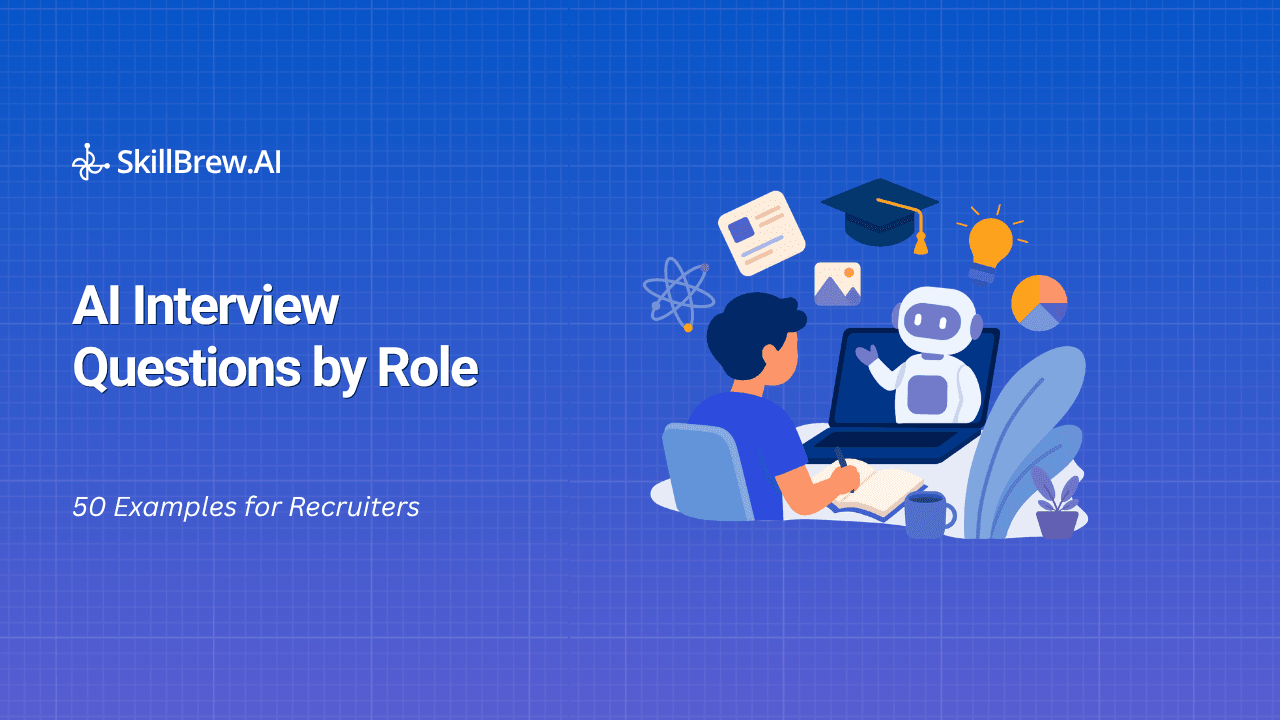
AI Interview Questions by Role: 50 Examples for Recruiters
Hiring teams rarely interview candidates for the same skills across every position. A software engineer needs technical problem-solving ability, while a sales executive needs persuasion, objection handling, and communication skills. A customer support executive may need empathy, troubleshooting, and conflict-resolution skills. That is why AI interview questions should be aligned with the requirements of the role rather than pulled from a generic question bank. Importantly, AI interview questio

Hiring teams rarely interview candidates for the same skills across every position. A software engineer needs technical problem-solving ability, while a sales executive needs persuasion, objection handling, and communication skills. A customer support executive may need empathy, troubleshooting, and conflict-resolution skills.
That is why AI interview questions should be aligned with the requirements of the role rather than pulled from a generic question bank.
Importantly, AI interview questions are not necessarily questions that only AI can create. They are role-specific questions that AI-powered interviewing platforms can help generate, deliver, adapt, and evaluate interview content based on job requirements and candidate responses.
This guide explains what makes a strong question and provides 50 examples across 10 common hiring roles.
Table of Contents
- What Are AI Interview Questions?: Understand what they are and how AI can generate, deliver, and adapt them.
- Why Role-Specific Questions Matter?: Learn why questions should align with each role's skills and responsibilities.
- How to Create Effective AI Interview Questions?: Follow a simple framework for creating relevant, evaluable questions.
- 50 AI Interview Questions by Role: Explore 50 examples across 10 common hiring roles.
- How to Choose the Right Questions?: Learn how to select questions based on skills, competencies, and seniority.
- How AI Can Adapt Questions During an Interview?: See how AI follow-ups can explore candidate responses in greater depth.
- How to Use an AI Interview Question Generator?: Learn how recruiters can generate and refine role-aligned questions with AI.
- Common Mistakes to Avoid: Identify common mistakes when creating and using AI interview questions.
- FAQs
What Are AI Interview Questions?
AI interview questions are role-relevant interview questions that AI-powered systems can generate, deliver, or adapt using information such as a job description, required skills, seniority, candidate profile, and previous responses.
The distinction matters.
A question such as:
"Tell me about a difficult project you worked on."
is a normal interview question. It becomes part of an AI-powered interview when a system can use the job requirements to determine why the question is relevant, ask it consistently, evaluate the response against defined competencies, and potentially generate a relevant follow-up.
For example, a candidate for a backend engineering role might say:
"I improved application performance by optimizing database queries."
An AI interviewer could then ask:
"How did you determine that database queries were the primary bottleneck?"
The value is not that AI invented a question that humans could never ask. The value is that AI can help make questioning structured, scalable, role-aligned, and adaptive.
Why Role-Specific AI Interview Questions Matter
Generic questions can reveal useful information, but they often provide limited evidence about whether someone can perform the actual job.
A strong set of AI interview questions should connect directly to:
- Job responsibilities
- Required technical or functional skills
- Behavioral competencies
- Seniority level
- Problem-solving requirements
- Communication expectations
- Realistic workplace scenarios
Consider the difference:
Weak:
Are you good at handling customers?
Better:
Tell me about a time you handled an angry customer. What was the issue, what did you do, and what was the outcome?
The second question asks for evidence rather than self-assessment.
A useful framework is:
Role-specific → Evidence-based → Evaluatable → Adaptable
Role-specific: The question relates directly to the position.
Evidence-based: The candidate needs to provide an example, explain a decision, or solve a realistic scenario.
Evaluatable: The recruiter knows what skills or behaviors a strong answer should demonstrate.
Adaptable: The answer can create opportunities for relevant follow-up questions.
This framework helps turn a simple question bank into a structured interview.
How to Create Effective AI Interview Questions
A practical workflow for creating AI interview questions is:
Job Description → Skills → Competencies → Question → Evaluation Criteria → Follow-Up
1. Start with the job description
Identify the responsibilities, required skills, and outcomes expected from the candidate.
2. Identify critical competencies
Separate requirements into categories such as:
- Technical skills
- Functional knowledge
- Communication
- Problem-solving
- Leadership
- Collaboration
- Decision-making
3. Create evidence-based questions
Ask candidates to describe what they actually did or explain how they would handle a realistic situation.
4. Define evaluation criteria
Determine what a strong response should demonstrate before interviewing candidates.
5. Add adaptive follow-ups
Follow-ups can probe vague answers, test depth, or ask candidates to explain the reasoning behind a decision.
50 AI Interview Questions by Role
The questions below are examples of role-specific interview questions that can be generated, delivered, or adapted within an AI-powered interview workflow.
Here is a quick overview of the 10 roles covered in this guide:
| Role | Key competencies |
| Software Engineer | Debugging, architecture, problem-solving |
| Sales Executive | Objection handling, negotiation, closing |
| Customer Support | Empathy, communication, troubleshooting |
| Data Analyst | Analytical reasoning, data validation |
| Product Manager | Prioritization, decision-making |
| HR/Recruiter | Stakeholder management, candidate experience |
| Marketing Executive | Strategy, analytics, creativity |
| Project Manager | Planning, risk management, prioritization |
| Business Analyst | Requirements, analysis, communication |
| Account Manager | Retention, negotiation, relationships |
1. AI Interview Questions for Software Engineers
Software engineering interviews should test technical reasoning rather than simply asking candidates to recall definitions.
| Question | What it evaluates |
| 1. Tell me about a difficult technical problem you solved. How did you identify the root cause and verify your solution? | Problem-solving |
| 2. An API suddenly becomes significantly slower after a traffic increase. How would you isolate the bottleneck? | Debugging |
| 3. Describe a project where you had to make an architectural decision with incomplete information. | System thinking |
| 4. Tell me about a technical disagreement you had with another developer. How did you reach a decision? | Collaboration |
| 5. An application's response time has increased by 40%, but CPU utilization remains normal. What would you investigate first? | Technical diagnosis |
Example follow-up:
"What metrics would you check first, and how would each help narrow down the problem?"
2. AI Interview Questions for Sales Executives
Sales interviews should test how candidates diagnose situations, handle objections, and make decisions.
| Question | What it evaluates |
| 6. A prospect says they are not interested after your first pitch. How would you decide whether to continue the conversation? | Objection handling |
| 7. Tell me about the most difficult deal you have closed. What made it difficult and what changed the outcome? | Sales strategy |
| 8. How do you determine whether a prospect is genuinely qualified? | Qualification |
| 9. A customer rejects your proposal because of price. How would you respond? | Negotiation |
| 10. You have missed your sales target for three consecutive months, but your activity volume is high. How would you diagnose the problem? | Analysis and adaptability |
Example follow-up:
"If your activity levels were strong but conversion was falling, which stage of the sales funnel would you investigate first?"
3. AI Interview Questions for Customer Support Executives
Customer support interviews should test how candidates respond to realistic customer situations.
| Question | What it evaluates |
| 11. An angry customer says they were charged incorrectly. How would you handle the conversation? | Empathy and conflict resolution |
| 12. Tell me about a difficult customer interaction and how you resolved it. | Customer handling |
| 13. What would you do if you did not know the answer to a customer's question? | Resourcefulness |
| 14. How would you explain a technical problem to someone with no technical background? | Communication |
| 15. A customer rejects your first proposed solution. What would you do next? | Adaptability |
Example follow-up:
"What would you change if the customer became more frustrated after your first response?"
4. AI Interview Questions for Data Analysts
| Question | What it evaluates |
| 16. Tell me about an analysis that changed a business decision. What evidence influenced the decision? | Business impact |
| 17. Monthly revenue suddenly drops by 20%. How would you investigate the cause? | Analytical reasoning |
| 18. Two data sources show conflicting results. How would you determine which result is reliable? | Data validation |
| 19. How would you explain an unexpected data insight to a non-technical stakeholder? | Communication |
| 20. Describe a SQL analysis you completed and explain how you validated the result. | Technical proficiency |
Example follow-up:
"What would make you question your initial conclusion?"
5. AI Interview Questions for Product Managers
| Question | What it evaluates |
| 21. Three customers request different features, but your team can build only one. How would you prioritize them? | Prioritization |
| 22. Tell me about a product decision you made with incomplete information. | Decision-making |
| 23. How would you determine whether a newly launched feature is successful? | Product thinking |
| 24. Engineering and sales disagree about a product priority. How would you resolve the conflict? | Stakeholder management |
| 25. Product usage increases after a launch, but customer complaints also increase. How would you investigate? | Critical thinking |
6. AI Interview Questions for HR and Recruiters
| Question | What it evaluates |
| 26. A hiring manager keeps changing the requirements for an open position. How would you manage the situation? | Stakeholder management |
| 27. Tell me about a difficult candidate situation you handled. What did you learn? | Candidate management |
| 28. Candidate drop-off has increased significantly during the hiring process. How would you investigate it? | Process improvement |
| 29. You have several urgent roles to fill at once. How would you prioritize them? | Organization |
| 30. What would you do to create a consistent candidate experience across multiple hiring teams? | Candidate experience |
7. AI Interview Questions for Marketing Executives
| Question | What it evaluates |
| 31. How would you create a campaign for a product entering a new market? | Strategy |
| 32. Tell me about a campaign that underperformed. How did you diagnose the problem? | Adaptability |
| 33. Which metrics would you use to determine campaign success? | Analytics |
| 34. How would you identify the right audience for a new product? | Market understanding |
| 35. Leadership wants to cut your marketing budget by 20%. How would you decide what to protect? | Prioritization |
8. AI Interview Questions for Project Managers
| Question | What it evaluates |
| 36. A critical project is likely to miss its deadline. What would you do first? | Risk management |
| 37. A stakeholder keeps adding requirements during development. How would you manage scope? | Scope management |
| 38. Two teams disagree about project priorities. How would you resolve the conflict? | Conflict resolution |
| 39. Several project issues occur simultaneously. How would you decide what needs attention first? | Prioritization |
| 40. A critical dependency suddenly becomes unavailable. How would you adjust the project plan? | Contingency planning |
9. AI Interview Questions for Business Analysts
| Question | What it evaluates |
| 41. Two stakeholders have conflicting requirements. How would you determine what the business actually needs? | Requirements gathering |
| 42. Tell me about a time your analysis uncovered an unexpected business problem. | Analytical thinking |
| 43. How would you explain a complex business requirement to a technical team? | Communication |
| 44. A stakeholder cannot clearly explain what they need. How would you structure the discovery process? | Discovery |
| 45. How would you determine whether a proposed solution addresses the root problem rather than just the symptom? | Critical thinking |
10. AI Interview Questions for Account Managers
| Question | What it evaluates |
| 46. A major client is considering leaving. How would you diagnose the problem and respond? | Retention |
| 47. Tell me about a time you managed an unhappy client. | Conflict resolution |
| 48. How would you identify opportunities to expand an existing client relationship without damaging trust? | Account growth |
| 49. A client requests something your company cannot deliver. How would you manage expectations? | Communication |
| 50. How would you build trust with a new client during the first 90 days? | Relationship building |
How to Choose the Right Questions
Having 50 questions available does not mean recruiters should ask every candidate all 50.
The goal is to select questions that provide enough evidence to evaluate the most important competencies without creating unnecessary interview fatigue.
Consider three categories:
Critical skills
These are capabilities that candidates must demonstrate to succeed.
For a software engineer, this could include debugging and system design. For a sales executive, it could include qualification and objection handling.
Supporting competencies
These include communication, collaboration, adaptability, and decision-making.
Situational judgment
Candidates should have opportunities to explain how they would respond to realistic workplace situations.
Adjust questions by seniority
The same competency can require different levels of complexity.
Junior software engineer:
How would you investigate an API that suddenly became slower?
Senior software engineer:
API latency has increased by 40% after a traffic spike, but CPU utilization is normal. How would you isolate the bottleneck and decide what to change?
The first tests fundamental debugging. The second requires deeper system-level reasoning.
How AI Can Adapt Questions During an Interview
This is where AI-powered interviewing can provide value beyond a static question bank.
Consider this progression:
Candidate answer:
"I reduced page load time by optimizing database queries."
AI follow-up:
"How did you determine that database queries were the primary bottleneck?"
Candidate answer:
"We reviewed application logs and query execution times."
Second follow-up:
"Which metric changed after the optimization, and how did you verify that the improvement was sustained?"
The interview has moved from:
Claim → Evidence → Technical depth
This type of adaptive questioning can help explore a candidate's reasoning instead of simply accepting a rehearsed response.
For example, SkillBrew.AI's AI Interviews describes a role-aware approach in which the system uses the job description and candidate information to generate questions and adapt follow-ups based on responses.
The important distinction is that the evaluation framework should remain structured even when the conversation adapts.
How to Use an AI Interview Question Generator
An AI interview question generator can speed up preparation, but recruiters should still review the generated questions before using them.
A practical workflow is:
1. Add the job description
Give the system the responsibilities, qualifications, and required skills.
2. Identify must-have competencies
Separate essential skills from nice-to-have requirements.
3. Select seniority
A junior, mid-level, and senior candidate should not necessarily receive questions with the same depth.
4. Generate questions
Create behavioral, technical, situational, or competency-based questions aligned with the role.
5. Define evaluation criteria
Specify what evidence a strong answer should contain.
6. Add follow-ups
Create potential probes for vague, incomplete, or particularly interesting answers.
7. Review before interviewing
AI-generated content should be checked for relevance, clarity, duplication, and appropriateness for the role.
AI-generated questions should also be reviewed for factual accuracy, especially when they involve technical concepts, regulations, tools, or domain-specific knowledge.
The recruiter remains responsible for deciding which questions are appropriate and how the resulting candidate information should be used.
Common Mistakes to Avoid
1. Using generic questions for every position
A universal question bank rarely measures the competencies that matter most for a specific job.
2. Asking questions that cannot be evaluated
If there is no clear idea of what a good response demonstrates, the question may produce little useful signal.
3. Asking too many questions
More questions do not automatically produce better hiring insights. Prioritize the competencies that matter most.
4. Ignoring seniority
A junior candidate may need foundational scenarios, while a senior candidate should be asked to reason through ambiguity, trade-offs, and complex decisions.
5. Treating AI output as automatically correct
AI-generated questions should be reviewed by recruiters or hiring teams for relevance and quality.
6. Using AI as the final hiring decision-maker
AI can help structure interviews and surface candidate insights, but hiring decisions should remain subject to appropriate human review and organizational processes.
FAQs
Q1. What are AI interview questions?
AI interview questions are questions that AI-powered interviewing systems can generate, deliver, or adapt based on a role's requirements, candidate information, and interview responses.
Q2. How does AI generate interview questions by role?
AI can analyze a job description, required skills, competencies, seniority, and candidate information to create questions relevant to the position. It can also generate follow-ups based on responses.
Q3. Are AI interview questions better than traditional interview questions?
Not automatically. The advantage comes from how AI is used. Role-specific generation, consistent questioning, adaptive follow-ups, structured evaluation, and scalability can make AI-assisted interviewing more efficient and consistent than manually managed processes.
Q4. Can AI interview questions be customized for different seniority levels?
Yes. Questions can be adjusted based on the complexity of the role and the level of responsibility expected from the candidate.
Q5. How many questions should an AI interview include?
There is no universal number. Recruiters should consider interview duration, role complexity, seniority, and the number of competencies that need to be evaluated.
Q6. Can AI adapt questions based on candidate answers?
Yes. AI interview systems can use a candidate's response to determine relevant follow-up questions. This allows the conversation to explore specific claims, skills, or areas that need more evidence.
Q7. Are AI-generated interview questions reliable?
AI-generated interview questions can be useful when they are grounded in the job description and reviewed against defined competencies. Recruiters should review questions for relevance, duplication, bias, and factual accuracy before using them in an interview.
Final Takeaway
The value of AI interview questions does not come from putting the word "AI" in front of a traditional interview question.
The real value comes from connecting questions to the job, asking candidates for evidence, evaluating responses against defined competencies, and adapting the conversation when more information is needed.
For recruiters, this can turn a static question bank into a more structured interview workflow:
Job Description → Competencies → Role-Aligned Questions → Candidate Responses → Adaptive Follow-Ups → Structured Candidate Insights
For high-volume hiring teams, platforms such as SkillBrew.AI can automate parts of this workflow, from generating role-aligned questions to conducting adaptive interviews and producing structured candidate reports.
The goal is not to let AI make hiring decisions. It is to help recruiters ask better questions, gather more relevant evidence, and spend more time making informed hiring decisions.
See AI-powered hiring in action
Discover how SkillBrew helps hiring teams cut time-to-hire by 60% with skill-validated assessments and AI-ranked shortlists.
Book a free demoNo commitment required · 30 minutes
Continue reading
View All Posts