BrewVoice
Your Recruiters Are Making 80 Calls a Day. They Shouldn't Be.
High-volume hiring has a quiet crisis: in many TA teams, a significant share of the work week disappears into first-round telephonic screens that a machine can handle better, faster, and without bias. AI voice calling for hiring exists precisely for this problem. It automates round one completely, a structured voice agent calls candidates, evaluates responses against a defined rubric, and returns a scored shortlist to the hiring team. No recruiter on the line. No scheduling tetris. No call note

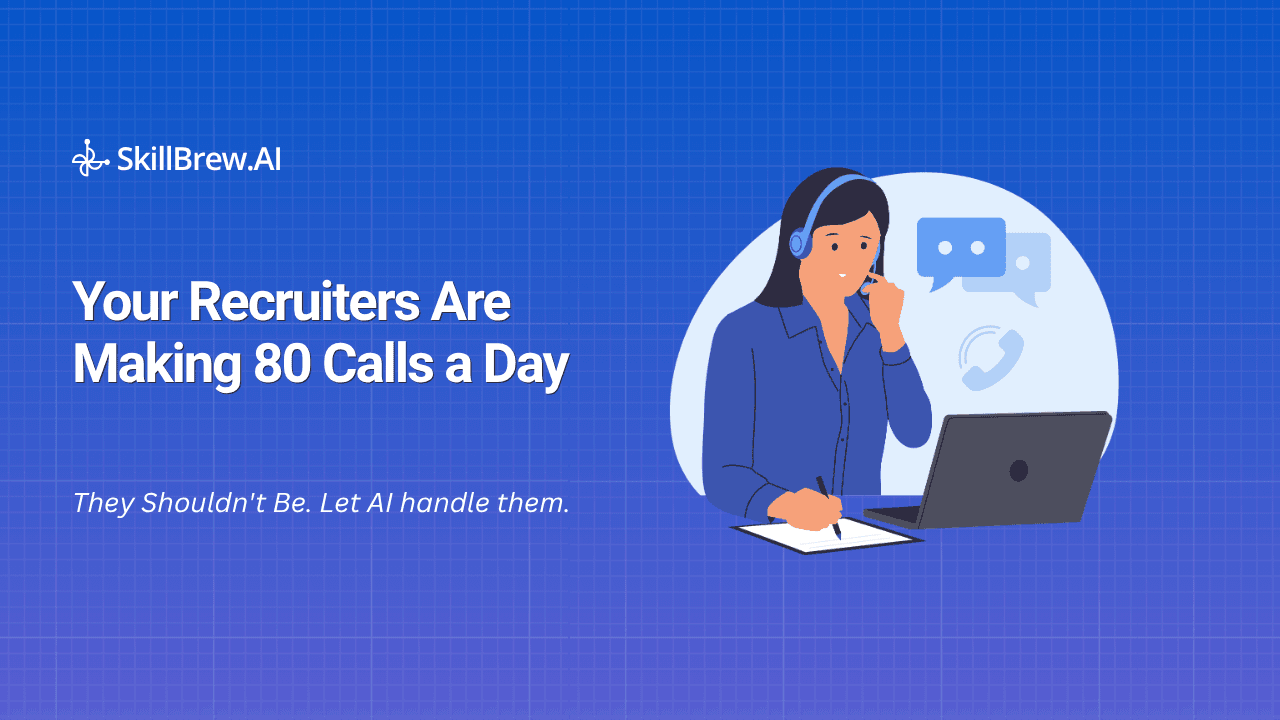
High-volume hiring has a quiet crisis: in many TA teams, a significant share of the work week disappears into first-round telephonic screens that a machine can handle better, faster, and without bias.
AI voice calling for hiring exists precisely for this problem. It automates round one completely, a structured voice agent calls candidates, evaluates responses against a defined rubric, and returns a scored shortlist to the hiring team. No recruiter on the line. No scheduling tetris. No call notes that vary by who picked up the phone.
That is what SkillBrew.AI built Rhea for. And that is why TA teams across India are replacing manual phone screens with AI voice calling for hiring at scale.
Table of Contents
- What is AI voice calling for hiring?: Definition and what it automates
- Why manual telephonic screening fails at scale?: Where the old model breaks down
- How Rhea AI recruiter works?: End-to-end workflow, trigger to scored report
- What happens during an AI voice screening call?: Candidate experience, consent, Hinglish, noise handling
- What the 3-signal dashboard tells you?: Role fit, technical signal, communication clarity
- AI voice calling vs. traditional telephonic screening: Side-by-side comparison
- Who benefits most from a voice screening tool in India: Key hiring contexts
- How to deploy an AI voice bot for HR in your existing workflow: Setup inside HireFlow
- Frequently asked questions: Recruiter time saved, custom questions, ATS integration, scoring
What is AI voice calling for hiring?
AI voice calling for hiring is the use of an automated voice agent to conduct structured, first-round candidate screening calls without a recruiter present on the call.
The agent dials the candidate on WhatsApp or direct telephonic, works through a set of role-relevant questions, listens and scores responses in real time, and delivers a structured report to the hiring team within hours. The process runs autonomously, no calendar blocks, no recruiter bandwidth, no inconsistency between calls.
AI voice calling for hiring is not the same as a basic IVR that records a voice memo and routes it to a recruiter. It holds a real conversation. It asks follow-up questions when a candidate's answer is incomplete. It understands regional Indian accents and evaluates communication quality against a consistent rubric, whether it is handling call one or call five hundred in a single day.
The output of AI voice calling for hiring is a scored shortlist with evidence per candidate, not a pile of call notes for a recruiter to wade through.
What AI voice calling for hiring automates
- Outbound dial and retry logic for unresponsive candidates
- First-round question delivery, calibrated to the job description
- Real-time evaluation of candidate responses against a defined rubric
- Multi-language conversation handling across 10+ Indian languages
- Structured shortlist report, delivered to the hiring dashboard within hours
AI voice calling for hiring is designed to handle exactly the part of the recruitment process where human time is most expensive and consistency is most likely to break down.
Why manual telephonic screening fails at scale
Manual telephonic screening is not a process failure. It is a design failure. The phone screen was built for a world where hiring volumes were manageable by humans. That world does not exist for most TA teams anymore.
Run the numbers on a typical campus drive or bulk lateral push (these are illustrative, but the pattern is consistent across high-volume hiring contexts):
- 2,000 applicants in the pipeline
- 40% are worth a first-round call: roughly 800 candidates
- Average call: 12 to 15 minutes per candidate
- One recruiter at full capacity: 25 to 30 calls per day
That can easily translate to several weeks of recruiter time just to clear round one, before a single interview has been scheduled.
Three structural breakdowns that automated telephonic screening fixes
Consistency degrades at volume.
A recruiter can deliver a fair, well-judged screen for 10 candidates. At 40, evaluation starts to drift. At 80, decisions are driven by fatigue as much as fit. Research consistently shows that structured, standardized screening outperforms unstructured interviews on both validity and fairness. Automated telephonic screening applies the same rubric to candidate one and candidate five hundred with no variance.
Accent familiarity introduces silent bias.
India's hiring market spans hundreds of regional accents. When screening depends on a recruiter's ear, candidates from unfamiliar linguistic backgrounds lose points they did not deserve to lose. Automated telephonic screening evaluates communication effectiveness, not accent familiarity.
Slow callbacks cause drop-off before screening even starts.
The window between application and first call is where candidate drop-off is highest. If it takes three to five days to schedule an automated telephonic screening, a portion of the strongest candidates have already accepted offers elsewhere. AI voice calling for hiring triggers the first round automatically, cutting that window from days to hours.
How Rhea AI recruiter works
Rhea AI recruiter is SkillBrew.AI's outbound voice agent, built specifically for high-volume hiring in the Indian market. It places calls, runs structured conversations, evaluates candidates in real time, and returns a 3-signal scored report per candidate to the HireFlow dashboard.
Here is the end-to-end workflow:
Step 1: Candidate enters the HireFlow pipeline
Via direct job application, WhatsApp intake form, or bulk upload from an ATS or college database. The platform picks up automatically once a candidate is in scope for screening.
Step 2: Rhea places the outbound call
No scheduling needed. The voice agent dials the candidate on WhatsApp or direct telephonic at the configured call window. If the first attempt does not connect, Rhea retries on a set cadence before flagging the candidate as unreached.
Step 3: Structured conversation, not a script reading
The AI recruiter works through role-relevant questions calibrated to the job description. It analyzes responses in real time and asks follow-up questions when needed, it does not advance until it has the signal it needs from each question.
Step 4: Multilingual, accent-aware evaluation
Rhea handles 10+ Indian languages and is trained on the full range of Indian regional speech patterns. Candidates from Tamil Nadu, Bihar, Gujarat, and Maharashtra are evaluated on the same criteria, communication clarity, not accent familiarity.
Step 5: 3-signal report delivered to the dashboard
Within hours of the last call in a batch, recruiters receive structured candidate reports without spending hours on first-round calls. The shortlist is ready to review.
What happens during an AI voice screening call?
Before getting into the scoring system, it helps to understand what the candidate actually experiences, because this is where many TA teams have questions.
When Rhea AI recruiter calls a candidate, the call opens with a clear disclosure: the candidate is informed they are speaking with an AI recruiter from SkillBrew.AI on behalf of the hiring company. Transparency is built into the call flow by design.
From there, the conversation follows a structured but natural format. Rhea asks the opening question, waits for the candidate's response, and then either asks a role-relevant follow-up or moves to the next question based on what was said. Candidates who speak in mixed Hindi-English (Hinglish) or switch mid-sentence between languages are handled without interruption, BrewVoice is trained on code-switching patterns common in Indian conversational speech.
Background noise and connectivity variation are factored into evaluation. Rhea does not penalize a candidate for a noisy environment; it focuses on response content and communication clarity rather than audio perfection.
Consent is managed before the call begins. Candidates who have applied to the role have already provided consent as part of the application process, and the disclosure at the start of the call reinforces this. Recruiters retain full control to pause, skip, or override any candidate's screening status directly from the HireFlow dashboard.
If a candidate requests a human at any point, that flag is surfaced in the dashboard immediately for recruiter follow-up.
What the 3-signal dashboard tells you
Every AI voice calling for hiring session that Rhea completes produces a structured report built on three scored signals:
| Signal | What it measures |
| Role fit | Does the candidate's background, experience, and stated intent match the role requirements? |
| Technical signal | How well did the candidate respond to role-specific domain or functional questions? |
| Communication clarity | Is spoken communication clear, coherent, and confident enough for the role? |
Signal weightings are configured per role type. A customer support role weights communication clarity heavily. An operations or logistics role may weight role fit and technical signal more. Configuration is done at the hiring drive level inside HireFlow.
Recruiters see the score, the signal breakdown, and a structured evidence summary per candidate. Not a fuzzy "good call" note. Scored data on three dimensions that actually determine shortlist decisions.
AI voice calling for hiring produces a shortlist with the reasoning behind it, not a stack of audio files to review.
AI voice calling vs traditional telephonic screening
| Factor | Manual telephonic screening | AI voice calling for hiring (BrewVoice) |
| Calls per day | 25 to 30 per recruiter | Handles high volumes autonomously |
| Time to shortlist | Several days to over a week | Hours, not days |
| Interview consistency | Varies by recruiter, time of day, fatigue | Identical rubric applied to every candidate |
| Follow-up questions | Ad hoc, inconsistent | Asked automatically when a response needs probing |
| Language support | One language per recruiter | 10+ Indian languages in a single campaign |
| Accent bias risk | High | Minimal -- evaluated on clarity, not accent |
| Candidate experience | Wait days for a callback | Called same day, structured and professional |
| Candidate drop-off risk | High (slow callback window) | Low (same-day engagement) |
| Recruiter time saved | 0 -- recruiter runs every call | Recruiters review reports, not calls |
| Reporting quality | Variable recruiter notes | Structured 3-signal report per candidate |
| Audit trail | Difficult to reconstruct | Full record: questions, responses, scores |
| Scheduling overhead | High | Zero |
| Cost model | Fixed recruiter cost | Pay-as-you-go per screen |
Across every dimension that drives a shortlist decision, consistency, speed, reporting quality, and candidate experience, AI voice calling for hiring outperforms manual telephonic screening at scale.
Who benefits most from a voice screening tool in India
BrewVoice is not a generic AI tool. It is built for the specific hiring patterns that define the Indian TA market. A voice screening tool in India needs to handle high volumes, regional language diversity, and thin recruiter-to-role ratios, all at the same time. For a deeper look at how AI handles regional accent variation in screening, see Voice and Accent Assessment for Hiring.
Illustrative example: A retail chain hiring 1,200 store associates across three cities launches AI voice calling for hiring the same day applications close. Instead of a recruitment team spending a week making outbound calls, Rhea screens the entire pool overnight. Recruiters arrive the next morning to structured scorecards ranked by role fit and communication clarity, and move directly to final interviews without a single first-round call on their calendar.
Staffing and RPO agencies
Running multi-client, multi-role pipelines with limited recruiter headcount? A voice screening tool in India like BrewVoice multiplies throughput without linear headcount growth. One recruiter overseeing 500 Rhea AI recruiter calls delivers more quality shortlists than five recruiters running manual screens.
Campus recruitment teams
Registrations close, 4,000 applicants are in the system, and the college expects a shortlist in 48 hours. AI voice calling for hiring processes the first round overnight. The team shows up with a ranked list, not a to-do pile. For a full breakdown of automating this workflow, see How to Automate Campus Hiring.
Frontline and blue-collar hiring
Logistics, manufacturing, retail, field operations. High volume, high regional language diversity, communication screening that has historically been inconsistent or skipped entirely. A voice screening tool in India purpose-built for this market makes the process fair and scalable.
High-volume laterals in BPO, BFSI, and IT support
Where communication skills matter as much as technical fit, and where losing a strong candidate to a slow, inconsistent first round is a real business cost.
Traditional sectors expanding to Tier 2 and Tier 3 talent pools
Pharma, civil, infrastructure. The strongest candidates often come from markets where recruiter familiarity with local speech patterns is low. AI voice calling for hiring levels the evaluation across every region a company hires from.
How to deploy an AI voice bot for HR in your existing workflow
Most modern AI voice screening tools follow a similar deployment pattern: configure the role, load candidates, set call logic, and review the scored output. The specific features and integrations vary by platform. Here is how that process works inside SkillBrew.AI, which connects the AI voice bot for HR directly to HireFlow, the free orchestration layer that manages pipeline, communications, and candidate tracking across every hiring stage.
Configure the role
JD, question set, language preferences, and call timing windows. HireFlow's JD parser generates an initial question set in under two minutes. The AI voice bot for HR is ready to run a screening call the same day.
Load the candidate pool
Bulk upload, ATS sync, or direct intake via WhatsApp application form. The AI voice bot for HR pulls candidates from wherever they are entering the pipeline.
Set the call logic
Trigger timing, retry cadence for unreached candidates, language priority per campaign. This is configured once per hiring drive.
Review the shortlist
The 3-signal reports are on the HireFlow dashboard when screening completes. Filter by score, sort by signal, and move forward. No call notes to reconcile. No audio files to review.
Move to round two
The shortlist from AI voice calling for hiring feeds directly into SkillBrew.AI's AI Interviews, technical assessments, or a human interview round. The pipeline continues without a gap.
Recruiters always make the final hiring decision. BrewVoice standardizes first-round screening, but it never replaces human judgment, it clears the path so that judgment is applied where it actually matters.
Ready to cut first-round screening from days to hours?
See how BrewVoice helps hiring teams screen faster, reduce candidate drop-off, and spend more time interviewing qualified candidates, all in a 30-minute live walkthrough.
Book a BrewVoice demo with SkillBrew.AI
No commitment. No lengthy setup. Just a live look at AI voice calling for hiring on a real pipeline.
Frequently asked questions
Q1. What is AI voice calling for hiring?
AI voice calling for hiring is the use of an automated voice agent to run structured first-round screening calls with candidates, without a recruiter on the call. The agent dials candidates, holds a real conversation, evaluates responses in real time, and delivers a scored shortlist report to the hiring team.
Q2. How much recruiter time can AI voice screening save?
The time saved depends on pipeline volume, but the mechanism is consistent: recruiters stop running individual first-round calls and instead review structured reports. Teams using automated telephonic screening at scale typically redirect the bulk of round-one recruiter time toward shortlisted candidates and later interview stages -- where human judgment has the most impact.
Q3. Can recruiters customize the screening questions?
Yes. Questions are generated from the job description using HireFlow's JD parser, and recruiters can edit, add, or remove questions before a screening campaign goes live. Signal weightings across role fit, technical knowledge, and communication clarity are also configurable per role type.
Q4. How are candidate responses scored?
Rhea AI recruiter analyzes responses in real time against a structured rubric configured for the role. Each candidate receives a 3-signal score -- role fit, technical signal, and communication clarity -- along with a structured evidence summary. Scores are not based on audio quality or accent; they evaluate the substance and clarity of what the candidate communicated.
Q5. Is AI voice calling for hiring suitable for experienced hires, not just freshers?
Yes. While AI voice calling for hiring sees heavy use in campus and frontline hiring, it is equally effective for lateral hiring where first-round volume is high. The question set and evaluation criteria are calibrated to the role level, so the same infrastructure works for both fresher pipelines and mid-senior lateral screening.
Q6. Does BrewVoice integrate with existing ATS platforms?
SkillBrew.AI supports bulk candidate upload and pipeline import, making it compatible with standard ATS workflows. For teams already using an ATS, candidates can be pushed into HireFlow for the AI voice calling for hiring stage, and shortlists can be exported back. Native integrations vary, book a demo to confirm compatibility with a specific platform.
Q7. How is Rhea AI recruiter different from a basic IVR system?
An IVR records or routes responses mechanically. Rhea AI recruiter holds a real spoken conversation, it analyzes responses in real time, asks follow-up questions when needed, handles 10+ Indian languages and regional accents, and scores responses against a structured rubric. The output is a scored candidate report, not a transcript.
Q8. Can an AI voice bot for HR handle Indian regional accents accurately?
Yes. An AI voice bot for HR built on BrewVoice is trained on the full spectrum of Indian regional speech patterns, including Tier 2 and Tier 3 city accents across Tamil, Telugu, Hindi, Marathi, Bengali, and other languages. Evaluation is based on communication clarity for the role, not accent familiarity.
Q9. What does automated telephonic screening cost on SkillBrew.AI?
SkillBrew.AI runs on a strict pay-as-you-go model. No subscriptions, no seat fees, no credits that expire at month end. Automated telephonic screening is priced per screen, so cost scales with actual hiring activity.
Q10. Which roles benefit most from AI voice calling for hiring?
Sales, customer support, BPO, operations, logistics, manufacturing, and campus hiring see the most immediate impact. Any role where communication quality matters and first-round volume exceeds 50 candidates per week is a strong candidate for automated telephonic screening.
See AI-powered hiring in action
Discover how SkillBrew helps hiring teams cut time-to-hire by 60% with skill-validated assessments and AI-ranked shortlists.
Book a free demoNo commitment required · 30 minutes
Continue reading
View All Posts