Technical Screening
How AI Is Changing Technical Screening for Recruiters
AI technical screening is changing how recruiting teams evaluate technical candidates before an interview is ever scheduled. Instead of relying on resumes, keyword matches, and years-of-experience filters, recruiting teams can assess role-specific technical knowledge, problem-solving, and communication earlier in the pipeline, before a technical interview needs to be scheduled. Resumes show where a candidate has worked, but do not always show how well the candidate can apply the technical skill

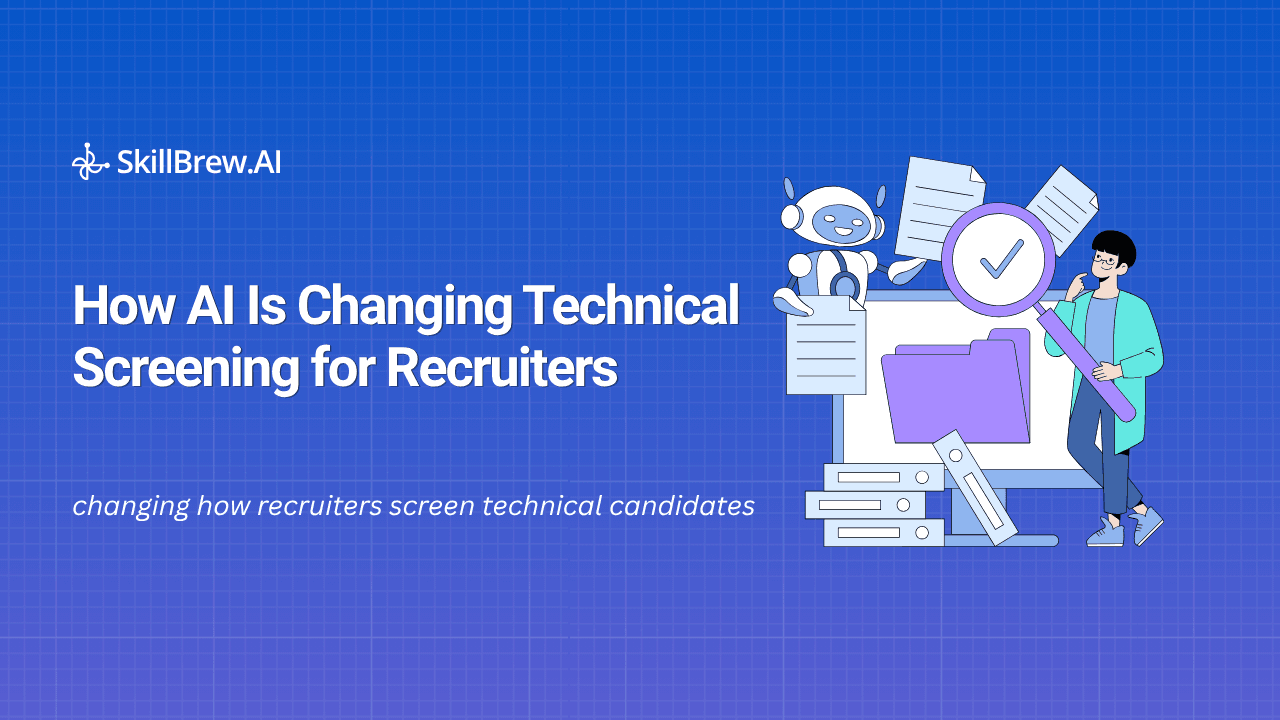
AI technical screening is changing how recruiting teams evaluate technical candidates before an interview is ever scheduled. Instead of relying on resumes, keyword matches, and years-of-experience filters, recruiting teams can assess role-specific technical knowledge, problem-solving, and communication earlier in the pipeline, before a technical interview needs to be scheduled.
Resumes show where a candidate has worked, but do not always show how well the candidate can apply the technical skills a role requires. Technical hiring has gotten harder as engineering and IT teams compete for scarce skilled candidates, and recruiting teams are asked to manage larger applicant pools with the same headcount. AI technical screening is one of the more concrete answers to that pressure: it takes structured evaluation and moves it earlier in the process, so recruiters and technical teams spend interview time on candidates worth that time.
This is not about removing people from technical hiring. It is about deciding which parts of screening are repetitive and rules-based, and which parts require a human to sit with the context.
Table of Contents
- What Is AI Technical Screening?: a working definition and what it actually automates
- Why Traditional Technical Screening Is Changing: the volume, time, and consistency problems it was built to fix
- How AI Is Changing Technical Screening: the specific mechanics: question generation, adaptive follow-ups, scoring
- Types of AI Technical Screening: the different formats this takes in practice
- What AI Can Evaluate: the signals that hold up to automated assessment
- Benefits of AI-Powered Technical Screening: what teams actually gain
- AI Technical Screening vs Manual Screening: a side-by-side comparison
- Technical Screening vs Technical Assessment: a distinction worth getting right
- What Recruiters Should Still Evaluate: where human judgment stays essential
- How to Implement AI Technical Screening: a six-step rollout, with a worked example
- Common Mistakes to Avoid: what makes automated screening worse, not better
- The Future of Technical Screening: where this is heading
- FAQs
What Is AI Technical Screening?
AI technical screening uses artificial intelligence to evaluate candidates for technical roles before a technical interview happens. Depending on the workflow, it can generate role-specific questions from a job description, evaluate written or spoken responses, score candidates against defined criteria, and organize results for recruiter review.
It sits between resume review and the technical interview. Instead of moving a candidate forward based only on job titles or keyword overlap, recruiting teams get an additional, structured signal on technical fit before committing an interviewer's time.
The distinction that matters: AI technical screening should support the decision, not make it silently. Recruiters define what matters for the role, review how candidates are being scored, and keep oversight over anything that affects who advances.
Why Traditional Technical Screening Is Changing
Manual technical screening follows a familiar sequence. A recruiter reviews a resume, checks it against the role's requirements, reaches out to the candidate, asks an initial round of questions, then loops in a technical team member for a deeper look. That sequence holds up fine at low volume.
It breaks down in three specific ways once volume increases.
- Time.
Recruiters spend hours reviewing candidates who do not meet the technical bar, time that never gets recovered. - Consistency.
Two recruiters screening the same role can weigh the same answer differently, or focus on different signals entirely, without either one being wrong. - Scale.
A process built for twenty applicants a month does not hold its shape at two hundred.
AI technical screening addresses this by moving structured evaluation earlier in the funnel, so candidates are assessed against role-specific criteria before anyone schedules a call.
How AI Is Changing Technical Screening
The shift shows up in five specific mechanics, not just "faster resumes."
1. Role-Specific Question Generation
Generic screening questions cannot tell a hiring team whether a candidate fits a specific role. AI can generate questions directly from a job description: required technologies, seniority level, and the skills that actually matter for that opening. A backend engineering screen and a QA screen should never look the same, and JD-to-question generation is what keeps the two from converging into one generic test.
2. Adaptive, Resume-Aware Questioning
Static, one-way question sets miss context a resume-aware system can use. Adaptive AI interviews ask a baseline set of questions, then follow up based on the specifics of the response, closer to how a human interviewer probes an answer than to a form with fixed fields.
3. Structured Response Evaluation
Written and spoken answers get evaluated against a scoring framework defined in advance, not against a recruiter's gut read in the moment. This is what makes the process auditable: the criteria exist before the first candidate is scored, not after.
4. Skill-Level Classification
Rather than a single pass/fail cut, AI screening can classify responses by skill level or category, giving recruiters a clearer picture of a candidate's strong and weak areas, instead of one blended number.
5. Screening Reports and Candidate Comparison
Results get compiled into a structured report recruiters can scan and compare across a candidate pool, rather than reconstructing each conversation from memory or scattered notes.
SkillBrew.AI's Technical Assessments module applies role-specific question generation directly, turning a job description into a structured technical, behavioral, and cognitive assessment in roughly two minutes, with complexity adjustable through a simple chat interface rather than a manual question bank.
Types of AI Technical Screening
"AI technical screening" is not one format. In practice, it takes several forms, often combined:
- AI-powered technical interviews - autonomous, adaptive video or audio interviews that ask follow-up questions based on the candidate's actual answers
- AI-generated technical assessments - JD-to-test generation covering role-specific technical, behavioral, and cognitive questions
- Coding and problem-solving screening - structured technical exercises scored against a defined rubric
- AI voice or video screening - automated first-round conversations, useful for high-volume roles where a live recruiter call for every applicant is not feasible
- Resume plus technical skill screening - resume parsing combined with a structured technical layer, rather than resume data alone
- Automated screening reports - compiled, comparable summaries recruiters can review before deciding who advances
Most technical hiring pipelines end up using two or three of these together rather than picking one.
What AI Can Evaluate
AI screening holds up best against structured, role-related signals that can be defined ahead of time:
- Knowledge of required technologies and tools
- Understanding of core programming or technical concepts
- Problem-solving approach, not just a final answer
- Technical communication and clarity of explanation
- Responses to role-specific scenarios
- Familiarity with relevant development or testing practices
- Alignment against explicitly defined technical requirements
A software engineering screen might cover programming fundamentals, debugging logic, API design, and system-design basics. A QA screen looks entirely different: test case design, automation concepts, API testing, and defect reporting. The criteria should trace back to the actual requirements of the role. Screening against topics the role does not need adds noise, not signal.
Benefits of AI-Powered Technical Screening
The value is not speed on its own. It comes from pairing structured evaluation with a process that scales.
- Faster screening.
Automated workflows process initial evaluation without a recruiter manually stepping through every candidate, shortening the gap between application and next-stage review. - Better scalability.
A screening process built to handle twenty applicants does not need to be rebuilt from scratch to handle two hundred. - More consistent evaluation.
A predefined framework reduces the variation that comes from different recruiters weighing the same answer differently, especially useful across multiple teams or locations. - Earlier technical signal.
Role-specific evaluation happens before the interview stage, so recruiters are working from more than resume keywords when deciding who to advance. - Recruiter time back.
Less time on repetitive first-pass evaluation means more time for candidate communication and stakeholder coordination, the parts of the job that actually need a person. - A clearer candidate experience.
When criteria are explicit and tied to the role, candidates understand the basis for evaluation, and fewer candidates sit through interview stages with no realistic path forward.
AI Technical Screening vs Manual Screening
Manual and AI-supported screening are not competing approaches. Many hiring workflows combine both.
| Area | Manual Screening | AI-Supported Screening |
| Candidate volume | Harder to scale | Easier to scale |
| Question consistency | Can vary by recruiter | Can be standardized |
| Recruiter involvement | High for repetitive steps | Lower for repetitive first-pass steps |
| Contextual judgment | Direct human judgment | Requires human review |
| Technical evaluation | Often requires technical team involvement | Can collect structured signals earlier |
| Candidate comparison | Manual notes and review | Structured reports and summaries |
A practical pipeline looks something like: resume review, AI-supported technical screening, recruiter review, technical interview, final evaluation. The exact sequence varies by company and role. The principle holds regardless: automate where it adds efficiency, keep a person where context and judgment matter.
Technical Screening vs Technical Assessment
These two terms get used interchangeably, which causes confusion during vendor evaluation and internal process design.
Technical screening is generally an earlier evaluation used to determine whether a candidate should progress. It is typically designed to be relatively fast and scalable across a candidate pool.
Technical assessment provides a deeper evaluation of technical ability and may involve coding exercises, practical tasks, or structured tests. Depending on the hiring workflow, an assessment can be used either during screening or at a later stage.
Screening is generally broader and earlier, while an assessment typically goes deeper into technical ability.
What Recruiters Should Still Evaluate
AI can carry a meaningful share of technical screening. It should not carry all of it.
Recruiters remain best positioned to evaluate communication with the candidate, career context, motivation, availability, and compensation alignment. Hiring managers and technical interviewers still own the deeper technical exploration: system design conversations, live coding, and the kind of back-and-forth that reveals how someone thinks under pressure.
Recruiters also need to keep reviewing the screening framework itself. A poorly designed set of questions or scoring criteria does not get better because it runs faster; automation just makes a flawed process faster at being flawed.
Human review matters most for candidates who do not fit a conventional profile: career changers, people with transferable rather than direct experience, and nontraditional backgrounds that a standardized model was never built to catch.
How to Implement AI Technical Screening
Adopting AI technical screening does not require rebuilding the entire hiring process at once.
Step 1: Define the role requirements.
Separate what is essential from what is merely preferred.
Step 2: Decide what gets screened early.
Not every skill needs evaluation at the first stage. Pick the signals that actually determine whether a candidate should move forward.
Step 3: Build a consistent evaluation framework.
Set the questions, criteria, and scoring approach before screening a single candidate.
Step 4: Introduce automation.
Apply AI technical screening to the parts of initial evaluation it handles well: question generation, response collection, structured scoring, summary reports.
Step 5: Keep human review in the loop.
Recruiters should be able to open any result and dig into context the system could not capture.
Step 6: Measure the process.
Track screening completion rate, time to screen, progression rate, interview conversion, and recruiter hours saved.
Worked example: For a QA Engineer opening, the role requirements might come down to API testing, test case design, automation, and defect analysis. AI generates role-specific questions around exactly those four areas, evaluates the structured responses, and produces a screening summary. The recruiter reviews that summary, not raw transcripts, before deciding who moves to a technical interview.
Common Mistakes to Avoid
Automation is not automatically an improvement. A few mistakes show up repeatedly.
- Using generic questions.
If every technical role gets the same question set, the screening stops producing role-specific information. - Over-automating the decision.
Screening output should inform a recruiter's call, not replace it. Teams need clarity on exactly where human intervention is required. - Optimizing only for speed.
Faster screening that loses relevance or damages candidate experience is not actually a win. - Ignoring candidate context.
Resume history, technical responses, and interview performance need to be read together, not in isolation. - Never revisiting the criteria.
Technical requirements shift as roles evolve. Screening questions and scoring frameworks need periodic review, not a one-time setup.
The Future of Technical Screening
Technical screening is moving toward something more structured and data-informed, not toward full automation. Repetitive first-pass evaluation increasingly runs through AI, while technical teams put working hours into the deeper assessment that actually needs a person: system design, architecture trade-offs, live problem-solving.
The shift is not human screening being replaced by automated screening. It is the hiring process getting split along a different line: repetitive, rules-based work goes to the system built for it, and judgment-heavy work stays with the people equipped to make that judgment.
For recruiting teams, the practical opportunity is straightforward: identify what is repetitive, what needs technical expertise, and where AI can support the first without eliminating the second.
FAQs
Q1. What is AI technical screening?
Evaluation of technical candidates using AI before a technical interview, covering question generation, response scoring, and structured reporting.
Q2. How does AI technical screening work?
A job description gets parsed into role-specific questions, candidate responses get evaluated against a predefined scoring framework, and results are compiled into a report for recruiter review.
Q3. What technical skills can AI screening evaluate?
Structured, well-defined signals hold up best: programming fundamentals, debugging concepts, API and database knowledge, testing practices, and technical communication. Deeper judgment calls, especially for nontraditional candidates, still need human review.
Q4. Is AI technical screening suitable for software engineers?
Yes. Programming fundamentals, debugging concepts, API knowledge, and system-design basics are all screenable with role-specific question generation.
Q5. What is the difference between AI technical screening and a technical assessment?
Screening is an early filter deciding whether a candidate progresses. Assessment is a deeper evaluation, usually involving coding or practical tasks, that happens after screening.
Q6. Can AI technical screening replace technical interviews entirely?
No. It replaces repetitive first-pass evaluation. Deeper technical exploration, system design conversations, and live problem-solving still need a technical interviewer.
Q7. How can recruiters start using AI for technical screening?
Start with one role, define its actual requirements, build a scoring framework before screening anyone, and keep human review built into the process rather than treating automation as the final word.
Recruiting teams evaluating AI technical screening can see how SkillBrew.AI turns a job description into a role-specific technical assessment, or book a walkthrough to see the workflow against a live job description.
See AI-powered hiring in action
Discover how SkillBrew helps hiring teams cut time-to-hire by 60% with skill-validated assessments and AI-ranked shortlists.
Book a free demoNo commitment required · 30 minutes
Continue reading
View All Posts